
This is the blog of Ian Rosales Casocot. Filipino writer. Sometime academic. Former backpacker. Twink bait. Hamster lover.


The Great Little Hunter
Pinspired Philippines, 2022

The Boy The Girl
The Rat The Rabbit
and the Last Magic Days
Chapbook, 2018

Republic of Carnage:
Three Horror Stories
For the Way We Live Now
Chapbook, 2018

Bamboo Girls:
Stories and Poems
From a Forgotten Life
Ateneo de Naga University Press, 2018

Don't Tell Anyone:
Literary Smut
With Shakira Andrea Sison
Pride Press / Anvil Publishing, 2017

Cupful of Anger,
Bottle Full of Smoke:
The Stories of
Jose V. Montebon Jr.
Silliman Writers Series, 2017

First Sight of Snow
and Other Stories
Encounters Chapbook Series
Et Al Books, 2014

Celebration: An Anthology to Commemorate the 50th Anniversary of the Silliman University National Writers Workshop
Sands and Coral, 2011-2013
Silliman University, 2013

Handulantaw: Celebrating 50 Years of Culture and the Arts in Silliman
Tao Foundation and Silliman University Cultural Affairs Committee, 2013

Inday Goes About Her Day
Locsin Books, 2012

Beautiful Accidents: Stories
University of the Philippines Press, 2011

Heartbreak & Magic: Stories of Fantasy and Horror
Anvil, 2011

Old Movies and Other Stories
National Commission for Culture
and the Arts, 2006

FutureShock Prose: An Anthology of Young Writers and New Literatures
Sands and Coral, 2003
Nominated for Best Anthology
2004 National Book Awards


 5:24 PM |
One Particular Stupid, Ugly, Toady Freak
5:24 PM |
One Particular Stupid, Ugly, Toady Freak
5:24 PM |
One Particular Stupid, Ugly, Toady Freak
5:24 PM |
One Particular Stupid, Ugly, Toady Freak
7:33 PM |
A Break in Chris's Murder Case
7:33 PM |
A Break in Chris's Murder Case
7:33 PM |
A Break in Chris's Murder Case
3:53 PM |
More Stupid, Ugly Freaks
3:53 PM |
More Stupid, Ugly Freaks
3:53 PM |
More Stupid, Ugly Freaks
1:28 AM |
On Chris Abella
1:28 AM |
On Chris Abella
1:28 AM |
On Chris Abella
1:48 AM |
More National Book Awards Brouhaha...
1:48 AM |
More National Book Awards Brouhaha...
1:48 AM |
More National Book Awards Brouhaha...
10:05 AM |
Out!

10:05 AM |
Out!
10:05 AM |
Out!
7:13 PM |
People Murder For This?

7:13 PM |
People Murder For This?
7:13 PM |
People Murder For This?
6:43 PM |
Art in a Time of Terror
I wrote this a day after I heard Chris was shot by cellphone robbers. The tragedy occupied my mind all through the day and in the beginnings of weekend. I saw Chris's shadow everywhere...
Art in a Time of Terror
Thinking back, it must have been around the time I was preparing to go see the art exhibit on show in the Silliman University Main Library this week -- a collection to commemorate Peace Week -- when I first heard via an SMS alert that my friend and college classmate Chris Misajon -- son of former Silliman President Mervyn Misajon -- was fighting for his life in an Iloilo hospital, becoming yet another statistic in the creeping reality of murderous cellphone robbers.
The Philippine Daily Inquirer/GMA News Network website had it as a breaking story: "[He] was driving with a companion on a dimly lit street when at least four robbers flagged them down... While his companion ran for help, the suspects shot Misajon and took his cellular phone." That's it. Human life for a piece of merchandise.
Later, I learned that a shotgun had been leveled at his guts.
"He was shot at close range," Eric Joven, another friend, had texted those of us who were suddenly in the grips of bearing bad news. "He was hit at the left side of his abdomen," his kidney shattered, but more than that, there were shotgun splinters all over his other organs -- the liver, the pancreas, the intestines. It took nine hours for the doctors to clean everything out. Much later, we learn from GMA-7 producer and former classmate Ahd Marco that Chris was recuperating in Intensive Care, but now he was within what the doctors called the "72-hour critical period," after which we could finally learn whether our friend's life -- as a young father and husband and as a dedicated TV news anchor -- had been spared. We have learned to count the hours.
Sometimes, it is increasingly hard to believe there could be anything less in our lives than the paramount knowledge of our daily encounters with terrors big and small. Sometimes, when we feel the burden and the weight of such grim realities in our lives, we learn to ask questions without answers: What for everything, given all these? What now?
Specifically, art. What for, art, indeed? If art is supposed to be the classic human celebration of beauty, does it have any import in times of terror?
You could say this notions of dark days was born under what sequential storyteller and Pulitzer Prise winner Art Spiegelman has called "the shadow of no towers," bearing in mind the repercussions of that fateful day in September 2001 when we knew for sure that the world as we knew it was in for some extensive turbulence. Those turbulences have indeed come true, spilling blood and guts all over the world, from Bali to Manila, from Baghdad to Madrid, from Jerusalem to Islamabad, from Washington, D.C. to Riyadh.
In his recent essay, "Writing in a Time of Terror and the (Mis)Manmagement of Grief," Filipino writer Charlson Ong writes about such repercussion on his fiction: "No doubt the events of 9/11 and their consequences have cast a shadow over our work as writers. Already, fictionists like Salman Rushdie and Haruki Murakami have responded with important works. As a nation, we have been victim to political and sectarian violence even before the catastrophe in New York. You in Mindanao have had to live with war or the threat of it for many decades. But now, our involvement in America's 'war against terror' threatens to engage us in a broader conflict."
Art does not develop in a vacuum, indeed, as F. Sionil Jose used to say. Echoing Salvador Lopez, the National Artist for Literature had continued: "The artist is first responsible not just to his art but to society as well."
Ong further writes: "Historically, conflict and catastrophe often bring out the best in artists. Tolstoy's War and Peace, and Dostoyevsky’s Brothers Karamazov deal with the drama wrought by profound changes in Russia at the end of the 19th century. World War II spawned such novels as Norman Mailer's The Naked and the Dead and Stevan Javellana's Without Seeing the Dawn. The Spanish Civil War inspired Picasso's Guernica. Lu Xun wrote Ah Q during the 1920s as China suffered imperial collapse, strife and foreign aggression. So, too, the excesses of the 'Cultural Revolution' of 1960s became the subject of the new wave of Chinese cinema as well as the work of Nobel laureate Gao Xingjian. Apartheid in South Africa was the canvas across which Nadine Gordimer and J.M. Coetze painted their intimate literary portraits."
Thus, in the tradition of Pablo Picasso's Guernica (the Spanish artist's famous abstract, painterly thesis on the horrors of war), we now have within the very walls of Silliman University's Main Library a continuation of the artistic treatise on the meaning of war and peace in an Age of Chaos and Terror. Timely, too, because the exhibit -- sponsored by Silliman’s Peace Resource Center -- comes during the week when all of the Philippines remember the imposition of Martial Law by then dictator Ferdinand Marcos.
The exhibit is interesting for two reasons. One is its curatorial decision to juxtapose the works of established artists now working in Dumaguete with works by young amateurs -- teenagers and grade-school children, I take it, who had taken to the brush and the canvas in an "on-the-spot" art competition to celebrate Peace Week. These works -- some of them colorful doodles done with such grand passions, and perhaps reflective of the Matisse style -- are a merry insight on young people's conception of what is happening right now in our society, proof perhaps that they, too, know the gravity of things happening.
The other reason, for me, is the way the exhibit makes me see how artists render social reality. I like the way some of the works channel our pains with such subtle use of imagery and composition. I like their thoughtful provocation. Others, however, disappoint by giving something "too easy": a bludgeoning of on-your-face "message," in other words.
But this is, nevertheless, only a critic's demand. I am even ashamed to demand so much from an exhibit of good intentions. Over-all, one must only admire the way our artists have indeed lived Sionil's call, that "art must not develop in a vacuum." These works have something to say, that is important. But some just say it more poetically than the others.
Of the more seasoned artists, exhibits such as this tend to draw out the pedantic, the didactic. You know... artwork that slaps you with "obvious" message -- a clear line drawn between point A and point B. Sometimes I call this "PLDT Art," referring to the competition sponsored by the telephone company that calls for artworks celebrating "nationhood," the best of which becomes the cover for PLDT's annual phone directory.
Sometimes I call this "Obvious Art." But, really, I have no real quarrels with such art, only with their easy blatancy. What to make of Diosdado Custodio's "Let Peace Arise," for example? The title tells us enough of what the painting means to "be," including the motif of a hand breaking glass, bearing roses. Or Crystlyne Faith Gayo's "Deuteronony 30:19," which just shows us the scale of justice, licked by flame and dotted with doves with laurel leaves in their beaks? Or Helton Jerome Acahay's "Deep Within a Rifle," where a green hand reaches for the insides of a rifle, only to reveal what looks like the entire circulatory system? If poetry is supposed to be about beauty in the tangential, there's no poetry here, only a rendering of the didactic and the obvious. There's also Rene Elivera's "A Piece of My Peace," a nonetheless interesting work that still showcases the obvious: a background of dusk with a foreground of blooded barbwires suddenly revealing a rose. The talented Mr. Elivera has made more demanding paintings, of course. Just not this one.
I find that the more interesting works in the exhibit lie in their almost subversive use of the obvious, however.
Sharon Rose Dadang-Rafol's "A Bubble of Hope," for instance, may seem flippant in its use of blue and green bubbles, complete with praying hands and tulips, but the pastel rendering and the implied message that all of these are "bubbles" hint of the precariousness, indeed, of hope in post-modern times.
Susan Canoy's "Temporaryong Kalinaw" also hints at this. Hers is a work also done in strange bright pastels and in painstakingly rendered realism, and surrealism. What you have is an image of a family in dead-center between what seems to be representations of country and city. The "nice" family, however, is surrounded with balloons -- labeled "temporaryong kalinaw" -- which are almost ready to burst. I liked the feel of danger to this seemingly bright picture. That, for me, is subversive, and saves the work from being too obvious.
Jaruvic Rafols's "Black Eye Peace," too, is of that mold. He features a huge human eye in the center of widening rainbow ripples, with a pair of hands somewhere in the composition gripping at something. There is something there, a hallucinatory take of perceptions, perhaps. There's also Lord Allen Hernandez's "Unity Against Diversity," the title of which may hint of the Obvious. But Mr. Hernandez saves his work with his delicious play of shadows and color, and the use of an interesting image -- what looks like puppet figures (a man in Muslim garb, a priest, and a woman) embracing for the "light." Very interesting, but again, there is nothing new here.
Over red wine last Thursday night in CocoAmigos, I asked artist Mark Valenzuela what he intended to say in "Love Affair." What I get of the painting are two blue human figures -- a Muslim and a Christian -- under seawater, bubbles drawing out their last breath. He just smiled and said, "Under water, all you have is silence." Which is interesting concept going beyond Obvious.
But the first thing that drew my attention, though, is Jutze Pamate's "The Terrorist Dogs and the Doves of Peace." The title alone sounds so much like one of those magic realist opus by some South American writer. The artwork itself is thought-provoking: two orange dogs (one prominently splashed in the foreground) with beady eyes, standing on their hind legs, surrounded -- attacked? -- by doves. I like the use of metaphor. I like the composition. I like the comical sense the work displays that nonetheless also shows an understanding of this prevalent undercurrent of restiveness, of the animalism of terror. But Pamate has always done this: his paintings have always been brilliant social commentary, but without the obviousness that mars most artists' works.
In the end, I can say that Art perhaps becomes our ultimate refuge in times of terror. Not an escape, no. It makes sense -- within frames, within measured color and composition -- of senseless times. It captures zeitgeist in its rendering of metaphors, in brush strokes (and for writers, in words), the perfect mouthpiece with which we tell our story of understanding of a troubled world. In art, we get an understanding of the latter's complexity, and perhaps of hope. For the artist, his/her art is expression of what is bottled up within us all. Conversely for the viewer, the art becomes the medium, the Rorschach ink blot, with and upon which we heap our pains. Art is necessary.
6:43 PM |
Art in a Time of Terror
I wrote this a day after I heard Chris was shot by cellphone robbers. The tragedy occupied my mind all through the day and in the beginnings of weekend. I saw Chris's shadow everywhere...
Art in a Time of Terror
Thinking back, it must have been around the time I was preparing to go see the art exhibit on show in the Silliman University Main Library this week -- a collection to commemorate Peace Week -- when I first heard via an SMS alert that my friend and college classmate Chris Misajon -- son of former Silliman President Mervyn Misajon -- was fighting for his life in an Iloilo hospital, becoming yet another statistic in the creeping reality of murderous cellphone robbers.
The Philippine Daily Inquirer/GMA News Network website had it as a breaking story: "[He] was driving with a companion on a dimly lit street when at least four robbers flagged them down... While his companion ran for help, the suspects shot Misajon and took his cellular phone." That's it. Human life for a piece of merchandise.
Later, I learned that a shotgun had been leveled at his guts.
"He was shot at close range," Eric Joven, another friend, had texted those of us who were suddenly in the grips of bearing bad news. "He was hit at the left side of his abdomen," his kidney shattered, but more than that, there were shotgun splinters all over his other organs -- the liver, the pancreas, the intestines. It took nine hours for the doctors to clean everything out. Much later, we learn from GMA-7 producer and former classmate Ahd Marco that Chris was recuperating in Intensive Care, but now he was within what the doctors called the "72-hour critical period," after which we could finally learn whether our friend's life -- as a young father and husband and as a dedicated TV news anchor -- had been spared. We have learned to count the hours.
Sometimes, it is increasingly hard to believe there could be anything less in our lives than the paramount knowledge of our daily encounters with terrors big and small. Sometimes, when we feel the burden and the weight of such grim realities in our lives, we learn to ask questions without answers: What for everything, given all these? What now?
Specifically, art. What for, art, indeed? If art is supposed to be the classic human celebration of beauty, does it have any import in times of terror?
You could say this notions of dark days was born under what sequential storyteller and Pulitzer Prise winner Art Spiegelman has called "the shadow of no towers," bearing in mind the repercussions of that fateful day in September 2001 when we knew for sure that the world as we knew it was in for some extensive turbulence. Those turbulences have indeed come true, spilling blood and guts all over the world, from Bali to Manila, from Baghdad to Madrid, from Jerusalem to Islamabad, from Washington, D.C. to Riyadh.
In his recent essay, "Writing in a Time of Terror and the (Mis)Manmagement of Grief," Filipino writer Charlson Ong writes about such repercussion on his fiction: "No doubt the events of 9/11 and their consequences have cast a shadow over our work as writers. Already, fictionists like Salman Rushdie and Haruki Murakami have responded with important works. As a nation, we have been victim to political and sectarian violence even before the catastrophe in New York. You in Mindanao have had to live with war or the threat of it for many decades. But now, our involvement in America's 'war against terror' threatens to engage us in a broader conflict."
Art does not develop in a vacuum, indeed, as F. Sionil Jose used to say. Echoing Salvador Lopez, the National Artist for Literature had continued: "The artist is first responsible not just to his art but to society as well."
Ong further writes: "Historically, conflict and catastrophe often bring out the best in artists. Tolstoy's War and Peace, and Dostoyevsky’s Brothers Karamazov deal with the drama wrought by profound changes in Russia at the end of the 19th century. World War II spawned such novels as Norman Mailer's The Naked and the Dead and Stevan Javellana's Without Seeing the Dawn. The Spanish Civil War inspired Picasso's Guernica. Lu Xun wrote Ah Q during the 1920s as China suffered imperial collapse, strife and foreign aggression. So, too, the excesses of the 'Cultural Revolution' of 1960s became the subject of the new wave of Chinese cinema as well as the work of Nobel laureate Gao Xingjian. Apartheid in South Africa was the canvas across which Nadine Gordimer and J.M. Coetze painted their intimate literary portraits."
Thus, in the tradition of Pablo Picasso's Guernica (the Spanish artist's famous abstract, painterly thesis on the horrors of war), we now have within the very walls of Silliman University's Main Library a continuation of the artistic treatise on the meaning of war and peace in an Age of Chaos and Terror. Timely, too, because the exhibit -- sponsored by Silliman’s Peace Resource Center -- comes during the week when all of the Philippines remember the imposition of Martial Law by then dictator Ferdinand Marcos.
The exhibit is interesting for two reasons. One is its curatorial decision to juxtapose the works of established artists now working in Dumaguete with works by young amateurs -- teenagers and grade-school children, I take it, who had taken to the brush and the canvas in an "on-the-spot" art competition to celebrate Peace Week. These works -- some of them colorful doodles done with such grand passions, and perhaps reflective of the Matisse style -- are a merry insight on young people's conception of what is happening right now in our society, proof perhaps that they, too, know the gravity of things happening.
The other reason, for me, is the way the exhibit makes me see how artists render social reality. I like the way some of the works channel our pains with such subtle use of imagery and composition. I like their thoughtful provocation. Others, however, disappoint by giving something "too easy": a bludgeoning of on-your-face "message," in other words.
But this is, nevertheless, only a critic's demand. I am even ashamed to demand so much from an exhibit of good intentions. Over-all, one must only admire the way our artists have indeed lived Sionil's call, that "art must not develop in a vacuum." These works have something to say, that is important. But some just say it more poetically than the others.
Of the more seasoned artists, exhibits such as this tend to draw out the pedantic, the didactic. You know... artwork that slaps you with "obvious" message -- a clear line drawn between point A and point B. Sometimes I call this "PLDT Art," referring to the competition sponsored by the telephone company that calls for artworks celebrating "nationhood," the best of which becomes the cover for PLDT's annual phone directory.
Sometimes I call this "Obvious Art." But, really, I have no real quarrels with such art, only with their easy blatancy. What to make of Diosdado Custodio's "Let Peace Arise," for example? The title tells us enough of what the painting means to "be," including the motif of a hand breaking glass, bearing roses. Or Crystlyne Faith Gayo's "Deuteronony 30:19," which just shows us the scale of justice, licked by flame and dotted with doves with laurel leaves in their beaks? Or Helton Jerome Acahay's "Deep Within a Rifle," where a green hand reaches for the insides of a rifle, only to reveal what looks like the entire circulatory system? If poetry is supposed to be about beauty in the tangential, there's no poetry here, only a rendering of the didactic and the obvious. There's also Rene Elivera's "A Piece of My Peace," a nonetheless interesting work that still showcases the obvious: a background of dusk with a foreground of blooded barbwires suddenly revealing a rose. The talented Mr. Elivera has made more demanding paintings, of course. Just not this one.
I find that the more interesting works in the exhibit lie in their almost subversive use of the obvious, however.
Sharon Rose Dadang-Rafol's "A Bubble of Hope," for instance, may seem flippant in its use of blue and green bubbles, complete with praying hands and tulips, but the pastel rendering and the implied message that all of these are "bubbles" hint of the precariousness, indeed, of hope in post-modern times.
Susan Canoy's "Temporaryong Kalinaw" also hints at this. Hers is a work also done in strange bright pastels and in painstakingly rendered realism, and surrealism. What you have is an image of a family in dead-center between what seems to be representations of country and city. The "nice" family, however, is surrounded with balloons -- labeled "temporaryong kalinaw" -- which are almost ready to burst. I liked the feel of danger to this seemingly bright picture. That, for me, is subversive, and saves the work from being too obvious.
Jaruvic Rafols's "Black Eye Peace," too, is of that mold. He features a huge human eye in the center of widening rainbow ripples, with a pair of hands somewhere in the composition gripping at something. There is something there, a hallucinatory take of perceptions, perhaps. There's also Lord Allen Hernandez's "Unity Against Diversity," the title of which may hint of the Obvious. But Mr. Hernandez saves his work with his delicious play of shadows and color, and the use of an interesting image -- what looks like puppet figures (a man in Muslim garb, a priest, and a woman) embracing for the "light." Very interesting, but again, there is nothing new here.
Over red wine last Thursday night in CocoAmigos, I asked artist Mark Valenzuela what he intended to say in "Love Affair." What I get of the painting are two blue human figures -- a Muslim and a Christian -- under seawater, bubbles drawing out their last breath. He just smiled and said, "Under water, all you have is silence." Which is interesting concept going beyond Obvious.
But the first thing that drew my attention, though, is Jutze Pamate's "The Terrorist Dogs and the Doves of Peace." The title alone sounds so much like one of those magic realist opus by some South American writer. The artwork itself is thought-provoking: two orange dogs (one prominently splashed in the foreground) with beady eyes, standing on their hind legs, surrounded -- attacked? -- by doves. I like the use of metaphor. I like the composition. I like the comical sense the work displays that nonetheless also shows an understanding of this prevalent undercurrent of restiveness, of the animalism of terror. But Pamate has always done this: his paintings have always been brilliant social commentary, but without the obviousness that mars most artists' works.
In the end, I can say that Art perhaps becomes our ultimate refuge in times of terror. Not an escape, no. It makes sense -- within frames, within measured color and composition -- of senseless times. It captures zeitgeist in its rendering of metaphors, in brush strokes (and for writers, in words), the perfect mouthpiece with which we tell our story of understanding of a troubled world. In art, we get an understanding of the latter's complexity, and perhaps of hope. For the artist, his/her art is expression of what is bottled up within us all. Conversely for the viewer, the art becomes the medium, the Rorschach ink blot, with and upon which we heap our pains. Art is necessary.
6:43 PM |
Art in a Time of Terror
I wrote this a day after I heard Chris was shot by cellphone robbers. The tragedy occupied my mind all through the day and in the beginnings of weekend. I saw Chris's shadow everywhere...
Art in a Time of Terror
Thinking back, it must have been around the time I was preparing to go see the art exhibit on show in the Silliman University Main Library this week -- a collection to commemorate Peace Week -- when I first heard via an SMS alert that my friend and college classmate Chris Misajon -- son of former Silliman President Mervyn Misajon -- was fighting for his life in an Iloilo hospital, becoming yet another statistic in the creeping reality of murderous cellphone robbers.
The Philippine Daily Inquirer/GMA News Network website had it as a breaking story: "[He] was driving with a companion on a dimly lit street when at least four robbers flagged them down... While his companion ran for help, the suspects shot Misajon and took his cellular phone." That's it. Human life for a piece of merchandise.
Later, I learned that a shotgun had been leveled at his guts.
"He was shot at close range," Eric Joven, another friend, had texted those of us who were suddenly in the grips of bearing bad news. "He was hit at the left side of his abdomen," his kidney shattered, but more than that, there were shotgun splinters all over his other organs -- the liver, the pancreas, the intestines. It took nine hours for the doctors to clean everything out. Much later, we learn from GMA-7 producer and former classmate Ahd Marco that Chris was recuperating in Intensive Care, but now he was within what the doctors called the "72-hour critical period," after which we could finally learn whether our friend's life -- as a young father and husband and as a dedicated TV news anchor -- had been spared. We have learned to count the hours.
Sometimes, it is increasingly hard to believe there could be anything less in our lives than the paramount knowledge of our daily encounters with terrors big and small. Sometimes, when we feel the burden and the weight of such grim realities in our lives, we learn to ask questions without answers: What for everything, given all these? What now?
Specifically, art. What for, art, indeed? If art is supposed to be the classic human celebration of beauty, does it have any import in times of terror?
You could say this notions of dark days was born under what sequential storyteller and Pulitzer Prise winner Art Spiegelman has called "the shadow of no towers," bearing in mind the repercussions of that fateful day in September 2001 when we knew for sure that the world as we knew it was in for some extensive turbulence. Those turbulences have indeed come true, spilling blood and guts all over the world, from Bali to Manila, from Baghdad to Madrid, from Jerusalem to Islamabad, from Washington, D.C. to Riyadh.
In his recent essay, "Writing in a Time of Terror and the (Mis)Manmagement of Grief," Filipino writer Charlson Ong writes about such repercussion on his fiction: "No doubt the events of 9/11 and their consequences have cast a shadow over our work as writers. Already, fictionists like Salman Rushdie and Haruki Murakami have responded with important works. As a nation, we have been victim to political and sectarian violence even before the catastrophe in New York. You in Mindanao have had to live with war or the threat of it for many decades. But now, our involvement in America's 'war against terror' threatens to engage us in a broader conflict."
Art does not develop in a vacuum, indeed, as F. Sionil Jose used to say. Echoing Salvador Lopez, the National Artist for Literature had continued: "The artist is first responsible not just to his art but to society as well."
Ong further writes: "Historically, conflict and catastrophe often bring out the best in artists. Tolstoy's War and Peace, and Dostoyevsky’s Brothers Karamazov deal with the drama wrought by profound changes in Russia at the end of the 19th century. World War II spawned such novels as Norman Mailer's The Naked and the Dead and Stevan Javellana's Without Seeing the Dawn. The Spanish Civil War inspired Picasso's Guernica. Lu Xun wrote Ah Q during the 1920s as China suffered imperial collapse, strife and foreign aggression. So, too, the excesses of the 'Cultural Revolution' of 1960s became the subject of the new wave of Chinese cinema as well as the work of Nobel laureate Gao Xingjian. Apartheid in South Africa was the canvas across which Nadine Gordimer and J.M. Coetze painted their intimate literary portraits."
Thus, in the tradition of Pablo Picasso's Guernica (the Spanish artist's famous abstract, painterly thesis on the horrors of war), we now have within the very walls of Silliman University's Main Library a continuation of the artistic treatise on the meaning of war and peace in an Age of Chaos and Terror. Timely, too, because the exhibit -- sponsored by Silliman’s Peace Resource Center -- comes during the week when all of the Philippines remember the imposition of Martial Law by then dictator Ferdinand Marcos.
The exhibit is interesting for two reasons. One is its curatorial decision to juxtapose the works of established artists now working in Dumaguete with works by young amateurs -- teenagers and grade-school children, I take it, who had taken to the brush and the canvas in an "on-the-spot" art competition to celebrate Peace Week. These works -- some of them colorful doodles done with such grand passions, and perhaps reflective of the Matisse style -- are a merry insight on young people's conception of what is happening right now in our society, proof perhaps that they, too, know the gravity of things happening.
The other reason, for me, is the way the exhibit makes me see how artists render social reality. I like the way some of the works channel our pains with such subtle use of imagery and composition. I like their thoughtful provocation. Others, however, disappoint by giving something "too easy": a bludgeoning of on-your-face "message," in other words.
But this is, nevertheless, only a critic's demand. I am even ashamed to demand so much from an exhibit of good intentions. Over-all, one must only admire the way our artists have indeed lived Sionil's call, that "art must not develop in a vacuum." These works have something to say, that is important. But some just say it more poetically than the others.
Of the more seasoned artists, exhibits such as this tend to draw out the pedantic, the didactic. You know... artwork that slaps you with "obvious" message -- a clear line drawn between point A and point B. Sometimes I call this "PLDT Art," referring to the competition sponsored by the telephone company that calls for artworks celebrating "nationhood," the best of which becomes the cover for PLDT's annual phone directory.
Sometimes I call this "Obvious Art." But, really, I have no real quarrels with such art, only with their easy blatancy. What to make of Diosdado Custodio's "Let Peace Arise," for example? The title tells us enough of what the painting means to "be," including the motif of a hand breaking glass, bearing roses. Or Crystlyne Faith Gayo's "Deuteronony 30:19," which just shows us the scale of justice, licked by flame and dotted with doves with laurel leaves in their beaks? Or Helton Jerome Acahay's "Deep Within a Rifle," where a green hand reaches for the insides of a rifle, only to reveal what looks like the entire circulatory system? If poetry is supposed to be about beauty in the tangential, there's no poetry here, only a rendering of the didactic and the obvious. There's also Rene Elivera's "A Piece of My Peace," a nonetheless interesting work that still showcases the obvious: a background of dusk with a foreground of blooded barbwires suddenly revealing a rose. The talented Mr. Elivera has made more demanding paintings, of course. Just not this one.
I find that the more interesting works in the exhibit lie in their almost subversive use of the obvious, however.
Sharon Rose Dadang-Rafol's "A Bubble of Hope," for instance, may seem flippant in its use of blue and green bubbles, complete with praying hands and tulips, but the pastel rendering and the implied message that all of these are "bubbles" hint of the precariousness, indeed, of hope in post-modern times.
Susan Canoy's "Temporaryong Kalinaw" also hints at this. Hers is a work also done in strange bright pastels and in painstakingly rendered realism, and surrealism. What you have is an image of a family in dead-center between what seems to be representations of country and city. The "nice" family, however, is surrounded with balloons -- labeled "temporaryong kalinaw" -- which are almost ready to burst. I liked the feel of danger to this seemingly bright picture. That, for me, is subversive, and saves the work from being too obvious.
Jaruvic Rafols's "Black Eye Peace," too, is of that mold. He features a huge human eye in the center of widening rainbow ripples, with a pair of hands somewhere in the composition gripping at something. There is something there, a hallucinatory take of perceptions, perhaps. There's also Lord Allen Hernandez's "Unity Against Diversity," the title of which may hint of the Obvious. But Mr. Hernandez saves his work with his delicious play of shadows and color, and the use of an interesting image -- what looks like puppet figures (a man in Muslim garb, a priest, and a woman) embracing for the "light." Very interesting, but again, there is nothing new here.
Over red wine last Thursday night in CocoAmigos, I asked artist Mark Valenzuela what he intended to say in "Love Affair." What I get of the painting are two blue human figures -- a Muslim and a Christian -- under seawater, bubbles drawing out their last breath. He just smiled and said, "Under water, all you have is silence." Which is interesting concept going beyond Obvious.
But the first thing that drew my attention, though, is Jutze Pamate's "The Terrorist Dogs and the Doves of Peace." The title alone sounds so much like one of those magic realist opus by some South American writer. The artwork itself is thought-provoking: two orange dogs (one prominently splashed in the foreground) with beady eyes, standing on their hind legs, surrounded -- attacked? -- by doves. I like the use of metaphor. I like the composition. I like the comical sense the work displays that nonetheless also shows an understanding of this prevalent undercurrent of restiveness, of the animalism of terror. But Pamate has always done this: his paintings have always been brilliant social commentary, but without the obviousness that mars most artists' works.
In the end, I can say that Art perhaps becomes our ultimate refuge in times of terror. Not an escape, no. It makes sense -- within frames, within measured color and composition -- of senseless times. It captures zeitgeist in its rendering of metaphors, in brush strokes (and for writers, in words), the perfect mouthpiece with which we tell our story of understanding of a troubled world. In art, we get an understanding of the latter's complexity, and perhaps of hope. For the artist, his/her art is expression of what is bottled up within us all. Conversely for the viewer, the art becomes the medium, the Rorschach ink blot, with and upon which we heap our pains. Art is necessary.
6:25 PM |
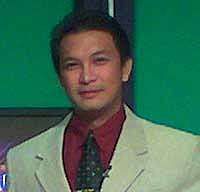
Goodbye, Chris
6:25 PM |
Goodbye, Chris
6:25 PM |
Goodbye, Chris
11:29 PM |
Stupid Freaks
11:29 PM |
Stupid Freaks
11:29 PM |
Stupid Freaks
1:32 PM |
Chris Needs Our Prayers!
1:32 PM |
Chris Needs Our Prayers!
1:32 PM |
Chris Needs Our Prayers!
3:07 AM |
Literatura


3:07 AM |
Literatura
3:07 AM |
Literatura
10:55 AM |
Hot Christian Romance
10:55 AM |
Hot Christian Romance
10:55 AM |
Hot Christian Romance
11:32 PM |
Sabi ng student ko, "Who's Marshall? And why does he have a law?"
Martial law was a great divide; even today, it separates all that came before, from all that has come since. Our history before 1972, when you think of it, represents the profound influence ideas and intellectuals can impact on a nation. The history of the Philippines since martial law has been marked by the steady bankruptcy of ideas and those who propagate them in our society.
The ideas -- and ideals -- of the propaganda movement; the motives and motivations of the revolution; the adaptation of the heritage of both in our attempt to reclaim our independence; the great thoughts that tried to give meaning and relevance to independence once reestablished in 1946: our country's story has been the story of thoughts, of ideas that moved the sectors that constitute our nation.
But after 1972, ideas and the intellectuals and ideologues who make them have increasingly been sidelined in the story of our national life: not least because so many intellectuals sold out or were deluded into supporting the dictatorship. The dictatorship, too, in wrecking the economy and turning us into a nation of overseas workers, virtually liquidated our middle class as a moving force of national development, and guaranteed that fewer and fewer Filipinos would have the capacity to be inspired, much less motivated, by ideas. Even people power, as we have seen in the 21 years since Ninoy Aquino's assassination, has never been fully formed, made truly workable, as a motivational idea. We have tried to make people power part of our lives, but its principles are so vague, its applications so unclear that we have gotten to be unsure if it was ever a real thought at all. People power was-is-perhaps, more of an emotion than a genuine idea.
11:32 PM |
Sabi ng student ko, "Who's Marshall? And why does he have a law?"
Martial law was a great divide; even today, it separates all that came before, from all that has come since. Our history before 1972, when you think of it, represents the profound influence ideas and intellectuals can impact on a nation. The history of the Philippines since martial law has been marked by the steady bankruptcy of ideas and those who propagate them in our society.
The ideas -- and ideals -- of the propaganda movement; the motives and motivations of the revolution; the adaptation of the heritage of both in our attempt to reclaim our independence; the great thoughts that tried to give meaning and relevance to independence once reestablished in 1946: our country's story has been the story of thoughts, of ideas that moved the sectors that constitute our nation.
But after 1972, ideas and the intellectuals and ideologues who make them have increasingly been sidelined in the story of our national life: not least because so many intellectuals sold out or were deluded into supporting the dictatorship. The dictatorship, too, in wrecking the economy and turning us into a nation of overseas workers, virtually liquidated our middle class as a moving force of national development, and guaranteed that fewer and fewer Filipinos would have the capacity to be inspired, much less motivated, by ideas. Even people power, as we have seen in the 21 years since Ninoy Aquino's assassination, has never been fully formed, made truly workable, as a motivational idea. We have tried to make people power part of our lives, but its principles are so vague, its applications so unclear that we have gotten to be unsure if it was ever a real thought at all. People power was-is-perhaps, more of an emotion than a genuine idea.
11:32 PM |
Sabi ng student ko, "Who's Marshall? And why does he have a law?"
Martial law was a great divide; even today, it separates all that came before, from all that has come since. Our history before 1972, when you think of it, represents the profound influence ideas and intellectuals can impact on a nation. The history of the Philippines since martial law has been marked by the steady bankruptcy of ideas and those who propagate them in our society.
The ideas -- and ideals -- of the propaganda movement; the motives and motivations of the revolution; the adaptation of the heritage of both in our attempt to reclaim our independence; the great thoughts that tried to give meaning and relevance to independence once reestablished in 1946: our country's story has been the story of thoughts, of ideas that moved the sectors that constitute our nation.
But after 1972, ideas and the intellectuals and ideologues who make them have increasingly been sidelined in the story of our national life: not least because so many intellectuals sold out or were deluded into supporting the dictatorship. The dictatorship, too, in wrecking the economy and turning us into a nation of overseas workers, virtually liquidated our middle class as a moving force of national development, and guaranteed that fewer and fewer Filipinos would have the capacity to be inspired, much less motivated, by ideas. Even people power, as we have seen in the 21 years since Ninoy Aquino's assassination, has never been fully formed, made truly workable, as a motivational idea. We have tried to make people power part of our lives, but its principles are so vague, its applications so unclear that we have gotten to be unsure if it was ever a real thought at all. People power was-is-perhaps, more of an emotion than a genuine idea.
11:13 PM |
Swiss Chocolate and Gmail Invites
11:13 PM |
Swiss Chocolate and Gmail Invites
11:13 PM |
Swiss Chocolate and Gmail Invites
8:02 AM |
Why you shouldn't hate Marc Gaba.
8:02 AM |
Why you shouldn't hate Marc Gaba.
8:02 AM |
Why you shouldn't hate Marc Gaba.
1:27 AM |
eXperim[E]nto!


1:27 AM |
eXperim[E]nto!
1:27 AM |
eXperim[E]nto!
1:04 AM |
The Grim Sign of Troubled Days
Over dinner at Little Asia along Tomas Morato (selected by our youngest gourmand Ralph for their delectable Boneless Tilapia in Honey-Mayo Sauce), the gang and I engaged in talk about jobs like the old farts that some of us are becoming.
I grew up during the time when, when thinking about a stable future for their children, parents would insist on a certain hierarchy of professions. Tier One: Doctor, Lawyer; Tier Two: Architect, Engineer, and so on. It was drummed into my head that these were the jobs that guaranteed financial independence and a good life, along with respectability and a very high position in the social strata.
In fact, I was so brainwashed by their conviction that I moved through my formative years convinced that I needed to be a doctor or a lawyer. Nothing else would do. My little talent with words was considered of interest but of no real import or relevance to real life. When I applied for college, I landed a pre-med quota course at UP Diliman, which would enable me to make my final choice between law and medicine. Later, I came to my senses when my unhappiness became too much to bear and I abandoned the prescribed path, stunning my three parents (my mother and stepfather called in my biological father from the US so they could triple play me). My final choice was to go where my heart led me, and they all forecast doom, misery and inevitable poverty.
A few days ago, I began to gather information on how well these high priority professions pay.
I encountered an architect who works for a small firm with competitive pay. Only a few years younger than myself, he had the title of Senior Architect. His monthly salary is just around the same amount a fresh graduate working in a call center would make. Starting architects make as much as I would pay a Junior Designer in my own company.
With doctors, you need to be very well-connected or wealthy in the first place. For example, to have a clinic in the new hospital along Ortigas, you need to plunk down P10 million, in addition to other expenses. Or you work as an employee for a company like Clinica Manila with a stunningly low monthly wage augmented by your P300 consultation fees. Or even worse, you can work for the small derma clinics and make much less.
With law, unless you're into Tax Law or Corporate Law, your monthly take-home for the many rungs of the ladder is nowhere near the promised bonanza. I know of a trial lawyer who struggles to make ends meet: his salary is barely enough to support himself, his wife, two children and payments on their home. Unless you create a niche like my brother, it's going to be long and hard road.
It is not much different for other professions. For example, a new policeman makes around P12k a month, with incremental raises as they get promotions, all the way to the rank of Director which makes around P40k.
A manager at a resto chain makes around P15k, while it is minimum wage for staff-level positions and their equivalents (salesgirls, promofolk, waiters, and the like).
Insurance promises gigantic windfalls if you are a killer salesperson with incredible connections. Then you get to drive around in a Jaguar. Otherwise, you experience life in feast-or-famine mode.
Teachers continue to get underpaid compared to the private sector. You can spend years as a consultant in consultancy firms at around P12k-P15k. Think your MBA can help you? At one point in time, a brilliant acquaintance of mine with an MBA from the requisite impressive US school was making around P30k. Another MBA holder is currently jobless and is willing to work for peanuts.
Professional writing is not much better. You can freelance and get a word rate, averaging around P1.5k-P2.5k per article for magazines from the Summit Group, or be employed by a company with copy requirements for around P15k-P20k. Pure creative writers who dream of living off publishing royalties in the Philippines have to produce a large number of best-selling books in a short span of time, in an industry where print runs are generally 1,000 copies (with big print runs at around 10,000 copies).
The tech industry had its heyday with the bubble of irrational exuberance. At one point in time, designers could command up to P60k, with managerial salaries over P100k. Those days, of course, are gone, with a few sterling exceptions.
Advertising and marketing companies exist in an odd space. On one hand, if you are a creative, you are pretty much taken care of. If you consistently do good work and bring in awards, your pay will grow as you climb up the pyramid, earning anywhere from P30k to P80k and even higher. However, in the same industry, rank and file (and account executives) operate along the same low pay level: start at around P8k and progress to the twenties.
Creatives also do well in similar industries (acting, directing, production). Actors can do TV series and get around P50k per episode or do TV guesting at around P10k to 15k (they get bigger paychecks with films). TV advertising directors can make from P80k upwards. MTV directors can charge along P100k+, depending on the producers -- but if you're new and unheard of, chances are you'll be doing it for much much less, if you're tasked to do it at all. Composers begin at around P30k for a jingle if you're friends. Food stylists can make a killing, given the fact that so few of high caliber exist -- they charge P7.5k-P25k per plate (per layout). While starting photographers make around P5k-P10k per shoot, big name photographers play at P150k+ per day (there's also cutthroat competition for the wedding market).
For me though, nothing beats having your own business. The risks and headaches are terrifying, but everything balances out. Your small business can grow and take care of your future. Owners of restos, retail stores and other small businesses can pay themselves what their books can afford.
At a recent job fair, the organizers were forced to extend their hours and days to accommodate the thousands of people looking for work. Growing unemployment is a reality, with thousands of new graduates joining the ranks of the jobless every year. Openings are biased towards those who matriculated from the "top" schools: UP, Ateneo and La Salle. But having a diploma from those schools is not a guarantee of a job, much less good pay.
What does all this mean? When my daughter is of the appropriate age for such things, I will tell her: (1) Whatever you choose to be, make sure you like it. Find a job that fits you or, if it does not exist, create it. Follow your bliss but manage your own expectations. (2) You do not have to be a doctor or a lawyer or a corporate person to be comfortable. Define what makes you comfortable and work to achieve it. Do not buy in the previous generations' flawed reasoning spawned by the need for social positioning. (3) Do not undervalue your creative abilities. Contrary to what I was taught to believe in, words or a good eye for beauty CAN feed you. Develop your skill sets in language, writing, art and similar lines. (4) Look at starting a business. Even if, like me, you don't think you’re a businessman, you could be surprised. (5) The good life isn't about money, so that shouldn't be your number one priority. But if you want to be able to travel around Europe, barefoot and carefree for three years, you need to be able to pay for it. (6) Abolish the notion of job hierarchy from your mind. As long the people holding jobs maintain their values and principles, no one job is intrinsically superior to the next. Apart from that, I really don't know.
Yes, 'tis the season to be Starstruck once more. It was only a few months back when Anj was convincing us all to go to Broadway Centrum for the first Starstruck. During its first weeks it had no audience and they had to pay people fifty pesos to watch it. Then they stopped paying the audience because soon fans clubs emerged and the lines were so long they had to tighten security.
Now, Piercing Pens observes that many teenagers are desperate to dream, believe and survive to be the next generation of Filipino superstars. These past few years, their ambition in life has shifted from becoming astronauts, engineers and doctors to becoming caregivers and cultural entertainers overseas. Now they hope to be movie and television stars, veejays and noontime show hosts. As Rolando B. Tolentino put it clearly during a symposium where we were both speakers. There's a shift from intellectual investment (puhunan) that one gets from proper schooling and education to a more physical puhunan: one's looks, body and manual labor over one's intelligence and wealth of knowledge. The example he cited was Hero Angeles from the star search show from the rival network. A UP student, Angeles didn't rely on his education but banked on his physical appearance that now guarantees him better financial gain and puts him in a better social position. If land was a sign of power during our Spanish colonial past, then education during our American colonial period, now it is the body that is used as capital. This all ties up with Tolentino's theory of the Philippines as a sexualized nation, where the only thing maybe preventing our economy from collapsing are the remittances from the overseas Filipino workers, most of them using their bodies in service-oriented or manual work.
It's a lack of faith in the Philippine educational system, especially when a college degree from a Filipino school or university fails to secure a career with better pay and better living conditions. So many unemployed college graduates find themselves accepting call center and other outsource labor jobs from multinational companies that it seems to be an undergrad's rite of passage. Either after graduation or a few semesters before graduation, a student (from these exclusive schools and prime universities in Metro Manila) finds he or she has to get this outsourcing job, part time at first then slowly, slowly after so many class sessions are missed, completely leaving school and then living the night shift or that of a contractual worker just to get some financial advancement.
And what's better than answering calls and troubleshooting during those harrowing hours of the graveyard shift? Superstardom. After all, the only requirements seem to be that you have to be young, willing and be present. No talent, no experience necessary as long as you have an image that can be worked on by a good PR team. If fortunate, success and upper social mobility happen immediately. If not, oh well ... at least you had your fifteen minutes of fame.
So who needs school? And who wants to work in cubicles with a faux American or English accent, or clean as you go as a service crew in fastfoods when you can be the next packaged image for a whole new generation to adore. And then someday ... politics!
1:04 AM |
The Grim Sign of Troubled Days
Over dinner at Little Asia along Tomas Morato (selected by our youngest gourmand Ralph for their delectable Boneless Tilapia in Honey-Mayo Sauce), the gang and I engaged in talk about jobs like the old farts that some of us are becoming.
I grew up during the time when, when thinking about a stable future for their children, parents would insist on a certain hierarchy of professions. Tier One: Doctor, Lawyer; Tier Two: Architect, Engineer, and so on. It was drummed into my head that these were the jobs that guaranteed financial independence and a good life, along with respectability and a very high position in the social strata.
In fact, I was so brainwashed by their conviction that I moved through my formative years convinced that I needed to be a doctor or a lawyer. Nothing else would do. My little talent with words was considered of interest but of no real import or relevance to real life. When I applied for college, I landed a pre-med quota course at UP Diliman, which would enable me to make my final choice between law and medicine. Later, I came to my senses when my unhappiness became too much to bear and I abandoned the prescribed path, stunning my three parents (my mother and stepfather called in my biological father from the US so they could triple play me). My final choice was to go where my heart led me, and they all forecast doom, misery and inevitable poverty.
A few days ago, I began to gather information on how well these high priority professions pay.
I encountered an architect who works for a small firm with competitive pay. Only a few years younger than myself, he had the title of Senior Architect. His monthly salary is just around the same amount a fresh graduate working in a call center would make. Starting architects make as much as I would pay a Junior Designer in my own company.
With doctors, you need to be very well-connected or wealthy in the first place. For example, to have a clinic in the new hospital along Ortigas, you need to plunk down P10 million, in addition to other expenses. Or you work as an employee for a company like Clinica Manila with a stunningly low monthly wage augmented by your P300 consultation fees. Or even worse, you can work for the small derma clinics and make much less.
With law, unless you're into Tax Law or Corporate Law, your monthly take-home for the many rungs of the ladder is nowhere near the promised bonanza. I know of a trial lawyer who struggles to make ends meet: his salary is barely enough to support himself, his wife, two children and payments on their home. Unless you create a niche like my brother, it's going to be long and hard road.
It is not much different for other professions. For example, a new policeman makes around P12k a month, with incremental raises as they get promotions, all the way to the rank of Director which makes around P40k.
A manager at a resto chain makes around P15k, while it is minimum wage for staff-level positions and their equivalents (salesgirls, promofolk, waiters, and the like).
Insurance promises gigantic windfalls if you are a killer salesperson with incredible connections. Then you get to drive around in a Jaguar. Otherwise, you experience life in feast-or-famine mode.
Teachers continue to get underpaid compared to the private sector. You can spend years as a consultant in consultancy firms at around P12k-P15k. Think your MBA can help you? At one point in time, a brilliant acquaintance of mine with an MBA from the requisite impressive US school was making around P30k. Another MBA holder is currently jobless and is willing to work for peanuts.
Professional writing is not much better. You can freelance and get a word rate, averaging around P1.5k-P2.5k per article for magazines from the Summit Group, or be employed by a company with copy requirements for around P15k-P20k. Pure creative writers who dream of living off publishing royalties in the Philippines have to produce a large number of best-selling books in a short span of time, in an industry where print runs are generally 1,000 copies (with big print runs at around 10,000 copies).
The tech industry had its heyday with the bubble of irrational exuberance. At one point in time, designers could command up to P60k, with managerial salaries over P100k. Those days, of course, are gone, with a few sterling exceptions.
Advertising and marketing companies exist in an odd space. On one hand, if you are a creative, you are pretty much taken care of. If you consistently do good work and bring in awards, your pay will grow as you climb up the pyramid, earning anywhere from P30k to P80k and even higher. However, in the same industry, rank and file (and account executives) operate along the same low pay level: start at around P8k and progress to the twenties.
Creatives also do well in similar industries (acting, directing, production). Actors can do TV series and get around P50k per episode or do TV guesting at around P10k to 15k (they get bigger paychecks with films). TV advertising directors can make from P80k upwards. MTV directors can charge along P100k+, depending on the producers -- but if you're new and unheard of, chances are you'll be doing it for much much less, if you're tasked to do it at all. Composers begin at around P30k for a jingle if you're friends. Food stylists can make a killing, given the fact that so few of high caliber exist -- they charge P7.5k-P25k per plate (per layout). While starting photographers make around P5k-P10k per shoot, big name photographers play at P150k+ per day (there's also cutthroat competition for the wedding market).
For me though, nothing beats having your own business. The risks and headaches are terrifying, but everything balances out. Your small business can grow and take care of your future. Owners of restos, retail stores and other small businesses can pay themselves what their books can afford.
At a recent job fair, the organizers were forced to extend their hours and days to accommodate the thousands of people looking for work. Growing unemployment is a reality, with thousands of new graduates joining the ranks of the jobless every year. Openings are biased towards those who matriculated from the "top" schools: UP, Ateneo and La Salle. But having a diploma from those schools is not a guarantee of a job, much less good pay.
What does all this mean? When my daughter is of the appropriate age for such things, I will tell her: (1) Whatever you choose to be, make sure you like it. Find a job that fits you or, if it does not exist, create it. Follow your bliss but manage your own expectations. (2) You do not have to be a doctor or a lawyer or a corporate person to be comfortable. Define what makes you comfortable and work to achieve it. Do not buy in the previous generations' flawed reasoning spawned by the need for social positioning. (3) Do not undervalue your creative abilities. Contrary to what I was taught to believe in, words or a good eye for beauty CAN feed you. Develop your skill sets in language, writing, art and similar lines. (4) Look at starting a business. Even if, like me, you don't think you’re a businessman, you could be surprised. (5) The good life isn't about money, so that shouldn't be your number one priority. But if you want to be able to travel around Europe, barefoot and carefree for three years, you need to be able to pay for it. (6) Abolish the notion of job hierarchy from your mind. As long the people holding jobs maintain their values and principles, no one job is intrinsically superior to the next. Apart from that, I really don't know.
Yes, 'tis the season to be Starstruck once more. It was only a few months back when Anj was convincing us all to go to Broadway Centrum for the first Starstruck. During its first weeks it had no audience and they had to pay people fifty pesos to watch it. Then they stopped paying the audience because soon fans clubs emerged and the lines were so long they had to tighten security.
Now, Piercing Pens observes that many teenagers are desperate to dream, believe and survive to be the next generation of Filipino superstars. These past few years, their ambition in life has shifted from becoming astronauts, engineers and doctors to becoming caregivers and cultural entertainers overseas. Now they hope to be movie and television stars, veejays and noontime show hosts. As Rolando B. Tolentino put it clearly during a symposium where we were both speakers. There's a shift from intellectual investment (puhunan) that one gets from proper schooling and education to a more physical puhunan: one's looks, body and manual labor over one's intelligence and wealth of knowledge. The example he cited was Hero Angeles from the star search show from the rival network. A UP student, Angeles didn't rely on his education but banked on his physical appearance that now guarantees him better financial gain and puts him in a better social position. If land was a sign of power during our Spanish colonial past, then education during our American colonial period, now it is the body that is used as capital. This all ties up with Tolentino's theory of the Philippines as a sexualized nation, where the only thing maybe preventing our economy from collapsing are the remittances from the overseas Filipino workers, most of them using their bodies in service-oriented or manual work.
It's a lack of faith in the Philippine educational system, especially when a college degree from a Filipino school or university fails to secure a career with better pay and better living conditions. So many unemployed college graduates find themselves accepting call center and other outsource labor jobs from multinational companies that it seems to be an undergrad's rite of passage. Either after graduation or a few semesters before graduation, a student (from these exclusive schools and prime universities in Metro Manila) finds he or she has to get this outsourcing job, part time at first then slowly, slowly after so many class sessions are missed, completely leaving school and then living the night shift or that of a contractual worker just to get some financial advancement.
And what's better than answering calls and troubleshooting during those harrowing hours of the graveyard shift? Superstardom. After all, the only requirements seem to be that you have to be young, willing and be present. No talent, no experience necessary as long as you have an image that can be worked on by a good PR team. If fortunate, success and upper social mobility happen immediately. If not, oh well ... at least you had your fifteen minutes of fame.
So who needs school? And who wants to work in cubicles with a faux American or English accent, or clean as you go as a service crew in fastfoods when you can be the next packaged image for a whole new generation to adore. And then someday ... politics!