Wednesday, January 06, 2016
 6:27 AM |
Film Log 10: Irrational Man
6:27 AM |
Film Log 10: Irrational Man

A philosophy professor escapes from life by taking up a job teaching at a small and gossipy college. His demons follow him, and with that his reputation as a campus cad. That does not stop two women -- a colleague and a student -- from falling in love with him. And so he turns to the only thing he can do to make life matter: plot out a murder. That should make for a fascinating film but what an unexpectedly tedious film Woody Allen's
Irrational Man (2015) turned out to be. Maybe not tedious. Maybe the word boring, or repetitive, or unnecessary would suffice to describe this story that borrows the dilemma from Fyodor Dostoevsky's
Crime and Punishment and sprinkles it with a collegiate setting, a mouthful of philosophy, and well-treaded elements from
Crimes and Misdemeanors, Matchpoint, and all other Allen films where an older man falls for a younger woman. Of course, Allen is known to recycle many of his plot points, but this film seems to go the extra mile to seem irrelevant: it has none of the wit of Allen's best. You can tell where the story is headed from a mile away, and every exchange in this film feels forced, contrived, dispirited. Considering that this stars Joaquin Phoenix, Emma Stone, and Parker Posey, it's a waste of talent and a waste of an opportunity. I am a huge Woody Allen fan, and this feels like a huge let-down. ★★☆☆☆
Labels: film, murder, philosophy, review
[0] This is Where You Bite the Sandwich
Friday, April 10, 2015
3:17 AM |
"Now is the Envy of the Dead"

Don Hertzfeldt's latest animated effort,
World of Tomorrow (2015), is a surprising curiosity: a short but thematically rambunctious meditation on life, the future and the possibilities of being human, and the imperative of living the best life you can
right now.
Catch it however you can.Labels: cartoons, film, life, philosophy
[0] This is Where You Bite the Sandwich
Friday, July 04, 2014
11:51 PM |
Originality is a Bad Word

I started writing because I was desperately in love with the words of Nick Joaquin. I was a college sophomore, and my Philippine literature teacher—the fictionist Timothy Montes—just made me read “May Day Eve,” and I was enthralled. Later that day, I went straight home and made my own story, taking care to carry over many of the things I fell in love with in Mr. Joaquin’s prose: the breathless lyricism (that long swirly sentence of a first paragraph! which gets echoed, in tone and style, by the last paragraph!), the melodramatic characters, and the seamless shifts in time frames which seem to be signaled by sheer fiction sorcery. When we follow the beautiful and headstrong young Agueda, for example, as she heads her way to the mirror to disprove Anastasia’s claim of midnight magical prophecies, we see her closing her eyes and mouthing the strange incantation. And when Mr. Joaquin finally describes the act of Agueda finally opening her eyes to behold her reflection on the mirror, our minds race to think: what did she see? As if to read our minds and our anticipation, Mr. Joaquin pens down the exact same question in the next line—but this time as the opening dialogue by some other character in another scene and in another time. And just like that, seamlessly, time shifts.
I was enthralled.
I wanted to do the exact same magic in a story I thought I could write. And write I did—but to my estimation now, it was a complete amateurish disaster. But so be it. That story, cribbed from the stylistics of Nick Joaquin, made me the writer I am today.
Years later, the poet Cesar Ruiz Aquino, another one of writing mentors, casually remarked of the stories I wrote: “You’re so Joaquinesque.” Which I perfectly understood. And for me, it was an observation of influence. Not to say I was being unoriginal, of course. Because I would like to believe there is no such thing as “original,” anyway.
When you swim in the world of creatives—if you are a visual artist, for example, or a designer, a musician, a writer, a performer—being called an “original” comes to you as a stamp of utmost approval, an implicit acknowledgment that you may be unique in an overwhelming ocean of mediocrity and the dogtired. We castigate “sameness,” sport an upturned nose on “derivative,” and congratulate the “individual effort” that sings for the beholder a different tune from the rest. We think of that individuality, that uniqueness as the be-all and end-all of what you do as creative.
But I’ve always felt that there is an allure to the word “original” which we mistake for virtue—a confusion that is fuzzy and misunderstood. And so let me just make my point clear: I do not believe in the “original.” There is no such thing. When I am asked questions seeking to ascertain whether we have
enough fresh, new, and yes, “unique” ideas to continue to push the boundaries of literature and music and film, I get a little uneasy.
Because ideas are not a finite thing, like a well that dries up. It’s not fossil fuel—although it is a different kind of fuel that feeds a machine that embraces all. And the true answer to that question is this: if you take a closer look at history itself, and the way that life unfolds, the fact that we are still astounded by things that crop up every single day is testament to the fact that ideas—fresh and new—will always be there. People have been complaining about the death of the novel for ages, for example. The death of the novel has been declared for a few hundred years now. And yet it’s still around, it has evolved with the times. I believe boundaries exist to be pushed further.
I am also asked:
Is everything derivative then? But I like “derivative.” Although I prefer a better term for this: “remix” is better—and has a jazzy sound to it.
Is originality something altogether unattainable in this day and age? I am also asked, sometimes. And I think that’s looking at a green apple and complaining that it’s not red. It’s still an apple.
I’m going to say arguing for originality like as if it is some sacred thing, like a literary holy grail every writer must try to wrest in some crusade, is old hat. Any literature teacher worth her salt would tell you that there is no such thing as an original story. If you believe certain literary sources, there are only seven, or three, or 20, or 36 plots in the world, depending on whose account you are listening to.
Arguing for originality that is yours alone, unique in the whole unfolding creative history of mankind is a little too selfish, too grandiose, and always impossible: it denies the whole dynamism that we are human beings who create because we are inspired, because we are able to react, because we have the gift to transform. What for me becomes original is the way writers are able to manipulate so-called old stories into something fresh, new.
This is the transformation that is the heart of every art. Take for instance the recent Hollywood blockbuster
Edge of Tomorrow, which stars Tom Cruise. It is the story of a military man—who is more a PR person than a soldier trained for combat—who is sent against his will to battle aliens. And something happens to him in the battlefield that enables him to relive the same day each time he gets killed in that battle. Which is really Groundhog Day meets Starship Troopers meets the journey of the hero archetype proposed by Joseph Campbell. Nothing original about the story at all—but it was a very engaging movie, which enthralled critics and audiences alike. And what seemed fresh about it was not the hoary storyline it hitches itself to. It was how the director—and probably also the screenwriter—shaped or crafted that whole storyline that made it more immediate, scintillating, powerful.
Where do we insert “newness” in storytelling then? Storytelling is old as mankind—but if you think about it, the stories and the ways we tell them have always been shaped by the available technology prevalent at the time. Think of the caveman and his urge to tell the story of a bison hunt—his technology of cave wall, pitch, and clay would soon produce those beautiful cave paintings. Before writing was invented, the Bard used an oral means of transmitting his tale, which required specific techniques necessary for him or her to be able to retell an entire epic from memory: the repetition of certain motifs, the musicality of the narrative, the flatness of characters. You needed such mnemonic devices to be able to recite an epic. The technology of writing completely eradicated that technique: there was no more need to memorize—and soon a specific of writing emerged: more complex characters, less dependency on sound devices, restraint from the overuse of motifs. We were still telling the same stories, but we were telling them differently.
In the Age of the Internet, where short attention span and a mobile media platform dominate, we need to fit our old stories now to these new media to cope with the times.
I’m going to mention the New York writer Teju Cole, who has been taking to Twitter to write his short stories, the form of which is completely influenced by the medium: very short and concise, with the characteristic of social share-ability. There’s also “Hawk Funn,” a Facebook experiment in storytelling that we are now beginning to call the “social story.” And most of all, I’d like to mention Humans of New York, which is basically a photography blog and Facebook page—but I think it sets a good example of what storytelling is like in the social media age. You first get from HONY a striking picture of ordinary denizens of a city, and we get a caption that thoroughly humanizes the photo because of the story these denizens tell of themselves. The first time I encountered HONY, I was struck by the fact that these little stories managed to excite my imagination, that nerve center in my brain that responds to good narrative. And they were short—which is appropriate for our age. And they were easily shared. And people were responding to them in droves. If each like or comment to each of these HONY posts was the equivalent of a subscription to a literary magazine, you could say literature is alive and well and kicking in the Age of Social Media.
This is the new literature. The stories are old, but the media is new. That’s where the originality lies.
I’ve been reading a book titled
Steal Like an Artist by Austin Kleon. For him, an artist is a collector, not a hoarder—meaning to say he collects selectively the things that he loves. Artists collect ideas, and writers do this by reading. Kleon recounted stumbling on a technique of “doing poetry” by clipping out newspaper articles he likes, and then emphasizing certain words he finds fascinating, and then blacking out with a marker the rest of the article—leaving a clipping with only certain words standing out from the blackness. The words, of course, strung together read out like some found poetry.

He found later on, however, that this technique of doing poetry was not unique. A guy named Tom Phillips was doing something like this before. And the more he researched, the more he found out there was a tradition of doing something exactly like this. He uncovered William Burroughs, and then uncovered Brion Gysin before Burroughs, and then uncovered Tristan Tzara before Gysin, and then uncovered Caleb Whitefoord before Tzara—which accounted for a 250 year old tradition of black out poetry.
And he came to this conclusion:
nothing is original. All creative works build on what came before, and the best we can do is not to call this “derivative” work, but to call it a “remix,” a “mash-up.” It is mash-up because we take the best of what already existed before, and then giving it our own take. According to Klein, we need to become “creative kleptomaniacs.”
Given the question of originality, it pays to be reminded about what some of the best creatives in history has said about the issue. Pablo Picasso once said, “Good artists copy. Great artists steal.” David Bowie once described himself as a “tasteful thief.” T.S. Eliot once said that great poets steal, but they turn what they have stolen into something better.
That’s transformation. That’s remixing. That’s mash-up.
PHOTO CREDITS: Photo of Nick Joaquin by Neal Oshima, for Rogue Magazine. Photo of Austin Kleon by Ryan Essmaker for The Great Discontent.Labels: art and culture, life, philosophy, writers, writing
[0] This is Where You Bite the Sandwich
Thursday, October 06, 2011
6:02 PM |
In Celebration of Round Pegs in Square Holes
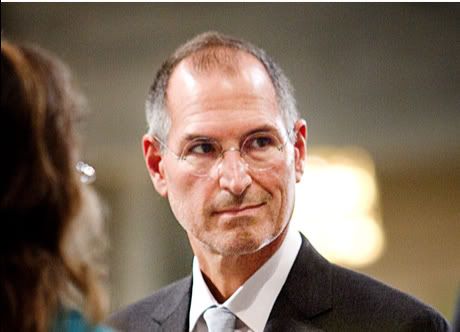
As I write this, the news is pouring in and tributes are flying everywhere about the passing of Steve Jobs, the co-founder and visionary behind Apple. It wasn’t exactly news that surprised many of us. We had known of his battle with pancreatic cancer for the longest time, and the evidence of the ravages that the illness wrought could be seen in Mr. Job’s gaunt, emaciated look of late. A few months ago, he stepped down as CEO of Apple. And we knew the day would soon come. And it did. But it didn’t make it any less painful.
Truth to tell, I am myself surprised by the level of grief I have found myself indulging in. I have never been an ardent Steve Jobs fan—my friend JB Lim is, and aside from the fact that he owns virtually every gadget Apple has produced of late (JB also used to be the man behind the Genius Bar of Dumaguete’s iStore), he goes around his every day life in signature black wardrobe inspired by the man.
But I am always, always saddened when visionaries and people of distinguished talent pass away, and most often in the prime of their lives. Because these people contribute so much to the world, and yet they die too soon, I think.
Pero si Sen. Juan Ponce Enrile—the architect of the Martial Law and a powerful lawmaker whose latest antics in the Senate (the masturbation brouhaha, for example) could be grounds for speculation on his verging towards senile dementia—
bakit buhay pa? Of course, Billy Idol once said that “the good die young,” and such may be the irony of life, which I cannot be bothered with trying to understand.
I must admit there was a profound sadness in the way I greeted my day when I woke to this news this morning. Perhaps no one can understand this level of grief unless one has been touched by the kind of technological lifestyle Apple has given to hipsters, creatives, and forward-thinking people this past decade. For many of us, there is a demarcation between a certain past and then the moment when the magic of Apple’s humanized technology touched us.
Once you go Mac, so they say,
you can’t go back. I write this article, for example, on a MacBook while listening to a movie score by Michael Giacchino for a Pixar film from my iPod. Mac, Pixar, and the iPod. That’s three instances, all at once, with which Jobs can lay claim to an influence on the way I live.
And yet beyond all these marks of influence, it is Mr. Job’s template of having forged unlikely success in a culture of low-minded thinking that captures my imagination. A hipster to the core—his enduring philosophy advises us to “stay hungry, [and to] stay foolish,” something he got from
The Whole Earth Catalog from the hippie culture of the 1960s—his success can be traced to a singular drive to strip everything down to a marriage of technology and design informed by taste, which he knew could not be gleaned from the overpowering marketing notion that the consumer is king. From the New York Times tribute to him, John Markoff writes: “When asked what market research went into the iPad, Mr. Jobs replied: ‘None. It’s not the consumers’ job to know what they want.’”
And to this, I say,
Thank you very much. This is something that ABS-CBN and other panderers of the quick-profit philosophy of common taste can learn, if they want to stay relevant in the long run. The antithesis to Steve Jobs would be this masa culture awash in Willie Revillame, the
Transformers movies, the Kardashians and reality TV shows of their ilk, FoxNews, the
Twilight novels, StarCinema’s
No Other Woman, and others of their kind, which follow undying formula and get rewarded by the masa for the comfortable conformity they champion—but do not push human civilization any further at all. Why do you think StarCinema gives us the same kind of movies every single time? Because every single frame has been market-researched to death, destined to give what the consumer wants, and all for profit.
What change the world are often people with vision and drive. These are people who don’t follow rules, who could care less for the status quo, who are often unpopular. Or if not unpopular, these are people who rock the boat and send shivers down the spine of people who only have eyes for the bottom-line. I am reminded of Oprah Winfrey when she decided to chuck the template of daytime talk popularized by Phil Donahue back in the day. These are shows, not unlike Jerry Springer’s, glorifying in trashy topics, which does bring in eyeballs and the eventual ratings and dollars. But no, Oprah said; she wanted to do a show that specialized in “elevating the human spirit”—and that must have made the television moneymen cringe then.
Who profits from goody-goody daytime television? But guess who has the last laugh.
Of all things that I want to remember most about Steve Jobs, it is this quote: “Here’s to the crazy ones, the misfits, the rebels, the troublemakers, the round pegs in the square holes… the ones who see things differently — they’re not fond of rules… You can quote them, disagree with them, glorify or vilify them, but the only thing you can’t do is ignore them because they change things… They push the human race forward, and while some may see them as the crazy ones, we see genius, because the ones who are crazy enough to think that they can change the world, are the ones who do.”
Think about this. Men and women who have broken the rules have shaped world history. Give me a conformist or a rule-follower who has impacted history, and you will most likely draw a blank. Jesus? He angered the religious authorities of his day, which led to his crucifixion. Gandhi? His unquiet revolution of “passive resistance” molded a nation, and cost him his life. Mother Teresa? She abandoned first world comfort to take care of India’s unwanted—not a career shift anybody “practical” would wish for anybody.
Today we live in a world that forces—or even shames us—to conform, to abide by the strict rules, to surrender to hierarchy instead of merit, to give up the pursuit of creative thinking in favor of “the practical.” I get reprimanded for eschewing these reminders all the time; sometimes they even call this “arrogance.” But I don’t mind. I know who I am.
It takes guts to be a Steve Jobs. But if you have the guts, and you have the courage to follow the promise of your potential, you can change the world in your own small ways. Mr. Jobs said it best: “Your time is limited, so don’t waste it living someone else’s life. Don’t be trapped by dogma—which is living with the results of other people’s thinking. Don’t let the noise of other’s opinions drown out your own inner voice. And most important, have the courage to follow your heart and intuition. They somehow already know what you truly want to become. Everything else is secondary.”
Farewell, Mr. Jobs. And thank you very much.
Labels: life, obituary, people, philosophy, web and tech
[1] This is Where You Bite the Sandwich
Thursday, September 29, 2011
10:51 PM |
The Dangers of Comfort, The Theater of Dinner Conversation
And I don’t mean the pedestrian gossip that slakes over our dinner tables most of these days—although that, too, has its own perverted pleasures. The thrill of finding frail humanity among our kind. Schadenfreude as drama.
“Did you know so-and-so and so-and-so got together over the weekend?”
“Seriously? But what about so-and-so? Aren’t they living together?”
“Well, a little birdie told me that so-and-so has done this-and-that.”
“Oh. Em. Gee.”
Not that.
What I mean is dinner conversation of the illuminating kind—not about politics or religion, those two deadly bores. But about the place of humanity in the scheme of the universe, in philosophy—leavened, of course, by anecdotes from personal experience. Imagine a conversation about art, a painting or sculpture or what-not a friend of yours have seen in a museum which has touched him, which has given him fodder for thought. Imagine that friend as an impresario of talk. Over a three-course meal, pushed by the sweet intoxication of red wine, you hear him give a dramatic musing of what he has seen. You are both surrounded by kindred spirits, and the talk becomes organic, more philosophical, a little bit tipsy from the wine. There are affirmations, counter-arguments, jokes and laughter, more illuminating anecdotes. You leave that dinner table knowing you have learned a little bit more about the nature of humanity. You become, at least for a few hours during and after that dinner, a better human being—because you have partaken of a strange communion, a mix of food and words and friends.
I find myself in rare instances of this in Dumaguete. When the chance presents itself—usually in the delightful company of Dessa Quesada-Palm, Arlene Delloso-Uypitching, Esther Windler, Cecilia Hoffman, Annabelle Lee-Adriano, Laurie Raymundo, Margaret Helen Udarbe, Betty McCann, Moses Joshua Atega, Patrick Chua, Myrish Antonio-Cadapan, Jacqueline Veloso-Antonio, Leo Mamicpic, Ben Malayang III and his wife Gladys, Myrna Pena-Reyes, Tata and Simon Stack, John Stevenson, and assorted artists/friends from Manila and elsewhere who would join us—I grab it, and I prepare for a night of scintillating talk, knowing it is good for the soul, and for the mind.

I thought as much when I saw the filmed dinner conversation between André Gregory and Wallace Shawn, playing versions of themselves in Louis Malle’s
My Dinner with André [1981]. This film, hailed as a unique cinematic experiment and is considered one of the best films to come out of the 1980s, is ripe with witticism, philosophical musings, and provocative thoughts, but this one strain of dialogue between the two struck me the most:
ANDRE: I mean, if you don't have that electric blanket, and your apartment is cold, and you need to put on another blanket or go into the closet and pile up coats on top of the blanket you have, well then you know it's cold. And that sets up a link of things: you have compassion for the p-- ... well, is the person next to you cold? Are there other people in the world who are cold? What a cold night! I like the cold, my God, I never realized, I don't want a blanket, it's fun being cold, I can snuggle up against you even more because it's cold! All sorts of things occur to you. Turn on that electric blanket and it's like taking a tranquilizer, it's like being lobotomized by watching television. I think you enter the dream world again. I mean, what does it do to us, Wally, living in an environment where something as massive as the seasons or winter or cold don't in any way affect us? I mean, we're animals after all. I mean, what does that mean? I think that means that instead of living under the sun and the moon and the sky and the stars we're living in a fantasy world of our own making.
WALLY: Yeah, but I mean, I would never give up my electric blanket, André. I mean, because New York is cold in the winter, I mean, our apartment is cold. It's a difficult environment! I mean, our lives are tough enough as it is, I'm not looking for ways to get rid of the few things that provide relief and comfort, I mean, on the contrary! I'm looking for more comfort, because the world is very abrasive, I mean, I'm trying to protect myself, because really there are these abrasive beatings to be avoided everywhere you look.
ANDRE: Yeah, but Wally, don't you see that comfort can be dangerous? I mean, you like to be comfortable and I like to be comfortable, too. But comfort can lull you into a dangerous tranquility. I mean, my mother knew a woman, Lady Hatfield, who was one of the richest women in the world, and she died of starvation because all she would eat was chicken. I mean, she just liked chicken, Wally, and that was all she would eat, and actually, her body was starving but she didn't know it 'cause she was quite happy eating her chicken and so, she finally died! See, I honestly believe that we're all like Lady Hatfield now, we're having a lovely, comfortable time with our electric blankets and our chicken, and meanwhile we're starving because we're so cut off from contact with reality that we're not getting any real sustenance. 'Cause we don't see the world. We don't see ourselves. We don't see how our actions affect other people.
[The transcript of the film can be read here.]
End scene.
The dangers of comfort. That made me take pause. Because I have been thinking about this for some days now. And there it was, the whole notion of it, discussed at length in one of the best films of all time. And I have just stumbled on it, like the “omens” they talk about in the film. Is this film my own form of Wally’s fortune cookie?
A few days ago, I posted this status update in my Facebook wall: “I don’t know what the Universe is trying to tell me these days, but I’m willing to listen.” The things is, I have been out-of-sorts lately, bombarded by tiny problems with magnificent wings which I can’t talk about to anybody, trying to make sense out of ... something. I had no idea what was bothering me, but I have been feeling odd. Strangely sad, feeling blue. And so I popped in this film like I have always promised myself I would. And I’m glad I did.
And what a beautiful film it is. When it ended, I just stared and stared off into space as the end titles rolled over Erik Satie’s
Gymnopédie No. 1, and I was thinking about the things they were talking about: theater, domesticity, the imprisonment of comfort, how life must be lived when one realizes how we have forgotten to connect... I think this is one film one should watch when one turns 36 (Wallace’s age when this was made). I’m 36 now, and I love the film because I feel it now, more thoroughly, because of having have lived. Because the questions it asks are things I have come to know through all those years. I wouldn’t have gotten this film when I was 21.
Amy Taubin
in the Criterion website captures exactly what I felt upon finishing: “And then the dinner is over. Nothing is concluded—not for Wally or André, and certainly not for the audience. But on the way home, Wally is surprised to find that something has changed in the way he attends to the city as he sees it from the taxi window. And that slight shift in consciousness is what André ... would have applauded. And we might do the same as the image fades to black.”
The film finally reminds me that I need to have dinner with my good people again. Because you need these little events of gab to go beyond the vapidity of everyday life, the drone of television, the mindless cares of zombies around you. A dinner conversation is a small strike against the electric blanket of life. It is rare when the right talk chemistry sparks, and so when it happens, one has to be of mind to cherish it.
Labels: film, life, philosophy, theater, travel
[0] This is Where You Bite the Sandwich
Friday, June 29, 2007
7:59 AM |
Mantra for Life
Seiri
[sort]Seiton
[systematize]Seiso
[sweep]Seiketsu
[standardize]Shitsuke
[self-discipline]Meaning comes in filling in the spaces.
Labels: life, philosophy
[0] This is Where You Bite the Sandwich
GO TO OLDER POSTS


