Celebration: An Anthology to Commemorate the 50th Anniversary of the Silliman University National Writers Workshop Sands and Coral, 2011-2013
Silliman University, 2013
I’ve never felt this much despair. And knowing full well that it is not just me, it’s also coming from so many people. It’s a world heaving in hopelessness. We are stewing in the sweat and stir craziness of our quarantine, but the world—inept leaders mostly—still manages to make us scream. The raging summer heat we feel now is no longer just weather, it feels like the suffocation of an existential pressure cooker—and any minute now we will burst.
Once a year, on a day in September, I begin the daunting task of packaging tidbits of information that make my stomach queasy, and proceed to put them up one by one in Facebook and Twitter—complete with photos and complete with research and links—in a meticulously paced posting that allows for the entire run of the hours in the day. It is a flood of dark information, and sometimes I cry over them.
But it is only one day, and once a year at that, and it has to be done.
What is that day?
It is the day we came to know the number 1081.
It is the proclamation number with which Ferdinand Edralin Marcos, former Philippine dictator and the boogeyman of our collective historical nightmares, plunged the entire country into martial rule.
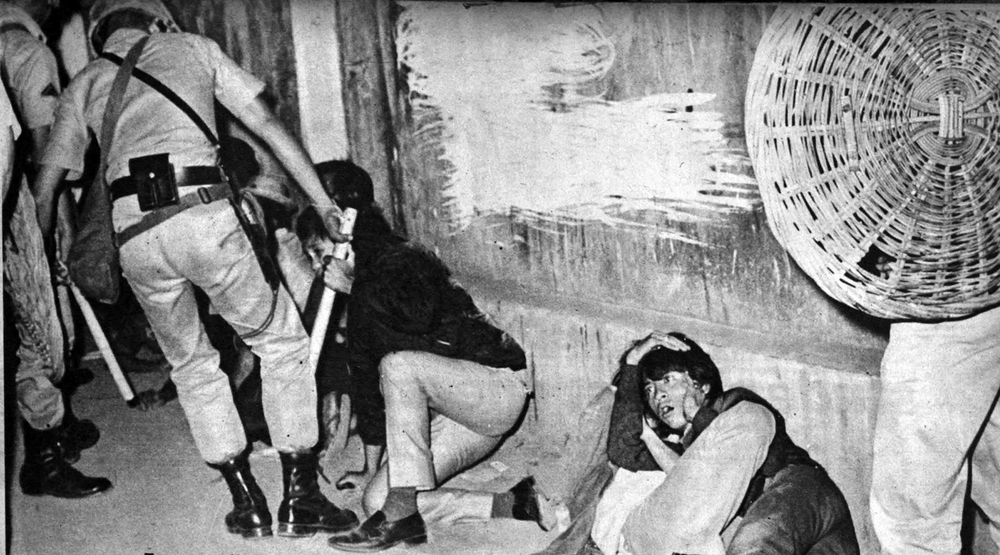
By the time it was over twenty long years later, the numbers had to be crunched, and the numbers do not lie. According to a report made by Amnesty International shortly after the EDSA Revolution happened, after the imposition of Martial Law, 70,000 people were arrested, 34,000 were tortured, and 3,240 were killed by the military and the police, all with the blessings of a despot who wanted to stay infinitely in absolute power.
What do they say about absolute power again?
So why do I do this social media barrage? Because more than forty years after 23 September 1972, that day of infamy, there is a different battle going on, and it is a battle for the Filipino soul. On one hand, there is memory—but one that is not meticulously kept, for certain reasons that underscore a Filipino frailty (which is a cultural forgetfulness). On the other hand, there are the claws of revisionism. And it is a revisionism that is being waged, soul by soul, in the murky landscape of the Internet. Every few days, we see posts of some young person questioning whether the darkness of those years was truly darkness. Perhaps you are mistaken, we are told by them. And I am perfectly all right with the act of questioning the writing of a history, which is—as we like to say—always written by the so-called victors. But what if what is being questioned belittles the blood that had been spilled in the name of your freedom? What if what is being questioned is a national nightmare that has been twisted by a grammar of lies that aim to render it more like a reverie? Do we question, for example, the horrors of the Holocaust in World War II? That idea is preposterous, but it has happened. There are Holocaust deniers existing in the world. They are the very shadows of evil.
According to the Philippine Center for Investigative Journalism, that revisionism for Martial Law began in 2011 with a YouTube video made by a certain “Baron Buchokoy” who purported to reveal the “hidden truths” about EDSA. The video became viral, and most of all, young people lapped it up.
Reacting to the popularity of this video in 2012, Mon Casiple, then executive director of the Institute for Political and Economic Reform, seemed prophetic in the assessment that he gave, where he underlined what could be causing this rash of revisionism: “We did an analysis of the textbooks in the Philippines. For the period covering martial law, there was a deafening silence by the textbooks on the human rights violations. They treated it like an ordinary period of any presidential term. Edsa was never given a special place.” In other words, generations of young people after 1986 have never been properly taught about the evils of Martial Law.
Casiple also said that Buchokoy’s video tapped into the yearning and frustrations of the youth for a better life, and that after hearing all the promises of EDSA from older generations, many young people might be feeling alienated: “They see that there are the same problems like corruption. What tie them together are aspirations, but there is a twist. They go by the results, not the process. If that trend is not reversed, in a few years, we will have a majority of voters who did not go through that period, and who therefore, will be susceptible to videos like this.”
Well, it took only three years. Now, too many young people—especially those of the generation born after EDSA—think that Marcos was a maligned hero. That rattles me.
Because he and his wife Imelda were never heroes, and their evil in fact took many gradations—depending entirely on who they could easily dispose of. The great writer Nick Joaquin, for example, absolutely detested Imelda Marcos and only accepted the National Artist for Literature award from her as an instrument to free the poet and journalist Pete Lacaba from jail. But after being thus honored as National Artist, Joaquin used his position to work for intellectual freedom. It is said that in one ceremony held at Mount Makiling, which was attended by the First Lady, Joaquin gave an invocation to the mountain’s mythical maiden, and used it to talk about the importance of freedom and the artist. Imelda was not pleased. After that incident, he was excluded by the Marcos regime from speaking in many important cultural events. Joaquin nonetheless was given better treatment because of his literary stature.
Other writers, less legendary than Joaquin, fared worse. There’s the poet Emmanuel Lacaba, Pete’s brother. Ed Maranan writes about him once: “Acclaimed while still alive as one of the best Filipino writers of his generation, Eman Lacaba and his guerrilla comrades were killed and disposed of [on 18 March 1976 in Davao del Norte] with the brutal dispatch and cruelty that became the trademark of the Marcos constabulary. Days after receiving information that Eman was with an NPA group that had been slain by government troops and hastily buried in an unmarked grave, relatives and friends were finally able to reach the Tagum municipal cemetery in Davao escorted by soldiers. Mendez Ventura recounts the discovery: ‘The cemetery caretaker led them to a paupers' grave where he remembered having seen four bodies dumped side by side, minus coffin or wrapping paper, about two weeks before. The grave was shallow, the better to dig out any corpse a relative might wish to claim. Marks of his friend's posthumous degradation drove Freddie (Salanga, another writer) to near-hysterical tears. Eman’s hands and ankles were tied with rope, and the flesh on his back had been macerated by the rocky terrain over which he had been dragged like a dead cow.’”
But that’s a rebel, you say. He was with the NPA, you say. Well, then, consider the case of 14-year-old Luis ‘Boyet’ Mijares, the son of Primitivo Mijares who worked for Marcos before he got the ire of Kokoy Romualdez, Imelda’s brother. Mr. Mijares exiled himself to the U.S. and wrote a scathing expose in a book titled The Conjugal Dictatorship. He later was made to disappear—one of our desaparechos. On May 1977, the body of his teenage son Boyet was found dumped outside Manila, his eyeballs protruding, his chest perforated with multiple stab wounds, his head bashed in, and his hands, feet and genitals mangled—Marcos’ punishment to the family.
But things were good under Martial Law, you say.
Let me put it this way. Marcos’ system of crony capitalism had the illusion of sheen, and it can be said indeed that between 1972 and 1976, the Philippines seemed to be prospering. Its exports were rising, and everybody seemed happy. (This is the “period of prosperity” our revisionists love talking about.) The corruption, however, was deeply entrenched, perfumed only by massive propaganda that declared a “smiling Martial Law” or a “benevolent dictatorship.” But by 1977, world affairs—in particular the start of hostilities in the Middle East—moved in such a way that soon revealed the maggots that were hiding beneath that illusion of prosperity. By 1980, the economy was collapsing, and we owed US$10 billion to the World Bank and IMF—a debt, plus interest, that we are still paying today because of Marcos’ bad government policies. It was the Filipino people who suffered from those policies, not the Marcoses who squirrelled away their kickbacks in secret bank accounts and ostentatious property purchases.
One can honestly say that almost everything that ails the Philippines today you can trace back to the Marcoses. The current culture of corruption? It became systemised under Marcos, with his vast network of cronies, where family and close friends benefitted from the spoils of a nation under paralysis. The current culture of dirty electioneering? It sprang from the never-before-seen massive frauds in the elections of 1972 and 1978. The current problems in Mindanao? It sprang from the Jabidah massacre, in Marcos' crazy bid to get Sabah from Malaysia. The longest-running communist insurgency in the world? Marcos’ shenanigans strengthened it. The current Aquino administration’s apathy towards the arts and culture? It seems to come from a genuine desire to counter Imelda’s twisted sense of “love and beauty.” The current marriage of showbiz and politics? Think of Imelda singing in all of his campaigns, and see that as the instance where see the cementing of the idea that you don’t win Philippine elections by platform or service; you win by entertainment.
Of course, all of the above will be denied by the fervent Marcosians in our midst. They are playing the literal Devil’s advocates—and they know how to twist things, the way Imelda has been twisting things all her life post-exile. “Not a single person was killed during Martial Law,” she candidly tells the camera in Ramona Diaz’s 2003 documentaryImelda. And you know she’s lying through her teeth—but she believes wholeheartedly her deception.
Let them be.
Let us remember, but let them be. One rule for sanity is to never argue with fools. When they sing their lies, don’t respond. Just whistle. But remember.
Never again.
~~~
Watch Batas Militar (below), still the most compelling documentary about Martial Law ever. If you are a Filipino and you love this country, you owe it to yourself to watch this at least once in your life. Those interview clips of Imelda's strange pronouncements juxtaposed immediately by images and sound that underscore her delusions and lies still make my blood boil.
And read up and wise up! There's a rich literature on the Martial Law and its aftermath. Don't let cultural amnesia take over for good.
I get why this happens. It has happened before. What most people don't get is that, unlike TV or radio or the Internet where breaking news can happen, newspapers are physical objects in need of systematic circulation that need specific deadlines to run -- and if you are a national newspaper, that's a lot of circulation to consider.
If a story is imminent, newspapers make a template of what could possibly happen, run with it, and hope for the best. (Major newspapers, for example, have an active obituary staff who write every important persons' obituaries, with constant updates, long before these people are dead. So that when death does come, the writers just fill in the blanks regarding the specifics -- and voila, instant publication only minutes after the announcement.) It is all done in the name of scoop and/or timeliness.
This is not a story of bad journalism. This is a story of how one medium of news may no longer be suitable for the times we are living in. Most of the time, editorial hunches for imminent news stories are correct -- but sometimes it does spell disaster, like the famous "Dewey Defeats Truman" headline of Chicago Tribune in 1948. Shouting "Stop the press!" happens only in movies. (But I do wish these newspapers have the prescience of that newspaper in the film Chicago. In that scene near the end, the newsboys await the verdict for Roxie Hart's murder charge, with two headlines ready for the selling: "Guilty!" says one version, "Innocent!" says another. They get the proper go-signal from the courthouse -- and one version of the newspaper vanishes instantly into the truck. But this happens only in movies.
To quote the great Alain de Botton in The News: A User's Manual: "... The stories we take in were decided not by supernatural decree after a conclave of angels but by a group of usually rather weary and pressured editors struggling to assemble a plausible list of items in harried meetings in corner offices over muffins and coffee. Their headlines don't constitute an ultimate account of reality so much as some first hunches as to what might matter by mortals prey to the same prejudices, errors and frailties as the rest of us, hunches plucked out of a pool of several billion potential events that daily befall our species."
Which makes me think: in the age of instant gratification, news do run better now in social media (where errors are necessarily less forgivable), especially if you need your news like you need your instant coffee. Newspapers may not be dead yet (and I hope they don't die off like the dinosaurs), but as a medium of news in the age of breaking news via Twitter, it is truly showing its creaky joints.
Watching Dan Gilroy's Nightcrawler (2014) reminded me -- in a very painful way -- why I never pursued journalism as a career, although it was my major in college. I graduated in 1999 with a mass communication degree with some Latin honours attached to it, and promptly got the job -- I knew it was going to be a temporary thing -- as editor-in-chief of a regional newspaper. Around the time, I was also fielding offers to work in a Makati bank (I still wonder how they got my resume), among others. This included an offer to become the regional news director for The Manila Times, which was going through a terrible reshuffling at that time -- which was perhaps they were willing to take on a greenhorn like me. The job meant I had to be based in Cebu City, and then pursue and direct hard stories in the name of news. For some reason, I just could not see myself doing it. I turned it down. Back in journalism school, I hated the grind of covering the police beat, and I hated having to run after politicians, criminals, and other newsmakers to get my sound byte in order to beat the 3 p.m. deadline. Watching this new film reminded me about that pursuit. But it was also something else quite entirely. Nightcrawler is a mindfucker of a movie, and by the end of it, I found myself delirious and uneasy over what it wanted to say.
What exactly is Nightcrawler? Is it a contemporary film noir, living off the muck of Los Angeles urban crime? Is it a diatribe against tabloid journalism and its blurring of morality in newsmaking? Is it a procedural over how to be ingenious and crafty enough to get the footage you want that's "fit" for the morning news and primed for ratings bonanza? Is it a study of sociopathic behaviour? Is it an illustration over how to build a business from the ground up, throwing in chutzpah and business school rhetoric as major ingredients for success? Is it the perfect embodiment of what Austin Kleon once said about how to make it as an artist: "Fake it till you make it"?
I guess this is all of that. Jake Gyllenhaal -- who is incredibly wiry and scarecrowy as the sociopathic Lou Bloom -- plays a "nightcrawler," which is industry lingo for those independent "news gatherers" that hover over police scanner dispatches to get to scenes of crime just in time to capture graphic footage of what's happening. These they serve up to directors of TV news, who pay them piecemeal -- and more if the footage happens to be bloodier, or more exclusive, than the rest. The interesting about Lou Bloom is that he stumbles into this career quite by accident. He starts out as some petty thief, and chances upon Bill Paxton's nightcrawler in an accident -- and gets fascinated by what he sees. He is intrepid and smart, he is business-savvy, he is hungry for relevance, and he learns fast. And soon he starts making a name for himself as the topnotch go-to guy in his field, with much thanks to Rene Russo's Nina, a news director of a lowly TV station who recognises in Lou a kindred spirit, and who shares a preponderancy for brushing aside moral dilemmas for the sake of a story. This is basically a rags-to-success story for Lou Bloom, but it's a film that has none of that Horatio Alger sentimentality. We are asked to sympathise with a conniving, cold-blooded creature who will sacrifice anything and anyone to be good at his job. What unsettles is that we actually find everything that Lou does to be logical and honest. He is good.
But is that ever enough?
I'm glad I quit the news job before it could ensnare me into this kind of dilemma. It's hyperbolic, of course, but with the news the way it is right now, I'm not sure the hyperbole in the film is even unreal anymore.


 7:56 AM |
Déjà Vu?
7:56 AM |
Déjà Vu?