Friday, March 31, 2006
 12:51 PM |
Writers and Maytime in Dumaguete
12:51 PM |
Writers and Maytime in Dumaguete
If you are planning to spend your summer in
Dumaguete, in time for May's
writers workshop...

... do email me at icasocot(at)gmail(dot)com, and I can send you information regarding places to stay. So far, from feedback, May promises to be a merry month. Ginny Mata, Dean Alfar, John Bengan, Jean Claire Dy, the La Salle writers, and many others, are coming...
Labels: dumaguete, dumaguete writers workshop, writers
[0] This is Where You Bite the Sandwich
Oh, God.
 Stanislaw Lem
, science fiction writer and philospher,
dies at 84. I am going to watch
Solaris tonight.
The Russian version by Andrei Tarkovsky, mind you, and
not the George Clooney one by Steven Soderbergh.
Labels: literature, writers
[0] This is Where You Bite the Sandwich
10:29 AM |
Cirilo F. Bautista
The venerable
Cirilo F. Bautista...

... has a
website.
[texted in by
shirley lua]
Labels: philippine literature, writers
[0] This is Where You Bite the Sandwich
12:19 AM |
Is the Pen Dry in Dumaguete? (Part 2)
Second of Three PartsWhat shocks most people about the proposition that Dumaguete seems to have "abandoned" its rarified position as a city of writers springs from a knowledge of history. The Palanca-winning author
Dean Francis Alfar --
whose novel Salamanca is being released by Ateneo Press this April 1 -- for instance sends me this message after the last post: "I, for one, am startled by this. I was always under the assumption that there was a vibrant writing culture in Dumaguete. I mean, how can there not? Mom [Edith] Tiempo is there, you are there, writers live there. It's very distressing...."
It's very distressing, indeed, if the case is in fact true. Dumaguete after all has significantly made its mark on our literary culture being the home of two National Artists -- Edith Tiempo for literature, and Eddie Romero for film. It was in this sleepy seaside town where one of the earliest literary ferments went on, starting with The Sillimanian, perhaps the oldest student paper in the country which later on produced one of the earliest literary journals,
Sands & Coral. In the 1950s, Sillimanian writers were publishing more frequently in national papers and magazines than any other campus-based writers in the country -- a feat, given the distance between Manila and Negros Oriental. In 1962, Dumaguete became home of
the oldest (and still running) creative writing workshop in Asia, patterned after the Iowa workshop which Edilberto and Edith Tiempo attended in the 1930s. A cursory look at the list of fellows who have trained or paneled in the workshop is a proverbial Who's Who of Philippine letters -- from Kerima Polotan to Lakambini Sitoy, from Krip Yuson to Angelo Suarez, from Nick Joaquin to Conrado de Quiros.
I've written
something about this in the
Philippine Daily Inquirer once, where I said -- with more than a hint of native pride:
Perhaps what makes the Dumaguete workshop different from others is history. Dumaguete is the "x" on the map of the Philippine literary imagination. In this place, the acacia trees run, the surf dances, the air is heavy with sepia memories, life is recalcitrant to change. It is a friendly place for the pen: To be a writer in the Philippines is to be, at heart, a Dumagueteno.
Philippine literature has lain claim to a mythic Dumaguete -- the same literary sense of geography that embraces Manuel Arguilla's Nagrebcan, Carlos Aureus' Naga, Anthony Tan's Muddas, Nick Joaquin's Old Manila, and NVM Gonzalez's Romblon. [Perhaps you can add to this list, F. Sionil Jose's Cabugawan.] But while each of these places is mythologized in one writer's dream of words, Dumaguete is borne on more than one pen, and has colonized more than one imagination.
Dumaguete is home to Edith Tiempo, and her late husband, 'Doc' Edilberto K. Tiempo. Many of us call her 'Mom,' and every summer, the Philippine literary world knocks on Mom Edith's doors to take part in the oldest creative writing workshop in Asia. The quiet appeal of Dumaguete has made its way into the magic pages of books, journals, and literary magazines, immortalized in countless stories, poems, and essays. The authors we read have been through here, walked on these streets, and wrote sonnets to the sunrise off the Boulevard.
Given that,
Rodrigo's
complaint may seem to be a shock to the system, a slap perhaps to our continued "reverie" of the good old glory days.
I complained of this once as well, but I remember an exact moment four years ago when I decided not to entertain such thoughts anymore.
That time, the last of my writing mentors -- the brilliant Ceres Pioquinto -- had packed her bags to leave for Germany, and I felt this stinging hollow inside, a residual memory of being a child and my mother had left me alone in the house while she went to find bread to sustain us. My writing teacher Timothy Montes had already transferred to Davao to teach in U.P. Mindanao, with Nino de Veyra and the rest of my literary
barkada in tow. There was no one to talk to -- I only had rare mornings with Mom Edith in her office or in Montemar, where we'd usually talk about the past when everything else seemed livelier, and more colorful. That increased my sense of being without anchor some more. Talk about being a writer and being alone in the city without a community of your own. I had began cajoling Bing Sitoy, Marjorie Evasco, Anthony Tan, and Jaime An Lim to return "home" to Dumaguete as soon as possible, even reminding Jimmy (before he took FEU by storm) that he still had his old house somewhere in
purok Bunao -- and they assured me somehow that one day they would.
"One day we will." That seemed to be the overriding theme in the lives of Dumaguete writers -- all of them somewhere else.
Finally, I told myself that a sense of the writing life adrift should not be the way to be. That while many of the Dumaguete writers I know may no longer be "home," I still had my summers of writers to look forward to. Every year in May, you see, Dumaguete virtually throbs with verse-makers and story-weavers from all over the country. May is Writers Month here, an orgy of letters and beer and laughter and escapades to Casaroro or Siquijor. And somehow that seemed enough.
Sometimes I credit my newfound nonchalance to the fact that I have always considered such argument -- that Dumaguete writing is a dry riverbed -- debatable at most. This has always been an old, old complaint. In the early days of the
Sands & Coral, back in the late 1940s and early 1950s, what was singularly the foremost complaint by its editors were their predictable lamentations that it was getting harder and harder to harvest literary efforts from the community for the annual issue. And this was during a time when Silliman had such formidable literature teachers as Dolores and Rodrigo Feria, David V. Quemada, Edith and Edilberto Tiempo, Albert Faurot, and Ricaredo Demetillo, and could boast of such campus writers as Aida Rivera-Ford, Cesar J. Amigo, Claro R. Ceniza, Reuben R. Canoy, Lugum Uka (one of the earliest Moslem writers in English), James M. Matheson, Leticia N. Dizon, Kenneth R. Woods, Maria Luisa E. Centena, Graciano H. Arinday Jr., Jose Montebon Sr., and Carminia Anonuevo Yaptenco.
Sands & Coral has always been the primary pulse for everything creative in Dumaguete, gathering together the works of writers (and artists) not just from Silliman University, but from other local schools as well. Foundation University has always been well-represented in
S&C through the masterful poetry of multi-Palanca awardee Artemio Tadena and wife Gemma Racoma, and St. Paul University (the first Paulinian institution in the country) has always had the fiction of Bobby Flores Villasis.
The dry spells in the long history of
S&C -- in the 1980s, for example -- seem to me to be paradoxical to the number of writers actively writing in campus of that time. In the 80s, Vim Nadera, Dinah Roma, Vicente Soria de Veyra and others were the stalwarts of the local writing scene -- but their efforts can be read only in one issue of the journal edited by Nino de Veyra, a rare issue from the desert of the 80s. That decade proved to be most turbulent for Dumaguete literature, which finally broke out to dismaying proportions in the much-lamented Tiempo-Deriada debacle that eventually saw the separation of the National Writers Workshop from Silliman.
Timothy Montes noted the end of things then. In his article "Silliman in the Eighties: Of That Time, Second Person," published in the Silliman Centennial edition of
S&C, he wrote of coming to the university as a freshman, and learning to navigate the divides of the literary establishment here:
Unfortunately, you have also arrived at the tail-end of Silliman's literary golden age. The famous Tiempo-Deriada war is raging.
When you enroll in English 12, you read with a certain pride the bulletin board of the English Department announcing that Leoncio Deriada and Rowena Torrevillas have won the top Palanca awards. That year the school is featured in Asiaweek because two of the Tiempo students won the short story contest sponsored by the magazine. Silliman is touted as a center of excellence in literary writing in Asia....
One morning, on your way to biology class, you meet Rowena Tiempo-Torrevillas on the second floor of Science Complex. You gaze at the goddess as she adjusts the strap of her high-heel shoes, straightens up without looking at the students walking past her, and walks on with that regal bearing, leaving a strong scent of perfume in her wake. (A few years later, when you first read Arguilla's "How My Brother Leon Brought Home A Wife," you will associate 'the fragrance of her was like a morning when papayas are in bloom' with Rowena walking by. The nose, indeed, has its own memory.)
Edilberto Tiempo, Vice President for Academic Affairs, sleeps during convocations. As an impressionable young man, you think his narcolepsy is a sign of genius.
Leo Deriada, with a string of Palancas to his name, is chairman of the English Department. During the second sem enrollment, you accompany a friend to the English Department to inquire about your English 11 grades. The famous writer himself is behind the window dispensing grades. "I'm sorry, you flunked," he casually says to your friend, who breaks down in tears. When your turn comes, you edge over to the window to get a better look at him: curly hair, furrows on the forehead. He calls out your name as he nonchalantly scans the grading sheets. Then, in exaggerated tones which sound almost sarcastic, he says "Congratulations! You got an A minus." (Later, after years of teaching, you will often catch yourself sounding that way, too. Academic exhaustion, you realize. Not literary sarcasm.)
Edith Tiempo is dean of the Graduate School. Everyday you see the famous red car waiting for her outside Katipunan Hall. One time your teacher in Philippine literature assigns you to write a critical interpretation of Nick Joaquin's The Woman Who Had Two Navels. You go to the grad school library to plagiarize a thesis on your assigned topic -- and Mrs. Tiempo, followed by her masteral students, enters the room and holds a class right there. You try to disappear into a corner, sinking into a chair while reading a critical analysis of Joaquin's women characters, half-listening to Mrs. Tiempo talk about the history of the English language. You wonder how such a gentle-spoken old woman could be so revered by so many people. (Later, when she becomes your teacher in poetry, you will understand the Tiempo magic.)
Those descriptions of the everyday in Silliman can make you shiver,
if you know your Philippine literature. But take note of Tim's use of the word "tail-end" to preface everything else.
In the mid-1990s, there was a revival of sorts in the writing scene. With Tim Montes, Andrea Soluta, and Cesar Ruiz Aquino in the helm of things literary, local writers emerged from the shadows and stunned Dumaguete with poems and short stories that were audacious and masterful. This group included Dinah Baseleres, Shelfa Alojamiento, Anne-Marie Jennifer Eligio, Gracchus Arinday, Douglas Crispino, Eva Rose Repollo, Sherro Lee Lagrimas, Noel Villalba, Victor Padilla, and Jean Claire Dy -- and perhaps even me, although I was never really part of any writing group, preferring a world all my own. I was weird that way, and never thought of myself as a creative writer then. I remember Shelfa approaching me in the
Weekly Sillimanian office in 1996, asking me if I could take over the editorship of
S&C. The invitation amused me to no end, and I refused -- although I did edit
S&C finally in 2002.
When we all graduated, there seemed to be no one left in Silliman (or Dumaguete) to carry on the literary torch. There was no one ambitious enough to carry on with the
S&C either, an enterprise that does require an abundance of ambition, and hours of free time (or loads of sheer madness). When I first became a teacher, I poured over the leaden composition of students, looking for that proverbial gem in the haystack -- often to disheartening realization. The collegiate
Weekly Sillimanian -- perhaps mismanaged by the top brass assigned to look over publications -- gradually became a high school rag, its issues given to concerns like "Love and the College Student." The make-up of the student population had changed by then because of increasing tuition -- and everything else seemed geared not to the pursuit of enlightenment or liberal education, but towards a brand of "practicality." Which meant:
nursing. There was a time when no one enrolled in any other course except Nursing. The English program once only had three students, and Chemistry none. Nursing, thousands. Art, the wise ones always say, is the first thing sacrificed when belt-tightening begins.
But is creative writing really dead in Dumaguete? Not in the very least. Everything goes through cycles, and all great institutions have undergone a merry-go-round of fortunes in their histories. Already, I see a resurgence in the quality of student writing, and mark my words, these names will ring bells in the future.
Michelle Eve de Guzman reminds me of the young Bing Sitoy.
Zara Dy writes creative non-fiction, usually about Spanish hacenderos, with astonishingly rich details, and humor.
Anna Casiding's feminist poetry scintillates.
Miggy Unabia, Anthony Odtohan, Robert Jed Malayang, Cindy Mae Almazan, Lorraine Evasco, and
Marianne Tapales show a fierce control in their prose that marks them as writing old souls. And there are others.
(To be continued...)Labels: dumaguete, philippine literature, silliman, writing
[0] This is Where You Bite the Sandwich
Tuesday, March 28, 2006
4:04 PM |
Is the Pen Dry in Dumaguete? (Part 1)
First of Three PartsNear the end of the second semester in Silliman University, one of my former students -- a brash and promising future mass communicator named
Rodrigo Bolivar -- wrote me an email which stirred the writer and teacher in me. What I felt, perhaps, after reading the email, was a sudden awareness of the need for a kind of cultural advocacy, or a realization that something must be done to awaken what has been virtually sleeping in Dumaguete for the past years --
which is our creative writing culture.
I am printing that letter in full, which goes:
Dear Sir Ian,
During my last trip in Bacolod for the Negros-wide Journalists Fellowship, I was amazed to see how much the students in the University of St. La Salle are into literary works. They publish an annual literary folio, and I [found] all the [published] short stories and poetry to be not mediocre [at all] but could be considered [seriously literary]. I was also amazed when they told me that one of their past times is to do poetry reading at local cafes and coffee shops.
So when one student from St. La Salle asked me how the creative writing "culture" was here in Dumaguete, I [couldn't] answer because I really didn't know what to say. Sir, let me ask you, how is the creative writing "culture" here in Dumaguete?
I remember asking somebody in Silliman how come not many in the faculty of the English department are getting themselves involved in literary competitions, in publishing books, etc. The person was not able to answer that. This afternoon, I asked Mr. Misael Ondong [note: an English teacher in Silliman] about the creative writing culture in Dumaguete, and he told me that it was in a "drought." Mr. Niccolo Vitug [note: a poet and former English teacher in Silliman] even told me before that the Creative Writing Program in Silliman wasn't as good as it had been before.
Is the creative writing 'Golden Age' already over in Silliman? Weren't you the one who once told me that Dumaguete is a rite of passage for Filipino writers, and that there's no significant writer in the Philippines today that has no connection [of some sort] with Dumaguete? What has happened to our Silliman students? How come it has been quite some time since a Sillimanian even qualified for the Dumaguete National Writers Workshop?
Mr. Ondong told me that it is because the best student writers in Silliman right now are enrolled in Nursing, and they are busy students -- and they know they will not be pursuing a writing career in the future. I remember that the Kapunungan ng mga Mass Communicators once held a poetry reading at Sted's Locker Room during the first semester, but it flopped.
Do you think the students right now are not anymore interested in writing, or even reading? Do you think it is because the best writers on school are now in the College of Nursing and that they are all busy [to bother with] poetry readings? Or has the creative writing culture here simply diminished or has deteriorated?
I think something should be done on this, Sir.
Yours,
Rodrigo
You don't get letters like that from students everyday. It moved me, and
alas it also awakened something in me. What I find most tragic in the aftermath of reading the letter is the fact that Rodrigo -- in many senses -- hits it right on the bull's eye. Dumaguete, once easily touted as the creative writing capital of the country, seems to have gone the way of a dry well.
I formulated a response to Rodrigo's email, after nights of agonizing over the right thing to say. What resulted is an essay that will surpass the acceptable length of this post. So this literary thread has to continue next week.
In the meantime, I would like to announce that the contest forms for the
2006 Don Carlos Palanca Memorial Awards for Literature are now available. You can avail of these forms by emailing me at sands_coral(at)hotmail(dot)com.
Applications for fellowships to the 45th edition of the
National Writers Workshop in Dumaguete City are also now being accepted until March 31. National Artist for Literature Edith Lopez Tiempo, workshop director, has announced that the summer sessions are to be held from May 8 to 27.
Application letters should be addressed to Dr. Tiempo, 2nd Floor, CAP Building, Rizal Boulevard, Dumaguete City, together with a resume, two 2x2-inch photos of the applicant, and manuscripts in English in any of the following genres, with respective quantity: 3-5 short stories, 7-10 poems, 3-5 creative non-fiction essays, or 2 one-act plays.
The manuscripts can be sent as hardcopy, but should also be accompanied by a disk copy, preferably in MS Word, plus a certification that the works are original, and a recommendation letter from a professor of literature or creative writing or a writer of distinction.
Fellowships cover board and lodging and a modest stipend for the duration of the workshop, as well as partial reimbursement of travel fare. Writers who have already received fellowships in other national workshops for this year are enjoined to apply at another time.
(To be continued)Labels: dumaguete, philippine literature, silliman, writing
[0] This is Where You Bite the Sandwich
Monday, March 27, 2006
12:08 PM |
Gigi Goes Gaga
Read the adventures of the adrenalin-impaired!Labels: blogging, writers
[0] This is Where You Bite the Sandwich
Sunday, March 26, 2006
8:27 AM |
Lumbera, Bautista, Barrios, and Yuson's Scathing Column
I
should have something to say about the current "controversy" gripping the Philippine literary community in the light of deliberations for the next Philippine National Artist for Literature -- but I blissfully don't. Not because I do not have any opinion about this, but because I just find the whole thing a little too silly. Like a comic game of
sabong. But for those not in the know, the whole bonfire of things started when Krip Yuson wrote the following "attack" in his
Kriptokin column last Monday in the
Philippine Star. (And because
Star's online archive is the very equivalent of hell, I'm going to shamelessly copy-paste everything. But do take note that I've been trying to convince Sir Krip to start blogging, and do his own archiving. So far, he's not taking the bait though.)
Nationalist Artist Awards, Anyone?
Three years ago, a day after initial deliberations were conducted for the National Artist awards eventually given out in June of 2003, UP's university professor emeritus, the distinguished poet-critic-mentor Dr. Gemino H. Abad, wrote a letter to the NCCA's then executive director Mafin Yonzon and CCP president Nes Jardin.
Dr. Abad offered his observations on the conduct of the deliberation, lamenting that not much time was given the Committee on Peers, headed by him, to review the comparative merits of the nominees for Literature.
The letter was dated March 6, 2003, a day after the first-level deliberations:
"It was only on March 4 that I knew who the nominees were -- Virgilio Almario, Cirilo F. Bautista, Jose Asia Bragado, Juan Hidalgo, Magdalena Gonzaga Jalandoni, and Alejandro Roces; and on the day itself, during the course of our deliberations, another 'sector' (the Multi-disciplinary) was authorized to pass to our Literature 'sector' two other names, Bienvenido Lumbera and Bienvenido M. Noriega, Jr.
"The actual deliberations started about 10 a.m., so that we were to consider eight nominees within about two to two-and-a-half hours. Our anguish then was for lack of time, for so serious an Award, for so great an honor, as the title of National Artist on the sole ground of a nominee's inimitable achievement in art as a rich and distinctive contribution to our national cultural heritage. Ironically, for lesser honors (though without doubt they are also very significant) -- the Magsaysay Award, the Palanca, even the Free Press -- so much more time for the judges is expended."
He suggested giving the NCCA's research group better lead time to accomplish their task, especially with regards regional writers, and perhaps allowing the Council of Peers at least three months to conduct their review and deliberation.
Of course, Dr. Abad commented, he was all too aware of the so-called "budgetary constraints" -- which to this writer must constitute the most tricky element in the choice of National Artists every two or three years.
Particularly telling, too, as part of Dr. Abad's post-mortem -- and which I will hark back to in my own observations about the way this delicate matter is handled -- is the following:
"...The documents provided us on each nominee are very helpful indeed, but they are not sufficient for the very day itself: we need to have thought out the matter long enough, consulting with other scholars, reading or re-reading the works of the nominees, reconsidering views and opinions, etc., way before the meeting where a decision has to be made.
"Speaking only for myself -- if I had known beforehand, and were given sufficient time -- I believe I could have made a much stronger case for Cirilo F. Bautista than the write-up prepared for him in our collection of documents. I must have been chosen, I suppose, as an 'expert' on Filipino poetry in English.
"I believe of course that Virgilio Almario deserves the highest honor of National Artist; but I also feel that, in his own place in our literature in English -- which is not comparable with the course of our literature in Tagalog -- Cirilo Bautista cannot be justly displaced."
Now here's my rhetoric and my beef, born of credible rumors to the effect that several weeks ago a differently composed Council of Peers had met to deliberate over the new set of nominees, and chosen a couple of names for Literature that would then advance to the second level of deliberations (which in turn had a regrettable end result). Well, to begin with, as for that new set of nominees, it seemed more like "same-same."
As reported by the usual birdies, the front-runners were Cirilo Bautista and Bienvenido Lumbera. National Artist for Literature Edith L. Tiempo, who joined that council deliberation, made a strong case for Bautista. It was also pointed out by some members of that seven-to-eight-man group that Bautista was the compleat creative writer. Epic poetry, short fiction in English, a novel and a book of poems in Filipino, and continuing works of criticism and journalism -- these are Cirilo's domain. For his part, Lumbera's more significant work was in the field of literary scholarship and criticism.
The Council of Peers agreed to select these two names from the nominees' list to advance to the second round, the deliberations in which would be conducted by committee officers of the NCCA. Bautista would be representative of the Literature nominees for creative writing, while Lumbera would advance on the strength of his literary criticism.
Now guess who was knocked off in that second round of deliberations, and whose name as finalist will now be presented -- and "lawyered" for -- in the third and final round of deliberations conducted by the CCP board members as well as a few NCCA reps?
Cirilo Bautista is a long-time friend of mine, and Jimmy Abad's. It is however NOT this terribly Pinoy factor that causes us much anguish over the choice of Bien Lumbera as the Literature finalist. I have much respect for Bien, and with little doubt he qualifies as a prospective National Artist for Literature. Candidly, however, I must say that I find his criticism unfairly biased for Filipino and regional writers; he has practically dismissed the works of writers in English. I suppose that's because he likes to be seen as, or is in effect seen as, a "nationalist."
By the by, not a few writers in English in UP and beyond have asked jocosely of one another, over bottles of beer: "Name me one particularly memorable work of literature Lumbera has penned." These same beer house rhetoricians also predict that it is the "extreme Left" that will be overjoyed by their champion’s ascension as National Artist. The communist candidate, it has been said rather bitchily.
Now I do not wish this to be construed as an attack on Bien Lumbera. Even as I could only smile over his backers' well-organized efforts at lobbying endorsement in the months leading up to NA deliberations, inclusive of testimonials from California Fil-Am groups and comprehensive Internet postings, I believe Bien has indeed done significant work for Filipino literature. Er, make that Philippine literature.
The least I could have bargained for, if someone cared to listen during those two rounds of deliberations, was that both Bautista and Lumbera were advanced as finalists for the ultimate reckoning. And, why, both could also be declared National Artists in Literature on the same year.
But I suppose that's where "budgetary constraints" come into the picture -- that same variable that would have a committee deciding on the inclusion of departed nominees because the cash involved in the case of posthumous awardees is significantly less.
If it were to be an absolute one-person choice however between Bautista and Lumbera, I say give the creative writer the better due, as the scholar, researcher and critic is necessarily a second-tier citizen in the republic of arts and letters.
It may be too late, however, to repair the damage done the literary persona of the eminent creative writer Cirilo Bautista, one charge against whom, I hear from my usual intelligence sources, during the NCCA second-level review was that his "reclusivity was a mark of selfishness."
My eye! My word!
It does not matter that Bautista prefers to cocoon himself in his room at home to work on his outstanding poetry and prose, rather than waste his time socializing at book launchings, or that he only occasionally indulges in a little beer with close writer-friends. He has been selfless in mentoring generations of students at De La Salle and UST and at writers’ workshops. His literary editorship of and column in Philippine Panorama magazine has for long years contributed to the molding of young poets and writers. He is the compleat writer, not merely (sorry, everyone) an epiphyte of a critic.
But that's how the ball bounces, especially when humans can only be human, subject to possible manipulation. I suppose that since my stalwart friend Virgilio Almario was anointed National Artist for Literature in 2003 (on the strength of his poetry in Filipino AND criticism, and conceivably not because scholar-critic Resil Mojares plugged for his scholarship on Filipino literature), a trend has been established, with Bien Lumbera's succession, that may keep our creative writers in English at bay where the National Artist for Literature is concerned.
I am sure that "Mom" Edith Tiempo, herself a notable critic, but whose poetry and fiction will be more of her inspiring legacy, will be saddened by this turn of events. And I can't help but imagine how Franz Arcellana, NVM Gonzalez and Nick Joaquin -- our previous National Artists in Literature, all of them supremely creative writers in English -- may be pshaw-pshawing in their graves.
Maybe we can start calling it the Nationalist Artist awards. That should be just as good a novel term as what's been bandied about as the "DNA" or Dagdag National Artist. I hear this year Soc Rodrigo might posthumously lay claim to that sorry title. Alas and alack. A pity, for Soc was a poet.
The Wordsmith's Window happily notes that this has irritated several (mostly UP-based) creative writers in Filipino. One of them is the always radiant poetess Joi Barrios, who then wrote a letter to the
Star editor:
So What's Wrong With Being a Nationalist Artist?
Like all texts, there are many ways to read Alfred Yuson's column Kripotkin published in the Philippine Star on 20 March 2006. Among them are:
1. He was merely sour-graping. He wanted Cirilo Bautista to get the National Artist award and Bautista got eliminated in the second round. I agree with Yuson. Bautista does deserve the award (I even think Gemino Abad deserves it as well!). However, to attack Lumbera because his candidate didn't win is to be pikon. As we say, pikon talo! Yuson did Bautista a disservice.
2. Mr. Yuson fears that after Almario and Lumbera, "a trend has been established...that may keep our creative writers in English at bay where the National Artist for Literature is concerned." I would like to remind Mr. Yuson that of the ten National Artists in Literature, only two (Amado V. Hernandez and Virgilio Almario) are writers in Filipino and only one is bilingual (Rolando Tinio). If anyone should be afraid of being marginalized, it should be the writers who write in the regional languages, not the writers in English.
3. Mr. Yuson is horrified that the National Artist Award could possibly go to a nationalist. I regret that at his age, Yuson still does not understand the meaning of the word "nationalism" nor the great tradition of nationalist writing espoused by both National Hero Jose Rizal and National Artist Amado V. Hernandez. One could even argue that the writings of Gonzalez, Joaquin, Tinio, and Almario are nationalist writings, because yes, even writers in English -- surprise! surprise! -- can be nationalists. If I were a mind-reader like Mr. Yuson, I could perhaps say that the writers he mentioned -- Edith Tiempo, Franz Arcellana, Gonzalez, and Joaquin -- are turning in their graves not because they are "saddened by the turn of events" but because they will be the first to deny that their patriotism can be doubted. After all, they did spend their lives " "promoting national cultural identity and the dignity of the Filipino people through the content and form of their works" -- one of the criteria for being named a national artist.
[Note: Edith Tiempo is not dead.]
4. Mr. Yuson's column should be read in the context of the political repression in the country. Five Representatives of Congress (Satur Ocampo, Liza Masa, Joel Virador, Teddy Casino and Paeng Mariano) are holed up at the Batasang Pambansa because they have arrest warrants; Representative Crispin Beltran, 73 years old, is in prison. Randy David, Risa Hontiveros, and Dinky Soliman have all been arrested for supposedly leading rallies. This past year, more than a hundred people have been summarily executed. Indeed, to be perceived to be "leftist," is dangerous in the Philippines.
Mr. Yuson has irresponsibly called Dr. Lumbera a "communist," making him an open target for the likes of Maj. Gen. Jovito Palparan, who was decorated yesterday for his "anti-left executions." I am therefore holding Mr. Yuson responsible for whatever may happen to Dr. Lumbera.
In one of the other dailies, the headlines read: "Attacks on leftists mount." Perhaps the column was not really about Bautista. Perhaps it was not really about the "marginalized" writers in English. Perhaps Mr. Yuson was simply revealing who his patrons are.
I have yet to meet Sir Cirilo in person, but I have had great conversation with Sir Bien. I even "sparred" with him in Iligan over this piece of shitty poetry from a Davao fellow, which I proceeded to trash with gusto (yes, Iligan 2002 -- with such co-fellows as Gabby Lee, J. Dennis Teodosio, U Eliserio, Pearlsha Abubakar, and Glenn Mas -- was known as
the workshop year when the fellows talked and critiqued more than the panelists...and even successfully lobbied to change the workshop schedule for all of us to be able to watch Miss Universe,
hahaha), and Sir Bien proceeded to praise for its "revolutionary" symbolism. Since then, we've had great talk, in Silliman, in Manila, anywhere we happen to bump into each other.
Who deserves the National Artist title more? Should we even fight over this?
Wendell Capili also has posted reactions from Chari Lucero and some clarifications about the selection process from Piping Dilat.
[texts via
decongestant]
UPDATE:Paolo Manalo provides great coverage (
here and
here) of the brewing issue. I've since texted Sir Bien. He tells me not to fret, but that he is encouraged by the response of many supporters and defenders.
Labels: issues, philippine literature, writers
[0] This is Where You Bite the Sandwich
The best blogging discovery today. An excerpt from "a tribute to fashion, style, and good taste":
Of course it's absolutely impossible to make lait to Melanie Marquez except in retrospect, when the tides of fashion had already taken a turn towards the next more tasteful level, and previous photos of her wearing fashion from the eighties are now nothing but a bad reminder of how stupid humanity had been to think that shoulder pads were actually cool and the long bulbous blouse with a very wide elastic garter that pretends to be some sort of skirt was actually sexy.
That said, we would like to reiterate that we simply loooove Melanie because she is so classically beautiful and ageless and adorable and her brother is not a book and therefore should not be judged.
Here's
more from the warped and witty mind of Laitera.
Labels: blogging, celebrity
[0] This is Where You Bite the Sandwich
Saturday, March 25, 2006
9:58 AM |
Who Was It Said Who Said Nothing Good Ever Happens in March?
Three words:
final exam week.(And all the teachers out there smile and shake their heads in a shared sense of despair...)And that briefly explains why I have not been around this space for quite some time. That, and matters of love, too. But I'll be back before you know it.
Ciao for now.
Labels: life, teaching
[0] This is Where You Bite the Sandwich
Friday, March 24, 2006
12:27 PM |
Two of My Favoritest People in the World
This is Mark, and this is Angel. And they're in the Boulevard.
 Lovely...
Labels: friends, love
[0] This is Where You Bite the Sandwich
Thursday, March 23, 2006
11:41 PM |
Something Wonderfully Cheesy
For M.When you're in love,
you're in love. No one chooses to be in love, one just learns to succumb to it, to grow into it like beautiful second skin. It hits you right between the eyes like great poetry, and shields you from all else. Soon you learn to take it as the very air you breathe -- and without it, you are nothing but a shadow of your old and silly make-believe that you are all right alone. No one's all right alone. We live to return home to the comfort of someone else's embraces.
Labels: love
[0] This is Where You Bite the Sandwich
Monday, March 20, 2006
6:21 PM |
Writers Tale #1
In the five years I've been seriously writing fiction, plus essays and some secret poetry on the side, I've met (and "experienced") many Filipino writers who have somehow shaped the trajectory of how I write. Some I can't meet in person anymore:
Nick Joaquin was one, and in college, when I first stumbled upon "May Day Eve," he gave me my first writing insight: that sometimes style
is substance. (Charlson Ong would soon say the same thing about my first story collection,
Old Movies and Other Stories.) What do you have in "May Day Eve" after all but the simple but bitter love story between Agueda and Badoy Montiya, made fantastic by the author's tropical baroque style? The way Nick Joaquin bent time and continuance in that story astounded me. I was hooked on fiction for life.
This got me thinking last night, that maybe I'd like to do some small tribute to all those writers who somehow got me going. And I'd like to begin with
Lakambini Sitoy.
 In Montemar with Mom Edith Tiempo and Bing Sitoy
Everyone else calls her Bing. There's always something wondrously animated
and mysterious about Bing: we've been out on many dinners in Dumaguete, and I still can't put my finger on it. My earliest memories of her are hazy -- notable only for one single defining characteristic: everytime I bring out a mental picture of her from my memories, she always wears a headband. Sometimes it is grey, most times it is red.
I have two theories to explain this. When I was growing up in Dumaguete, she was already the consummate campus Renaissance woman, daughter of the well-respected University pastor who was also a very good writer. Bing seemed to be into
everything. Her stories were already being published everywhere. And she was president of the student government. This was during the heady, radical days of the 1980s. I remember walking home from school one day, and she was out in the street with a bunch of other students. They were all bearing placards, and Bing was on the bullhorn, coaxing students to join them in some kind of protest. I think she was wearing that headband that day.
But she could have been wearing that headband, too, on a photo of hers that got published in one of the issues of
The Sillimanian Magazine.
It was through that magazine that I became most familiar with her fiction. What people closest to me do not know is that Bing was the
one writer who somehow got me going, and for a long time, she didn't even know it. I read her story "The Australian" in
The Sillimanian Magazine once when I was a freshman in high school. It was the story of a hunky Australian who comes to small-town Philippines to check on, and hopefully collect, his mail-order bride. What ensues is comic Pinoy social hijinks -- but even then, I
knew the story had an underlying and very serious feminist critique. I was a young boy newly-graduated from grade school, still testing the unfamiliar waters of high school life. I proceeded to emulate (
sige na nga, made an "homage") everything in Bing's story. I wrote a piece of embarrassing juvenalia I titled "Leaves." It wasn't Bing Sitoy at all, but that got my freshman English teacher's attention, and I was soon drafted to join
The Junior Sillimanian, the student organ. That piece of fiction -- together with an even earlier piece I titled "Philodendron" -- started what "career" I may have in writing.
Years later, it was also Bing who managed to shake me out of a particularly iron-clad writer's block, which descended on me soon after the Dumaguete workshop in 2000. I couldn't write for almost a year; everything I learned from the workshop were like pieces of an intricate puzzle that was only slowly coming together.
Finally, I met Bing personally for the first time during a party in Silliman, in 2001. Over buffet and
lechon in old Silliman Hall, I told her about my block, and Bing just stared at me and simply said:
"Just stop thinking about it, and start writing."I did.
And the story I eventually wrote won the Palanca. Who knew?
Bing as a literary fairy godmother? Perhaps. Because I had another block a year ago, and she came by to visit Dumaguete again. You can guess what happened... Sometimes I wish Bing was just around the corner, here in Dumaguete, and then we could go out for coffee or what-not, any time we wanted, and gossip about everybody else. (We gossiped about you,
Dean.
Hehehe.) She published some of my stories in
The Sunday Times, when the weekend magazine
was still accepting fiction. When she won the David TK Wong Fellowship, we corresponded through email. She came visit Dumaguete now and then after that, and before she left for Denmark early this year, we had a nice dinner in Persian Palate. She told me she was still uncertain about going to Copenhagen. That she might stay in Dumaguete for a while, and write. I told her I was trying to write a novel about the Sierra serial murders of old, and she gasped --
because she was trying to do the same thing. We both agreed that this
is the one Dumaguete story that grips all of us in silence, because it is so strange and fascinating at the same time.
A Filipino serial killer? From the Spanish upper class? In quiet Dumaguete? We shared notes over lassi, carefully analyzing what was true and what had become urban legend. Her graciousness showed when she told me she was bequeathing the project to me; I was in Dumaguete, after all, and I had the
feel of the place. Bing is like the
ate I never had, I guess. But an unconventional one. And I'm really glad I got to know her.
Bing's first story collection, Mens Rea and Other Stories, was published by Anvil in 1998. Her newest collection, Jungle Planet and Other Stories, was published by the UP Press early this year.Labels: philippine literature, writers
[0] This is Where You Bite the Sandwich
12:18 AM |
Fiction By Candlelight
The second issue of
Story Philippines is finally on newsstands. (And the website itself has many interesting features, including new stories by
Sarge Lacuesta and
Emily Abrera.)

This new issue both excites me and horrifies me because ... well,
because it includes "The Painted Lady," and I cannot help but cringe over this. (It's soooo old, it smacks of my very brief -- thank God -- Henry James phase.
Just look at the title.) I had told editor-in-chief Vanni de Sequera that this was intended to be an anti-love story, for an issue supposedly devoted to love stories. Didn't think he would bite -- but
alas. Still, it's nice to have this story finally see print. Written in 1998 when I was lovelorn and heartbroken (I always seem to be,
eh?) in Tokyo, of all places, it's been languishing in the dark recesses of my hard drive ever since. Why didn't I submit it anywhere? I didn't feel it was ready -- besides, there was a time when I felt it was too autobiographical for comfort. It still is,
in a way. Here's an excerpt:
The Painted Lady
She was one to talk, that giving in to breathing the tequila air was to take in, like a lover, the nervelessness of affection without hope or resurrection. Lost love can be found in bottom of the bottle, she said once, with that smile bordering on sadness; or madness. I remembered this because her face was a haze when she spoke to me last, but that was Veronica. She was always a puzzle. Also this: that everything else began to shrink around me, everything consciously there, and yet not there, everything throbbing and mocking.
(More here.)
By the way, did I tell you this was supposed to be
pseudo-vampire story? No?
What was I thinking? Given that I share pages with these writing luminaries? You have
Dean Francis Alfar with "The Maiden and the Crocodile."
Mads Bajarias (also
here) with "The Sound Wranglers." Vicente Garcia Groyon with "The Haunting of Martina Luzuriaga."
Marie La Vina with "Welcome to Limbo." Rachelle F. Medina with "Girl on a Couch." Jo Pilar with "Quizas."
Anna Felicia Sanchez with "How to Pacify a Distraught Infant." Michelle Sarile with "Hangers." Rachelle Tesoro with "Hibernation." And
Marianne Villanueva with "Don Alfredo & Jose Rizal." I wanna go hide under a rock.
But Dean and Vince -- whose Palanca-winning novels I love with a passion -- are perfect companions to be with in an issue of
Story. And two of my favoritest girls -- Anna and Marie -- are with us as well.
Yay. With the legendary Marianne Villanueva
pa.
Go buy a copy now.
(Dean, thanks for the copies!)Labels: fiction, philippine literature, writing
[0] This is Where You Bite the Sandwich
Sunday, March 19, 2006
It's Sunday,
6:06 in the morning. I can't sleep. Outside, the false dawn gives out this blue light and morning is quiet. I would have embraced days like this, but my body reels from sleeplessness. Even when I went dancing last night and my body aches from absorbing too much movement, and even when I downed three bottles of beer which -- especially if you are not a drinker -- is enough to turn my head around three times. I can't sleep, and there is this:
my heart floats in a hollow, for the nth time I should suppose. It knows only that, and sad songs. Imagine what's inside me: or better yet, imagine what is
not inside: a filling wholeness, or a rapture I once have known. How do we lose things? How do you keep the heart from betraying what is truer than what you
want to believe? How do you measure hope and unlearn expectations, and how does one journey from stasis, to moving on? How do you relearn how to love, and how do you stop saying sorry for your mistakes? How do you keep your hands from hurting yourself? How do you begin a Sunday with this taste of loss? How do you say this is the first day of all days, and believe what is easily the impossible? How do you choose to be happy? How do you turn all grief to glitter, and where do you begin to map the extent of pain so you will know where it borders sanity and redeem yourself?
Tell me how.
I can't sleep.9:24 a.m.I brewed a cup of coffee, and I am watching the day pass by slowly. I don't know what to do except to stare at the play of light on my closed glass jalousie windows. I feel like vomiting, but there's nothing inside -- so even that proves hollow. I decide to work. On a Sunday. Work will save me. Work, and gym.
Please God, let me learn how to breathe.9:49 a.m.3 A.M.By Rodrigo V. Dela Pena Jr.As the clock ticks to 3 a.m., the sounds
of the city begin to fade: the honking cars
and jeeps and buses thin out along EDSA,
the cats in heat on the roofs stop screwing,
and in smoke-choked videoke bars,
the mike conks out, images of bikini-
clad ladies blurring into snow.
An ambulance siren dwindles in de-
crescendo until it fades into a mere
whimper, and one by one, the cellphones
cradled in sweaty palms mysteriously
flicker and die after beeping a last gasp.
Exactly at 3 a.m., like musicians stilled
by a conductor in an orchestra, like
a choir suddenly voiceless and holding
its breath, everyone is drowned by the purest
silence. And so the drunks in the neighborhood
are stunned, sobered up by the clarity
that silence brings, and couples nesting
on cramped beds make love quietly
yet intensely, each city-dweller awe-struck
by the immense, engulfing silence. In this
nightly miracle, does anyone imagine
how astounding a moment of no-sound can be?
Even the infants wake up from their dreams,
marveling at the stillness, and for once,
everyone can listen to his own heartbeat.
10:22 a.m.It's a wonder how we can fool ourselves into a semblance of living. The morning's not even over yet, and I have gone from sentimental fool to actor playing a part. I inhale the seething disbalance of Marlon Brando, the suave nonchalance of Cary Grant, the aw-shucks attitude of Tom Hanks, and finally the unperturbed resignation of Bill Murray.
I can win an Oscar for this. The cup of coffee is gone, and then I turn to the morning papers online to read how the rest of the world has come to pieces, then I see a segment about lava in Hawaii in Discovery Channel, then I write a poem about lava, then I read of Monica's unraveling in Sarge Lacuesta's
White Elephants: Stories. This is the paradox I subscribe to: small tasks can banish great pains. But only until the next moment when you suddenly find yourself thinking, and thinking, and then sinking deep into remembered despairs. To punish the dull ache, I make lists: there's laundry to deposit and get at the nearby laundromat, there's the paper to edit for my college dean, there are students' grades to calculate, there is the whole Sunday to spend forgetting. We move on, I guess, only little by little. Margie Udarbe, my wise one, once texted me this: "There will be sad days, and there will be better days. Somewhere along the way, the better days will outnumber the sad days. And then you just learn to stop counting."
11:00 a.m.I don't know what to do next.
I need to get out of here.4:54 p.m.When will this f*****g day end?
Labels: life, love, poetry
[0] This is Where You Bite the Sandwich
Saturday, March 18, 2006
Ask me a question about one of or each of the following...
1. Friends
2. Sex
3. Movies
4. Drugs
5. Love
6. Other (open-ended)
... no matter how rude, sexual, or confidential ...
just ask it. Then post this in your journal and see what questions you get asked.
(
But if you want to know the scandalous answers, you really should get a
livejournal account first. And attempt to be friends with me. And be able to get inside my locked entry.
Ehe.)
[meme (slightly changed) swiped from
moki]
Labels: life, memes
[0] This is Where You Bite the Sandwich
Thursday, March 16, 2006
"One of the perils of sincerity is derision."
--Manohla Dargis, in her review of the wonderful Bee Season, which everybody should rent and buy nowLabels: quotes
[0] This is Where You Bite the Sandwich
8:12 PM |
The Be(a)st of Prendster
Why
Friendster will be the end of us all...
(Quick! Call Darwin!) I know, I know...
 That was mean.
Pero, keber. I hate this day. It's too hot for comfort, the sun's frying my brains, I'm always thirsty and I broke the last glass I had in the pad, and despite losing all of ten pounds I still feel fat, and I'm all stressed out as the finals week comes even closer, and with that the dreaded prospect of having to check papers, and the one recourse I had for relaxation -- a session of Nuat Thai massage -- was so badly done (my
suki masahista had the day off to get married,
pakshet), I feel icky.
[
agent provocateur compiles some of the
worst from the original posts by
id configuration]
Labels: humor
[0] This is Where You Bite the Sandwich
1:05 PM |
Something to Start My Day
I just received this email from a student. It's one of those emails that give you just enough hope to persevere in the teaching profession, despite what we think as a general decline in the quality of college students.
Hi Sir Ian, how are you? I hope you're okay ... I just want to thank you, Sir, I really appreciated everything. =) I never regretted being in your class... Friends told me it's really hard to pass in your class, but I didn't listen to them. Actually, it was a challenge for me. To be honest, I really enjoyed your class this semester. I learned a lot from you. Thank you again, Sir Ian. I won't forget you... Take care and God bless.
And I didn't even give the guy a spectacular grade, just something that made him pass.
Labels: teaching
[0] This is Where You Bite the Sandwich
Wednesday, March 15, 2006
9:24 AM |
Rosario and Jomike
Anybody who can create something delightful like this ...
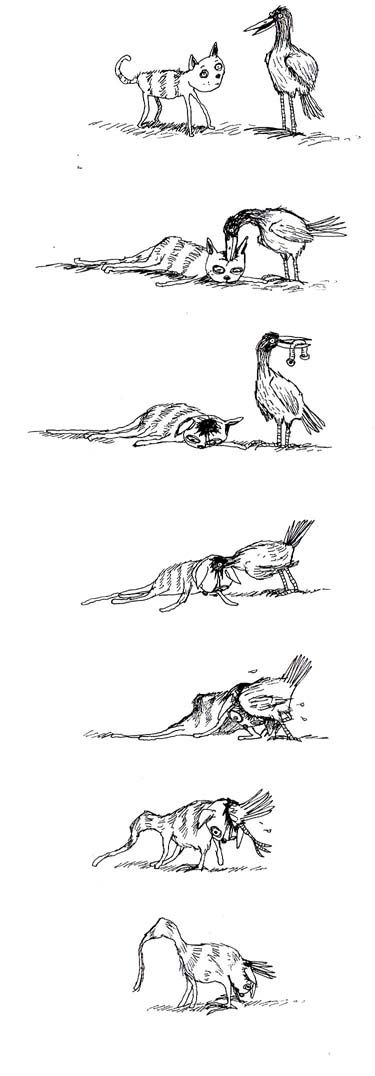
... must be a genius.
Congratulations to
Jomike Tejido (see his
Mikrokosmos) for winning Honorable Mention in the
PBBY-Alcala Prize for illustrating "Rosario and the Stories."
Nakakatuwa.I was reading the story again last night, just to remind myself of what I did to come up with something like that ... and I really want to do something like "Rosario" again.
Pero, it's hard. Children's storywriting is very hard. But let's see.
[thanks to
the coffee goddess for the news]
Labels: philippine literature, writing
[0] This is Where You Bite the Sandwich
8:02 AM |
Pekeng Prendster
God, I miss her wild hair on TV... Mich Dulce
,
lovable ex-housemate, on being an instant celebrity: "[I] am proud to say [I] now know that [I] have officially reached celebrity status. [H]ow do I know this? [B]ecause there are now two fake [F]riendster accounts of me. You must be a celebrity if someone actually takes time out to be your impostor! ... In fairness, mail order bride
pa rin ang occupation
ko sa isa. LOL.
Alavetttttttt!!!"
Labels: celebrity, television
[0] This is Where You Bite the Sandwich
GO TO OLDER POSTS
GO TO NEWER POSTS


 In Montemar with Mom Edith Tiempo and Bing Sitoy