Tuesday, October 31, 2006
 11:38 AM |
Dumaguete in the Eye of the Beholder
11:38 AM |
Dumaguete in the Eye of the Beholder
Here's
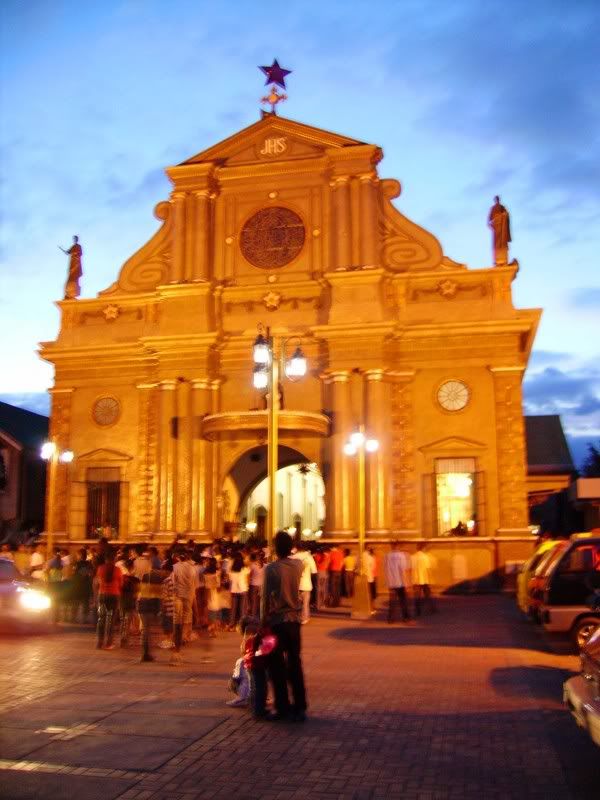
an interesting blog about Dumaguete, from American eyes. It's always good to look at the familiar from a totally different perspective. I have an American friend named John Stevenson, a photographer who has made Dumaguete his home (no, the blog above is not his). I always found it fascinating to note that everytime I take pictures of Dumaguete, they come out touristy. Like this.
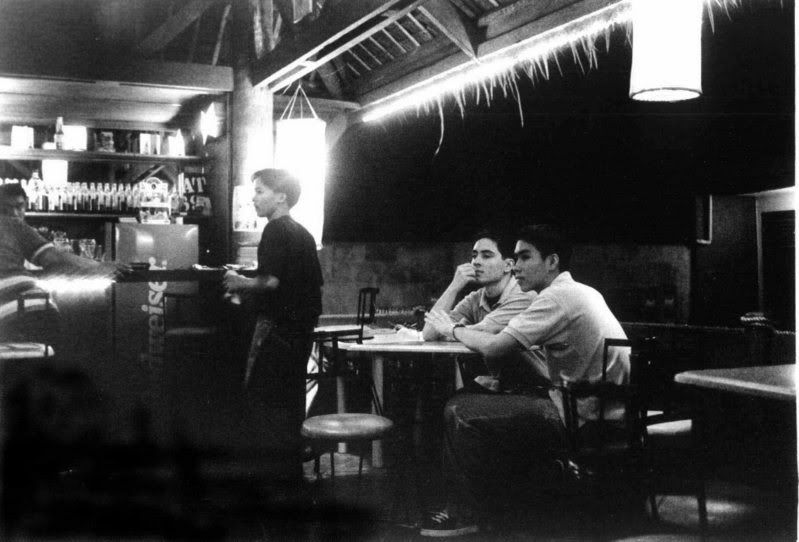
His pictures come out from a netherworld, Dumaguete rendered in film noir, always with a hint of dark mystery or something sinister to them. Like this.
 Which is the real Dumaguete?
 It's all in the eye of the beholder. We all create our own sense of place.
Labels: dumaguete, photography
[0] This is Where You Bite the Sandwich
Oprah in the past has given her audience free cars and their wildest dreams...

Now she has given away $300,000, which is $1,000 for every audience member -- and promptly tells them to give the sum away ... to charity.
Ouch.CNN
reports: "I can honestly say that every gift I've ever given has brought at least as much happiness to me as it has to the person I've given it to," the 52-year-old talk-show host said. "That's the feeling I want to pass on to you."
Okay. I bet the audience was happy.
Labels: celebrity, television
[0] This is Where You Bite the Sandwich
Monday, October 30, 2006
"Forsan et haec olim meminisse juvabit.
(Maybe someday you will rejoice to recall
even this.)"
-- Aeneas, in
The Aeneid Book 1
Only three people know about this: I broke down last month under the weight of sheer depression, it incapacitated me. I have what you can call a mild form of manic depression, nothing too clinical to certify me a nut, but I have managed for most of my life to put it under some control. But after August -- given the whirlwind of expectations and recriminations my life constantly harvests -- I broke.
It lasted a full month, ending only when I finally told a friend -- a psychologist -- what was going on with me. I told Mark, too, and there was one night when I just walked out of my apartment, and walked half the city in a daze. I can't tell you what happened next, but it was bad.
For the longest time, I've felt that I've taken this slowburning vacation from my life -- a gradual descent that has me flummoxed, bewildered, disoriented. Sometimes, when I take a shower especially, I get this shiver of recognition about what a sorry state this existence has turned out to be so far. Involuntarily, I'd curse out a prayer, always an "Oh, Jesus, I need your help." It would be cute if I didn't do that like twenty-four times a day, always after being bitten by this shadowy rebuke, this sense of failure.
But I have always been my own worst critic, and to my mind, I have yet to reach my full potential. And it pains me no end to realize that I have fallen short of my expectations. Sometimes, my own prayers seem to reach only deaf divinity.
Let's hope I'm wrong.
Labels: life, psychology
[0] This is Where You Bite the Sandwich
10:37 PM |
Make the Macho Squirm
Read
the latest entry from John Bengan. It's heartbreaking.
Labels: blogging, queer, writers
[0] This is Where You Bite the Sandwich
The truth of the matter is, sometimes the unplanned things take on the highest degree of pleasure. A long time ago, during the summer, a bunch of us friends -- Mark, Angeli, Goldy, Charlotte, and probably half of Dumaguete's party crowd -- just congregated into what was for once a cozy El Camino Blanco interior without any real plans from any of us to have a good time, and danced the night away to the intoxicating beat of Banda Manga, this percussion band that knows exactly how to lure people into the dancefloor. (And if there is one thing about Dumaguetenos one should know, it's that it is virtually a challenge to bring
anyone to dance at all.) That night sticks in my memory as one of the best night-outs I've had for the longest time. It was all the more fun because we never expected the night to turn out the way it would. Afterwards, there were many other nights when we tried to replicate the sense of gaiety and abandon of that Banda Manga night, always ending in various forms of disappointment.
I guess, the same is true when they also talk about love: it finds you when you don't go around looking for it.
Tonight, while I was dusting off the pad, Mark came along to take me out. I hadn't seen him the whole day. I was off to work after the semi-vacation of the past three weeks. When he dropped by, he was wearing my old blue shirt and my old blue jeans. The guy looks great in my clothes.
"Hi," I said.
"Hey."
"What are you doing here?"
"I promised you a steak dinner some time ago," he said. "We're having filet maitre d'hotel in Le Chalet."
"Now?" I said. I was sweaty. I only had a shirt and skimpy shorts on.
"
Now," he said.
So off we went. He had his steak well-done, and I had mine medium-rare. Just once, we wanted to veer away from our usual rare fare, carnivores that we are. It was a grand meal, the beef cut into three tender balls of oozing perfection, every bite of which was smothered with succulent herb butter. We missed the juicy bloodiness of rare steak, however, but no matter. Later, for our nightcap, we dropped by CocoAmigos. Mark had two glasses of martini bianco, and I had one, quickly followed by another glass of Bailey's on Kahlua.
It was a perfect,
perfect night.
Unplanned, too. Like the best things in life.
Labels: life
[0] This is Where You Bite the Sandwich
Sunday, October 29, 2006
9:37 PM |
How Much More Blood, Mr. Perdices?
"Natuslok ka na ba ng ice pick sa Lo-oc? O naka-pick-up ng babae sa Tocino Country? O nai-snatchan ng bag sa Luke Wright? O na-hold-up ka na ba sa PNB? May gana ka pa mag-aral sa Silliman nursing? O maagawan ng cellphone sa Tinago? Tara na tara na! Byahe tayo sa Dumaguete City, City of Gentle People!"
-- content of text message, a reworking of the popular "Wow Philippines" jingle, currently circulating around the country
We are slowly being murdered, all of us.
When the boy was rushed to Silliman Medical Center's emergency room in the early morning, no one, not even the PGI on duty, knew exactly what was wrong with him. He was already a syncopetic mess, complaining of a black dizziness that drifted in and out, but other than that, there were no real reasons to suppose that the boy was going to end up dead before daylight could even come.
He had straggled in on the shoulders of friends whose faces were masks of concern and fright. Theirs were college boy faces etched with surprise at sudden turns of events -- guises of youth given in to an unanticipated collision course with hospital gray walls and early morning tomb silence, when they should still have been out celebrating being blissfully careless, the way only the very young can. All of them were, predictably, refugees from the Friday night, straight off from El Camino Blanco. They still smelled of beer and cigarette smoke, but now their gelled hair were disheveled, and creases marred the silky sheen of their nightlife clothes.
On most Friday nights, surgery and the emergency room in Dumaguete were beehives of activity. Always, on weekends, there were bursts of vehicular accident cases coming from all over the city and nearby towns: mostly young people with broken arms, or broken legs, or broken necks. The weekend dead count was usually high, a pathetic statistic marked by hormones and reckless exuberance -- boys and girls who'd crossed the deceptive veneer of mortality, meeting it head-on in a crush of metal, rubber wheels, asphalt highways, and scattering of blood, and flesh, and brains.
The boy in question was soon barely conscious.
There was a fight in the parking lot outside the bar, one of the boys said slowly. Later, in the hospital, the ER staff would discover a puncture wound in the right lower half of the boy's belly. It was small in diameter, almost undetectable -- something an ice pick could cause. But they knew the small wound was far deeper and deadlier than it looked, its gash only a wink to the deep slash underneath, perhaps already perforating his intestines. The blood and intestinal contents, including the feces, might have since spilled into the abdominal cavity, and the bacteria might have already eaten through the sterile cavern. It would not be long before there could be peritonitis. Or worse: a ruptured abdominal aorta, gushing blood into the peritoneum like a mad river, the body a ticking time bomb. Already, the boy was exhibiting a rapidly extending abdominal distention, and soon shock would take over from the lowered blood pressure. That was why he was groggy, dehydrated, blacking out.
But for some strange reason, the resident ruled out surgery, and the boy was taken instead into the Intensive Care Unit, just as dawn was breaking out and there was a shock of deep blue scattering throughout the wakening skies. Amidst the dark and the hum of machines, the boy was bleeding inside. He was dying. Before daylight came, he was dead.
That boy was a friend of mine, a college mate. I wish I could name him specifically here, but in the name of privacy -- and friendship beyond death -- I cannot. How many years ago was this? Not too long ago. I usually think of that unfortunate night as one of the beginning death knells that have led us now to a city curiously awash in blood. Every morning now seems to bring us bad news of newer massacres, of senseless murders.
Angeling Lajato. Erlinda Tomongha. Jong-jong Sibala. Dennis Mainit. Joel Canon. This litany of names, of course, is only a fraction of the many who have met grisly ends. And to add to that horrifyingly growing list, here is one more name: Nina Estacio. The last two -- Joel and Nina -- were students of mine, two people you would never think of as candidates for murders. In the end, the senseless manner by which they died could only sharpen what is true about crime: that it could happen to anyone.
Of course, it still puzzles me how their lives could end the way they did, in a place where we used to joke around like this: "Nothing bad can happen to you in Dumaguete. If something bad does happen,
you'll like it." Now, nothing is plain laughing matter anymore. Perhaps we have overdrawn too much on our past as a place where nothing much happens. We have become complacent to the surges of the times, and that may have been our biggest mistake.
Still, a little more than three weeks ago, Silliman University and the rest of the Dumaguete community finally did what should have been done a long time ago: we rose to protest the seemingly endless cycle of blood that has drenched the city.
It's remarkable to me how we are finally capable of something we are not usually known for:
outrage. Is it enough, however? Because if there must be a final recipient to end the blame game that has now ensued, the culprit would very well be you.
Us.
All of us.It's the utmost irony worthy of an Oedipal tragedy: that when we finally get to unmask who the proverbial murderer is, we are the one who is slowly killing ourselves.
Never before in the history of Dumaguete City has seen this community stumble in a state of slowly dawning shock, of outrage and disbelief, of siege. Our nature has always been to take for granted our genial ways, our myths of trustworthy neighbors, and our legend of cultivated sophistication.
Nothing bad can happen in Dumaguete. That has been our consistent mantra for years.
How foolish that mantra sounds now.
We do live in a state of siege. The siege's name is fear. And the fear is palpable in the way we go about our lives now: always looking over our shoulders to see who might be following, always being wary now of the overcrowding of strangers, always mistrustful of the pulsating and descending darkness of night. But even the daylight no longer provides the sense of security which we now all feel to be elusive. For it was in the daytime, after all, when Sillimanian nursing student Nina Estacio was brutally murdered in what should have been the safety of her home, a knife sticking out of her chest, one of her eyes gouged out by strangers who did not respect the sanctity of life.
What is happening now is a perfect shock to the system. We stumble simply because we are coming to grips with the reality the way any nitwit would stumble through something completely foreign and unprepared for. The city simply does not know what to do with this flood of blood.
There has been much finger-pointing in the wake of all this blood. Some of us, of course, are all too quick to assign the murderous reality by harping on the theory of foreign elements, that those who perpetrate these outrageous crimes are misfits from Davao, from Cagayan de Oro, from Iligan, from Zamboanga, all of them come to Dumaguete attracted by its element of naivete. The attempt in this message seems to be that Dumaguetenos are completely incapable of bloodshed, a perfect delusion that erases the city's hidden bloody history.
Some blame the city's progress for the escalation of crime. "It's perfectly natural for a growing city," one friend remarked, the way a teenager acquires zits, for example. Dumaguete is indeed growing, its population mushrooming, and with that probably comes an innate inability to monitor everybody the way small towns usually can. In small towns, conformity and moralistic prejudice are the ready buffers for everyone's behavior (not always a good thing, of course). That small town safeguard quickly dilutes in a metropolitan setting. Still, no one can halt progress. And progress as a harbinger of evil is really a lazy myth, with a perfect foil in the fact of Singapore, where progress moves on but chewing gum is still considered anathema.
Some blame an incapacitated police force, many claiming that the current number of policemen simply cannot handle a growing city. And there are many others who claim a certain ineptness in police procedure. "That's why most people do not even trust the local police anymore," says a friend who wishes to remain anonymous. "We were robbed once. We called the police. A plainclothesman came over in less than an hour, surveyed the damage, and said, 'Do you have a camera which we can use?' Can you imagine! They don't even have the equipment to gather evidence! The police soon told us that a complaint would be filed, but that there was nothing they could do really."
Which should provide our mayor an answer to his complaint last week. What did he say? He said something in the vein of how impossible it was to solve these crimes when no one was even filing charges.
Simple, Mr. Mayor. Because no one wants to bother. Or if we do want to bother, we are inherently afraid of reprisals, no matter how paranoid that may sound.
Because we know nothing will happen,
bisag magpa-ugat ug file
ug complaint.
Because we know that even the deaths of people of consequence -- Angeling Lajato (a close friend of the mayor) and Erlinda Tomongha (a City Hall official) -- remain unresolved, their deaths reduced to mere statistics and cautionary tales. How much more the majority of us who only have ordinary lives to lead? Only a few, for example, can remember the name of that grade school girl in Taclobo who was recently raped, and then murdered. Worse, no one at all remembers that Boulevard banana fritter girl whose body was dumped like ordinary garbage years ago, when I was still in college. I don't know what happened to the killers, or whether they were caught.
Because we know that the old cliche remains true: that the local brand of justice does not work, or is infuriatingly slow, especially if the criminal in question happens to have deep pockets, or deeper political connections. We also know too well about the botched attempts at criminal prosecution. (Consider the still unresolved Dumaguete sex scandal.) We have generally lost trust in the way justice gets done. Or if we do want to raise noise, we fear most for our lives.
Still, there is one unbendable truth in what the mayor has complained about. It is not an excuse for any of us to be living in fear, to be complacent about things. Silence, and an unwillingness to prosecute when needed, can only breed a more vicious cycle of things. Our inaction will not stop the horror. There will always be a certain nobility -- quixotic it may be -- in raging against what seems to be an impossibility. Who cares about justice predictably going awry? The point is
to try.
In the final analysis then, what is slowly killing all of us is a mutant kind of Dumagueteno complacency. It is a complacency that is both benign and festering with fear. The last one I have already detailed above. That other characteristic of being benign, however, is a gradual accretion of our "gentle airs" and "inviting hospitality" -- so much so that we have become like contented cows, breeding a false sense of security and a naive view of the ways of the world.
A good example for this tendency exploded in the last elections. Convinced that our little gentle bubble should not burst and that the old gentle ways should still remain the status quo, we voted to keep Dumaguete the way we thought it
should always be:
we voted for a man whom we know would do absolutely nothing. Three years ago, somebody said, "Dumaguete deserves the mayor it votes for." Three years later, we can only reply:
And how!Because the crimes in Dumaguete is nothing but a damning indication of a failure in leadership. (What does the proverb say about the buck stopping where it should?) The only decisive thing this mayor has ever done is concretize our roads (which has led to the overwhelming heat that now engulfs this city on most sunny days), and banning movies. There is a word for this kind of politician:
lameducks -- incapacitated public officials whose days may be numbered. There are talks that he may go on for the next term he is still entitled for. Or that he may go on to run for governor. The thought comes to mind: administrator for the whole island? He can't even run a city properly!
What we need is new blood in politics. Where are the civic-minded young men and women who are still uncorrupted by all these traditional politics? Why not put to pasture the old, always recycled political geezers of Oriental Negros, and bring this city and this province into the twenty-first century?
Because how much more blood should be spilled, Mr. Mayor, before you will do anything?
Labels: dumaguete, issues, politics
[0] This is Where You Bite the Sandwich
Saturday, October 28, 2006
My God. I haven't blogged this long?
Whoa.
Labels: blogging
[0] This is Where You Bite the Sandwich
Wednesday, October 18, 2006
9:43 PM |
Thing I Tell Lazy Students When Being Mean is the Only Way to Get Into Their Heads, No. 2
DID I MISS ANYTHING
By Tom Wayman
Question frequently asked by
students after missing a class
Nothing. When we realized you weren't here
we sat with our hands folded on our desks
in silence, for the full two hours
Everything. I gave an exam worth
40 per cent of the grade for this term
and assigned some reading due today
on which I'm about to hand out a quiz
worth 50 per cent
Nothing. None of the content of this course
has value or meaning
Take as many days off as you like:
any activities we undertake as a class
I assure you will not matter either to you or me
and are without purpose
Everything. A few minutes after we began last time
a shaft of light descended and an angel
or other heavenly being appeared
and revealed to us what each woman or man must do
to attain divine wisdom in this life and
the hereafter
This is the last time the class will meet
before we disperse to bring this good news to all people
on earth
Nothing. When you are not present
how could something significant occur?
Everything. Contained in this classroom
is a microcosm of human existence
assembled for you to query and examine and ponder
This is not the only place such an opportunity has been
gathered
but it was one place
And you weren't here
Originally from The Astonishing Weight of the Dead, Vancouver: Polestar, 1994.
[from maryanne moll]
Labels: poetry, teaching
[0] This is Where You Bite the Sandwich
Thursday, October 12, 2006
11:04 PM |
Thing I Tell Lazy Students When Being Mean is the Only Way to Get Into Their Heads, No. 1
"My standards are too high? Whoa. Well, you really don't have to go to a good college, you know. The economy also needs sales ladies and gasoline boys."
Labels: teaching
[0] This is Where You Bite the Sandwich
Wednesday, October 11, 2006
1.From
CNN.com:
[Newly-religious] Mel Gibson [in an interview with Diane Sawyer] calls his anti-Semitic rant following his arrest for drunk driving in July "the stupid ramblings of a drunkard" ... The interview with Sawyer is the first time Gibson has spoken to the media since sparking a scandal by unleashing what he later called "vitriolic and harmful words" during his arrest. Gibson told the arresting officer: "The Jews are responsible for all the wars in the world," and asked him, "Are you a Jew?"
But really, Mr. Gibson,
in vino veritas?
2.From
Salon:
[Has-been actor] Stephen Baldwin has released a memoir, The Unusual Suspect, a reference to the one critically acclaimed film for which he's known. The book, the "Gospel according to Stevie B.," is part testimonial and part evangelical manifesto, a cocktail of anti-intellectualism and a biblical interpretation that would have Jesus spinning in his grave, had he stayed there. Baldwin preaches that free will is a lie of Satan -- we must shut off our brains, he says, and be led by what God tells our hearts. Furthermore, he writes, efforts to end global poverty and violence are just the sort of "stupid arrogance" that incur God's wrath, which we'll be feeling any day now in the coming apocalypse. I suppose when the star of Bio-Dome is advising the president and converting kids by the thousands to his gnarly brand of faith, the end is, indeed, nigh.
The Unusual Suspect features an open letter to Bono, lambasting him for lobbying for debt relief for developing countries instead of preaching the gospel on MTV. Bono must be in league with Satan, whom Baldwin spends a lot of time thinking about. "I am smart enough to know that Satan is alive and well today," he writes. "Satan has all kinds of power, and he is able to control the minds of anyone whose mind isn't controlled by God." Baldwin's theology -- and criticism of secularists and Christian poseurs like Bono -- is written with remarkable confidence for someone who can only recite six of the Ten Commandments and four of the Twelve Apostles.
All of this might seem like the easily ignorable ravings of a Hollywood has-been if the book wasn't climbing bestseller lists. Baldwin writes that "God has called me to go and make disciples of the youth of America. That is what I am going to try to do, and if you try to stop me I am going to break your face." Most frightening of all, Baldwin is succeeding. All of his dude-speak is actually speaking to the dudes. Thanks to his book, videos and live sermons, he continues to draw thousands of young people across the country into his church of celebrity and absolutism.
And to think I used to consider
Threesome -- where he plays a college jock involved in a menage a trois with his gay roommate-buddy and their sultry female roommate -- one of my favorite movies!
Sign of the Apocalypse: Mr. Baldwin has recently been chosen by George W. Bush as a cultural adviser.
Great God.It's no wonder it's taking me a long time to decide to go back to church. I don't want to be with freaks, that's all.Labels: celebrity, religion
[0] This is Where You Bite the Sandwich
Friday, October 06, 2006
5:56 AM |
Step 3 Back to Normal Life : Get Back to the Writing Groove
Here's something I contributed to...
From Cecilia Manguerra-BrainardAnvil will be releasing a collection entitled
Ala Carte: Food and Fiction, which is a wonderful collection of short stories and Philippine recipes. Edited by
Cecilia Manguerra Brainard and Marily Ysip Orosa, the anthology includes stories (and recipes) by:
Edna Weisser
Ma. Romina Gonzalez
Corinna Arcellana Nuqui
Margarita Marfori
Alfred YusonSusan Evangelista
Carlos Cortes
Linda Ty Casper
Dean Francis AlfarJose Dalisay Jr.Janet VillaIan Rosales Casocot
Joel Barraquiel Tan
Marie Aubrey Villaceran
Shirlie Mae Mamaril Choe
Reine Arcache Melvin
Erma M. Cuizon
Veronica MontesBrian Ascalon Roley
Nadine Sarreal
Erwin Cabucos
Edgar Poma
Oscar Penaranda,
and the two editors Cecilia Brainard and Marily Orosa also have stories in the collection.
The book's Introduction follows:
INTRODUCTION
By Cecilia Manguerra-Brainard
In some places in the Philippines,people greet you by asking if you have eaten: not Good morning, or Good evening but "Kumain ka na?" Have you eaten? And even if you have, they will serve you food anyway and it would be considered an insult if you did not eat. Even when I was young, I had an inkling about the special relationship Filipinos have with food. At home my mother was constantly prodding people to eat more, a habit I have picked up, sometimes to the embarrassment and annoyance of my American sons. Another thing that annoys them and my American husband is my difficulty to throw food away, so much so that my refrigerator is filled with bowls of forgotten dishes, some of them with very interesting multicolored mold on them. I had a son threaten to use one of those forgotten containers for a Science project!
I had to explain to them that the inability to waste food came from my mother, who with the family spent the World War II years in Mindanao, and who, like many other Filipinos during those War years, experienced hunger and deprivation. But I suspect the reluctance to throw food away runs deeper than that; perhaps to Filipinos, it is clear that food is life, and life should not be thrown away or treated with disrespect.
Indeed the connection Filipinos have with food is almost religious. Eating is the time when the family gathers, when the community is one, and is something of a sacred time. In the home I grew up in, the entire family sat down for breakfast, lunch, and supper. Lunch and supper were elaborate, with soup, and fish, and meat, and rice, and vegetables, followed by a variety of fruit and/or some sweet for dessert. I believe there are still many Filipino households that have meals like this. Others, because of their modern hectic lives, have simplified their daily meals, but when it comes to parties, Filipinos still go the full length to have a grand spread.
It was this deep connection that Filipinos have for food that prompted Marily Orosa and me to edit this collection of Philippine stories and recipes. Marily and I share a love for fiction primarily because stories reflect the soul or culture of people. So does food and we thought combining stories and recipes in one book would reveal Filipino culture in a unique manner and would invite lovers of both stories and food to take a look at our delectable collection.
Soon after the release of the other book Marily Orosa and I co-edited (Behind the Walls: Life of Convent Girls, Anvil, 2004) we publicized a search for this collection. Initially, we anticipated we'd get light stories, possibly comic ones. When the stories started coming in, we were surprised to see that the topic of food had triggered some serious stories. We quickly realized that food and eating bring back memories of families and friends, and relationships are always complex. The stories we finally selected were by writers from America, the Philippines, Singapore, Australia, France, and Germany. The majority of the contributors are published writers who are well-known in the literary and academic communities.
An inspiration to this book is Laura Esquiviel's novel, Like Water for Chocolate. Each chapter in Esquiviel's book is introduced by a recipe so that the chapters flow out of those recipes. Likewise, the 25 stories in our collection are preceded by related recipes. Following the food theme, we arranged the book like a menu, and so we have categories of Breads, Appetizers, Salads; Soup; Rice; Main Dishes; and Dessert, with the recipes and stories falling under the appropriate sections.
The recipes included in the book are: Aragula in Blue Cheese Sauce; Shrimps on Leeks; Tokwa't Baboy; Banana Turon; Pan de Sal; Ensaymada; Green Mango Relish; Feta Cheese with Greens, Artichokes, and Crabfat; Shanghai Fried Rice; Garlic Fried Rice; Pork Adobo; Manok Inasal; Paella/Arroz; Kare-Kare; Lumpia, Laing, Sinanglay na Karpa; Pork Sinigang; Filipino-Korean Lumpia; Rellenong Bangus; Humba; Escabeche; Binagoongang Baboy; Cascaron; and Halo-Halo. They have not been taste-tested and we suggest that those who wish to try the recipes do so in the spirit of experimentation and adventure.
Some stories in the collection are light-hearted. Edna Weisser's Merienda Alemania is an autobiographical piece about a Filipina and her husband in Germany who have invited their friends over for merienda, but this time with the German touch. The stories of Dean Francis Alfar and Ian Rosales Casocot, combine magic-realism and slapstick. Alfar's Sabados Con Fray Villalobos relates the Spanish friar's attempts to win the hearts of Filipino Indios although some Indios have other ideas. Casocot's Pedro and the Chickens is about the blossoming of a romance in the town of Dumaguete and the accompanying strange events that happen to the town's chickens. The story Wok Man (by Jose Dalisay) is about the kinship of a short-order cook and his employer who both find joy in cooking. Hanging Rice by Carlos Cortes is a short-short about a Visayan eating Cebu's common street meal; what's uncommon about it is how the rice is wrapped in a work of weaver's art.
The other stories have a more serious style. In Bread (by Ma. Romina Gonzalez) a 26-year old woman prepares bread as her mother had taught her and recalls the time her father left her mother. Ensaymada (by Corinna Arcellana Nuqui) is about a homesick Filipina in the U.S. who in the act of baking visits her past. Margarita Marfori's Mango Seasons is a first-person piece focusing on the narrator's memories of a special summer, brought on by the cutting down of an ancient mango tree. Alfred Yuson's Romance and Faith on Mount Banahaw is a surreal piece accompanied by the salad recipe (in poetry form) of Feta cheese, with Greens, Artichokes, and Crabfat.
Linda Ty-Casper's story, Visit to Myself, is about a 15-year old girl and a 94-year old woman, and how they, one hurrying to the future and the other living in the past, recognize one another. My story (Cecilia Manguerra Brainard), Romeo, focuses on the narrator's mother, now old and whose sole companion is the dog, Romeo, who had once belonged to the narrator. Janet Villa's CloseOpen and Joel Tan's Sinanglay na Karpa look at people trapped in relationships that they cannot escape. Marie Aubrey Villaceran's story, Sinigang, is about a girl, who while cooking, recalls the funeral of a half-brother and it is also during this time that she comes to terms with her relationship with her father. Marily Orosa's story recalls her relationship with a handicapped relative.
Shirley Mae Mamaril Choe's Kitchen Secrets is about a young girl who struggles to reveal a terrible family secret. Through her weekly cooking lessons, she develops a strong relationship with her mother which enables her to finally share her burden. Reine Arcache Melvin's The Fish is about complex relationships among members of a household that come to head during the gutting of a fish caught after a shipwreck. Erma Cuizon's Secret Scent is nostalgic piece about a woman who yearns for the old life that is gone forever. Two Drifters by Veronica Montes is about a young woman who has to cope with the addiction and brokenness of her family members. Brian Ascalon Roley's semi-autobiographical piece remembers a menacing encounter at summer camp in the 70s, involving his Filipina mother and White father. Edgar Poma's Desperata is set in Hawaii, about a struggling writer's break when a firefighter managed to find an editor's note to have his work published. The firefighter's visit to Hawaii makes the writer realize that his mother needs more than phone calls, but that, as the firefighter said: "you gotta see her every chance you get while you still can and you gotta hold her in your arms." Oscar Penaranda's story, Mango Lady, recounts a Filipino American's visit to the Philippines after an absence of 19 years and his search of the fruit vendor who a part of the memories of his youth. The accompanying recipe is a favorite dessert, Halo-Halo.
The stories in this book are a mixed bag of joyful stories as well as more somber ones; all of them explore the dynamics of human relationships. The editors of this book sincerely hope the reader will find enjoyment in them.
Buy it.
Labels: philippine literature, writing
[0] This is Where You Bite the Sandwich
Thursday, October 05, 2006
8:52 PM |
More Palanca-Winning Pieces
Here are four more contributions to the
Palanca 2006 Issue of
Literatura from
Bryan Mari Argos (Third Prize of the Hiligaynon Short Story),
J. Dennis Teodosio (Second Prize for Dulang Pantelebisyon),
R. Torres Pandan (Third Prize for Poetry), and
Christian Tordecillas (Third Prize for Dulang May Isang Yugto).
Labels: palanca, philippine literature
[0] This is Where You Bite the Sandwich
Tuesday, October 03, 2006
10:08 PM |
Step 1 Back to Normal Life : Watch an Orchestral Concert
The thought came to me that Thursday night, a little more than a week ago, that the choice of orchestral music was ironically and strangely appropriate for our town.
It had been half a decade since we last heard them play. But when the Philippine Philharmonic Orchestra finally came to Dumaguete for that rare concert, this time in the newly-refurbished Sofia Soler Auditorium in Foundation University, they chose Franz Schubert's Symphony No. 8 as its opening salvo. The Schubert piece is otherwise (and perhaps more famously) known as the Unfinished Symphony, and for those in the know, it can very well be both metaphor and irony for this atypical gathering of Dumaguetenos come to this corner of our "university town" for a taste of classical music.
I will get to the metaphor later, but first must come the irony.
That a musical score left undone by the Austrian composer
should be played in a packed Sofia Soler Hall is ironic. Sofia Soler Hall had, for the longest time, been relegated to the doldrums of local theater for the sheer horror of its cramped accommodations, imperfect acoustics, and non-existent, even hellish, ventilation. Unfinished, indeed, if we only consider the potential it could have realized as a legitimate stage for local performances. When was the last time all of Dumaguete watched anything at all in Sofia Soler?
Today, however, we celebrate Sofia Soler Hall's reincarnation -- and the Sincos do it one better by inviting Maestro Eugene Fredrick Castillo, PPO's fourth music director and principal conductor, to come with the country's foremost orchestra and rededicate Sofia Soler to an invigorated thrust to become one of Dumaguete's leading centers for the performing arts.
Consider the careful redesign of the theater that comes at the heels of Foundation University's earnest efforts to refurbish its campus and its academic programs. Many of the changes are subtle, but some are quite dramatic. All in all, it is essentially a better, and perhaps more imaginative, reworking of the old building, the structure of which has stayed for the most part. There are some structural changes in the stage (now bigger) and in the acoustic and sound system (now modernized). But what has changed dramatically is the open-air design concept, each side wall of the auditorium making way for the natural ventilation of night air, of nothingness. Which may be strange for any auditorium, but in Sofia Soler's case, a strange suitability.
There is also the welcome banishment of the old and uncomfortable bleachers with wooden chairs, and raising the floor to a balcony level. There are now the orchestra seats
and the balcony seats, perhaps to appropriate the old (and beloved) snobbishness to the theatergoing experience where your seat assignment largely determines your social status. I have no quarrel with that: it's a quaint practice now invariably lost in the "democratization" of local theater -- which, for the longest time, largely means the Claire Isabel McGill Luce Auditorium, where even gala shows now have patrons going to the ballet
in jeans. (Sofia Soler -- like the rest of the civilized world -- insists on long skirts or dresses for balcony ladies. Which makes for a merry and beautiful sight. In my snobbish heart, I sometimes wonder whether the
masa-fication of local theater-going is a factor in the declining interest in performance art in Dumaguete, given the mere fact that most Dumaguetenos, for better or for worse,
love to be seen. Because, really, we used to go to the theater partly to entertain ourselves, partly to indulge in sophisticated artistic treat, partly to keep a necessary appointment in the local social calendar, and partly to dress up and be seen. Now, even what remains of high society in Oriental Negros has shied away into the shadows, leaving culture in Dumaguete City bereft of patrons, except jeans-clad teenagers required by their Fine Arts teacher to watch and write reaction papers.
How perfectly dreary.)
But to get back to the music.
The concert was not exactly Philippine Philharmonic Orchestra's best, which is not to say they were not good. They were very, very good -- it's just that I've heard them play better. Seven years ago to be exact, when they were still under the baton of Ruggero Barbieri. But there has always been that tendency among some Manila performing companies to "tone down" their standard for provincial shows. (Read:
Promdi lang ang mga 'yun, they don't know any better.)
Should I say uninspired? Perhaps. There is the matter of the short program -- only two symphonies and a scattering of local musical pieces that is at best interesting. In their rendition of Ludwig van Beethoven's Symphony No. 8, the rigorous score -- famous for its cyclic
legro vivace e con brio with its overwhelming crescendo near the end, its amusing and even affectionate
allegreto, its coarse
menuetto, and its fierce and fast
allegro vivace -- does not approach transcendence like the best renditions of it. I've heard this symphony performed before in Suntory Hall in Tokyo by the Tokyo Metropolitan Symphony Orchestra when I did not know my Mozart from my Bach, and the piece -- the first time I heard it -- moved me because it was ... well, cheerful. I did not expect
that of classical music. But it has always been a score often left to the sidelines of more famous Beethoven pieces because it is not as overtly heroic as some of the others, nor too emotional. Which may be why I like it: its beauty is subtle. Carl Czerny once asked Beethoven why the Eighth Symphony was not -- as it is also now -- as well-received by audiences as the Seventh. The master was supposed to have replied: "Because the Eighth is so much better."
Their take on Schubert's Unfinished Symphony -- which opens the concert -- was comparably so much better. Or perhaps my initial reception to it was colored by the fact of personal excitement. But I have always loved Schubert -- always my secret pick every time people ask me who my favorite composer is, and I invariably reply, "Mozart," because people always
get that answer without necessitating explanation. Schubert's Symphony No. 8 -- a seminal piece since the symphony's key, in B minor, had never been done before even by Mozart, Haydn, and Beethoven -- may be best known to ordinary people (those who loved the Tom Cruise sci-fi thriller
Minority Report anyway) as incidental music in that Steven Spielberg movie. Those who grew up watching The Smurfs will also get its first movement as the accompanying music to the villain Gargamel. I like the way the score begins in virtual silence, and then straining, as in a call, into a mournful arc that ends each time in dramatic crescendo. The piece, like the first time I heard it in a borrowed CD recording, gave me goose bumps.
I don't remember much of the "Matud Nila" number, perhaps because I found it unnecessary, a token gesture for the Bisaya in all of us. What I found delightfully surprising was the vigorous reworking by Carmelo Elli (who conducted in lieu of Maestro Castillo) of the often sedate "Dumaguete Hymn," composed so many years ago (and sang in schools!) by Cate Villariza, and eternally reminding me of the classic Christmas paean, "Silver Bells." (Doesn't it?) But
it worked, the whole new arrangement -- easily becoming one of the highlights of the short show.
But what was virtually the highlight of the show -- precipitating a standing ovation -- was the encore, a medley of all the favorite songs from the musical
The Sound of Music. Everything, from the title song to "Do-Re-Mi" to "Climb Every Mountain." Because it was familiar, because everybody loved and grew up with this musical by Rodgers and Hammerstein, and because everybody in the popular mainstream had lost that feel for the classical (
Schubert who?), it proved the musical hit of the night, so much so that many in the audience refused to budge from their seats even after conductor and musicians bowed out from the stage. Perhaps they were hoping to hear more popular fare, and perhaps they were feeling that the concert had only and barely begun. I will not quarrel with popular appeal -- hey, I found myself singing along
all the songs, too -- simply because film scores (by musical theater greats, as well as composers such as John Williams, John Barry, and Thomas Newman) really are the new "symphonies," sadly relegating the music of the masters to the Museum of the Sophisticated Old Fart.
That the Dumaguete audience -- composed for the most part by the local culturati and what remains of the local "socialites" (even the mayor was there!) -- watching the concert that Thursday night embodied this very last realization provides me my example for that metaphor I mentioned at the beginning of this essay. How sadly "unfinished" we all are, taste-wise, not that it matters anymore either.
It brought me some sad realizations, but nonetheless I enjoyed a really good show.
But one last note to Dumaguetenos: please don't clap between the movements of symphonies. It's like applauding the singer after the first stanza of the song and right before the chorus.
You just don't do that. It's rude.
Labels: dumaguete, music
[0] This is Where You Bite the Sandwich
Sunday, October 01, 2006
4:33 PM |
From the Silence of Walls
Which comes first. The silence? Or the quietly invading madness? Perhaps both at the same time, copulating and living off each other like
ordinary monsters, spawning paralysis -- and dark and darker days. They came out of the closet one day, about a month ago, and kept me company. They're still there, singing to me their horrible sad songs. Last night, they made me wail.
No one knows.Labels: life
Monday, September 25, 2006
4:02 PM |
A Remembrance of a Weekly Grind
An email from current
Weekly Sillimanian editor-in-chief Michelle Eve de Guzman -- who is a former student of mine and one of Silliman University's brightest young writers -- asking me to give a testimonial about my days as a
tWS staffer for an exhibit celebrating the paper's 103rd year opened a floodgate of both memory and emotion. Perhaps even pride,
the good kind.Because,
why not pride? Sometimes it takes mere numbers to make us realize how rich a tradition can be. Consider this:
the Weekly Sillimanian is already
one hundred and three years old?
It is, and with a rich history, too. It has indeed been an honor and a privilege to be part of that legacy.
Starting in 1903 as
Silliman Truth, barely two years after the Hibbards arrived in Dumaguete to found what was then Silliman Institute, the fledgling paper was at once a multilingual operation, with articles written in English, Spanish, and Cebuano. It was the first newspaper to be published in the whole of Negros Oriental, and because of that served for the most part of its early history as a community organ as well. By 1920, it became a biweekly publication now called
The Sillimanian. (A separate publication still carried on the name of
Silliman Truth, which had then become the monthly official publication of the Board of Trustees.)
At the dark heights of World War II,
The Sillimanian moved underground like most of the teachers and students caught by the war in campus, renamed itself
The Daily Sillimanian, and became a fly-by-night paper for the Resistance, publishing articles on singular sheets of paper that chronicled the daily fight against the Japanese. That reaching out for the concerns of the local community had always been a significant part of the publication's ideals -- so much so that by the time Martial Law arrived in Negros Oriental, the Police Constabulary immediately raided the Weekly Sillimanian office for subversive activities, including publishing articles critical of Marcos's shenanigans. (A quick look at the template and contents of
tWs circa the 1970s would give one a jolt over how different the temperament was during those days as compared to now.)
The Weekly Sillimanian has always been a significant instrument for chronicling change, and has always been a voice for Sillimanians and Dumaguetenos alike. But like many institutions weathering time and changing faces, it has both checkered episodes and glorious periods. (Its heyday may be the two years between 1958 and 1959, when the paper won First Place twice in the Columbia School Press Contest, a prestigious award given out by the Columbia Scholastic Press Association of Columbia University in New York City, besting other school papers worldwide, including those in the United States.) In their famous history of Silliman University, Edilberto Tiempo, Crispin Maslog, and Valentino Sitoy wrote of
tWS: "Their quality through the years has been uneven, ranging from the bland to the relatively well-edited publications. Likewise, their outlook has been varied, reflecting the climate of the times and the temperament of their editors."
And so that is true even until today. Thank God, under Ms. De Guzman's capable hands, with the able guidance of Gina Fontejon-Bonior as adviser,
the Weekly Sillimanian is slowly coming out of a long shadow that saw it crippled and hobbling in the last five or six years, no thanks to an ogre now long since gone.
(Oh, don't ask me who.)As for me and
tWS, it was an essay in English composition class that pushed open a chance to work in
The Weekly Sillimanian. I was a sophomore college student, laboring over the nuances of English 12 -- what is now better known as Basic Communication 12 -- and my nostalgic piece about an old movie theater in my mother's homestown of Bayawan made my teacher, the award-winning fictionist Timothy Montes, take me aside to say, "You should be writing reviews for the school paper."
It just so happened that in the downstairs apartment of the building my family was renting at that time, a certain William Go -- perhaps the most successful
tWS columnist there ever was (his column gained an obsessive following in the three years he was with the school paper) -- resided. Through him, I got to know the editors of the paper at the time, and was ultimately made part of Silliman's intellectual elite.
When I became part of the feature staff together with firebrand Dinah Rose Baseleres (now a
Maxim Magazine intimacy guru), I gained entry into a period of
the Weekly Sillimanian that would remain to this day its last golden age. From that period between 1991 and 1998 sprang capable writers like Eric Samuel Joven, Kristyn Kay Maslog (who would ultimately become a
New York Times contributor), Desiree Bandal, Joanna Ruth Utzurrum, Fleur Carmelee Luntao (now a
Freeman reporter), Jade Sheryl Yamut (now a Barnes and Nobles corporate relations officer in New York), Maria Theresa Siquioco, Vanessa Iway, and Jean Claire Dy, artists like Ritchie Teves and James Renan Dalman, and photographers like Quddus Ronnie Padilla.
It was a veritable zoo.
We worked tirelessly, ending most working "days" at two o'clock in the morning, the aftermath of which was then spent at the nearby burger stand. (The next day, most of us would make a beeline to the office --
which was headquarters and home, really -- even before the early birds caught the earliest worms. How we managed to do that and still keep sane body clocks remains a mystery to me until today.)
We were also meticulous. Weekly editorial meetings were always merry wars (consisting of fiery debates and endless jokings), which always ended with our favorite fare: Coke and cheese bread from the Cafeteria. Our articles were also rigorously written and edited, our photographs serious-minded in their composition, our graphics (old-fashioned they may seem to be now) heavily debated upon and executed with a kind of elan, and our layout always crisp and clean. We abhorred writing the sophomoric stuffs: no simple Valentines Day or Who's Your Crush? or My Day as a Student articles for us; we prided ourselves as intellectuals, and considered for our competition the high-minded content of U.P.'s
Collegian. We were careful even with our use of spaces and lines: we fretted over columns matching lengths, the appropriate stoppers for articles, ditches in boxed articles, the layout and the hierarchies of articles following the movement of a typical reader's eyes, etc. We ushered
tWS into the computer age from the typesetting dinosaur of our immediate predecessors: we were the first batch to use scanners and computers and digital cameras, and relieved the Silliman Press from touching our layout by being the first
tWS staff to give its workers the first camera-ready output.
Most importantly, we were also scandalous bunch: we fired two editors-in-chief for various reasons, and transformed the office into a cabaret. I remember Jade Yamut climbing on top of tables to grab the hanging electric fan switch, which she would use as a microphone to sing the songs of Alanis Morrisette. I remember our eternal battles with a crafty midlevel administrator otherwise known as The Witch. I remember Dinah Baseleres making endless prank calls to radio jockeys with irritating American accents. I remember a Christmas party where we all trooped to Irma Pal's house, all dressed in futuristic costumes. (That we stopped traffic was a given.)
Oh, we did many mischievous things.Being in
the Weekly Sillimanian with that old bunch is without doubt one of the best parts of my life, something I look to with the most earnest of nostalgia. I can even say that that privilege of belonging to the staff -- both as writer and as editor-in-chief -- transformed me, and made me what I am today. And that is saying a lot.
Labels: journalism, life, memories, writing
[0] This is Where You Bite the Sandwich
Friday, September 22, 2006
7:20 PM |
Children's Boot Camp for the Culture Wars
Horror movie.
Labels: film, issues, religion
[0] This is Where You Bite the Sandwich
Thursday, September 21, 2006
12:02 PM |
A Man Called Dad
In memory of Dr. Edilberto K. Tiempo on his tenth death anniversary
I never met the man, had only seen him on rare occasions, and always from a distance. The last time I saw him, it was in 1996, which was the year he died; his hair was already graying around the edges, but his cadence was still strong and precise despite his age. His face still bore a striking resemblance to the actor Gregory Peck.
"That's Edilberto Tiempo, the writer," somebody once pointed him out to me in Silliman Campus -- but of course I
already knew him, and did not need an introduction. (Approaching him was totally another matter. For how do mere mortals approach gods and without trepidation? I was just a young man then, my literary ambitions still budding and virtually non-existent. All I had to show for my fiction was a strange tale about an unfortunate man named King Kong, and a few other misfires that consisted of my sophomoric attempts at storytelling. I felt -- wrongly -- that I had no right to approach The Man.)
I knew him, as every Sillimanian worth their salt knows him. There was that reputation, of course -- beloved literature and creative writing teacher, founder of the premier summer creative writing workshop in Asia, and multi-awarded storyteller. There was also that strong and angular face, made iconic from all the black and white portraits of him emblazoned on the dust jackets and back covers of books I'd read.
Dr. Edilberto K. Tiempo, I knew,
was and still is a giant in Philippine literature.When I was a boy -- around that peculiar age when one began discovering the adventures of the printed word via the Hardy Boys and Nancy Drew -- I came across an old battered copy of
A Stream at Dalton Pass and Other Stories in our old rented house in Tubod. It must have been owned by one of my brothers, or one of their friends who used to frequent our house. It was a slim book, and I took to it one afternoon in the confines of the bedroom I shared with my brothers. I had just congratulated myself for finishing my first "real" novel, Peter Benchley's
Jaws, but voracious readers would know of that sudden pang of hunger that could strike upon the turning of the last page of a riveting book: there was that internal clamor for the next reading fare, and
A Stream at Dalton Pass just happened to be handy.
That book, to the best of my memories, is the first story collection by a Filipino author I've ever come across and read, which must have prepared me for my warm reception to the stories of Lakambini Sitoy and Nick Joaquin later on. It did not matter to me that this was not a work straight off some foreign (read: American) imprint, always an important consideration in a culture steeped in a colonial stranglehold. At ten years old, however, one does not readily make the distinctions we come to wield as weapons in the name of "discriminating taste," like when we do in adolescence, and particularly in adult life -- which often lead to relegating even the best of Philippine literature into the netherworld called Filipiniana, unread and unexamined.
For the boy that I was then, there were
only stories. The story was what mattered most.
Doc Ed's "The Witch" was an early favorite. In that story, Minggay Awok -- the witch in a small Leyte town -- loomed large in my young imagination as a perfect manifestation of a very native concept of evil, and yet the story resonated even in my young mind. I felt for Minggay, which seemed an extraordinary consideration at that time.
A few weeks before Doc Ed passed away, the poet Cesar Ruiz Aquino informed Dinah Rose Baseleres and I that Doc Ed wanted to meet us, ostensibly to talk shop. Dinah and I were perhaps the most active campus writers in Silliman in the mid-1990s, coming in the heels of Anne-Marie Jennifer Eligio, Timothy Montes, Nino Soria de Veyra, Victor Padilla, and Shelfa Alojamiento who came before us. (That was the last literary wave for Silliman University -- which culminated in Jean Claire Dy and myself being granted fellowships to the National Writers Workshop, the
last Sillimanians to make the official cut.) Upon being given the invitation, I thought: "For what? Certainly
not for my stories -- they're extremely bad, as in
baduy." Dinah must have felt the same way, because we never took up the invitation, both of us straddled with crippling insecurity for us to even consider facing The Man, and talking about creative writing with him.
When he died a few days later, bound with the sadness I felt --
which was strange, for I hadn't even met Doc Ed personally -- was a strong sense of regret. For how does one pass up an opportunity to meet with a literary giant? The answer: With utmost stupidity. It was a learning experience.
Sometimes I wish I had grabbed that chance to know him, even if only for a brief moment, so that I too could be part of that elite brood of Filipino writers -- which would include the likes of Susan Lara, Marjorie Evasco, Merlie Alunan, Anthony Tan, Bing Sitoy, Dean Francis Alfar, Timothy Montes, Sarge Lacuesta, Jose Wendell Capili, Gemino H. Abad, Jaime An Lim, J. Neil C. Garcia, D.M. Reyes, Bobby Flores-Villasis, Grace Monte de Ramos, Butch Dalisay, Danton Remoto, Eileen Tabios, Krip Yuson, Wilfredo Pascua Sanchez, and many others -- who knew him as mentor, and who taught them not just the basics of the writing craft, but also a way of seeing the world.
From the stories of him that I've heard since then, Doc Ed came off as an exacting critic who valued the story more than anything else -- beyond literary fads, disconcerting ideology, and empty purple prose. But that he was also a gentle soul. "Giving" is the adjective most people describe him with, enough so that, together with his wife the National Artist for Literature whom we know as "Mom Edith," Doc Ed was for many, simply "Dad."
In the Philippine literary circle, the Tiempo writing brood -- which consists of many of the best in this side of the literary world -- is the only "literary family" in the Philippines that has withstood time. Doc Ed remains the shepherd of this illustrious flock. This week, in celebration of his tenth death anniversary, Susan Lara sent me an email with an article that she wrote for
Sunday Inquirer Magazine immediately after he died.
In this essay, she articulated the sense of grief that descended on much of Philippine literati when the first of the giants -- to follow Doc Ed in death were NVM Gonzalez, Wilfrido Nolledo, Francisco Arcellana, and Nick Joaquin -- succumbed to the dying of the light. Here is the entire essay:
The earthshaking news about Edilberto K. Tiempo, whom we lovingly call Dad, came to me from Dumaguete less than four hours after he drew his last breath. I insist on the word "earthshaking," although it would make Dad squirm. Too much, he would say: in literature, as in life, he had always taught us to practice restraint. But "heartbreaking," though also accurate, would probably be dismissed by him as "too soft." "Gut-wrenching" is not quite precise, either; and Dad had also taught us precision. Yes, Dad's death shook our world, hurling us into a void, our hands flinging about for a lifeline, feet casting about for some solid ground to stand on.
Mom Edith's assistant, Isabel, tried to break the news gently. "I have bad news, Ma'am," she said, "and I don't know how to begin." Immediately I knew, and at the same time didn't want to know. Impossible, I said, not caring that I sounded irrational. Dad intended to live to witness the turn of the century, and he had enough strength and will to make that happen. Only last summer, he said he had so much to live for. And we thought we would see him again that day in a matter of hours: the Manila Critics Circle's National Book Awards, for which Dad was a finalist, were to be given that afternoon. I was tempted to say, "I am not sufficiently prepared for the ending -- I cannot accept it," words he often said, when a story he was discussing could have ended differently.
Mark Twain once wondered how a person, "all unprepared, can receive a thunder stroke like that, and live."
The mind's mysterious way of coping kept me going that day. There was, mercifully, almost no time for self-pity. I dreaded breaking the news to friends in Manila who, nevertheless, had to know: Dad's good friend Franz Arcellana, and adopted children Krip Yuson, Marj Evasco, Grace Monte de Ramos, Butch Dalisay, Bimboy Penaranda, Ricky de Ungria, Ophie Dimalanta and Ruel de Vera, who all had to quickly recover from shock, because many others had to be told. I caught Jun Dumdum at work and asked him to break the news to writers in Cebu.
Then we started to wonder if someone was with Mom: Rowena and Don were in Iowa. It turned out that even friends in Dumaguete still didn't know: Krip stunned Cesar Aquino with the news; I called Ernie Yee, who left unfinished business at the court and rushed to Mom's side. Tim and Rhoda Montes, and Bobby Villasis followed. When Marj checked on Mom later that morning, she seemed to be holding up well, and Ernie was right there: he had just prepared Dad's clothes and was shining Dad's shoes.
It was difficult for other people to understand why and how our lives could be turned upside down by the death of a teacher. Marj, Danny Reyes, Wendell Capili and I dropped everything -- speeches, classes, newspaper work, meetings -- and took the first available flight to Dumaguete to be with Mom. Parents, bosses, clients, colleagues and students could only look at us in utter bewilderment as we tried to explain why it was important for us to be there.
In Dumaguete, Dad gifted us with that characteristic half-smile. In the past that half-smile was usually accompanied by eyes that twinkled, followed by a one-liner. We missed the twinkling eyes, but all the same we almost expected him to say something like, "You look ready for mischief!" How like Dad, to have managed that our first sight of him should be reassuring. All during the wake until after the burial, Dad's many children gathered and walked with him in a world built with imagination and memory.
Remembering is always a tricky business. William Zinsser considered memory as one of the most powerful of writers' tools, but also one of the most unreliable. One's remembered truth often differs from another's. But about Dad there can be no disagreement among us: he is a giant in Philippine literature, a devoted mentor, an exacting critic, a very loving, giving person.
He and Mom taught us discipline by example. Back in the days when they lived in the Amigo house, he would go to their study at the annex in the early evening and write. On his way back to the house around two o'clock in the morning, he would meet Mom Edith, going to the annex to do her own writing. His tremendous creative energy and that remarkable discipline had produced more than twenty books -- novels, literary essays, short stories.
As a critic he was upfront and did not bother to pull his punches. He would sometimes begin a session with "The problem with this story is...," and Mom would promptly stop him with "The good points first, Dad." During my first summer workshop, I heard him say, "You know, there is a difference between writing a short story and simply telling a story. This is not a short story." I have since heard many variations on that familiar theme: "I'm sorry to say that this is not a short story. It is only an articulation of grief, an essay on loss and change." One summer he was particularly irascible, and said, "This is not a short story, period," then looked out the window and refused to be drawn into any further discussion.
Even after the workshop, when we're back at our writing desks, it is his voice that we hear when we try to manipulate our reader: "Do away with manipulation; use the peripheral approach"; when we try to cloak a weak story with pretty words: "Don't try to hoodwink me with pseudo-poetic language!"; when we tend to get lazy: "The writer must take care of everything. He must achieve resonance, a multiplying of meaning."
When I met him 17 summers ago, he had already reached retirement age. But there was absolutely nothing in him that hinted at retirement. He was sprightly, walking up the mountain in Valencia to reach their "Aerie nest," putting us to shame because we were lagging far behind him, huffing and puffing. Until the day before his death, he was in top form.
He loved surprises, especially when he was the one giving them. During my first summer there as a fellow, he would pay us surprise visits at the Alumni Hall. He would say, "Are you behaving well?" and would look disappointed if we said yes. Like all fictionists, he loved to gossip: he would ask who was in love with whom, or who were fighting over whom, and that would start him reminiscing about fellows in the past who wooed others besides the Muse while attending the workshop. To Cesar Aquino's perpetual discomfiture, one of Dad's favorite anecdotes was how Cesar fell into the Tiempos' lotus pond as he tried to pick a flower for a lovely workshopper. Another favorite story was about Mauro Avena, who forgot he couldn't swim and jumped off a boat, feet first, into the sea, to join Pris McIntyre, a skillful scuba diver. As Dad often related with great relish, Pris rescued Mauro, who survived to write more prize-winning plays.
I learned only a year after we met that he was a stern and caring father. By then, Rowena and I had discovered the many things we had in common, the most amazing and inexplicable being our identical penmanship. We had begun to suspect we were twin sisters in a previous life, and Mom once said "I believe it was under a special moon that I 'begot' you, Sue." Another year later, Rowena's and Lem's daughter Rima became my godchild. I had joined the Tiempos' growing brood, whom they nurtured and worried over. Dad would get distraught over any disturbing news about his adopted daughters and sons: he worried when our marriages were breaking up; and worried some more when new relationships were shaping up.
We worried about him, too. He gave us a big scare when he had a heart attack five years ago. Though he quickly recovered, he had slowed down a bit during workshops, attending only the afternoon sessions on fiction. He said it was to give himself more time to rest. But we suspect it was also to keep him and Mom from arguing too much. That deprived the fellows and panelists of their spectacular annual showdown over an infelicitous word or ambiguous phrase. Watching Dad and Mom in a verbal tussle used to be our main spectator sport in summer.
Students who made good were his constant source of pride. At the start of every workshop, he would introduce us as former fellows who had come back as panelists. It seemed to fascinate him no end that the callow, insecure fellows who were at the receiving end of criticism years ago were now by his side, evaluating younger writers' works. Last summer, Dad missed an extremely subtle suggestion of a sexual relationship between two fictional characters. When Marj and I pointed it out, his jaw dropped. "My goodness this is a classic example of students outdoing their teacher!" he said, and gave us what he meant to be a pat on the back (a hearty slap, really).
I find it hard to imagine him in his childhood, but I remember Rowena's story about how Dad as a little boy would go from house to house at Christmas in his small hometown in Leyte. In those days all the children made noise out of tin cans, and the ones who created the loudest noise got the most goodies from the neighbors, who probably simply wanted them to shut up. Dad had his own noisemakers, too, but they weren't very noisy, so he came home somewhat empty-handed.
He was never noisy, our Dad, which is probably one reason he went home last month somewhat empty-handed, too. But he had a power every rich man would envy: he touched the lives of hundreds of writers, thousands of students, millions of readers here and abroad.
He touched the life of a Silliman engineering student named Alfay*, who had read all his works, but had never seen him, didn't know what he looked like. He just happened to be passing by the Chapel of the Evangel one evening during the vigil, and saw on the white board the name of the author whose works he had read and admired. He went in, said a prayer for Dad, sat quietly amidst Dad's former students holding vigil and telling stories, and perhaps tried to believe that God in His own good time would make plain to him why he was not allowed to meet his favorite novelist in this life.
Dad touched the life of an old mountain woman named Simeona, who once dragged a pine tree from the mountains of Valencia, all the way down the 16 kilometers of bumpy road and dusty highway, just so Rowena could have the Christmas tree she wished for. Simeona came to the wake, her lined face dark with grief, exotic mountain flowers wilting in her hands.
And of course the writers, who flew or sailed home to Dumaguete from all parts of the country to say goodbye to Dad, among them Krip Yuson, Domini Torrevillas, Grace Monte de Ramos, Butch Dalisay, Butch Macansantos, Anthony Tan, Linda Alburo, Merlie Alunan Wenceslao, George Ramos, Bing Sitoy and Alan Larot. The "youngest" children, Joy Cruz, Tara Sering and Kris Lacaba, went to represent the latest batch of workshoppers.
We were all there to gaze at him one last time; we all saw him being lowered to the ground. But it will take much more than that to persuade us that he is gone. C.S. Lewis wrote about "the ubiquitous presence of a dead man" of whom one is constantly reminded by almost everything that happens. I know that in the coming weeks, months, even years, maybe as long as I live, I will always have the impulse to call Dad when I read a book I know he would love, or when a story I'm working on is giving me a difficult time, or when I simply want to hear his laughter.
One story he enjoyed enormously was about Paderewski, who, after an intermission in one of his performances, went back on stage to find a little boy at the piano innocently playing "Twinkle, Twinkle Little Star."
Much to the surprise of the audience, the pianist motioned the boy to remain where he was. "Don't quit," he whispered, "Keep going."
Leaning over, Paderewski reached down with his left hand and began playing the bass part. Soon his right arm reached around to the other side, encircling the child, to add a running obbligato. The old master guided the young boy through the end of that piece, and together they held the audience spellbound. Dad had done precisely that to hundreds of young writers.
Like most people who lived full and meaningful lives, Dad envisioned his life in paradise as pretty much like his life on earth. "I'd still be listening to Beethoven," he said, "I'd still be teaching literature." And, we are quite sure, he'd still be leaning over, enfolding us, saying "Don't quit. Keep going."
Once I told Susan that sometimes I feel like I simply have no right to call Doc Ed "Dad," the way his writing children do without batting an eyelash.
"I never really knew him," I said.
"Well then, think of yourself as his literary grandchild," she replied. "He's still very much 'Dad,' even to you."
That has always distinguished Dumaguete's legacy to the Philippine literature: a connection of hearts, a family. Here's to you then,
Dad. Even in death, your gifts continue to flower.
In behalf of your literary grandchildren, those of us who never had the privilege of knowing you -- Joel Toledo, Ronald Baytan, Gad S. Lim, Frances Ng, Sandra Nicole Roldan, Ronald Villavelez, Raymund Magno Garlitos, Larry Ypil, Lilledeshan Bose, Carlomar Arcangel Daoana, Rebecca Khan, Libay Linsangan Cantor, Indira Endaya, Mayo Uno Martin, Allan Popa, Bernice Roldan, Isolde Amante, Vincenz Serrano, Jean Claire Dy, Marby Villaceran, Janet Villa, Anna Bernaldo, Alfonso Dacanay, Jeneen Garcia, Paul de Guzman, BJ Patino, Peter Mayshle, Baryon Tensor Posadas, Naya Valdellon, Angelo Suarez, Allan Pastrana, Mookie Katigbak, Maryanne Moll, Daryll Jane Delgado, Vincent Coscolluela, Ken Ishikawa, Anna Felicia Sanchez, Mark Anthony Cayanan, Rosmon Tuazon, Niccolo Vitug, Kit Kwe, Carljoe Javier, Gabriela Lee, Mitzie Correa, Glenn Maboloc, James Neish, Ginny Mata, John Bengan, Faye Ilogon, Hedwig de Leon, Rommel Oribe, Marie La Vina, Myrza Sison, Ned Parfan, Rica Bolipata-Santos, Charisse Paderna, Anina Abola, Alfredo B. Diaz, Virginia Villanueva, Michellan Sarile, Patricia Evangelista, Ana Escalante Neri, Andrea Teran, Darwin Chiong, Douglas Candano, Dominique Cimafranca, Ino Habana, and many others, we would like to say, thank you, thank you,
thank you.* Alfay Vintola was one of my best friends in high schoolLabels: people, philippine literature, writers
[0] This is Where You Bite the Sandwich
Friday, September 15, 2006
4:56 PM |
A Goodbye for Chris
A few days before my friend Christopher Abella passed away more than a week ago, I swear I saw him driving by my apartment along Aldecoa Drive in his motorcycle, clad in his usual white T-shirt and jeans, heading for the city.
He had already rounded the bend at the corner of Tubod, and it was too late for me to call out. "There
goes Chris," I remember telling myself as he whisked by. He was more than a shadow of his former self, even thinner than the last time I saw him. Some would even say "ravaged," and not without an ounce of regret and pity, especially from those who knew Chris to be the very embodiment of health and boundless energy.
A few of us friends know him to be a peerless guidance counselor in Silliman University, someone who actually took time to get down to the level of any young student's experience and offer something that was both brotherly comfort and insight without the usual psychobabble bullshit. He was a favorite among students, and for many of them, he was "Kuya Chris." There are those of us who know him to be Paui, the perfect companion to feasts and gabfests. Some of us also know him to be Mayen's husband. I knew Mayen from long ago. Mayen taught me how to ballroom dance in high school; Chris marrying her made him an instant friend.

The first time I knew Chris, it was to witness his star turn as Bernardo in a local production of West Side Story. He was one of the scarce shining lights in that musical, at once able to turn the gruff character of Maria's protective older brother into somebody we could sympathize with. Why? Because Chris's Bernardo was so earthy, so lovable, so reachable, so funny and irreverent, even with all that tough exterior -- and when he sang and danced, by God he seemed real.
I wrote glowingly of Chris's performance in that play many years ago, reserving for him a reprieve from what had been --
I admit it now -- a very bitchy review. When he sought me out after that wretched article was published, it was to thank me for "the kind words," and just like that -- as what usually happens between the best of people -- there was an instant bond, a friendly chemistry at work. We would not see each other too often even if we lived in the same tiny city, but every time we met in some corner or other -- most famously in the culinary comforts of Chicco's in Why Not whose array of steaks and cold cuts we both loved to bits -- it was with instant camaraderie, as if we were already old friends.
It was heartbreaking then when, a few years ago, his body started to give up on him. The ultimate diagnosis is quite complicated to explain. I was walking home one day when he passed by me in his eternal motorcycle, stopping quickly to say hello, and proceeded to enlighten me with the medical details, most of which is lost in my mind in the way things seemed to become more complicated by the day.
He grew thinner and thinner, wasting away, it seemed. It is a measure of how much Chris was well-loved by friends when so many pitched in to help raise money for his mounting medical bills. That it was a long struggle is a testament of how much Chris and his family have persevered, and how much friends stayed around to ease, little by little, whatever burden that came. During those rare times when we had time to talk, Chris would tell me that sometimes he felt like giving up, but that there was always God by his side, coming around with a sudden blessing -- a monetary gift, for example, for the much-needed dialysis for the week. It was a day-to-day struggle.
To his credit, however, even during those trying times, Chris always seemed to radiate a thirst for life. Even when his cheeks lost their usual roundness and became sallow, Chris still smiled and cracked joked and insisted on living out the last of his days in mirth, perhaps only for our benefit, so that we would not worry too much.
But even then. It was a grand effort.
That week, when I last saw him alive, the sighting felt sad. "There goes Chris," I said, and felt a sudden darkness descending.
"Impossible," his widow Mayen told me when I finally visited his wake at Eterna a few days later. I had received a text message from Oyen Alcantara, informing us in grave tones of Chris's passing. Mayen continued, "He had been bedridden for a few months
na. He could not possibly get out and drive around the city in his motorcycle!"
"But I did see him drive by my place in Tubod!" I insisted. I knew for sure seeing Chris drive by in a motorcycle in a white T-shirt was not some trick of air, a funereal mirage. Could not possibly be my careless imagination.
"Impossible," Mayen said, softly this time.
Somebody then told me that sometimes some people get visitations of souls right around the time of death. "Maybe Chris was trying to tell you something," Mark, who was with me, said.
"But tell me what?"
Mayen suddenly said, "Wait--," and went to an adjoining room from where the wake was being held, and came back bringing in a blue hard-cover Merit record book. "Here you go," she said. "This is Chris's notebook, something he wrote in most days after his initial diagnosis. Somebody was looking for this, but we couldn't find it. I found it again right before you came." It made me shiver receiving that notebook from Mayen's hands.
I slowly scanned the pages, and felt the tremendous but silent power of beholding the words of a friend who was now gone. His words -- sometimes scribbled in careful penmanship in blue or black ink, and sometimes hurriedly scratched in as if borne out of sheer agony -- jumped out of the pages.
Chris called the whole thing
Paui's Winning Over Kidney Failure Notebook. In the beginning pages, his handwriting is sure and certain --
optimistic. "Hello!" Chris wrote. "My name is Christopher Luague Abella. What is my life? What is my life all about? What does my life consist of? What is life to me? What are my goals? Those are basically my guiding questions -- thoughts for my introduction of this personal notebook..."
In that upbeat beginning, he wrote a little bit about his family, particularly about growing up with his Lolo Pedring and Lola Layding, and then a little bit about his teenage years in Dumaguete. "To me, life is living with loving people," he wrote. "Life is loving work to provide basic needs to family... Life is music. Life is living and loving God. Life is when I found my one true love. Life to me is Mayen and my family Zachary and Xyla..."
There are quotes from the comedian George Carlin at the end pages, scribbled in pencil. There are some agonizing expressions of self-doubts. "My illness is a hopeless battle," he wrote on another page. Then there are the blank pages, the spaces in between -- and in places, there are many pages scissored away, as if the contents are contraband -- perhaps the unvarnished ragings of a man on the verge. But there are also the carefully rendered recipes for fried cheese, shrimp toast, Oriental short rib barbecue, sesame tofu salad, and "kiddie party" spaghetti. "
That's Chris," Mayen said, laughing a little. Then there is a short list of saints -- St. Judiel, patron saint for the heart, St. Gabriel for clear mind, St. Michal for the sick, St. Raphael for problems, St. Uriel for justice...
And there it was, on one of the last pages.
My name among the jumble of words in frenetic handwriting. Of all friends he knew, it was my name he remembered and wrote down: "We are living on borrowed times...," Chris wrote. "I let go of that line too many times with prophetic zest. I have said that statement to my doctors. I have shared that statement to my family and friends. 'Galvanizing,' an honest reply from Ian Casocot."
"He meant for you to read this," Mayen said. "Maybe that's why you saw him."
I realized then how powerful words could be. It was akin to life. Only a few feet from us, there was Chris's coffin, sealed shut because Mayen wanted everybody to remember Chris the way he was in health and in life: a little rotund and always zany. And yet, in this notebook, he was very much alive. Reading his words aloud, I could almost hear his voice, as if he still floated about, trying to tell us that everything was okay.
"I'll write about him," I told Mayen.
I might have said that, but thinking about it now, I'd rather end this post with Chris having the final say. From his notebook, in those last few pages of unwieldy penmanship, he wrote: "Upon knowing that I had end stage renal failure, a disease that is life-threatening, I cried and bargained with God. I felt like a helpless child for the first time in my adult life. I cried upon hearing my kids over the phone saying that they missed me. I cried like a child when my six-year old boy offered his kidneys to me.
"Am I afraid of death? If this question was posed to me [when I was a child], my answer would have been 'no.'
Simply because Jesus loves me and will always be with me, and will protect me, and I will go to heaven with him.... 'Yes, I am afraid of death,' would be my puberty-aged reply.
I don't know what it is. I think it is painful. I still want to enjoy my new bicycle and my Atari games. I want to live life with my parents and my crush... And God is a loving God. 'Yes and no' -- that would be my teenage-angst-driven, cynical reply.
Yes... I want to know more about life, I want to know who I am and what I would become with all the intricacies of this drama called life. I want to live life to the fullest. I want to marry my girlfriend, if I have the money. And no... who is not dying among us? Death! I don't care. "What about my present self? 'No. I am not afraid of death.' But that does not necessarily mean that dying is easy to accept. We go through a process to finally accept it. I am not afraid of death simply because Jesus made a promise to take care of me, to love me until eternity. I have lived my life with loving people... my kids, my wife, my friends, my Lola and my Lola...
"How about you? Are you afraid of death?"
And the notebook ends there.
Goodbye, Chris, my friend -- fearless even in the eternal.
Labels: friends, people
[0] This is Where You Bite the Sandwich
Tuesday, September 12, 2006
3:01 AM |
Literatura 12 The Palanca 2006 Issue
... is now
available online. Here's a screen shot of the issue:
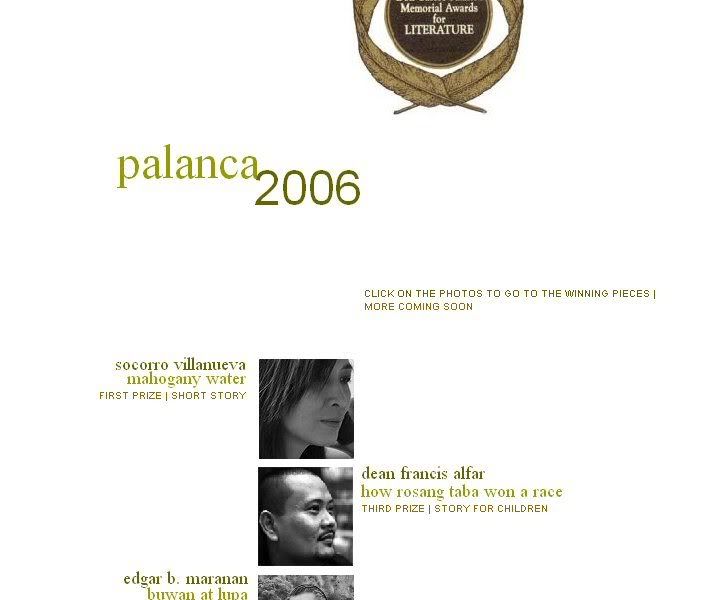
Here you can read the
Palanca award-winning stories, poems, essays, and plays of
Socorro Villanueva,
Dean Francis Alfar, Ed Maranan,
Vladimeir Gonzales,
Michael Francis Andrada, Sid Gomez Hildawa, Myrza Sison, Kristian Cordero, and many others. Of course, more will be uploaded soon.
Enjoy these wonderful pieces, and here's wishing everybody good luck next year...
[update]Works from Larry Ypil, Nikki Alfar, Glenn Sevilla Mas, Elyrah Salanga, Corinna Nuqui, Eros Atalia, Arturo Ilano, and Martin Villanueva newly uploaded! More coming soon...
Labels: palanca, philippine literature
[0] This is Where You Bite the Sandwich
Wednesday, September 06, 2006
By Gilda Cordero-FernandoPhilippine Daily Inquirer3 September 2006
Some time in my life I heard that UP was offering a Ph.D. in creative writing. I said, Wow, pagkakataon ko na. (Now its my chance.) I wanted so much to take up the course but then my friend Myrza Sison said,
"Siguro hindi ka na puwede riyan kasi ang inaaral namin short stories
mo." (No way. We critique your short stories.)
Well, that's good, I thought. Now I'll finally find out what my colleagues think of me.
Then I asked Dr. Jing (Cristina Pantoja) Hidalgo of the UP faculty, who is my friend, if I should take up this Creative Writing Ph.D. She hemmed and she hawed and then said, "
Ay naku, Gilda,
may poststructuralist theory
diyan,
may semiotics,
may postcolonial theory,
may hermeneutics
at marami pa." (Don't bother, Gilda. Here, you have to deal with poststructuralist theory, semiotics, postcolonial, hermeneutics and many others.)
Sub-text:
"Baka hindi ka pumasa." (You are likely to fail.)
E bakit ako di papasa! Akala ko ba doctor of "creative writing"!
Alam kong sulatin ang kini-critique-critique
nila -- essay, short story, poem
kung mapilitan,
nobela pa rin,
bakit hindi puwedeng pumasa? (How can I fail? You are supposed to be a doctor in creative writing. I know how to write what they critique -- essays, short story, poem. Even a novel, if you want. How can I not make it?)
Come to think of it, I had trouble with my master's degree in Ateneo, too. My classmates were doing theses on Katherine Ann Porter, James Joyce, Elizabeth Barrett Browning, T.S. Eliot, cribbing from every book they could get hold of. I just didn't know how to do that. All I knew was how to be
orig (original) all the way.
So one day I told the dean: I have 13 short stories that I can make into a book. Why don't you give me a break and let that be my thesis? That was 1960. I had four children by the time I got my MA diploma and
The Butcher, the Baker, the Candlestick Maker became the first-ever creative writing thesis approved by Ateneo.
Sa mundong ito, kung orig ka, lagot ka. Alam ninyo naman 'yon di ba? Siguro mas marami kayong experience diyan kaysa sa akin. (In this world, if you are unique, you'd bust. You know that, don't you? You must have known that.)
The shape of the majority of institutions around us is square. They fit very well in boxes. Boxes or categories are everywhere you go, stacked on top of one another. They're religious, government, corporate, bank, academe, painting, writing, fashion design. It's the box people who run our lives. Being in a box is what people call normal. But somehow we all know it's unhealthy.
For years cultural institutions had a very hard time trying to categorize artists for awarding. Is he a writer? Then why is he composing librettos? He should fall under "music." And he did a rock opera. He must be "theater." Can even paint! So is he a visual artist? That's strange because I never met a single artist who could do only one thing.
And yet fusion has been around for so long. There's fusion of eastern and western cooking, of rock and opera, of performance and art. There's mixed media art, creative nonfiction, ecumenical mass, gender-bender clothes.
Why does everything still have to fit the seven boxes of classical art, when maybe all one has to do is ask -- is he in artist? And if so, is he a good one? Ah, but that means breaking down all those ironclad boxes!
How we love the comfort zone of old forms! Look at what has been showing in Araneta Coliseum -- Andy Williams, the Four Aces, Barry Manilow, Paul Anka, the Lettermen -- all repackaged as "revival" or "retro." And for crying out loud -- "Gulong ng Palad" -- the sob story of the '60s, is back, too! As if there had never been anything newer! Ah, but new is risky. New is a zone of discomfort.
In the meantime, highbrow formal theater was having trouble breathing and staying alive. Every other Jack was jumping out of the box to put up his own starving thing. These were the living, breathing, evolving pockets of art, snubbed by the very institutions that should be supporting them.
In music, explains my friend, Manny Chaves, there was Club Dredd where the Eraserheads and Parokya ni Edgar began. Then Mayrics on Espana, with Maegan Aguilar and Cookie Chua, then the popular 70s Bistro, venue of Noel Cabangon and Joey Ayala. And now -- SaGuijo in Makati where three to five live bands a week fight to be heard. In Intramuros there was the Sanctum which, with the Republic of Malate, began the "Spoken Word" and its "open mike." It was followed by Conspiracy on Visayas Avenue, with its 99 owners, and Rock Drilon's lively Magnet on Katipunan.
Oh, but the canons had long been set -- what was popular art, also known as
pang-masa, was not to be considered serious art. This very much reminds me of Dr. Doreen Fernandez's columns on food, which were looked down upon by academe because they appeared in dailies and not in literary journals or read in scholarly lectures (which no one attended). But Doreen stuck to her
pancit luglog and
pochero. Today food is internationally considered an important aspect of a country's culture.
Eventually, too, the rock bands, indie movies and the comics were accepted by our powers-that-be of culture. But not before the artists had struggled so hard to make their name! How easy to join the bandwagon! And the movie stars of the
bakya crowd? FPJ made it to National Artist for being a political figure. Dolphy and Nora Aunor before him never had the ghost of a chance!
In literature there were great magazines like
Ermita, Jose, Pen & Ink and
Goodman that died raging against the night. Now it's
Story Magazine gasping for sponsorship. Memorable stage pieces like Bienvenido Lumbera's
Tales of the Manuvu,
Rama Hari and
Bayani were hits in the '70s. But how could they be memorable to people who had missed them or were too young to see them? That's because we have no boxes where filing boxes ought to be! There is no adequate and readily accessible documentation, in print or in video, of the works of major artists nor are these given importance.
In the '70s I remember trying to access from LVN and Sampaguita Studios something as banal as their movie stills.
"Ay wala na ho 'yan," what passed for the librarian said.
"Kaibigan ho ni direk hiniram, 'di na nakabalik. 'Yung iba na-damage
ng typhoon Dading." (We have nothing here. Some were borrowed and never returned. Some were damaged by typhoon Dading.)
Sounds familiar, doesn't it?
And yet, with the right stewarding, that is so easily remediable. In the visual arts, for instance, there is no complete file simply of all the art shows every year. In literature there is no file, simply of all the books by every publisher, campus or independent or professional, printed during the year -- just title, author, date, and a brief description. In the visual arts with only a digital camera and a ball pen, it's so easy today to document every exhibit or gallery happening all year round. Yes, there are books and magazines but they cover only the shows of the bookstores and galleries they work for. In one art awards for young people, several fine works were overlooked simply because the judges didn't know they existed.
Recently I was sharing a pizza with two young friends, Mich Dulce, a fashion designer, and Cecile Zamora, a fashion columnist. Suddenly a whole family from the next table complete with grandkids descended upon Mich, asking for her autograph. Not because she was a talented prize-winning designer, but because they had seen her in
Pinoy Big Brother!
Cecile and I were introduced and ignored. For the next 15 minutes I looked on in awe as they drooled over Mich's clothes, her hair, her makeup, her bling-blings. I had never been through such an experience of marginalization and it amused me no end.
Then a friend who visits Havana described to me its cultural scene. Support of the arts is in the constitution of Cuba. Its artists are national treasures and lionized just as much as its movie stars. Fans run after architects, painters, sculptors, writers, musicians, stage actors and directors for an autograph or to exchange a word or two. Not that I crave such attention, but it could help sell more books and tickets.
By the way, in the writing scene of the '60s and '70s, the Palanca Awards were a class act. Initially there were only a few categories -- short fiction, one-act play, and poetry. People remembered the winners and it helped us get additional fruit for our labors.
Now the prestigious Palanca has been cut up into so many little categories -- 15 at last count, with first, second and third prizes for each category in English and Tagalog and some vernaculars. I always try to remember who the young winners are. But with 40 or so names to keep up with each year, I just gave up. Dare one suggest that the awards be cut down and the prizes raised to dazzling amounts? Surely complaints will arise.
Bakit elitista? (It's elitist!) Why stop the multiplication of the loaves? Because an award is a distinction. It recognizes a major achievement and should be as elitist and exclusive as it can be!
Having so many categories, moreover, leads to a shortage of competent judges. And so writers become alternately contestants and judges which could very easily lead to horse trading.
Kayo ang nagsabi niyan, ha? (I didn't say that.)
Too many winners -- not just in the Palanca but other contests as well -- make winning ordinary. There are wholesale awards, too, where the whole town is with you on the stage. Not that I have not myself gone through a number of those. Once, in addition to the usual writer-publisher citation, a prestigious awarding body cited me as an "outstanding fashion designer." And I can't sew a stitch! I was relieved that there wasn't a couturier in the audience. I thought I'd just let it be, they'd realize their error in time. But then two months later the same awards with our pictures appeared in a newspaper! I brought it up to the awarding body. The official was surprised and promised to look into the matter. I am still an outstanding dress designer.
Another area where the-more-the-merrier seems to thrive is in the distribution of grants. The awarding body says, "There is only this much money to give away and there are so many of you applicants. So we are forced to spread it thin."
Now if a P1 million application for a performance or a film is awarded P400,000 and the proponent has no other source of funding, that is programming the project to fail. And so the theater and film landscape is littered with carcasses of failed grants. I think cutting a big thing up into little pieces whether it is a grant or an award is an invitation to mediocrity.
Who, by the way, checks the outcome of grants -- the shows, the books, the researches, the conferences? Who assesses what succeeded and what failed? Who looks for new grantees? Who checks whether the funders are not also the grantees and the checkers, too? Who assesses which should be given more weight -- a delegation to an important conference or the funding of a promising digital film?
What accounts for our small consumer market for the arts that it cannot make any cultural project survive for long? Even the best performances in CCP, the best art exhibits and the best books? Because the arts have never been considered necessary or important!
In New York everyone knows which new book is out, which play is showing (on Broadway, off Broadway) which exhibit, which musical. People talk about them because the papers seriously cover art happenings. Cultural events are as much a part of their lives as a hotdog. And so people are eager to pay for a ticket or a book they read about.
It's media after all, that shapes our tastes. The acceptance of any creative work very much depends on what is said about it. But an inordinate importance is given by media to society goings-on, fashion and especially beauty, that is why so many people covet a botox, a belly tuck or a pair of Havaianas more than a book. A real review of a cultural event is a rare treat. And you'll never find a short story.
So, who is to blame? The readers? The editors? The publishers? The government? But the government can't even generate jobs for starving people! This is when I get a real nostalgia for Imelda Marcos. She had an artistic vision for the Filipino. She could spot budding talent. She gave scholarships to Cecile Licad, Rowena Arrieta, Coke Bolipata, Raul Sunico and other gifted kids. She established the Cultural Center, the Film Center, the National Artist Awards, the OPM Awards, the Bagong Anyo showcase for Filipino couture, the Makiling High School for the Arts, the Central Bank antiques collection. She was the embodiment of the Filipino
terno, and you never caught her, even at 6 a.m., looking anything but radiant in it. But, of course, it all came with the hole in the sky and needed an entire dictatorship to support it!
Some say it was just her coterie that fed Imelda ideas. But then, she knew whom to co-opt and they were the cream of the crop -- Leandro Locsin, Lucrezia Kasilag, Jaime Laya, Kerima Polotan, Carmen Guerrero Nakpil, Johnny Gatbonton, Yen Makabenta, Adrian Cristobal, Virgilio Almario. I mention this because I never saw such enthusiasm for culture in the two women presidents of the next dispensations. In fact, in a rare appearance, one actually left before Act II of a ballet. No attempt, please, to get Mrs. Marcos back into the limelight, just giving credit where it's past due.
I think the Filipino artist is a hero. He gives so much for so little. He can never collect royalties for his plays or musical compositions, otherwise Freddie Aguilar would be a millionaire now. Poverty is the artist's lot unless he finds means of support other than his art and a wife to hold up half the sky. The government hardly remembers him except when he can be politically used. Big business does not ask him to be an endorser of whiskey, slimming tea or underwear.
But he will passionately craft his piece with no other thought than to give it to the world. At what sacrifice! For next he will abjectly beg and borrow or sell some material possession to send his unrecognized creation abroad to compete. Where it will reap award after award -- for filmmaker, actor, singer, painter, writer, musician, dancer.
Ang galing ng Pilipino! (The Filipino is great!)
The artist is aware of the boxes and boxes that surround him and that the only way to be free of them is to blaze a trail for the bastions of culture to follow. Thus he becomes invulnerable. Because creation is the only divine act of which man is capable and the artist is most like his Maker when he is pouring his soul into his craft.
Labels: philippine literature
[0] This is Where You Bite the Sandwich
GO TO OLDER POSTS
GO TO NEWER POSTS


