Celebration: An Anthology to Commemorate the 50th Anniversary of the Silliman University National Writers Workshop Sands and Coral, 2011-2013
Silliman University, 2013
11:06 PM |
This is Privilege Misbranding Itself as Privilege
A version of this article has been going around, but I always thought it was a joke somebody Photoshopped to make it look like the real deal from Business Insider. Turns out ... the article's real. And it's just ridiculous to know how the privileged can rebrand that privilege as "empowerment." In the real world, almost no one ever gets ahead without daddy's money or connections, or a lucky windfall, or in this case, mommy's "gift" of a job and some real estate. The "hardship" described here has nothing on real hardship. This is not empowerment. [For a bigger image, click here.]
The Philippine Center for Investigative Journalism went to the streets of Manila to ask college students what they know about the 1986 People Power revolt. Here's the video of what they found out:
I think it's true for any struggle. One fights for a cause -- and sometimes is even killed -- to secure the future of the next generation -- who will never ever remember, much less appreciate, the pain you had to undergo to give them that freedom to be ... complacent and forgetful.
That's one of life's biggest ironies.
Here's a true story. Once, many years ago, after my Philippine literature class, after giving my students homework to read up on specific poems by Emmanuel Lacaba, Merlie Alunan, and Ruben Cuevas (Pete Lacaba) in preparation for our discussion on Martial Law literature, a student approached me and asked: "Sir, who's Marshall, and why does he have a law?" To say that my heart sank is understating the impact of my realization: people forget their history fast.
Here's another true story from the mid-1990s. This was during the Final Question Round of a famous -- and very prestigious -- university pageant. The girls were smart, most of them beautiful. I was there that night in the audience, and the question was about Ninoy Aquino. The well-coifed candidate from Mass Communication looked around the venue and finally said: "I'm sorry but I don't know who Ninoy is." Then the host -- another girl, a former beauty titlist herself -- also looked around, and said, "I don't know either." And both stood there, in the middle of the stage, for what seemed like forever, while the entire place gasped at the unexpected spectacle, until finally one of the pageant advisers -- Kuya Moe to all of us -- rushed to the stage and gave the girls, and everyone else, a quick history lesson.
Let's all quote George Santayana now: "Those who cannot learn from history are doomed to repeat it. Those who do not remember their past are condemned to repeat their mistakes."
2:49 AM |
Calling for the Great Condom Buy-In of 2011
There’s a way to respond to the ridiculousness that is Ayala Alabang’s condom debacle. (For those not in the know, the neighborhood just made it a requirement that all buyers of condoms must register.) The answer: respond with equal ridiculousness. So they want registration every time one buys condoms? Pwes. Calling for the Great Condom Buy-in of 2011! All RH Bill supporters — all the thousands of you — go march right now to the neighborhood Mercury Drug and buy condoms at the same time, clamor to be served and fast, and crowd the place out to limit other traffic to the store — and proceed to watch the the entire store frantically list down everybody.
God help me, but a month or so has passed since I last saw Brillante Mendoza's Kinatay [2009], and yet the memory of that visceral journey through Manila's dark underbelly has stayed with me with a malevolent power I can't exactly define -- it is a prickling under my skin, a kind of labored breathing, a haunted voice that plagues the consciousness. It comes and goes, and when it does descend, it unsettles -- as it must. Last night, near midnight, I was bored and had nothing to do, and so I wandered the empty city streets in search for something, anything. That was how I found myself in a wayside eatery, a place I usually go to only after a full night's drunken debauchery, and always with friends. This time, I was alone, and I was hungry. The bored-looking waitress lazily considered my presence and barely made an effort to conceal an undefined irritation. She asked, "What do you want?" Or to be more exact, she gave me a look, her silence more than enough to convey that query. I said, "One order of tocilog, and a bottle of mineral water."
That instantly brought me back to the last few scenes in Mr. Mendoza's film when the men, straight off their fresh butchery of the prostitute Madonna, find themselves back in the streets of Manila and with such unsettling nonchalance, they go back to the ordinary rhythms of life: it is early morning and they enter a karinderia, quite similar to the one I ventured in last night, and they tell the woman who waits on them, "Isang tocilog..." In the foreground of that scene, a pork dish is being chopped, while the woman intones brightly: "Magandang umaga po, may lechon kawali po kami." The juxtaposition of butchered pig as delicacy and butchered woman, of course, is intended, and is meant to unsettle. Coco Martin, playing the rookie cop whose descent into hell is the story of this film, excuses himself from the murderous group and goes to the lavatory, where he retches.
His night and my night are not necessarily far apart. Of course, the crucial difference comes with the fact that he has participated in a murder and I didn't -- but what's to stop with that glaring difference if I had on my own stumbled on the same sort of evil, and like him, did nothing? His day began as ordinarily as I usually begin mine -- or you with yours. And this is the story of most evils. They are completely ordinary. They come to us not with the warning sound of trumpets or the blaring screech of eerie synthesizers, but in quiet, in insidious entrance. And sometimes when we finally realize we have gone past the invisible portals and evil now requires our participation or our indifference, I bet most of us will become accomplices, willing or not. Film critic Roger Ebert, writing about Claude Lanzmann's Shoah [1985], a 9-hour documentary about the Holocaust, tackled that idea of the ordinariness that often cloaks great evil in our midst:
Some of the strangest passages in the film are the interviews with the officials who were actually responsible for running the camps and making the "Final Solution" work smoothly and efficiently. None of them, at least by their testimony, seem to have witnessed the whole picture. They only participated in a small part of it, doing their little jobs in their little corners; if they are to be believed, they didn't personally kill anybody, they just did small portions of larger tasks, and somehow all of the tasks, when added up and completed, resulted in people dying.
And that is how we participate in evil, when we somehow know what's going on, and yet we excuse ourselves by saying, "I was just doing my job," or "I was just being told what to do." Many ordinary people in Nazi Germany knew what was going on -- and yet did not do anything about it.
There are two clinical studies that explain the possibilities of evil that reside within every human being. One is the now-famous Stanford Prison Experiment of 1971 where one set of participants (the "prison guards") started exercising their sadistic impulses on another set of participants (the "prisoners") without inhibition the moment they were "permitted" to do so by a "higher authority." The other famous attempt is the Milgram Experiment of 1961, where participants perplexingly allowed themselves to "electrocute" an unseen subject to certain fatality -- even when they protest -- as long as a "higher authority" orders them to do so. The men in Kinatay perfectly captured that. Acting on the orders of Kap -- a captain in the police force who is also (not so ironically) a crime kingpin -- they extort from roadside vendors, and they kill. And they do so without protest. It is "just" a job.
I quote Mr. Ebert's appraisal above because it is ironic that he would see a fine film in Lanzmann's effort, and not see the same in Mr. Mendoza's. When Kinatay was shown in Cannes in 2009 (where it won Mr. Mendoza the Best Director prize), Mr. Ebert was one of its most vocal critics, calling it the worst film ever presented in the august festival. He decries its abuse of idée fixe, its murky darkness, its incessant noise -- and then wisely puts up an armor to deflect the coming criticism:
You mark my words. There will be critics who fancy themselves theoreticians, who will defend this unbearable experience, and lecture those plebians like me who missed the whole Idea. I will remain serene while my ignorance is excoriated. I am a human being with relatively reasonable tastes. And in that role, not in the role of film critic, I declare that there may not be ten people in the world who will buy a ticket to this movie and feel the money was well spent.
I am a great fan of Mr. Ebert -- but I found that all-encompassing dismissiveness a little appalling. But I will be one of those critics. The murk? It's the perfect atmosphere for this story about the descent, this long journey, to hell. The incessant noise? That's the ordinary, bone-reaching sounds of the streets of Manila -- alien perhaps to Western ears, but perfectly common to ours. (The ambient sounds, compounded with the sheer tension of Teresa Barrozo's music, is the apt soundtrack this kind of story demands.) Was my money well-spent? I am also a human being with relatively reasonable taste -- and you bet it was. Yes, it is a discomforting film about a wretched story, and its aesthetics, as far as I am concerned, is what the story demands -- because how else to handle such a story? Certainly not with subtlety, something so prized by Western critics; we are beyond subtlety in this regard; what we need is art that is also a slap to our face. And this is certainly a slap. I don't think I can watch this film a second time, but that is a testament of its power. It is already so heavily imprinted in my brain, anyway, so I don't need to.
You see, Mr. Ebert, I watch the film and I see it as a dark but painfully true reflection of my sad country. Ordinary evil like this exists -- persists -- in my midst. The politicians are corrupt. The cops are murderers. The religious men are charlatans. And the common tao knows, and has reached the point of no longer caring.
Last week, for example, a six-year old girl in Cebu was kidnapped -- and later her battered body was found in a dirty sack thrown off a cliff. (What kind of people would do that?) Two years ago, a massacre of journalists exploded in a province called Maguindanao, a barbarity apparently sanctioned by its governor. There are a thousand other similar tales, but I don't want this post to become an encyclopedia of these dark things. The thing to realize is that these atrocities happen so often in my country, Mr. Ebert, that most of us have learned not to be shocked anymore. We have lost that crucial capacity for real outrage, because evil has become so pervasive, it has become ordinary. And most of us have learned to look away, to ignore that these things do happen. These people who have chosen to ignore these things are people one might even call God-fearing, even decent. But what they do not know is that by sheer indifference, by looking away, they participate in evil as well.
What I do know is that we need movies like Kinatay, if only to act as unwanted but needed reminders. When the film was shown in Dumaguete a few months back, the opinions were sharply divided. In the Silliman University Cultural Affairs Committee Facebook page, a certain Cereu Romero commented: "A grues0me,h0rribLE, ridicUL0Us, w0rst m0viE EvER pr0dUcE." (I have retained the original spelling and grammar for a reason.) And there you go. Such ignorant sentiment underlies the importance of films such as this. For these people perhaps, films are to be thought of as "for entertainment only." Which is sad, and largely myopic about the role of art in our lives. But not all films, not all great art, are meant simply to entertain. Sometimes they are meant to unsettle, especially when they show a true and hard reflection of what's happening in the society that surrounds us. What we see will most likely repulse many of us, make us retch the way Coco Martin's character did in the end. But retch all you want. That's an important reaction -- it marks you as human still capable of shock.
But don't look away.
And do acknowledge that these things really happen. Most of all, however you can, do something about them. Don't just look away.
[This is not a review of Kinatay. If you want a great review, read Francis Cruz's take on it in his blog Lessons From the School of Inattention.]
Christina Aguilera bungling The Star Spangled Banner in the Super Bowl is proof of what’s wrong with much of pop music today: it’s all about the riffing, and to hell with good lyrics. In The Huffington Post, John Eskow writes: “It’s called melisma — the bending of syllables for bluesy or soulful effect — and what’s especially creepy about the way it’s used now is that it perverts America’s true genius for song, as evinced by its creators in the world of gospel and R&B, like Ray Charles and Aretha Franklin. You will hear more of this tonsil-twisting insincerity — to your eternal sorrow — if you watch any episode of American Idol.” Read more here.
Now let's take a look at the more iconic take on the song from the same event: Whitney Houston's now-famous rendition...
Granted, this was pre-recorded, but listen to the possibilities when you pay respect to the song and not the riffing...
2:17 PM |
How to Be an Artist Without Really Trying
Truth to tell, I find myself stumbling all over the place trying to write something coherent about this film I have just seen. In a way, I am struck dumb by it. It is not because the film is bad; it is because it is very good, and perhaps my flailing has every thing to do with a conscious effort to process whatever it is about this documentary that impresses me as a work of genius. It got to me. I think I understand it in a deeply emotional and intellectual level, but it finally comes to me as a treacherous Chinese box: a film of so many layers, that to penetrate one is just gaining entry to another layer that leads to other layers. It playfully winds itself in unexpected ways even as we unravel it. This is the multidimensionality of Christopher Nolan's Inception taken to the heart of the art world and given the attitude of a prankster. Why do I say that? Because in some maniacal level, the film also seems to mock me: So you pretend to get me, eh? it says. What a pretentious ass you are. In many ways, that feeling is exactly like being a visitor to "Barely Legal," Banksy's landmark exhibition of his street art in 2006, and getting a souvenir that says "I Can't Believe You Morons Actually Buy This Shit."
I love Banksy's Exit Through the Gift Shop [2010] -- but the nagging question remains: what if what I'm buying is just "shit," a high concept joke? No matter. Because, divorced from all other post-modern considerations, it is actually a sincere film that (1) documents quite well the street art scene, but also (2) gives a devastating illustration of how we -- in an effort to be "in" or to be part of "cool" -- are easily taken in by so-called artists whose gifts may lie more in hype and personal showboating than in actual artistry. Pop Art has always been about skewering our unthinking allegiance to consumer culture. But in the ironic twist of eventually becoming part of that consuming culture it mocks (galleries! agents! shows! modern art buyers!), the film shows it is much like seeing a snake eating its own tail.
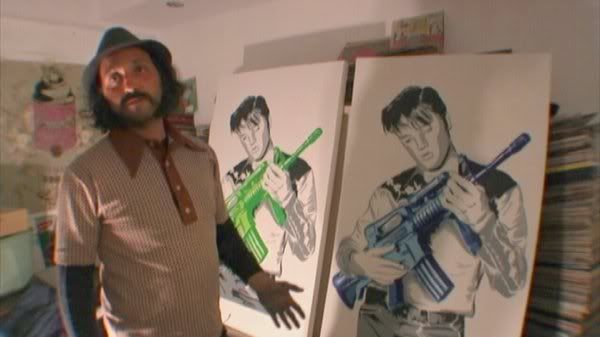
Consider, for example, the scenes in this documentary where we get the ambush interviews of people who have just witnessed the unveiling of Mr. BrainWash's debut exhibit in Los Angeles. In context, we have just seen the mad hamminess of Mr. BrainWash, his "artistry" nothing more than mere supervised scanning (by other people in his employ) and re-imaging (also by other people in his employ) of iconic works already out there. His works are derivative and uninspired, with none of the wit or the intelligence of the street artists he wants to emulate. (How many times can you rip off Warhol, put a Marilyn Monroe wig on everybody from Spock to Larry King, and still be considered somebody with something worthwhile to say?) But a careless banner story in the L.A. Weekly has already proclaimed him a new artist of grand reckoning -- hype that Mr. BrainWash has engineered himself. And so what do we get from the eventual ambush interviews? Of people fawning, just because they have been "told" to fawn. Most sputter something about the "genius" they have just seen, with some quite unsure about the artistry of most of the works in exhibition yet stammering on to confused conclusions that these works do "say something" about contemporary culture. I realize: we are those people. We do buy shit, especially if it's wrapped in hype and is labeled "cool."
We are these people who see blatant mediocrity jazzed up in some ways in an exhibition (or in a film festival!) -- and just because it just doesn't seem to run like the usual, we immediately proclaim it as a work of utter genius. (Alas, this is much the same way people lauded Francis X. Pasion's terrible Sampaguita, a messy soup of a film from the poverty porn factory that sadly belied his success in Jay.)
Mr. BrainWash -- nom de guerre of the (eventually) exasperating homunculus in the center of Banksy's many-layered documentary -- is either a hoax or a living/breathing symptom of everything that is wrong about pop culture and our unthinking consumption of it. In real life, he is Thierry Guetta, a French transplant to Los Angeles and one-time vintage clothes retailer whose obsession with videotaping every minute of his life has somehow led him to become an unwitting "documentarian" of street art, just as its popularity and mystique are exploding all over the world's metropolitan centers. (Think New York, London, and Paris.) He was on the scene at the right time and the right place, his entry to this world being an accidental footage he captured of his cousin -- the French street artist Invader -- at work gluing characters from the computer game "Space Invaders" (made from colorful square tiles) all over the streets of Paris. This chance glimpse eventually leads to other street artists that Mr. Guetta eventually films -- Seizer, Neck Face, Sweet Toof, Cyclops, Dotmasters, Swoon, Buffmonster, Monsieur André, Zevs, and Shepard Fairey -- big names in this counter-culture art world that works in the shadows, always on the sly, always courting danger and legal wrangling. What fascinates us about them is that they give us works that, first of all, titillate because they work outside the normal structures of the so-called art world, but also because they are witty surprises in paint or stencil that take our ordinary physical world, and gives it a dimension that unnerves or amuses. Consider Banksy's murdered phone booth in a London alley below...
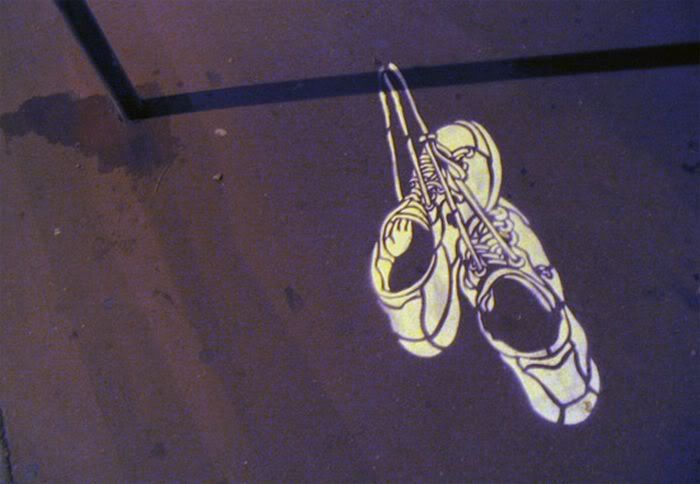
Or Ellis Gallagher's stenciled sneakers at play with shadows in New York...
One figure proves elusive, however: Banksy, the English street artist whose notoriety is exceeded only by both the unalloyed provocation of his genius and his preference to keep his identity (and process) hidden from public scrutiny. But a chance encounter eventually lets Banksy take in Mr. Guetta in confidence, allowing even the Frenchman to videotape him at work, citing the ephemeral nature of his art that cries for documentation. It's graffiti, after all, and like most graffiti, they're eventually effaced. The documentary, we are told, came about because of a challenge: Mr. Guetta has amassed years and years of footage, which he claims he is putting together into a documentary. Now the artists are wondering: when will the film be finished? Mr. Guetta hastily puts together a film he calls Life Remote Control, an unwatchable mess that runs for more than an hour, clearly the work of a person who is not in any way a filmmaker. It is at this point, so we are told, that Banksy takes control of the footage, and turns it on Mr. Guetta. The film starts to take another direction as we follow Mr. Guetta try to become a street artist himself, but as somebody who wants to take the short cut and get right to the top -- culminating in the aforementioned exhibit, his debut Los Angeles show called "Life is Beautiful." We are finally shown the process of how a small man -- utterly talentless in every way but imbued with the implacable sense that he is, or can be, a real artist -- can make it big in the modern art world, given hype and self-promotion.
That was painful to watch. I cringed, and cringed. It all seemed so familiar. Because how many people do we know who are exactly like Mr. BrainWash? People without an eye for composition, but call themselves photographers just because they have a DSLR or know how to Photoshop? People who have no concept of mise-en-scene, but call themselves film directors because they happen to have a camera and a screenplay on standby? People who don't read, but call themselves poets because they have feelings they want to share and they can rhyme? People who have no idea of artistic space and functionality, but call themselves furniture designers because they can cobble wood into slightly interesting shapes? People who dress up in eccentric clothing, wear their hair in strange ways, and call themselves "artistes" -- but are without the slightest discipline to produce anything?
And of course, there are the people who lap all that bullshit up.
This documentary is a great meditation on that, and the artistic process -- but at the same time, it also plays as a kind of mind game knowing Banksy's reputation as a prankster. Is this film for real? Is that hooded man even Banksy? In telling the story of Mr. BrainWash, is he giving us a deep look into the world of street art, or is he mocking us the viewers as the ultimate recipient of this joke? Who knows?
Read an interview with Banksy by All These Wonderful Things' AJ Schnack here.
[Acknowledgments: the photo of Ellis Gallagher's street art is lifted from Boredom/No Boredom and the photo of Banksy's Telephone Booth is from Art of the State.]
There was a time when we tuned in to MTV to find the coolest music videos. There was a time when it really meant what its acronym stands for: "music television." And there were some really cool stuff, like Daria and Beavis and Butthead and the first wave of The Real World and Unplugged. Now you tune in to view the lives of serious losers. There was Snooki, and now there’s Paris Hilton looking for another disposable BFF.
My friend, the much-missed speculative fictionist Baryon Tensor Posadas, recently posted a link to this New York Timescolumn by the cultural critic Stanley Fish, where Fish essentially announces the death of the humanities, especially in the academe. I paid close attention because this was personal: I am a teacher in the humanities, and I write, and the production and cultivation of culture has always been the focal point of my existence. I paid close attention because if the humanities is dead, has my life so far been essentially worthless?
In his column, Mr. Fish takes to task George M. Philip, the president of SUNY Albany, who last October 1 "announced that the French, Italian, classics, Russian and theater programs were getting the axe." He then does an extensive postmortem about how Mr. Philip got away with murder, and goes on to entertain the age-old debate once more about the worth of the humanities in contemporary life, especially in a world racked by a recession. He writes: "What can you say to the tax-payer who asks, 'What good does a program in Byzantine art do me?' Nothing."
He goes on:
But keeping something you value alive by artificial, and even coercive, means (and distribution requirements are a form of coercion) is better than allowing them to die, if only because you may now die (get fired) with them, a fate that some visionary faculty members may now be suffering. I have always had trouble believing in the high-minded case for a core curriculum — that it preserves and transmits the best that has been thought and said — but I believe fully in the core curriculum as a device of employment for me and my fellow humanists. But the point seems to be moot. It’s too late to turn back the clock.
What, then, can be done? Well, it won’t do to invoke the pieties ... — the humanities enhance our culture; the humanities make our society better — because those pieties have a 19th century air about them and are not even believed in by some who rehearse them.
And it won’t do to argue that the humanities contribute to economic health of the state — by producing more well-rounded workers or attracting corporations or delivering some other attenuated benefit — because nobody really buys that argument, not even the university administrators who make it.
There are no easy answers to the dilemma, and Mr. Fish does not even offer anything. Might as well. But he does underscore the notions of politics and ineptitude in the part of leaders who should know better as really the main causes of humanities' death. Academic leaders, he says, are supposed to be cheerleaders of the pursuit of education and knowledge, not undertakers who are only concerned about the bottomline. I firmly believe that something fundamental dies when the humanities in our culture is allowed to die. It is like a skewering of our soul.
I am already living through this. In the university where I teach, for example, I was shocked last semester to find out that the biggest college we have has dropped literature from its curriculum, simply because its autonomy from CHED declared it could. In essence, they rendered Philippine and world literatures unnecessary in the making of a thinking professional. It was a sad day when I found out this. And I could not just fathom that notion: how do you go to college without at least having a smidgen of literature in your academic life? What are we trying to produce, unthinking and unlettered robots? It felt like a kind of death.
My fellow teacher Sherro Lee Lagrimas also wonders: “What will they remove next? Have they forgotten this C.S. Lewis quote? ‘Literature adds to reality, it does not simply describe it. It enriches the necessary competencies that daily life requires and provides; and in this respect, it irrigates the deserts that our lives have already become.’” I’m not sure they have forgotten; they just probably do not care anymore.
All these also make me realize that sometimes those who are in-charge of our educational institutions, good-intentioned they may be by the cuts that they make, are often blind to the big picture. A friend, the Hong Kong-based journalist Heda Bayron, once told me a story: “A couple of years ago, I had the pleasure to meet and share a dorm room with an MIT professor emeritus in French Studies. She teaches French literature and fills a lacuna in the education of MIT’s math and science geeks, making them much more well-rounded human beings. Learning French literature or Chinese literature also makes MIT students more competitive in the global stage because success is no longer about your math aptitude or quaint skills, it’s also about how you conduct yourself. And you can only rise above the crowd if you possess a wider perspective.”
I don't know why but this whole thing made me think, somehow, of the writer Ayn Rand, but in a different light. In her polemic novel Atlas Shrugged, conversant of her belief that capitalism is the very engine of the world, she paints a possible time when all of the world's business leaders, innovators, and entrepreneurs go on a strike, hide from the rest of society who does not care for them, and watch that society slowly eat itself up from its uselessness. I wondered if somebody could write an artist's equivalent of Atlas Shrugged, where, instead of business powermen going on strike, artists will leave the rest of the world behind to wallow in its filth of no artistry and no soul.
My question though is this: if we follow these people's logic about the humanities not "contributing" anything to the economy or whatever, I counter with this idea of bankers and Wall Street people having seriously fucked up the economy and have given "the American way of life" the black eye. Why aren't business schools being closed down?
And then this: when I was in San Francisco, the city was trying to gentrify the down-on-its-luck Dogpatch industrial neighborhood near Arleta by inviting artists to come in and enjoy the low-rent warehouses. And many artists have come in, turning many of these unused warehouses into studios. There is now an upswing in the standard of living in that community, still in the beginning stages, but it's there. The city of course knows that this effort to bring in artists would soon bring in other people and other businesses -- cafes, boutiques, galleries -- and soon bring in the dollars. This has happened in New York, in Chicago, and in many other cities.
And soon, of course, this is what happens: the artists who have gentrified the neighborhoods in the first place have to move out because they can no longer pay the rent.
Gah.
In both cases, artists always seem to get the short end of the deal.
On another note about Stanley Fish, he posits that Rob Epstein and Jeffrey Friedman's Howl (2010), the pseudo-biopic of the poet Allen Ginsberg (played here by the swoon-worthy James Franco) is the first film to be a perfect demonstration of literary criticism at work. I cannot wait to see this film in New York.
I've been guilty of this. But no longer. Starting this semester, I've been telling my students to buy the original copies of books I'm requiring them to read. Absolutely no photocopies. Because I think, as teachers, we have somehow helped create a culture of disregard for books and reading by allowing our students to photocopy pages upon pages of text, with utter disregard for copyright and the authors' bottomline. It has also reduced written works produced with so much sweat and blood and research to the level of the cheap and disposable. No wonder there is a diminished regard for the writing profession in general to the level of the impractical. No wonder people keep going up to me, always asking for free copies of my book, as if they can do the same with an engineer, or a doctor, or a lawyer. Living in a third world country is no excuse. So yes books can be expensive sometimes. But that's paying premium for knowledge gained and a sense of literature found. You're already paying almost P400 a month to cable television that gives you nothing but the WoWoWee kind of stupidity. Why can't you do the same to something that can actually make you think and ponder and learn?
In her radio show, Dr. Laura Schlesinger said that, as an observant Orthodox Jew, homosexuality is an abomination according to Leviticus 18:22, and cannot be condoned under any circumstance.
The following response is an open letter to Dr. Laura, written by a U.S. man, and posted on the Internet. It's funny, as well as informative:
Dear Dr. Laura:
Thank you for doing so much to educate people regarding God's Law. I have learned a great deal from your show, and try to share that knowledge with as many people as I can. When someone tries to defend the homosexual lifestyle, for example, I simply remind them that Leviticus 18:22 clearly states it to be an abomination ... End of debate.
I do need some advice from you, however, regarding some other elements of God's Laws and how to follow them.
1. Leviticus 25:44 states that I may possess slaves, both male and female, provided they are from neighboring nations. A friend of mine claims that this applies to Mexicans, but not Canadians. Can you clarify? Why can't I own Canadians?
2. I would like to sell my daughter into slavery, as sanctioned in Exodus 21:7. In this day and age, what do you think would be a fair price for her?
3. I know that I am allowed no contact with a woman while she is in her period of Menstrual uncleanliness (Lev. 15: 19-24). The problem is how do I tell? I have tried asking, but most women take offense.
4. When I burn a bull on the altar as a sacrifice, I know it creates a pleasing odor for the Lord (Lev. 1:9). The problem is my neighbors. They claim the odor is not pleasing to them. Should I smite them?
5. I have a neighbor who insists on working on the Sabbath. Exodus 35:2 clearly states he should be put to death. Am I morally obligated to kill him myself, or should I ask the police to do it?
6. A friend of mine feels that even though eating shellfish is an abomination, Lev. 11:10, it is a lesser abomination than homosexuality. I don't agree. Can you settle this? Are there "degrees" of abomination?
7. Lev. 21:20 states that I may not approach the altar of God if I have a defect in my sight. I have to admit that I wear reading glasses. Does my vision have to be 20/20, or is there some wiggle-room here?
8. Most of my male friends get their hair trimmed, including the hair around their temples, even though this is expressly forbidden by Lev. 19:27. How should they die?
9. I know from Lev. 11:6-8 that touching the skin of a dead pig makes me unclean, but may I still play football if I wear gloves?
10. My uncle has a farm. He violates Lev.19:19 by planting two different crops in the same field, as does his wife by wearing garments made of two different kinds of thread (cotton/polyester blend). He also tends to curse and blaspheme a lot. Is it really necessary that we go to all the trouble of getting the whole town together to stone them? (Lev. 24:10-16). Couldn't we just burn them to death at a private family affair, like we do with people who sleep with their in-laws? (Lev. 20:14)
I know you have studied these things extensively and thus enjoy considerable expertise in such matters, so I'm confident you can help. Thank you again for reminding us that God's word is eternal and unchanging.
Your adoring fan.
James M. Kauffman, Ed.D. Professor Emeritus, Department of Curriculum, Instruction, and Special Education University of Virginia
P.S.
It would be a damn shame if we couldn't own a Canadian.
7:00 PM |
High School Blues, Sixteen Years Too Late
There's something I need to get off my chest. I don't know why this bothers me so. This is usually something I totally ignore -- but my mind keeps returning to this, like the way we do with scabs we love to pick, again and again. I have a high school classmate. A girl. Pretty, let's just say. She was normal in high school, I guess. I don't really remember her much. And I'm actually closer to her younger sister. This one hasn't been to any of the reunions, so I have completely forgotten her. Last May, she added me in Facebook. I remembered her name, it sounded familiar. "Hey, it's that girl," I said. I clicked "Confirm."
Let's call her Suzy J.
The next day, Suzy J. writes me a dramatic letter. How she has never forgiven me for something. You see, in Silliman High, we have this tradition in the Junior Sillimanian, the high school paper, where specific members of the roster of graduating honor students would write an assigned essay. One is the Class Will and Testament, where the Graduating Seniors bequeath responsibilities -- even talent! and specific things like books and what-not! -- to the members of the Junior Class. Another one is the Class Prophecy, where an appointed "prophet" predicts the future of the Seniors. Here we marry off each other, give each other fantastic jobs, and exile each other to even more fantastic foreign lands. All in good fun of course.
Come to think of it, I think I wrote both. Anyway...
Suzy J. wrote me in Facebook [unedited]:
Ian, you forgot to put my name as one of your classmates who have a golden voice in the Last Will and Testament in Highschool... Marrianne Joy Ga was defeated by me in the Singing Contest. I always won singing contest inspite of me being Philosopo .. i am not that ugly... I also have a golden voice... Anyway, I understand although I was deeply hurt by it.. You must have been busy studying you forgot to know your classmates more... I understand that you need to study because you need to... I just want to express how I felt about the Last Will and Testament you gave years back.. What a relief I finally said that to you.. God bless you... But I am thankful you never failed to know I've got brains more than I have the body and I love you for that.. It is just that I reaally do have a lovely voice.. hehhehhhe. LOL...
My immediate reaction went this way: Sheeesh, girl. High school was fifteen years ago. Grow up! I never replied. Still, I categorized her in one of my many Facebook friend tags, and in her particular case: "High School Buddies" + "No Chat Zone."
The other week, at the apex of preparations for the opening of the 48th Cultural Season of Silliman University, where I am a member of the Cultural Affairs Committee [in charge of publicity and general programming], I sent invitations of our upcoming events for the year to specific people. Facebook helps a lot. And tags in Facebook help in selecting special targets; and because this was a Silliman event, I naturally included in the invitation everybody categorized as a "High School Buddy."
She soon replied with something terse: "Stop sending me invitations. I'm in Ateneo now."
In that haughty tone that just riles you up. It says, I'm in Arneo now, I cahn't be bothered.
I replied: "Hormonal much. No wonder I don't remember you from high school."
I have always loved May time in Dumaguete. It was always, always magical -- as if the city was born for this time of the year. There was always the smell of sweet sepia coming from everywhere, the acacia trees and the sight of sea combining to make aflutter any romantic's heart. There was that constant bohemian air. There were those sultry summer days and nights that led to adventures of the senses. There were concerts, exhibits, dance and music mixers, beach outings, mountain trips, and endless unplanned dinner partiess with friends and family.
What happened?
There has only been crippling heat so far, and everybody's always sick. The artists are gone, the writers are in the mountains. The "parties" feel tired. The only excitement that has come into our summer lives was the rabid election spirit that had sowed only division and untold recriminations.
It's not about high expectations and the disappointment that comes with it, either. We've always expected May time in Dumaguete to be magical, and it has always delivered. So what happened?
Yesterday I received an email from what I assume to be a comics industry colleague, forwarding an article by Buddy Cunanan on why he will be voting for Manny Villar.
This post is not a point by point rebuttal of that forwarded article. The truth is, this is not a reaction to that article at all. I am simply offering my own separate views on why I won’t be doing the same thing.
Here was my response:
Since I received a message of endorsement for Manny Villar in a bulk email, I cannot help but offer my own opinion in return. I notice that there are many in this list who belong to the comics industry, and perhaps the art industry as a whole.
As an artist who values my freedom to express myself in my chosen field of art, I am honestly, and desperately terrified of a Manny Villar presidency. And I believe all artists in the Philippines should be.
Some of you may now no longer remember that as a Senator, Manny Villar filed a bill with the Senate called the “Anti Obscenity Bill”, or the Senate Bill 2464 where there is a strongly worded provision that portrayal of “nudity” in art will be punishable by law REGARDLESS OF THE MOTIVE of the author.
We all know the evils of pornography, and it is something I myself do not condone. But I also celebrate the beauty of art, and my God given human right to enjoy it and to create it.
As an artist, it is a bill that gravely concerns me because it has the potential to seriously curtail not only my freedoms as an artist, but my the ability to make my own choices as a mature, intelligent and moral human being.
By punishing the portrayal of nudity regardless of the motive of the author, it means nudity can no longer be portrayed by painters, filmmakers, graphic novelists, illustrators, sculptors, etc. Books on anatomy will now have to be censored, as well as medical books, history books specially on images of nudity on religious structures such as the Sistine chapel. Artists can no longer use nudity to portray innate human beauty.
Rightly so, the bill did not get the proper support in the Senate, and was shelved. Even then, by his filing of this bill, we get a definite idea of who Manny Villar is in terms of his views on art. He wants to censor it. He is of the belief that an adult Filipino is not capable of being mature enough to choose for himself (or herself) and decide for himself what to read, see, and hear. In other words, he does not believe that we can think for ourselves. He wants himself, and other people in power to think for us, and to decide for us, what is good for us or not.
This a reflection of Manny Villar’s character, and I’m sure this is how he will approach other issues as well. This has repercussions well beyond the field of art.
Manny Villar attended a Blogger’s meet last year to discuss with the youth the issues that concern them. My friend Jonas Diego attended this meet, and several times during the meet, he tried to raise the issue of the Anti Obscenity Bill. Jonas was never even given the chance to properly finish asking his question before he was waved away, his question trivialized and de-emphasized.
Not only has Villar shown that he is perfectly willing to censor the artist, he is also perfectly willing to ignore us as well.
This issue is a legitimate concern and is NOT black propaganda. It’s still up to you if you still want to vote for this man or not. But I feel that I needed to raise this issue, at least one more time just to let people become aware of just what they’re getting into.
I myself am not endorsing anyone in this election. Who I vote for remains a personal issue. This is not a campaign to steer the vote in favor of another candidate. I just feel that come election day, everyone should be made aware just who it is they’re putting into power.
Because by God, we’ll be paying for it for the next six years. Election day is the one day when we have the power. I hope and pray people use that power responsibly.
Somebody in my life texted me today. "I finally liked your column this week," he says. That's how he gives compliments about how I write, in an underhanded way that is annoyingly supercilious. I used to be bothered about it, but I've since realized I don't really write for people who writes "the same" as "de same."
"What will you do in bed? Stare at each other? That is supposed to make her happy?" ~ Patrick Seagrove
I am beginning to believe that those who like to throw around, with such careless abandon, the much-abused phrase "I don't believe in labels" are actually lazy idiots who think they can get by in the world in spineless namelessness. For example: "I'm not gay. I'm not straight. I just believe in love. Why label love?" Fuck that. You're already naming that chemical reaction inside you as "love." That's labeling. You cannot get away from naming. It is a basic function of intelligence that has a link to the spiritual. "In the beginning was the Word" -- even the Bible says that. If you think hard about it, such abandon of refusing to name oneself actually most often produces unexpected hurt and pain, especially for the party that has been [or will ultimately be] fooled/hoodwinked. It's the philosophical equivalent of fence-sitting, the coward's cop out. Be gay. Be straight. Whatever. Just deal with it. Don't live in the world that is full of shadows and call it paradise.
Over lunch in Jutsz Cafe, where I have my favorite dish of garlic fish fillet with salad, I begin filling out the calculations for my red mixed income form from the Bureau of Internal Revenue, which came with the regular income tax return. Michael, our English Department secretary who knows his accounting stuff, had earlier done the complicated mathematics for me—all those numbers swimming in my eyes signifying nothing.
Already that morning, I had dutifully made my annual pilgrimage to City Hall to get my CTC, my cedula.
In my head, the route for the rest of the afternoon is well-laid. I’d stop over at the BIR main office near the Capitol to have my documents checked. Then I’d scoot over to the nearest bank and pay whatever penalties I am supposed to pay. I’ve done this ritual every April for so many years. The only hassle I have ever encountered was once forgetting the filing deadline in 2007, and I had to frantically do the required legwork precious minutes before the banks closed. Afterwards, I think, I’d go home, pick up my laptop, go straight to class, lecture on Contemporary Philippine Literature, go to the gym, go home and shower, go to Maoai Benitez’s birthday party, and then watch Broken Hearts Club with The Hive. Perfect.
The BIR office is friendly enough. Entering its premises, I find a gigantic poster of the BIR head commissioner in a pose gesturing welcome. I think it funny how our high officials find it always necessary to put their visages on such things.
Inside the BIR, I joke around with fellow Silliman University employees who are, like me, doing their filing at the 11th hour. The nice BIR office lady tells me everything in my documents seems in order, but tells me only to change my entries in my red form from pencil marks to ink. I say thank you, and I proceed to redo the form in ink.
“Where can I pay my mixed income tax?” I ask later.
She smiles and says, “Well, there’s Landbank, and there’s DBP.”
I think: DBP is just a little too far, near the Boulevard. Landbank, on the other hand, is only a stone’s throw away from the Capitol Area. So I go down from the BIR building to the highway—and there I realize that there is no tricycle headed in the direction of Landbank. The DPWH has closed the strip to do repairs on the road, and public transportation has been routed somewhere else. “Great,” I think of the public works being demonstrated right in front of me. “This is my tax pesos at work.”
I decide to walk the length between the Capitol Area and Landbank. It’s not too far, I think. Under the 1:30 sun, I walk and brown in the sweltering summer heat.
I arrive in Landbank. I ask the guard on duty, “Where do I file my income tax?”
He nods towards the teller, “Go straight over there.”
I go to the teller. “Is this where I file my income tax?”
She says, “Go to the BIR representative over there. He will first approve your documents.” She points at his direction with her lips formed into a snout.
The BIR representative stationed in Landbank turns out to be an overeager asshole who gives me an unnecessary hard time.
I give him my forms, the same forms the people in the BIR main office have already gone over.
“You need to change this red form to the blue form,” he says, in a tone of such bright overeagerness it borders on the infuriating know-it-all.
“But I’ve always used this red form for my mixed income.”
“No,” he insists, “you have to.”
I look over the new form. “But the calculations are not the same anymore then, and my accountant has already filled in the calculations. Do you expect me to recalculate all this?”
“It’s the same,” he insists.
“But I have always used this form.”
“If you insist on using the red form, you will be liable for a tax audit.”
A tax audit? On a fixed income?
I sit down and study the difference between the two forms.
I text Michael at the department and my friend Jacqueline at the Silliman Business and Finance. These people will know what to do, I think. They breathe these things. But they tell me to just follow the BIR rep’s suggestion.
I study the forms some more. “But the boxes for the amounts are no longer the same,” I tell the overeager BIR rep.
This goes on for more than ten minutes.
“But they are the same,” he says.
“They’re not.”
“They are.”
“They’re not.” I become exasperated. I sit down, and try to fill out the new blue form anyway. They are not the same.
I think: I can get out of the bank, and have Michael recalculate this. Or, or...
Or go to another bank.
I immediately stand up and get out of Landbank, planning on a quick transfer to DBP.
Thirty minutes have elapsed.
There are no tricycles headed that way. So I walk again, under the heat of the sun, from Landbank to the Boulevard Area. I tan with each ticking second.
I arrive at the DBP. It is past 2 pm. The guard stops me. I tell him I am there to file my taxes. He asks, “How many sets of payments?”
I blink. “What do you mean?”
He takes my forms and starts counting. “One...,” he intones, “two... three... You have to fill out these three individual payment forms.”
An older guard suddenly comes out of the bank’s doors. “Are you sure?” he asks the first guard. He, too, counts my forms. “He only needs one payment form to fill,” he says.
“Oh,” the first guard says. “Okay then.”
I take the new form.
“Here’s your number,” the first guard says. “They will call you with this number.”
My number is 82.
“Do you have a cellphone?” he asks.
“Yes,” I say. “Why?”
“Leave it here with me. You can’t bring it inside,” he says, and then gives me another number. It is a claim tag. It is numbered 8.
“Okay,” I say, giving him my cellphone. “Where do I go after this?”
“Fill out the payment form first, and then go to that BIR representative stationed over there,” he says.
Yes, another BIR representative.
“Okay,” I say.
I sit down at the nearest couch and fill out the new form. It is mercifully short.
Then I go to the BIR representative seated at her table. She looks over my forms, including the OLD red one I had refused to change, and then she tells me, “Everything is in order. Please wait for your number to be called.”
In my head, I am screaming: What? What? What? What exactly was the problem with that other BIR representative in Landbank? How can two BIR representatives disagree on procedure?
I sit down and wait for my return. It turns out to be a long, long, long wait. But the electronic call number above the tellers’ heads does not seem to be working, and the numbers they are calling out do not seem to make sense with my own number. I am 82. They are calling out digits immediately after 10. Surely I am not supposed to be here in the bank forever! I go back to the guard outside.
“Are you sure this is the right number?” I ask.
He looks down at his work station—and on top of it was a merry pile of other numbers. He picks out a smaller one. Now I am No. 38.
Such system! I laugh inside. I am slowly being torn to pieces by the madness of it all.
I go back to the air-conditioned interiors of the DBP, wanting only to laugh at the absurdity, at the randomness of everything. I feel like I am in a Kafka story.
The minutes drag. I fall asleep where I sit.
I must have been inside that bank for more or less two hours.
And then finally, a voice rings out. “Number 35, 36, 37, 38, 39, 40...” and so on and so forth.
I rush towards where the voice is, and the kind-looking teller takes my form. “Please wait to be called again, sir,” she says.
I wait for thirty more minutes.
And then finally, my name, ringing out from another teller’s mouth.
I pay my taxes.
Soon I drag my feet out of the bank. I claim my cellphone from the guard’s desk. I begin to send out cranky messages to the rest of the world. I look at my watch. It is past 3:30. I am late for my class. And I no longer have any plans for going, or partying later in the night. I am exhausted.
While I pause to take a breather right outside the bank, a motorcycle screeches to a stop outside the entrance. An old woman alights from the passenger’s side, and goes straight to the doors.
She knocks.
The bank guard peeks out. “Ma’am, sorry. The bank closes at 3 pm.”
“But,” she begins with a voice laced with worry, “I have to pay this. This is my BIR income tax form. If I don’t pay this today, I will have to pay the penalty.”
“Ma’am, sorry,” the guard insists. “The bank closes at 3 pm.”
I quickly walk away from the scene, hoping for a quick tricycle ride home.
Manny Villar gives me the rashes, just so you know. Manny Villar is the political equivalent of suicide. Manny Villar is dirtier than a trapo, he's a pasador. That Google ad above of which I can do nothing about? I take that as a form of blog terrorism.
Ang daming maarte sa world. Pretentious freaks na walang utak. Well, may utak naman -- pero ang kapal ng mukha, I just want to hurl. Sana kunin mo na sila, Lord.
Honestly, there should be a name or a word for Facebook users -- perhaps newbies, eh? -- who are just now posting the funny videos, links, pictures, etc. we were laughing at months and months before. The Regurgitators? The Late Comers? The Oh-My-God-They're-Only-Laughing-At-That-Nows? Yes, I'm a snob that way. Naay mo palag?


 11:06 PM |
This is Privilege Misbranding Itself as Privilege
11:06 PM |
This is Privilege Misbranding Itself as Privilege