Tuesday, June 04, 2024
 9:15 PM |
I Feel Violated
9:15 PM |
I Feel Violated
Somebody tried to use my credit card for a significant purchase in Japanese yen. Immediately reported it — but now my card has been discontinued and will get a replacement card in seven working days. But what the hey. Scammers are awful.

Labels: crime, life
[0] This is Where You Bite the Sandwich
Thursday, March 16, 2023
7:00 AM |
The Darkness We Don’t Talk About
 In 2008, a sort of funny thing happened. It was the second year of the Man Asian Literary Prize, the now defunct literature award given to the best novel in the English language [or in translation] by an author in Asia—and four Filipino authors were longlisted for the award: yours truly, Lakambini Sitoy, Alfred Yuson, and Miguel Syjuco, with the latter ending up winning the prize [and the Palanca Award for the novel at that time].
It was an amazing harvest of Philippine literature, and being thrust personally in the middle of that was surreal. [It tickled me to see my name in print on the New York Times book section, for example.] Part of it was the allure of the prize being given by the same body that was sponsoring the Booker Prize, and thus the Man Asian Literary Prize was being seen in many quarters as the “Asian Booker.” Another part of the allure was also the fact that we were the sophomore follow-up to a stellar first crop: in 2007, the Chinese writer Jiang Rong won the inaugural prize with his novel Wolf Totel, with the short list consisting of Soledad's Sister by Jose Dalisay Jr. [another Filipino writer], Families at Home by India’s Reeti Gadekar, Smile As They Bow by Myanmar’s Nu Nu Yi, and Habit of a Foreign Sky by Hong Kong’s Xu Xi. [The longlist was even more formidable, and included Mo Yan, the future Nobel Prize winner for literature.]
But what struck me the most about the 2008 longlist was the fact that two Dumaguete writers made it in: there’s of course me, with the other one being Lakambini Sitoy. And ours were two novels whose premises are anchored on the dark soul of Dumaguete [and Negros Oriental as a whole].
My [still unpublished] novel is titled Sugar Land, and its drama springs from the infamous serial killings of young women by a landed Spanish mestizo that had rattled Dumaguete in the 1970s to the 1980s, ending in a tragic shoot-out near St. Paul’s in the early 1990s. Bing’s novel is Sweet Haven, where she renames Dumaguete as “Donostia” [and Silliman as “Sweet Haven University”], and follows the fall-out of a sex scandal, tailored after the infamous “Dumaguete sex scandal” in the mid-2000s, where several coeds were secretly filmed while engaging in sex, with the footage eventually leaked to pirates and jumpstarted the trend of amateur porn videos being titled after specific places [“Bacolod Sex Scandal,” etc.].
I joked then to Bing: “It’s funny how we are putting Dumaguete in a very negative light in our novels, with real life sex scandals and serial killers.”
But I know it was not easy for both of us to proceed with these projects, and we took pains fictionalizing the general information, although our details were culled from what reportage we could research from. She renamed the city to something else, and when we launched the novel at Silliman sometime in 2013, she understandably took pains to obfuscate the similarities. But anyone who knows Dumaguete/Silliman can read between the lines in her descriptions of Sweet Haven University, and her rightful condemnation of the misplaced moral lynching that can sometimes erupt in its hallowed halls. [In her novel, a young coed’s reputation has been tarnished because of the video, with her name gleefully dragged through the mud by the moralistic people of the town—but she has a secret she’s keeping: the man who raped and filmed her is the privileged son of a high-ranking university administrator.] In my novel, I did not hesitate from using the name “Dumaguete,” but I had to create another name for the alleged serial killer—simply because I knew his family [and I liked them!], and I did not feel it was right of me to have their name besmirched once more, even after so many years after their predecessor’s horrifying demise.
In a way, Bing and I were trading our tales using the subterfuges of secrets that Dumaguete traffics in. The truth is, you will never find concrete accounts of the serial killing or the video sex scandal on the Internet anymore, and the newspaper accounts are sketchy [if you can actually gain access to them]. But trust me, these accounts are alive in the private recollections and conversations among Dumaguetnons, gossiping as we do while in a party, while doing household chores, while drinking among friends. Nobody writes of these dark stuff in community newspapers. Nobody posts about these things on social media. But among ourselves, we talk.
People gossip. People have theories. People have emotional investments in the oral unraveling of these local misfortunes. But these discourses will never see print—except perhaps in the private chatgroups of Dumaguete Facebook.
And if you notice, I have never referred to a specific name at all in this article so far. This is the Dumaguete way.
Which explains why nobody in Dumaguete [and Negros Oriental] really puts out comments about the recent Pamplona massacre out there, especially on social media. Someone, obviously a langyaw [a stranger or newbie], had wondered about the silence. No one talks and no one names names! Which is strange because everyone certainly knows the name of the alleged perpetrators. It’s just probably very anti-Dumaguete to name names, and perhaps we are right to do so, mostly for fear of our lives. I wish I could list down past instances of this happening—but all of Dumaguete knows why I can’t.
Everyone here knows never to utter names, and if we really had to, we borrow a device from the Harry Potter books, and call the specter as He/They Who Must Not Be Named. Which is why it astonishes me no end to hear non-Oriental Negrenses uttering the name so clearly and blatantly in their social media posts and in their interviews. You really have to be from somewhere else to truly be able to do that. A few days ago, I was asked to facilitate the sourcing of potential interviewees for a podcast about the recent violence in Negros Oriental by a major media outlet. The producers seemed to be aware of the communal bind we were in regarding talking openly about these matters, and they hastily assured me: “We won’t be specific, we will speak only generally about the violence in the community.” And then also this: “If we can’t find locals to interview, perhaps you know of people who are willing to talk who are in the U.S.?” That buffer of generality and geographic distance is perfectly indicative of the paralyzing conundrum locals have about the occasional violence that erupt in our midst.
What does this say about the Dumaguetnon? Is this cowardice, or is this just a mechanism for survival? My friend, the theater artist Lu Decenteceo, tries to give an explanation: “We are as human as you get them. Our persons run the whole range even if we have been raised to admire the good and gentle. So we try to live the life we would like ourselves to be. The dark side, we recognize, but we would rather keep them in the shadows as they are not how we would like ourselves to be. [We in Dumaguete] are a genteel breed. Politeness and courtesy reigns — on the surface [at least]. And it is impolite and uncivil(ized) to be otherwise. As a society that is [was?] not so mobile, [we have] generations [who had to learn] to live with each other [because] we are [were] a small [closed] community. Or at least, even if we have our langyaw, we still have a core members of the community who see and have to deal with each other. We have to have a modus vivendi.”
It begs another question: are we really a city of gentle people, given this recent descent into hell?
I found a photo on Twitter many days ago. It shows an ordinary shot of Hibbard Avenue traversing Silliman campus, but what struck me was a painted sign attached to the base of a streetlamp that says: “None of you are gentle.” I don’t know who took it, or who made this sign, but it made me pause.
I’ve written about this before: the title we have given Dumaguete, that it is a “city of gentle people,” is something we inherited from the creative ploys of a popular local radio personality in the 1960s/1970s [Philidore Quingco of DYSR/DYRM] who brandished it so frequently we just adopted it through osmosis, until it finally became a kind of a brand. Some people then actually thought it was corny, but it stuck. I think of it more as bullshit marketing tag, the way most cities in the Philippines have something going on: Cebu as the “Queen City of the South,” Bacolod as the “City of Smiles,” Cagayan de Oro as the “City of Golden Friendship,” etc. They mean nothing, to be honest, just a tag to pat ourselves by.
So, are we no longer the city of “gentle” people, given recent circumstances?
But then again … were we ever “gentle”?
Nostalgia is nice [“Ahhh, mas tsada katong sa unang panahon...”] but it is unreliable and warps memories, and if you can only go back in time to the very past you think is great, you’ll encounter people who will bemoan the same kind of problems we hate today. What comes to mind easily is the 1951 murder of Magallon town politician Moises Padilla, who dared run for town mayor against the wishes of then Negros Occidental Governor Rafael Lacson—and for that disobedience, the governor had cohorts of his private army kidnap and torture Padilla, and then had his body dragged around through several towns as an explicit warning to the locals about the dangers of earning the ire of an all-powerful politician. President Ramon Magsaysay, angered by the murder, personally saw to it that justice would be served—and Lacson ended up incarcerated. [But because he was rich and influential, Lacson was quietly released under the presidency of Diosdado Macapagal some years later, and returned to live out the rest of his days in his hometown in peace.] The lesson to be gained is this: the past has never been innocent. [And the powerful will try to bend justice their way, whenever they can.]
This is not a Negros problem. The same kind of injustice and crime and killings that have been happening here in our island also occur everywhere else. [Think of Calauan, Laguna Mayor Antonio Sanchez and his rape/killings of two UP Los Baños students in 1993. Think of the Ampatuan massacre in Maguindanao in 2009. But what is it with murderous politicians, no?] We just feel ours more strongly now because they are within intimate reach.
I’d still like to believe Dumaguetnons and Oriental Negrenses are good people on the whole, gentle even. I know many of these folks. But evil does exist. Even among us.
And until we allow ourselves to articulate that evil, we will forever be victims of it, because it is a cancer that will not stop spreading until we name it. Any takers?
Maybe I’ll write a novel about it. [But most likely not, hahaha.]
 P.S.
P.S.
Since I just wrote about it, if you’re wondering where you can get a copy of Lakambini Sitoy’s Sweet Haven in Dumaguete, Tara De Leon just sent me this photo. It’s available at Caballes Bookstore! [And apparently also, Ichi Batacan’s Smaller and Smaller Circles.] Get them!Labels: crime, dumaguete, history, literature, negros, philippine literature, politics, sex, true crime
[0] This is Where You Bite the Sandwich
Monday, March 06, 2023
12:45 AM |
“None of You Are Gentle”
 I found this image on Twitter. I don’t know who took it, or who made this sign, but it made me pause. I’ve written about this before: the title we have given Dumaguete, that it is a “city of gentle people,” is something we inherited from the creative ploys of a popular local radio personality in the 1960s/1970s [Philidore Quingco of DYSR, Oliver Phil Quingco II’s father] who brandished it so frequently we just adopted it through osmosis, until it finally became a kind of a brand. Some people then actually thought it was corny, but it stuck.
[There are also related theories that the phrase comes from an offhand remark by Jose Rizal when he visited Dumaguete, or from the writings of Fr. Mariano Bernad, the last Spanish parish priest of Dumaguete. You can read my essay here.]
I think of it more as bullshit marketing tag, the way most cities in the Philippines have something going on: Cebu as the Queen City of the South, Bacolod as the City of Smiles, Cagayan de Oro as the City of Golden Friendship, etc. They mean nothing, to be honest, just a tag to pat ourselves by.
So, are we no longer the city of “gentle” people? But were we ever? Nostalgia is nice [“Ahhh, mas tsada katong sa unang panahon...”] but it is unreliable and warps memories, and if you can only go back in time to the very past you think is great, you’ll encounter people who will bemoan the same kind of problems we hate today. And the same kind of injustice and crime and killings that have been happening here also occur everywhere else. We just feel ours more strongly because they are within intimate reach.
I’d still like to believe Dumaguetnons are good people on the whole, gentle even. I know many of these folks. But evil does exist. Even among us. And until we allow ourselves to articulate that evil, we will forever be victims of it, because it is a cancer that will not stop spreading.
Labels: crime, dumaguete, peace
[0] This is Where You Bite the Sandwich
Friday, June 11, 2021
10:49 AM |
In Defense of Dumaguete Media
Dumaguete media people are brave. I need to say that, because the ganging up on local journalists is a little too dramatic. When they report the bad news, you hate on them for reporting without gloss. When they cannot report the bad news, you hate on them for the roadblocks they face. You have no idea what they are going through, the hoops they jump to be able to report truthfully. But they have also been targets of numerous, unsolved killings of late. Where was your outrage when news people like Rex Cornelio, Edmund Sestoso, and Dindo Generoso were killed? You’re enjoying your privilege of getting the news from the safety of your keyboard. Stop being a bitch. You don’t have a job that can get you killed.Labels: crime, dumaguete, media, politics
[0] This is Where You Bite the Sandwich
Friday, July 15, 2016
7:48 PM |
The New Normal of Quiet Despair
It is easy, even tempting, to dismiss the dread—a thick, growing mucus of it—as symptomatic of paranoia. Human nature is wonderful, but also perfectly naïve, that way. In Greek mythology, Cassandra refused Apollo’s gift of prophecy, which he was giving her in a bid for seduction. Scorned, the god spat into Cassandra’s mouth, inflicting her with a curse that nobody would ever believe any of what she prophesied. She did foresee the destruction of Troy, and warned its citizens about the Greeks hiding inside the Trojan Horse. And she saw the tragedies befalling everyone else around her.
But no one believed her.
History is ripe with Cassandras. The same fervent disbelief has churned in various permutations over the decades: “Hitler will not dare invade Poland.” “Senator McCarthy is just looking out for us because there are communists everywhere.” “Oh, come on, the science is not decisive about the link between cancer and smoking.” “Marcos could not possibly suspend the writ of habeas corpus.” “Climate change is not real.” And so on and so forth. Confronted with prophecies of darkness, the human tendency is to dismiss the warning, and to embrace the comforts of denial. The warnings, they’d say, are just a little too much on the paranoid side. But then again, to quote Joseph Heller in
Catch-22: “Just because you’re paranoid doesn’t mean they aren’t after you.”
In one of the panels at the International Conference of Philippine Studies held in Dumaguete last week, the scholar Oscar Campomanes made this remark that struck me as stark in its truthfulness: “History is the only discipline that matters.” He was right. An educated consciousness of what came before—and the learning that must stem from that—is the only way we could better inform the actions we take. George Santayana, of course, has given a version of this line, which has since passed into cliché: “Those who cannot remember the past are condemned to repeat it.” Alas it is a cliché that has never quite gotten into our skull thickened by denial.
When the bodies started piling up a few days ago in what appeared to be a growing rage for vigilantism, emboldened by a strongman’s battle cry for a war on drugs, the manner of the deaths and the manner of the disposal horrified me—as they should any right-minded human being. The anonymity of the hits. The crude fact of packaging tape sometimes covering the corpses, mummifying them in despairing positions. The cardboard signs that declare the dead a criminal—“Pusher,
‘wag tularan,” “Snatcher,
‘wag tularan,” etc.—justifying the murder. Inside, I scream: “What happened to due process?” These days those two words—bedrocks of a functioning democracy—are being laughed at. And I could not understand how people could shrug off the sinister implications.
There has been a quiet acceptance by almost everyone of these things happening. And also waves of violent mocking by a mob if you issue dissent.
It is not an entirely new thing. A sense of history would attest that these things have happened before, in exactly the same manner, give or take a culturally specific difference. I am going to use right now the most frightful of historical correlations. Because now I totally get what life was like for ordinary Germans in Nazi Germany, especially in the contentious pre-war decade. You see, seeing and reading about the horrors of World War II—in particular, the unbelievable death machine of the Holocaust—I used to ask myself: How come nobody did anything? Why were ordinary Germans so quiet, so passively (or aggressively) supportive of the programs of Hitler’s regime? Couldn’t a civilized people recognize a evil in their midst?
Actually, psychology has an answer: human beings are hard-wired to accept (and even participate in) evil, and be obedient—as long as there is an authority figure giving us a blanket permission to go ahead. The Milgram Experiment in 1963 proved that. The Stanford Prison Experiment in 1971 proved that.
We are the new Milgram experiment. We are the new Stanford Prison experiment. And for those who resist, you soon become aware that while you kind of know “what’s happening,” you feel a helpless about it. What is often worse in your discovery of the new normal is that the friend you thought you knew is actually a member of the Black Shirts, those ordinary people in 1930s Germany who supported Hitler’ s ascent by bullying everyone else around them. (They wore black shirts in their operations of intimidation, hence the name.) Today, any dissent you offer is met with very vocal violence, especially online. I have dissenting friends threatened with rape. I have received malicious emails, too. Most often I’m just told to shut up. “O.A. ka,” they’d say.
Hitler started with the “undesirables,” too—people he thought had no place in polite society he just systematically eliminated.
And everyone cheered him on.
I’m beginning to feel there is only a slight difference with Germany’s 1933 and our 2016. At least I could still write this article in the name of freedom of expression, and have some assurance there will be no knock on my door come midnight. But I wonder for how long? The media is now just beginning to be discredited, with pronouncements like “there are many media people who are connected with the drug trade.” It’s a subtle charge with deeper repercussions. There are calls for the “impeachment” of Senator De Lima, a dissenter—even though any person who knows the operations of government know a senator cannot be impeached. My fear is that soon, any dissenter—even those without drug connection—could just be anonymously picked up, killed, wrapped in tape, with a cardboard to proclaim the corpse: “Pusher ‘to.” And nobody can do anything about it. Is this paranoia? Or just the Cassandra warnings coming in with a sense of history?
The ironic thing is that I do know the President means well. This is my dilemma, and the extension of my human need to feel “everything is all right.” (The poet and activist Mila D. Aguilar told m: “I agree with everything you said except that ironic thing, Ian.” To which I replied: “I’m still hopeful kasi.” Mila replied in return: “Oh well. We can always hope against hope. Maybe I always see the worst so I won’t be disappointed.”) I’m not exactly sure though if our President knows how this framework he has created—given the history and the psychology that we know—could easily escalate into something monstrous and uncontrollable. History is rife with the bloody reminders of mob rule. Why are we not learning from it?
A friend, the filmmaker Jason Paul Laxamana—he directed
Magkakabaung (2014),
Babagwa (2013) and
Astro Mayabang (2010)—told me: “I’d make a prophecy: there will be no fascism in the next six years.” (God, I hope so.) To this, another friend, Prof. Philip Van Peel, added: “I think you’re right. Fascism requires two things: first, a clear cut ideology based on national identity, and second, iron discipline from the obedient followers. I don’t see any of these two emerging here.” But I do see an emergence. Marcos, for example, used to call his dictatorial regime as “martial rule with a smile.” The thing is, Filipinos tend to make “softer”—but nevertheless still harsh—versions of iron rule, so I’d wager this: there is a possibility of the next six years being “fascism with fiestas.” And that it will be predicated by two things: first, a resurgent nationalism about “a common good”—already present with these extrajudicial killings (
“Para sa kabutihan ng bayan!”); and second, a mob rule that believes the leader can do no wrong and any dissenter is either “bobo” or soon to be another corpse wrapped in tape with a cardboard attached to him. But there will be fiestas, sans fireworks.
Prof. Van Peel replied: “The future will tell, but I think it won’t be like you say…. I don’t see Duterte as a nationalist. Quite the opposite, he is very inclusive. A nationalist would always blame the ‘Other’—foreigners, ethnic or religious minorities, etc.”
Another friend, the lawyer Trixie Cruz-Angeles, told me: “This is an inappropriate comparison. The killings in Nazi Germany were unquestionably state-sponsored. There is no evidence yet that the alleged spate of killings is pursuant to a policy directive of the government. Right now, all we can assume is that these are murders. Who executed them? We don’t know yet.
Sige, compare
pa more.”
I told Trixie that that is not entirely true. He has been captured by television giving statements that basically encourage people to do extrajudicial killings. There was that infamous quote, for example, about the expected bump in funeral services. True, there is no “policy.” He’s wiser than that. He’s all public bluster, but no written rule—which makes it more dangerous. But he symbolizes the state (hence he is the authority), and words do come out of his mouth. For many people, that’s enough. That’s the Milgram experiment for you.
Trixie replid: “Yes but we know that it is not. You want liability, then prove it. Where is the government policy? Why do we presume there is no investigation when this is SOP for all homicides involving law enforcement? If we demand the presumption of innocence then it applies to all, including government agents.” In reply, I sent her a news item from GMA News about the new Solicitor General Jose Calida telling the Philippine National Police about not being afraid of possible congressional hearings on the recent spate of deaths in the currently raging “war against drugs.” I do know Trixie to be a fantastic lawyer—she’s a legal celebrity in the Philippines—and I know her replies spring from a knowledge of the rigorous demands of the law especially regarding allegations and evidence: the law
requires evidence, the law
needs a paper trail to convict. But I’m thinking: what if the perpetrator is a lawyer, is very smart and cunning, and knows how exactly not leave a paper trail, like written policies?
Of course, sooner or later, these things, no matter how hidden, do get found out with dogged investigation, but that takes years. We’re still finding out things about Marcos, for example. And Richard Nixon’s “smoking gun” White House tapes after the Watergate scandal erupted have several minutes suspiciously deleted from them. And to go back to Nazi Germany, the papers of the Wannsee Conference—the notorious high-level conference that determined the Final Solution for the Jews of Europe—were destroyed, except for some stray copies that were later accidentally discovered. The paper trail—great and damning evidence that it is—is also easy to hide, to tamper with, to destroy. And right now, my best “paper trail” is the President’s mouth and the things that come out of it, and then to consider the resulting body count that is happening. Aren’t words enough for us anymore?
Trixie replied: “Awwww Ian, you know me. I don’t like to lump cases together and make conclusions. Each one is driven by different motives or causes. This is not to say I don’t share your worries. I do. But I also don’t want the discourse to be based on emotion. Particularly when they involve very solid rights.” I tell her that as of the moment, given the quickness of what has been happening, I’ve been trying to balance emotion and evidence, as well as history and psychology. I tell her this combination is the best dissent available for me as of the moment. Because so many people these days are just too quiet, and too quick to say, “Okay
lang ‘yan.” It’s almost like I’m seeing unthinking zombies. I have been asking questions like:
what happened to my friends? why are they not alarmed?
“Because we link causes to personalities,” Trixie said.” “That is yellow. That is red. That is Marcos. Just my opinion, but divorce these from the possibility that they will damage the polar personalities and we may get better discourse. That’s just my guess. But it could be anything.”
And this is true. I do hope, however, that the mob believes that though. I’ve found it difficult to do “discourse” with most of them. Somebody just called me O.A. in a Facebook comment—just one dismissive word bereft of knowledge of history.
“Consider it a badge of honor,” Trixie said. “You out yourself out there, you’ll get some stones thrown. But you, at least, are out there. But here’s what I’m can promise you. I’ll be more stringent with the cops. They do bear the burden of public trust.”
But it dawned me hours after my dialogue with Trixie that I was perhaps wasting my time fighting people’s politics, and their earnest hopes that all these are “for the betterment of the country.” It made me feel utterly helpless—but also strangely liberated.

I have a favorite quote from Jean Renoir’s
La Règle du Jeu [
The Rules of the Game] (1939) that for me explains everything about people, and which has once more made me philosophical about things: “The awful thing about life is this: Everybody has their reasons.”
With that, I’m signing off from the debate.
Let history be our arbiter.
Let the blood that has been spilled so far mean something.
And God bless us all.
Labels: crime, current events, history, issues, politics, psychology
[0] This is Where You Bite the Sandwich
Monday, June 13, 2016
8:25 AM |
Orlando, 2016. New Orleans, 1973.
As the news unfolds about the terror that has consumed Orlando, Florida [
The New York Times keeps
a comprehensive live update, and the
official news story is here] -- at around 2 AM and lasting until 5 AM yesterday, a gun man took to a gay club named Pulse and shot 50 people dead as of the last count, and injured 53 more -- I thought about the massacre at the
Upstairs Lounge in New Orleans in 1973, and realised that while many things have changed since then, the same kind of murderous homophobic terror can erupt at any given moment, and the years hence have made no difference.
At least, for the Orlando shootings, there has been police response, there has been mourning and calls for condolences, and there has been an accounting of the victims complete with faces. The President of the United States has issued a statement and called it a devastating “act of terror.” He continued: “Today as Americans, we grieve the brutal murder and horrific massacre of dozens of innocent people. We pray for the families who are grasping for answers with broken hearts.” [More
here.]
There was only silence in 1973.


That year, on the 24th of June, 32 people died in an arson attack on a gay bar located on the second floor of a 3-storey building in the French Quarter of New Orleans in Louisiana. The official cause is still listed as of "undetermined origin," and it has come down in history as the deadliest arson attack in the United States, and, until the Orlando shooting last night, the biggest killing spree targeting the LGBT. Elizabeth Dias writes in
Time Magazine:
From the outside, the Upstairs didn’t look much different from the other gay bars on a particularly seedy stretch of Iberville Street. But up 13 steps on the second floor was a refuge: three adjoining rooms, decorated with red wallpaper and frilly curtains, where people could laugh, love, even worship without fear. The Metropolitan Community Church (MCC), a national Christian denomination founded to serve gays and lesbians, often held services in the bar’s back-room theater. At other times the space was used for the elaborately costumed drag cabaret performances that regulars called 'nelly dramas.' 'It was my safe haven,' says [Francis] Dufrene, [a regular].
The beer bust on June 24, 1973, was typically festive. A pianist from the nearby Marriott played Broadway and ragtime tunes as patrons sang along. Dufrene was there, as usual, this time on a first date with Eddie Hosea Warren, a 'husky country boy' he met at a hamburger joint near the Upstairs. Warren’s brother James and mother Inez came with him. Duane George Mitchell, an associate pastor at the MCC known for his Queen Victoria impersonation, and his partner Louis Horace Broussard stopped by after dropping Mitchell’s sons off at a movie. The bust prices ended at 7, but at least 65 people were still hanging around nearly an hour later when the door buzzer went off. It kept ringing, even though no one had ordered a taxi. The bartender sent a regular to check it out. When he opened the door, a fireball burst through as if shot from a flamethrower.
An updraft sucked the fire in, and within seconds the walls were aflame. Panic erupted inside. The bartender, Douglas 'Buddy' Rasmussen, called for people to follow him and led at least 20 of them to safety through a back exit and onto adjoining rooftops–before closing the door behind them when he didn’t see anyone else coming to prevent the fire from spreading. Many raced to jump out of the three large windows that were covered by metal bars. Dufrene was one of the few who squeezed through, body on fire.
'The small people seemed to get through the window, but the bigger people just couldn’t get out,' a survivor told the New Orleans Times-Picayune.
One of those trapped was the MCC’s pastor, Bill Larson, who struggled to push an air-conditioning unit through the window to escape. His head, torso and one arm made it halfway out before the glass pane above collapsed, trapping his body. In the street below, his friends heard him scream, 'Oh, God, no!' as flames consumed him. His body was left in the window for hours, with his watch, stopped at a few minutes after 8, a haunting relic.
And then it was over.
[More here.]
The other singular shocking thing about the massacre, beside the body count, was
the widespread indifference to the attack.
After the news spread, the jokes began. According to the
Time story, a radio host asked on air, “What do we bury them in?” and the punchline was: “Fruit jars.” The police dragged their feet identifying the remains, maintaining that most of the victims carried counterfeit identity cards, and that the place itself was reputed to have crawled with thieves and low-lifes. Several families refused to claim victims' bodies out of shame. One survivor was fired from his teaching job once his whereabouts in the bar was made public knowledge, and once the papers published the list of victims, it became a virtual outing. Some other survivors had to go back to work on Monday pretending they knew nothing. Churches closed their doors upon request of memorials -- and one Episcopal Church that did dare have a prayer service received dozens of angry phone calls and letters of protest. The mayor and the governor declined to issue statements of condolence, even though a month earlier they did so for two far-less deadlier fires. The investigation that followed went cold soon after.
Robert L. Camina, director of
Upstairs Inferno (2015), the documentary about the fire, said in 2013: “I was shocked at the disproportionate reaction by the city government. The city declared days of mourning for victims of other mass tragedies in the city. It shocked me that despite the magnitude of the fire, it was largely ignored."
And today, the Upstairs Lounge has become a forgotten affair, barely even acknowledged as a sad milestone in the gay rights movement.
Forty-three years later, a similar horror comes -- and I'm kinda glad people are taking notice, are making statements of condolences. But it won't bring back the fifty now dead who just wanted to go out for a night of fun, among friends who loved them for who they were, in a place that was supposed to be a safe haven for people of their kind. But some homophobe decided they deserved no such haven, and opened fire on them.
We may live in a culture of increasing tolerance and enlightenment but there are still people out there who still insist on their own fanaticism, and sometimes it turns deadly.


May we always remember the Upstairs Lounge and now Pulse.
[
Related: The Daily Beast reports that
L.A. cops have stopped an armed man headed to gay pride parade.
The Huffington Post says the Orlando massacre is
a reminder of the dangers LGBT People live with every day.]
#PrideMonth2016
Labels: bigotry, crime, homophobia, issues, queer, terrorism
[0] This is Where You Bite the Sandwich
Sunday, May 08, 2016
8:00 AM |
Change Better Be Coming
As I write this, it is the twilight of March 6, Friday, and the heat is on—and everyone’s scrambling for last minute surprises and mudslinging and appeals for rationality and what-not. Welcome to the tail-end of Halalan 2016. Facebook, in particular, has become a bloody battlefield. In many movie theaters elsewhere, the screens are showing Marvel’s Captain America: Civil War—but the cinematic skirmish the movie offers in the name of the titular battle is child’s play compared to the virtual bloodletting in the Philippines this electoral season.
The viciousness of the elections has moved even Teddyboy Locsin to remark in his column for ABS-CBN Online: “There’s never been a democratic contest like this one—for sheer viciousness; for brutality; for mano a mano fighting of one against one, all against one, and one against all. Everyday opened a new field of fire.” And this is a man who has seen almost everything. I don’t always agree with Mr. Locsin, especially when he takes on that mask of Troll of the First Order, but his assessment here is spot on.
So what else is there to write about?
Haven’t we exhausted every possible venue for debate, every possible chance to hurl a cherished ad hominem attack?
For me, the final recourse is to just wait out the hours until Monday comes, then do my bit for this right of suffrage entrusted to me, and later bring out the popcorn as the final battle begins in the post-election fever. There’s not much to do anymore. And I am hoarse from shouting, and tired from convincing people about the rightness or wrongness of their political convictions. As I’ve written before, the heart wants what it wants. You will vote for whomever you want to vote for.
Given the resounding lead he enjoys in surveys, and the almost messianic regard of him by many, many people I know, I am almost sure—barring massive electoral fraud—that Rodrigo Duterte, son of Davao and foul-mouthed political Dirty Harry, will almost certainly be the 16th President of the Republic of the Philippines.
I am not voting for him as I disagree vehemently with everything he stands for, but it won’t be a shock for me if he becomes Commander-in-Chief. I am actually quite prepared to accept that inevitability. To quote my friend the writer Gerry Los Banos: “I am less worried about the prospect of a Duterte presidency than I am about the possiblility that Ferdinand Marcos, Jr. might very well be a literal heartbeat away from reoccupying Malacanang.” I totally agree. And my vote for the Vice Presidency—needless to say—goes to Leni Robredo.
Duterte promises change. That change is coming. And this has become a mantra for many people who have been the most vocal in their support of him. So be it.

But I recall this anecdote posted by the writer Evan Tan in his Facebook: “I was in an Uber ride earlier. The driver was a Duterte supporter—a fact which he didn’t exactly hide, what with pro-Duterte stickers plastered brazenly on his windows and hood. I didn’t want to get into a political conversation at 8 in the morning, and more importantly I believed in freedom of speech, so I let it be. Midway during the ride, he eventually asked: ‘Sino’ng iboboto n’yo?’ I felt he wanted an opportunity to talk about the merits of his candidate, so I threw the question back at him. He said that he was tired of criminality and that Duterte was the answer to our woes. He cited that oft-repeated statement that Davao was one of the safest cities in the world (taken from a Numbeo survey, with around 400 respondents, if you must know), and insisted that the ranking was enough proof of Duterte’s record. He was adamant about his belief. I smiled, because I thought it wasn’t wise to get into a fight with a stranger on the wheel.
“Finally, the trip came to an end. Since my mode of payment was set to cash by default, I handed him a thousand.
“Sheepishly, he said that he didn’t have smaller bills.
“By then, it was already apparent that change isn’t coming.”
I like that punch line for the wit of its implications, literally and metaphorically speaking. And it reminds me that this should be our call in the aftermath of a Duterte presidency—to make sure that change, indeed, is coming. Because so many people can be such hypocrites about it.
And to remind Duterte supporters, most of all, that this is what they have been clamoring, so they better make sure the change has started with them.
Bantay baya na.
I’ll enumerate a brief list of things that are currently embodiments of approved ordinances in Dumaguete, or just things that are measures of civic order, and let’s see what can be done.
So by June 1, if you smoke anywhere near me in Dumaguete, and this is a non-smoking city, we will Duterte you.
If you are a tricycle driver and you do not give me the exact change, we will Duterte you. And if you refuse my fare, we will Duterte you.
If you throw your trash around without regard for public spaces, we will Duterte you.
If you jaywalk, we will Duterte you. If you do not fall in line, we will Duterte you.
If you use plastic bags, we will Duterte you.
If you burn your leaves and other wastes in your regular afternoon bonfire in your yard, we will Duterte you.
If you do fireworks during Christmas and New Year, we will Duterte you.
If you discriminate against women, children, and the LGBT, we will Duterte you.
If you drive more than 30 km/hour, we will Duterte you. If you do not park properly, we will Duterte you.
Because people almost always break the rules they expect other people to obey. Be the very change you’ve been saying you want in your Duterte delirium. Or somebody will Duterte you.
Labels: crime, issues, law, philippine history, politics, society
[0] This is Where You Bite the Sandwich
Saturday, May 28, 2011
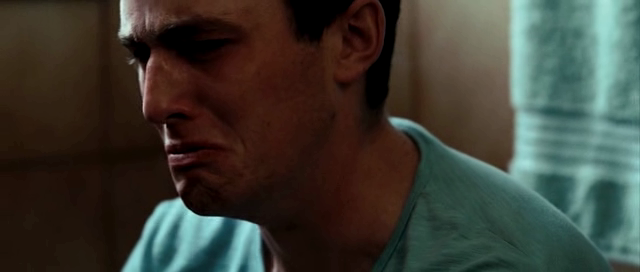
There is a reason why I've chosen the snapshot above from David Michôd's
Animal Kingdom [2010], the brilliant crime film from Australia that caused much chatter in last year's cinematic bumper crop. (It won Jackie Weaver, who plays evil matriarch Smurf Cody here with such uncanny sweetness, a Best Supporting Actress nomination at the Oscars. I now understand completely the acclaim: this film had me gripping my seat from the unrelenting tension of its unspooling, that even a sequence of a car slowly backing out of a doorway seemed the stuff of utter terror.) This is J Cody [played with virtuoso command by James Frencheville], and he has just discovered something terrible and bloody. In this scene -- set in the toilet of his girlfriend's parents' house -- we witness a breakdown and a transformation: he turns from being the naive teenage boy we have come to know him for most of the film, to a young man suddenly coming to terms with his dawning realization of an encounter with evil. He has been the innocent in this portrait of a family steeped in crime, so innocent in fact that when the film opens we find him nonchalantly watching television, his mother's dead body (from a drug overdose) beside him on the sofa. Alone in the word, he is taken to live with his estranged grandmother Smurf, and he gets re-introduced to his uncles -- all of them criminals with psychopathic tendencies, with the police in the city they live in scrambling to gather evidence to put them away. The film is his story -- and the story is about his loss of innocence. I am not going to say much more about how this film goes, but it is an elegant exercise of film form. There is no needless moment in this gripping narrative; everything is essential. The cinematography by Adam Arkapaw is deliberate in its beautifully rendered tracking shots and mise-en-scene, which reminds of a predatory point-of-view. The music by Antony Partos intensifies the action and the emotional turmoil of its characters with a stalking intensity. But it is the actors who make this devastating. They are the proverbial animals in this murderous kingdom -- all preys and predators in this game where the roles are sometimes interchanged. There are good guys, too, but this is basically an anatomy of evil people. Frencheville has the tricky role here: J's naivete could have been been cloying, and a less-gifted actor would have collapsed from the sheer madness of having to tread the fine line between innocence and a wearying nose-dive to hardness. But he gets the balance right, and there are little dramas constantly erupting on Frencheville's face that assure us he has this character down pat. And then there is Weaver: her Smurf Cody is probably the most evil character I have encountered of late in film, but she embodies it with strange rightness that rivals the intensity of a Meryl Streep or a Tilda Swinton. Hers is a role of utter complexity: nurturing and caring (in a Freudian way that's quite disturbing), the way a lioness can be with her pups -- while underneath lies a dark intelligence that has no qualms with intimations of murder. She makes a kind of Sophie's choice here that shocks -- but the way she still goes on with all sweetness and light and huggable motherliness also shocks us into a recognition that in life evil disguises itself in the mundane. When the devastating ending comes, we realize it is the only way to end a film such as this. It made me cry. It made me weep for how we can be robbed of such things as humanity.
Labels: crime, film
[0] This is Where You Bite the Sandwich
Wednesday, October 10, 2007
I remember when
Butch Dalisay wrote about the sometime lawlessness in the Internet in his blog and column ("The Anti-Rant Rant," which appeared in
Philippine Star last August 6). This part points to the problem:
It’s in the nature of the Internet, of course, to host these brutal and often unrefereed skirmishes. Some surfers see the Internet as an open and wide frontier where no rules obtain and manners don’t matter. The Web’s anonymity encourages boorishness, recklessness, and other behavior that might land you in court, in jail, or in the hospital in the real world. (You might say that, on the Web, anonymity breeds contempt.) People tend to shoot their mouths off and say the cruelest things online because there’s no sense of public accountability. Slinging mud from behind an alias, you can’t get sued, you can’t get slugged, and your mother won’t even know.
I've had my share of trolls and flamers and online stalkers before, problems that usually went away when I did the one thing calculated to silence this good-for-nothings:
absolute silence. But Mark's current troll (who's now trying to get at him through my blog and his mother's) is becoming dangerous day by day, and he writes about it
here. Of course, now we're fighting back -- not by flaming back, but by the judicious use of law. It's time online harassments come to a stop.
Labels: blogging, crime, issues
[0] This is Where You Bite the Sandwich
Thursday, October 04, 2007
11:42 PM |
The Shadows in Our Midst
I feel sad, and a little angry. Because something brought back memories I thought I had long since buried. I was reading
this review of Gregory M. Wilson's
Jack Ketchum’s the Girl Next Door (see the
trailer here), which led me to this other film by Tommy O'Haver titled
An American Crime (see the
trailer here). Both are based on
the torture and murder of a teenage girl named Sylvia Likens by Gertrude Baniszewski, an ordinary Indiana housewife, in 1965. (Crime Library has the story
here.) Sylvia and sister Jenny were her wards, and Gertrude soon began systematically torturing the older sister whom she accused of being "a prostitute," with the willing help of her children and their friends -- a perfect illustration in
Milgram's experiments on evil.
I
feel this story... because I know what it was like to be a mere child in the "care" of another person. Somebody who owns the house that you're family is living in and working for as caretakers. Somebody who soon takes special delight in first abusing you verbally, with each passing day becoming more and more sinister as the abuse grows grander and more sinister. I was ten.
It never became murder,
but you know what you did, J.Labels: crime, film, memories
[0] This is Where You Bite the Sandwich
Tuesday, March 06, 2007
I don't know exactly why, but
Time Magazine has a feature listing the
Top 25 Crimes of the Century, from the kidnapping and murder of the Lindbergh baby to the theft of
The Scream. What must have grabbed my attention was the Lindbergh lead story, given that last Sunday night, I watched Sidney Lumet's adaptation of Agatha Christie's
Murder on the Orient Express, a novel which was a derivative of the Lindbergh case. Back to the
Time list. Most -- especially the Richard Speck murder spree that included two Filipina student nurses in Chicago in 1966 -- left me nauseous and bewildered over these grand displays of evil. These are the rot of humanity. And yet, I couldn't look away. I read, and read and read ... and felt more nauseous and lightheaded. A small headache started throbbing at the back of my head.
Still I read. It could be the morbid fascination of watching a train wreck. I read on, and I sensed something slowly die in me, to be replaced by a shifting dread. I remember this dread. Many months ago, I watched Eli Roth's
Hostel and was horrified by its pornography of carnage. I swore I will never watch any movie like that again.
Never.Labels: crime
[0] This is Where You Bite the Sandwich
Wednesday, September 14, 2005
1:02 AM |
Notes on a Forthcoming Story (or Footnotes to Gruesome Tales of Murders)
Do not let Dumaguete's Southern Gothic charm fool you. It is easy enough to be reeled in by all the genteelity, the tropical calmness made palpable by lazy promenades along its famous seaside Boulevard, the everywhereness of acacia trees, and the vast quiet that pervades even the very pores of our skin, punctured only by the sounds of tricycles merrily wheezing by.
Everywhere you look, there is some trace of history and of the familiar, like finding in every nook a semblance of home. Overlooking Tanon Strait, for example, on the corner of Rizal Boulevard and Silliman Avenue, Silliman Hall -- which is one of the oldest American colonial architecture in the country -- stands in a kind of majesty, the keeper of many memories, including that one time when Rizal himself walked the old shores and remarked, "This is a place of gentle people."
The name stuck, and became Dumaguete's corny moniker.
Straight on from Silliman Hall, you will find mansions lining the Boulevard, old structures we call "the sugar houses" because they are remnants of Negros's
hacendero legacy, which exists today only as wisps, pale ghosts of ancient history when Spanish
mestizo debutantes from our side of Negros Island did not make their social coming out anywhere else but in St. James Court, right in the Royal heart of Great Britain. Like all of Negros, our sugar past makes us the original of all Pinoy bourgeoisie. And yet, the place still remains small and inert, like a treasure box.
It is easy to see only all of that.
But there is an underbelly of intrigue and mystery to the place, and truth be told, it borders on the
murderous. It is also true that this is probably one of the safest places in the entire universe. We have a saying here, one that I love telling every new crop of writing fellows that come knocking at our door every summer: "Don't worry about walking around Dumaguete at two o'clock in the morning. Nothing bad will ever happen to you. If something bad does happen, you'll love it."
Wink, wink. Which is all correct. Most small towns are essentially like that. And Dumaguete, despite its sweet pretensions, is really a small town.
But note this: two years ago, a famous local designer, a prominent gay man of good family, well-known among the well-heeled circles of the small city, was found dead in the rubbles of his Bantayan home. He was tied with the tightest of wires to a chair, his mouth gagged. His killers had set him on fire. The police investigation that followed revealed his stomach still full of his last dinner. The man, they deduced, had actually invited his killers in, had dinner with them. Something happened between dinner and dawn that had led to this tragedy. I remember that morning when the fire sirens came. My house is only a stone's throw away from his. Nothing remained of his house, only old wood scarred black and licked by flames.
To date, nobody knows who the killers are.
I am mentioning this incident to begin this portrait of my almost schizophrenic city: It has an abundance of Southern charm, a surprisingly exquisite blend of both our Spanish and American pasts. But it also has a beautiful, noxious Gothic air.
In the late 1970s, several young women, some of them coeds in Silliman University, disappeared without a trace. This must have apparently gone on for years, but nobody reported anything, only that some people had gone missing. Nothing dramatic about that. People disappered all the time.
But one of the last of these women went by the name of Mary Ann who came to Silliman to study Psychology. In the first year of her stay, she met a man famous around the city for his wealth, for his Spanish good looks, for his charm and beautiful face. I remember one of my college teachers recalling this man. "A------ S----- was the epitome of a perfect gentleman," she said. "I remembered him opening doors for me. He was very charming."
He was the son of prominent
hacenderos, of good breeding and of good repute -- the scion of one of Dumaguete's prominent clans. He was also a well-known Don Juan, who chased women with gusto -- and people then would just shrug and say, "There goes A------ S----- again, with his women."
But men of privilege, as usual, were expected to misbehave. People turned a blind eye.
Because what can happen in a small town?The night Mary Ann disappeared, she had slunk away from Carson Hall, her campus dorm, and was taken by two of her closest friends to a spot near Our Mother of Perpetual Help Church, to meet her secret paramour. (Our Don Juan,
of course.) She was pregnant, that was her news. Soon, her friends left her and Mary Ann and her Don Juan drove away to the man's
hacenda. That was the last time her friends -- or anyone else -- saw her alive.
She did not come back home the next day, and the day after next. Her teachers and friends noted her prolonged absence, and soon talk fueled more talk, and Dumaguete being the small town that it was (and always will be), finally brought all speculation down to the Don Juan in our tale. There had been small rumors before, you see, and people finally wondered,
Could it be true? Not our Don Juan! But an investigation was dispatched, and digging commenced both in his
hacenda and in his house in Amigo Subdivision, right at the heart of the city's residential section. (Today, the house remains removed from prying eyes in the streets: it has high walls resembling an army barracks, and what we can see over the top of that fence is a dark house lying squat in the center, shadowed by ominous old trees. The grounds, we presume, are extensive.)
They soon unearthed several bodies in both
hacenda and house, all of them women, and one of them was Mary Ann curled up like a fetus, hogtied. Her grave was shallow, and it appeared that she was buried alive.
Imagine that: a serial murderer in a small town. A handsome, charming Spanish
mestizo serial murderer in a small town!
And here is where my facts get confused, because most of what follows are basically elements of gossip carried on year to year in secret, furtive conversations nobody really acknowledges in the open. It is as if the whole episode was willingly buried by a polite town scandalized that one of their own could be a monster.
It's been more than thirty years since the first killing. And yet, now and then, the whole sordid tale emerges, bloody still and perpetually exciting, resurrected always by secret wagging tongues (and writers like me who are haunted by the whole thing) that refuse to let the story die.
The case, I have learned from my queries, was finally taken to court in the 1980s. The families of three of the girls led the prosecution, and for a while, it seemed that they would get justice. The bodies were compelling evidences enough. A prominent dentist (now dead) had identified Mary Ann's remains through her teeth. Her friends took note of the corpse's familiar clothes. And then Don Juan's driver (some say it was his gardener) confessed. Apparently, he had helped Don Juan bury his girlfriends, and he said that his conscience was finally burdened when he was left to bury the last of the victims alive. You can only imagine how the national press descended on Dumaguete, with headlines screaming the story in the front pages of those early 80's national dailies.
But Don Juan's family hired a very good lawyer from Cebu, someone with influence. People said that eventually the Marcoses stepped in, and that was how and why the man
was allowed to go to Spain "to rest" while the case was being tried. But one by one, the families of the other victims. many of them poor folk who could not afford a lengthy legal battle, fell silent -- save for the last three families who were vocal in their search for justice. People said the other families were paid off handsomely for their silence. Eventually, the driver, too, recanted.
Was he paid to become the fall guy? Speculations grew thick.
The case for the prosecution fell apart, and the presiding judge finally decided to dismiss the whole thing.
Our murderous Don Juan was released.But the people of Dumaguete was finally becoming tired of the whole murderous fiasco.
There was a need to move on, my mother remembered. An American photographer-friend told me that once he remarked to a close Spanish
mestizo friend during party. "Isn't that A------ S-----? Why are we partying with a serial killer?" he asked. The friend replied with the most
cono of shrugs,
"Who cares? He's not
murdering me."That, my dear
palanggas, is Dumaguete high society.
And yet it seemed that the gods had their own brand of justice. Some say that the Don Juan's own sister went mad. His well-respected doctor-older brother also perished at sea in an airplane which crashed during an emergency mission off the coast of Cebu. The body of his fellow passenger (and fellow doctor), a scion of a rich Dumaguete Indian family, was eventually found in the shark-infested waters. But the body of Don Juan's older brother was never recovered. I still remember this tragedy. I was in grade school then, and I remember going with my family to Cangmating Beach to witness the Filipino-Indian doctor's body burned in ritual cremation atop a pyre of wood and gasoline. I remember the ashes falling like rain from the otherwise blue sky.
The tragedy even went as far as my own time when Don Juan's daughter -- a beautiful high school lass who carried the feminine version of his name -- was found dead in the beach adjacent to Cangmating. Apparently she had drowned. But the friends who were with her earlier said that couldn't possibly be, because she was just walking in the shallows, eating a bag of Chippy. And her father was with her. The autopsy report allegedly showed she was pregnant at 14.
But who could have impregnanted her? Again, people talked. People noted that his other daughter -- an acquaintance of mine who eventually became Miss Silliman -- was taken away from her father's care when she was growing up, to live with her grandparents.
For protection, people's tongues wagged.
In the early 1990's, bloody justice finally came. Our Don Juan, now middle-aged, was riding his car (or was it a Jeep?), and in the intersection of Rovira Road and Real Street, on the corner of St. Paul's College, he was ambushed by what many people later claimed to be the Alex Boncayo Brigade of the NPA. The gunmen riddled him with bullets, and then gunned away with their getaway car.
That was how our monster died.
And until now, much of Dumaguete still talk about everything in a hush-hush. Truth be told, the story has occupied my thoughts for years, because this was something I grew up with, and the entire bloody saga actually grew
with me. I think it goes beyond morbid fascination. For me, this is very well something historical of my city; it is part of its heritage -- like all tales of the underbelly are; they may be swept under proverbial rugs, but they will never go away. We might as well
own them, because these stories have become a part of us, whether we like it or not.
I am beginning my story's rough draft this way...
Pedazo de Verguenza*
By Ian Rosales Casocot
Based on a true story
We can begin with the unceasing silence. It has grown moldy like the years -- the way nobody in this small Negrense city would talk about it in the open, but only in furtive and anonymous conversations, sensational gossip verging on urban legend soaked with blood.
We will begin, instead, with the body, the way the bullets riddled him, cutting him down to a bloody pulp. That day in September 1992, the man staggered from his Jeep which had rammed into a lightpost at the corner of St. Paul College, and crawled to the corner where a bakery tottered into the intersection: there, in the filth of melting asphalt, spit, and roadside dirt, he succumbed to the death people would say he deserved a long time ago.
A----- S----- past middle age was always a handsome man, more beautiful and charming than the common lot of his Spanish mestizo peers, and perhaps even forebears. And yet, by the time the smell of gunpowder dissipated into the thick heat of Dumaguete's air, there was no trace of that face or beauty. There was tattered flesh instead of charm, and in the fading sunlight, his brownish hair shone with the dark matting of blood. The gunmen had emptied their shells of the last of their bullets, and then -- with the careful confidence of righteous assassins -- they boarded their getaway car, almost leisurely. The car gunned twice before racing to the north, and disappeared.
In the corner, A----- S----'s body lay sprawling, his blood gushing into the asphalt quickly mixing with the dirt, and drying in the late afternoon sun. By then a crowd had gathered, a palpable electricity in the air. He lay untouched for a very long time, even as people gathered, pointing fingers at the dead man, the din growing in hysteria before the police arrived, thirty minutes late. By then, everybody knew who it was. A----- S----, they all whispered. In small places, news travel faster than the fastest calesa, and by the time night came to claim the small city into its familiar embrace of darkness, people everywhere knew that A----- S---- was dead.
And they all agreed that he deserved the most painful of deaths -- the only just wages for ordinary monsters.
But the city always has a habit of killing anyone who called it home. Perhaps it is the descending humidity of summer mixing with the baking heat of asphalt roads, sand, and surf. It is most likely that, on any given day, the place stands very still, like a beautiful corpse....
Hopefully, I will be able to dig deeper into all these, perhaps someday transforming the whole tale into a novel, something in the vein of
Midnight in the Garden of Good and Evil. In the meantime, this is where I will be, making a short story, performing autopsy into the dark recesses of my city's psyche.
What dark tales does your own city tell? And if you are a Dumagueteno, and you know something more about the serial killings, please do share. The comment board awaits your two-cents' worth.* pedazo de verguenza is the Spanish term relating to the familiar custom of leaving one last morsel on one's plate, not to be consumed.Labels: crime, dumaguete, fiction, history, negros, writing
[0] This is Where You Bite the Sandwich
GO TO OLDER POSTS


