Tuesday, May 13, 2008
 11:26 AM |
Just Above Road Rage
11:26 AM |
Just Above Road Rage
I stumbled on this comment by a certain Liz in film critic
Roger Ebert's new
blog, where he commiserates in
one post how some careless (and all-too reactionary) readers do not seem to comprehend well the written word. Liz writes: "I admire your open-mindedness, but given the constraints on your time I'm surprised you would have any interest in wading through the blind hate and idiocy that comprise most Internet comments. It's the lowest form of discourse, just above road rage."
I had to laugh, because the comment had more than a ring of truth -- it defines precisely the nature of the medium, and gives us a reason to take all that hate with a grain of salt.
And that it comes in the form of an Internet comment is itself so precious.
How meta!Labels: blogging, issues, web and tech
[0] This is Where You Bite the Sandwich
Monday, May 12, 2008
10:04 AM |
Dogberry Bites the House on a Hill
Have you ever begun reading a book, only to stop midway through the first chapter, and tell yourself, "I'm not mature enough to read this yet"? I have,
many times. What I do then is to put the book away, and wait ... and get a life. And then, in a month or a year, or two, I do go back -- and what usually happens next is something magical: the text suddenly becomes clear and intimate, and the book suddenly becomes a precious part of my reading life. (This sometimes happens with films, too.) What happened in the interim? Perhaps a case of simply growing up, and maturing. I know this to be true: appreciating things properly sometimes takes time and maturity, and when we bark too soon, it's really like being a dog barking at the wrong tree. Nobody wants to be a dog.
This is a good introduction to my rant below.
When I read professional blogger and
Manila Standard Today* columnist Connie Veneracion's
recent blog post on National Artist Amado Hernandez's
Mga Ibong Mandaragit a few days ago, I felt angry -- but I didn't exactly know then
how to articulate why I felt that way. Maybe because I liked the book, and found her put-down uncalled for? Maybe it was the smug way she wrote about it?
I've been teaching Philippine literature for
years now, and I have designed my [very demanding] curriculum to balance things out for my students. I take up popular (and easy-to-digest) texts such as the
ZsaZsa Zaturnnah and
Wasted comics and the poetry of Angelo Suarez. But I also take up more challenging fare like Dean Alfar's imagination-bending novel
Salamanca and the
what-the-? poetry of Paolo Manalo. I guess I am in a position to know first-hand the whole gamut of student reaction to a variety of texts. There are literary texts some students love, and there are texts they absolutely hate. None of these qualities stay fixed. Tastes change, and sometimes in the same term, too.
I have always believed that one important goal in teaching literature is to be able to take students out of their comfort zones, to push them to face new worlds and different realities. That's how you create thinkers. That's how you mould creatives. Why make them read "easy" stories that will simply reaffirm what they already know about the world? They may laugh and recognize the people in these stories, but what are you exactly teaching them? The point of art is to know new things or to see old things in a new light, to be moved or to be disturbed, to generate conversation, to make people think.
I do have students who have trouble with the written word, simply because they're not used to reading vigorously anymore. This is true in a world that's replete with television images and text messaging -- but that's an old complaint that has become stale with every repetition. (Which, of course, does not make it untrue.) A tragic majority of young people don't read books at all, and if you crawl through the thousands of Friendster profiles online, many of them even crow about being non-readers as if it was something to brag about. Crawl through these Friendster profiles again, and some would even list down, under the column of "Favorite Books," things like
Cosmopolitan magazine. Many times, asking my students to read a
short story can be a challenge. Asking them to imagine a different world in these stories -- with people whose lives don't exactly mirror their own -- is even more challenging. Asking them to read a
novel is asking for the moon.
Sometimes, they find reading stories and poems "boring" -- but in my years of teaching, I've since qualified that observation to one unacknowledged reality:
being bored over something is more often a reflection of who you are than of the quality of the text itself.There are "difficult" texts to digest, yes, but I've since found out that "digestion" is more often a matter of closely studying where students come from --
their backgrounds, their reading levels, their biases, etc. In a World Literature class, I remember once taking up the stories of Flannery O'Connor -- especially "Good Country People" and "A Good Man is Hard to Find." Many of my students
hated them. When I told them that critics actually consider these as being among the masterpieces of modern short stories, they cried,
"What?!" And
then I finally explained the stories, touching on the symbolism and the motifs and the use of language -- things that well-read people from O'Connor's time would already know. At the end, I could almost feel the palpable magic of the whole room responding to a sudden understanding. Many of them went back to reading the stories, and many of them came back to me saying they actually liked the stories this time around.
My point?
The art of appreciation is ultimately colored by where you come from, so don't judge anything -- books, paintings, music -- as being flawed, especially if you're the one who lack the tools to understand the nuances of the text at hand. Your ignorance and your personal incompetencies should not be the standard by which something should be judged with.
The same thing usually happens when I teach Manuel Arguilla's classic short story, "Midsummer." After assigning it for discussion in the next session, my students usually come back to me complaining that they hate it because "nothing happens," that the story is just about "a boy, a girl, and a carabao." I merely smile, because I know what usually happens after: in the next session, when we begin to peel the many layers of this "simple" story, they begin to see the nuances of the narrative, especially the complexities of Ading, who know more than we are led to believe, the ultimate spider spinning her web. "This is the most
igat story every written by a Filipino," I tell them. In the end, they all will nod with such smiles, having gained an ounce or more of appreciation for something they have never encountered before.
All of which explains my disgust over Connie's essay, which I won't even dignify by quoting.
And that is why I am happy with multi-Palanca awardee Exie Abola's rebuttal in his column in
Philippine Star. Read the entire thing
here, in his blog. Angela Stuart-Santiago also
calls Connie's post stupid.
* Then again, with a newspaper like this (it's also home to Malu Fernandez), why expect good columnists?
Labels: blogging, issues, language, philippine literature, writers
[0] This is Where You Bite the Sandwich
Saturday, May 10, 2008
9:15 PM |
Ang Pinaka... in Dumaguete
 Mark
Mark and I taped a segment for
QTV's
Ang Pinaka... program (now hosted by Rovilson Fernandez, who takes over from Pia Guanio) a few weeks ago, and it should be airing tomorrow, Sunday, May 11, at 6 p.m. We'll be talking about the top ten reasons to visit Dumaguete. It's a summer thing, I guess. I just honestly hope I don't look too fat on TV,
ehehehe. And no, I haven't seen that travel episode I shot with Patricia Evangelista for Living Asia yet.
Labels: dumaguete, television, travel
[0] This is Where You Bite the Sandwich
9:00 PM |
Moon Gone in Malaysia
This book is apparently "hot stuff" in Malaysia.

According to filmmaker and writer
Teng Mangansakan II, Malaysian customs officials seized all copies of his book,
Children of the Ever-Changing Moon. The pathbreaking anthology of essays by young Filipino-Muslim writers, published by
Anvil just last year, was supposed to take part in the ongoing Kuala Lumpur International Book Fair. No reason was offered to explain this action. Teng gives
several theories for the embargo.
Labels: books, issues, philippine literature
[0] This is Where You Bite the Sandwich
Friday, May 09, 2008
4:36 PM |
Talk to Me Unrealisticaly
One thing that sometimes gets my goat when panelists roast writers in workshops is when they go that high-and-mighty road to Realism, and declare one writer's use of dialogue as being, well,
unrealistic. "They don't talk like real people!" they'd say. Part of me says they're right, that one should always aspire to what veteran workshoppers call "verisimilitude." But part of me rebels, immediately recalling the stylized give-and-take of David Mamet or Tennessee Williams or Alan Bennett. Real people don't talk like Mamet or Williams or Bennett characters do. But, by God, listen to the "unrealistic" poetry in the way these characters talk! Here's one scene from Nicholas Ray's
Johnny Guitar, for example, starring Joan Crawford as cold cowgirl Vienna and Sterling Hayden as her old lover Johnny, where they meet again for the first time in years...
Johnny: How many men have you forgotten?
Vienna: As many women as you've remembered.
Johnny: Don't go away.
Vienna: I haven't moved.
Johnny: Tell me something nice.
Vienna: Sure. What do you want to hear?
Johnny: Lie to me. Tell me all these years you've waited ...
Vienna: All these years I've waited.
Johnny: Tell me you'd have died if I hadn't come back.
Vienna: I would have died if you hadn't come back.
Johnny: Tell me you still love me like I love you.
Vienna: I still love you like you love me.
Johnny: Thanks. Thanks a lot.
See? Unrealistic dialogue as delicious as they come.
Labels: film, life, writing
[0] This is Where You Bite the Sandwich
3:21 PM |
What is Your Secret Guilty Pleasure?

Mine is watching
Ryan Seacrest.
Seriously. Of course I know all the closet jokes from Jay Leno. (But what can you expect from an unfunny homophobe?) Of course, there's the too-meticulous attention Ryan has for his hair. But I find the guy really likable, and he does know how to spin every goddamn minute of
American Idol, stringing everything with his own brand of wit and thinking-on-his-feet.
The guy does not get tired -- and that's the crux of my admiration
. A media mogul in the making, he hosts dozens of TV and radio shows, co-owns several restaurants, and has a fashion line, and
his ambition to rule all of TV as the next Ed McMahon, Larry King, Regis Philbin, and Dick Clark combined is also quite impressive.
Washington Post's Tom SHales writes: "Seacrest couldn't care less about rumors of his sexual relationships, because he keeps adding corporate relationships to his repertory. 'Coca-Cola; that's a very good relationship. The strategy is to get them to spend dollars on our programs,' he says cryptically." When I grow up, I want to be Ryan Seacrest, hehe.
Hail Ryan!What's your secret guilty pleasure? Spill the beans...
Labels: celebrity, life, media, television
[0] This is Where You Bite the Sandwich
12:17 PM |
Darkness and Glimmers
I don't wish for anyone the dark days. But they happen. For me they're constant visitors. Sometimes I fly right through them like a plane would through turbulence, but sometimes they linger like a dark lover. I pinch myself endlessly to break free from its ugly embrace, but it doesn't of course leave at my bidding, and all I have left really is skin pinched to raw redness. I always find my dark days after especially hectic -- or joyful -- episodes in my life. They come without fail. I'd be particularly busy working on some projects for days on end, and when I'd be finally done, there would be that huge sense of relief, followed immediately by a sudden, screaming panic.
What now? I'd ask myself. And then the dark would come to consume me. So, of course, after those beautiful early summer days spent in Baguio and Sagada, and then after that hectic week trying to complete those stories for a certain contest, I sensed myself withdrawing from the world, suddenly feeling very sick (
really, really sick), suddenly feeling very helpless. And sad. So I took my meds. I deposited my cellphone in a secret place. I watched old Audrey Hepburn movies. I caught
all the episodes of the last season of
Lost, watching everything from first to last, nonstop. I commiserated with the wishy-washy weather. I Facebooked endlessly, until it, too, became a blur. I surfed all the cable channels -- my television was on 24 hours a day for several days straight -- and sank deeper into my bed. I sang John Barrowman songs. I tried reading, but couldn't finish anything. I had my meals delivered to my pad. I watched my hamsters go round and round in their wheels. I slept for the most part, endlessly praying that the pain, both physical and emotional, would go away. It's a Friday, and there are some glimmers in the distance, so here's wishing me... something. God? Luck? Happy days? A great cup of coffee?
Something.
But this made laugh:
Nestor U. Torre earnestly suggesting how to make American Idol better. Like anybody out there would listen. Paging Nigel Lythgoe! Ha!
Labels: life
[0] This is Where You Bite the Sandwich
 Philippine Daily Inquirer
 writer
Niño Mark Sablan now blogs. It's in LiveJournal, so you get whatever you get.
Labels: blogging, writers
[0] This is Where You Bite the Sandwich
Wednesday, May 07, 2008

The fabulous
Nicolas Pichay -- playwright and poet, man of the law, Palanca Hall of Famer, and shock artist -- now blogs.
Labels: blogging, writers
[0] This is Where You Bite the Sandwich
Tuesday, May 06, 2008
9:39 AM |
Writing, Trouble-Free, in Baguio
There are rites of passage typical for the Filipino writer: having your work first published in a magazine, enjoying your first fellowship to a national writers workshop (Dumaguete, Iligan, Bacolod…), winning your first Palanca, putting out your first book.
Of course, there are even higher reaches to scale, but for most writers, what becomes constant after
all that is the effort to stay firm in the craft—a considerable challenge in a country where writers are an underappreciated lot. Or, if they are, are mostly held in the lofty light of noble fools who think minting words is better than lawyering, or nursing. (Nevertheless, the romantic idea is to persevere.) Compound this vocational angst with the one reminder that keeps us trying to relight the creative fire: that you are only as good as your last piece of prose, or suites of poetry, or play.
Consider going to the Baguio workshop as having become an entirely different, and crucial, transition in the local writer’s life. The invitation to the Pine City comes only after one has already laid down the roots of a considerable literary reputation, in a time when workshops for most fellows have receded to become fond memories of a distant (and often rambunctious) youth. Baguio is where ambition, execution, and the imagination of a nation become paramount considerations in the writerly vision, and where, in the words of Cristina Pantoja-Hidalgo, one “contributes to solving the problem of how exactly to combine craft with emotional power.” In other words, Baguio is no longer your grandmother’s notion of how writing workshops are.
Already in its 47th edition, the University of the Philippines National Writers Workshop has, since its retooling in 2003, decided to take stock of that phase in the writing life where the sun, as far as outside scrutiny is concerned, barely shines: in mid-career, where the stakes are much higher and the critical attention one gets is the careful consideration of “colleagues” in the craft taking a look at your literary soul.
That was what they told us who they were when the workshop began last April 6, but if “colleagues” amounted to a panel composed of National Artists for Literature Virgilio Almario and Bienvenido Lumbera, and writing stalwarts Jose Y. Dalisay Jr., Gemino H. Abad, Cristina Pantoja-Hidalgo, Charlson Ong, Jun Cruz Reyes, and Vim Nadera, we quickly realized that expectations were charged. For most of us, it was a week to take serious stock of where we were going in our current writing projects, which forced us invariably to think hard about our own poetics. If only for that, it was an experience, one for a lifetime.
It was the workshop to end all workshops, we all agreed.
“We” would be the anointed twelve gathered from all over the country, most of us refugees from lowland humidity, much too eager to breathe in the cool mountain air.
There’s the Filipino fictionist Allan Derain, whose work titled
Munting Banal na Aklat ng mga Kumag blurred the boundary between fiction and poetry, and whose theme of small creatures as bearers of the sacred resonated with all of us throughout the week; Tara FT Sering, whose novel
Good People is bound to turn heads and push higher expectations beyond being the local chick lit queen; Frank Cimatu, who was made to reconsider his abandonment of Filipino poetry; and film director (and
Rizal and
Muro-Ami scribe) Jun Lana, who gave us the stirring simplicity of his screenplay of
Kariton.
There’s Mookie Katigbak, whose poetry collection,
History and Magic, is a breathless literary sleight of hand; Rica Bolipata-Santos, whose essays will take the memoir down a more searing path in
You Make the Road by Walking; Abdon Balde Jr., whose novel
Ramayana sa Donsol, a road-trip story that brims with action, sex, and comedy, is a certified page-turner; and Luis Joaquin Katigbak, whose story collection
Dear Distance takes his fiction to new heights and deeper insights about the hopes and mores of the young and the disconsolate.
There’s Ateneo poet Vincenz Serrano, whose collection
Short Walks attempts to redefine the geography (and memory) of Manila’s streets; Roberto Añonuevo, whose angry poetry collection
Sumpa, Simoy, Supling is an enthralling, if challenging, ride through the murk of personal and public politics; and the fabulous Nicolas Pichay, whose signature form was to shock us all into rethinking religion and politics, with his sexually-charged play
Sa Silid. My own project is
Sugar Land, a novel about Dumaguete in all its sweet historical and murderous details. It was everybody’s job to consider each other’s work with the scrutiny of the initiated, and to render the judgment of peers—some in unqualified adulation, some in a critical nudge to shape the material this way or that. For all its unvarnished and honest take on the literary works, it was surprisingly a congenial workshop.
To be part of this illustrious bunch was intimidating enough. Three of the fellows are Palanca Hall-of-Famers, and all have their fair share of books and awards, but the unexpectedly easy camaraderie that developed soon proved to be a weeklong chance to become more intimate with the craft and all that, surrounded by people who knew how it was to make words dance.
The fog, the beer, the red wine, the search for wifi and the perfect banana cake, the camwhorish tightness, the countless cups of frappuccino and coffee americano, the little dramas and the sweet tensions in the cold Baguio nights, the endless café-hopping (through Vocas, Rumours, Ayuyang, Bliss, Volante Pizza, Café By the Ruins, and the Starbucks in Camp John Hay…), Butch Guererro’s laugh, Jun Cruz Reyes’ drawing book, Frank Cimatu’s irresistible devil-may-care nonchalance, Vince Serrano’s uncanny Jing Hidalgo imitation, Rica Santos’ heartbreaking karaoke rendition of “I Don’t Know How to Love Him,” Joey Baquiran’s insistent time cards, Jun Lana’s closet of shoes, Bien Lumbera’s kung fu moves, Jun Balde’s intimate knowledge of Marcosian politics and construction, Tara “February” Sering’s hilarious real estate broker act, Bobby Añonuevo’s dancing to Madonna’s “Borderline,” and Butch Dalisay’s pronouncement that he was running “a tight ship,” all combined to make this year’s workshop something memorable, even when were ultimately described as “the most trouble-free” batch so far in the Kamustahan Series—a designation we mock-protested to, and to which Tara gave a grand reply, “If that’s the case, we will
create trouble in our writings.”
Perhaps that is the very reason why we had all willingly gone to Baguio that week, in mid-career. To relearn casting tempests with our pens, and to appreciate the fact that writing should ultimately be all about rendering life in poetic exactitude, through the emotional power of little earthquakes in words.
[this appeared in the may 5 issue of the philippine daily inquirer]
Labels: philippine literature, u.p. writers workshop, writers, writing
[0] This is Where You Bite the Sandwich
Monday, May 05, 2008
2:32 PM |
Notes From the Underbelly
My best friend has
a thing growing inside of her, and it's feeding like mad and will burst out anytime now, like, say, nine or eight months.
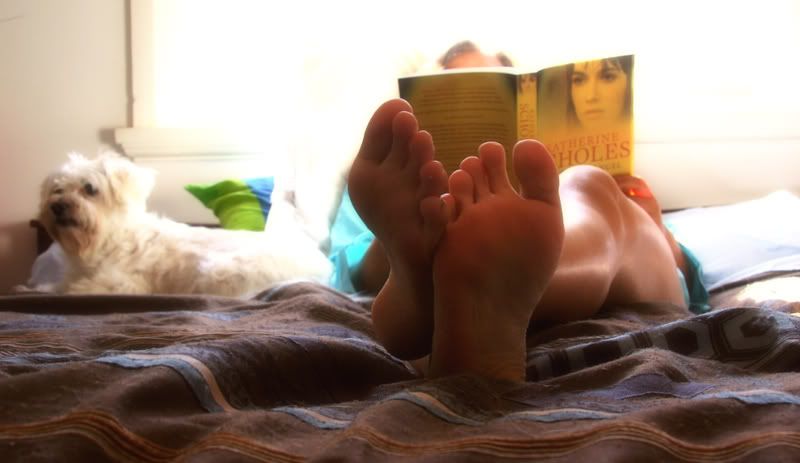
That's her above, reading, pretending like she's all okay. But the thing that scares me most, if you ask me, is that
this is irrefutable confirmation that my best friend, in fact, is a
woman.
Egad.I need to go to a support group, like right now.
Labels: friends
[0] This is Where You Bite the Sandwich
1:12 PM |
Lacabas Staring Down the Sun
Every semester, when I gear towards discussing literary writings during Martial Law for my Philippine literature classes, three poems always strike me as the most appropriate for the occasion -- Merlie Alunan's "The Bells Count in Our Blood," because it details the everyday concerns (and recriminations) of a town seized by the period's dark evil, and the works of the two Lacaba brothers, of course: Emmanuel Lacaba, whose "Open Letter to Filipino Artists" is an anguished confessions of a young man undergoing both a geographical and a metaphysical journey, and Pete Lacaba, writing as Ruben Cuevas, who proceeds to undo Marcosian tyranny with his "Prometheus Unbound," an acrostic puzzle that somehow got past the censors and made Lacaba a hunted man.
Labels: philippine literature, poetry, writers
[0] This is Where You Bite the Sandwich
7:22 AM |
The Inquirer Boys Finally Deliver


That's what Frank Cimatu says. And he's right. And it is about time, too. The
Philippine Daily Star girl (Rica Bolipata-Santos) and the
Manila Bulletin boy (Luis Joaquin Katigbak) have already given their spiel.
So here's our take on precious Baguio again.
Frank's, and
mine.
[all photos by vincenz serrano]
Labels: media, u.p. writers workshop, writers
[0] This is Where You Bite the Sandwich
Sunday, May 04, 2008
2:24 PM |
ZsaZsa Returns

[more information over at
the carver house]
Labels: comics, philippine literature
[0] This is Where You Bite the Sandwich
Saturday, May 03, 2008
1:05 AM |
Your Wetness
One of blogging's sources of fun is the
tracker --
and especially when it tracks down the keywords logged in various search engines that somehow lead to your blog. I'm especially amused by this week's set of keywords (click on image to enlarge):

Get this... THE SPY WHO BOUGHT A COLD. Hehehe. Which must have been a reference to John le Carré's 1963 classic
The Spy Who Came in From the Cold. But this is way better: I WETNESS BY HOWIE SEVERINO. Hehehe. How kinky.
In the meantime, for serious things, Jim Paredes has
some freaking great ideas on how to make this country better in his blog. Go check it out.
Labels: blogging, humor, issues, politics
[0] This is Where You Bite the Sandwich
Friday, May 02, 2008
10:58 PM |
Character Sketches No. 3: The Old White Man on a Bicycle
Nobody—except probably the family he belongs to—knows where he comes from. Is he Australian? Swiss? French? Belgian? German? British? There are so many of them here, expatriates all, most of them of a certain age that marks a settled life away from the cold hemispheres, but now blissfully transplanted in Negros’s sun and eternal surf. Most of them while the days away in their seaside cafes—Happy Fred’s, Why Not, CocoAmigos among them—with their talks of home, their long-haired brown women, their beer and their whisky. This one is certainly not American. He bellows in English, but always in a European accent. He is an old white man. His hair is white. His skin is red from the sun. He wears a pair of shorts and, always, a sleeveless white tee. He looks poor. Or maybe nobody looks after him, which might explain everything. We know him as the Bicycle Man. And he drives all over town—from the airport to the seaside boulevard to the main strip of town. And we know him well because, wherever he goes on his bicycle, he bellows to everybody by the roadside anywhere,
“Hallloooo yooooouuuu!” Hello. You. Hello you. A stretched out greeting that rings out and means so many things. Sometimes we holler back a hello. Sometimes we don’t. Sometimes we glare back at him because he has startled us from our deep concentration while walking down the road. Sometimes we ask: Who is he? Where does he come from? When will he go home? Is he mad? Most times, we just feel sad for this old white man on a bicycle. So far away from home. Perhaps he only feels lonely, and thus endlessly greets everybody a grand hello, hoping, perhaps, that one friendly hello back will bring for him saner days, more beautiful days, where a strange land becomes a little bit more like home.
Labels: dumaguete, life
[0] This is Where You Bite the Sandwich
8:30 PM |
Character Sketches No. 2 : The Vampish Typist
She spends most of her days in this hole-in-the-wall right between a second-tier department store named Nijosa and what used to be Dell Photoshop, before photoshops went the way of dinosaurs in the age of digital cameras. (Now, what used to be Dell is a print shop that specializes in making tarpaulins.) Our woman -- she must be past fifty, pushing sixty -- comes from the analog age, too. The hole-in-the-wall, only six feet wide but stretches inside to a length of a few rooms, is a shop where you go to have your documents
typewritten, and it must have enjoyed its heyday in our little university town where thousands of term papers and feasibility studies needed to get reproduced, carbon copy upon carbon copy, before computers became too much a fixture of our everyday lives. I remember our woman from my earliest days, and she was already there, right near the entrance, in front of her typewriter, tapping out document after document, day after day after day. But it is not her perseverance at a fragile profession that makes her stand out for many of us. It is the way our woman goes to work everyday, always in a sexy dress with thin straps, always in something silky or flowered, always in black or red stilettos. She wears her hair (dyed black) in a buoyant Farrah Fawcett fly-away cut, the tresses all perfectly in place, and her make-up is severe in the way that she puts them on uncompromisingly thick and glorious. When she goes on her break, she simply leaves her typewriter, a page sticking out like a white tongue, and goes to the nearest bakery, near the corner. There she eats, then smokes, and then comes back to her spot, and begins typing again. I have never seen our woman smile. But it has been a while since I've seen her. Is she still typing, somewhere? Or have our computers and our printers completely obliterated the way she has lived for so many years? But how we miss her sexy dress, her sexy walk, her sexy shoes -- and how she seemed to dare the passing years and their threats of obsolescence with every pore of her existence. She will lose, of course, but she will live on as a distinct mark in an Old Dumaguete that is dying every single day to new malls, new cars, new people, new noises...
Labels: dumaguete, life
[0] This is Where You Bite the Sandwich
8:23 PM |
The Compass That Went Nowhere

The DVD of
The Golden Compass is soon coming our way, and I think it's fair to say -- after all these months -- that when I saw the movie on the big screen last year, I tried to like it so much (because I love the book) but it kinda ... underwhelmed.
It was boring, actually. I loved individual touches of it, but the whole thing just did not work. I remember leaving the theater in Greenbelt with Mark, and we were all so silent, trying hard to mask our disappointment. "It was okay," we said.
Which is bad. I think the movie went wrong in pre-production when the makers tried to tailor it to follow all the marketing expectations of too many people,
especially people they didn't want to offend, thereby pushing the entire story towards a territory where it would lose its bite, and its magic. They virtually did away with Philip Pullman's anti-Christianity angle, hoping the rabid Evangelicals would not picket, and still go ahead and see the movie. Hell, they still didn't go anyway, and the movie only earned $70 million in North America (but grossed more worldwide). I wish they went ahead and stayed true to the spirit of the book. It would have been a better movie. The rabid dogs would have howled, of course, but at least there would have have been something salvageable in the film.
Will they film
The Subtle Knife? Here's crossing our fingers...
Labels: books, film, issues, religion
[0] This is Where You Bite the Sandwich
Thursday, May 01, 2008
2:22 PM |
Character Sketches No. 1: The Dandy Security Guard
Everybody first saw him roughly two months ago, exactly a day after a robber -- armed with a gun and sheer chutzpah -- walked into busy Cafe Noriter in the early evening and held up a young girl and her mother, hauling away a laptop, some money, and a cellphone. I had been sitting in that same table five minutes previously, and if I hadn't left, that gunman's victim would have been me. Such are the tiny fates we brush with in our daily lives. The very next day, the Korean owners of the new cafe hired this young man to guard the doors. I noticed him, not so immediately, the very next day, when I came in to have my frappuccino and wifi fix. He looked intimidated, the poor boy: he was eternally gawking at the laptop crowd before him who were drinking things with funny Italian names he didn't know existed. He seemed too young, too thin, and too shy to fend off the random dangers from the street. But he had his blue uniform on, and what looked like a pistol in a holster -- standard issue, I suppose -- and that seemed enough to spell security for the little place. But the cafe's laptop crowd must have gotten to him. Soon, he was putting pomade in his hair. Soon, he was sporting a spiffy-looking pair of sunglasses. Soon, he was walking across the cafe with a strut, to the counter to get himself a glass of water, and then back to his post outside, where he positions himself against a parked motorcycle like Adonis waiting to be claimed by the gods. Everyone has dreams. This boy is probably living it.
Labels: dumaguete, life
[0] This is Where You Bite the Sandwich
10:03 AM |
Call for Submissions to Likhaan Journal
After the launch of the first
Likhaan Journal at the last Writers Night, the UP Institute of Creative Writing is again calling for submissions for this year’s volume. The journal is open to fiction, poetry, essay and graphic novel submissions in English and Filipino.
The first
Likhaan Journal was edited by Dr. Jose Dalisay, with Drs. J. Neil Garcia and Lilia Quindoza Santiago as poetry and fiction editors, respectively. The volume featured fiction from Alwin Aguirre, Mayette Bayuga, Catherine Bucu, Amelia Lapena-Bonifacio, Charlson Ong and Socorro Villanueva; poetry from Raymond de Borja, Mikael de Lara Co, Francis Arias Montesena and Joel Toledo; essays by Gemino Abad, Exie Abola and Reuel Molina Aguila; a photo essay by Vim Nadera, drama from Rene O. Villanueva and an interview of National Artist Bienvenido Lumbera.
The
Likhaan Journal is available for P250 at the UP ICW and at UP Press Bookstores.
The deadline for this year’s submissions is
May 31.
Submission Guidelines1. For its second issue,
Likhaan will accept submissions in the following genres, in both English and Filipino:
(a) Short stories ranging from about 12 to 30 pages double-spaced (in 11-12 points Times Roman, New York, Palatino, Book Antique, Arial or some such standard font). A suite of short prose pieces will be considered.
(b) A suite of four to seven poems, out which the editors might choose three to five. Long poems will be considered in lieu of a suite.
(c) Essays (critical, scholarly, and/or creative nonfiction), subject to the same length limitations as short stories, above.
(d) Excerpts from graphic novels, or full short graphic stories, for reproduction in black and white on no more than 10 printed pages, 6” x 9”. Excerpts should be accompanied by a synopsis of the full narrative.
2. All submissions must be original, and unpublished anywhere else. All submissions must be accompanied by a biographical sketch (no more than one or two short paragraphs) of the author, including contact information (address, telephone number, e-mail address).
3. Submissions may be e-mailed to likhaanjournal(at)gmail(dot)com, or posted to The Editors,
Likhaan Journal, UP Institute of Creative Writing, Rizal Hall, University of the Philippines, Diliman, Quezon City, 1101.
4. All submissions should be received (whether by e-mail or post) no later than May 31, 2008.
5. All submissions will undergo a strict pre-screening and blind refereeing process by the editors and a panel of referees composed of eminent writers and critics from within and outside the University of the Philippines.
6. Writers whose work will be accepted for publication will receive a substantial cash payment and a copy of the published journal.
7. The editors reserve the right to edit any and all materials accepted for publication. The editors may also solicit or commission special, non-refereed articles for publication outside of the aforementioned genres and categories to enhance the editorial content and balance of the journal.
Labels: call for submissions, philippine literature, writing
[0] This is Where You Bite the Sandwich
GO TO OLDER POSTS
GO TO NEWER POSTS


