Celebration: An Anthology to Commemorate the 50th Anniversary of the Silliman University National Writers Workshop Sands and Coral, 2011-2013
Silliman University, 2013
Why is it that the things that we don't get at all—like falling in love with all sorts of wrong people this side of heartbreak—are sometimes the ones that make most sense?
Yesterday I received an email from what I assume to be a comics industry colleague, forwarding an article by Buddy Cunanan on why he will be voting for Manny Villar.
This post is not a point by point rebuttal of that forwarded article. The truth is, this is not a reaction to that article at all. I am simply offering my own separate views on why I won’t be doing the same thing.
Here was my response:
Since I received a message of endorsement for Manny Villar in a bulk email, I cannot help but offer my own opinion in return. I notice that there are many in this list who belong to the comics industry, and perhaps the art industry as a whole.
As an artist who values my freedom to express myself in my chosen field of art, I am honestly, and desperately terrified of a Manny Villar presidency. And I believe all artists in the Philippines should be.
Some of you may now no longer remember that as a Senator, Manny Villar filed a bill with the Senate called the “Anti Obscenity Bill”, or the Senate Bill 2464 where there is a strongly worded provision that portrayal of “nudity” in art will be punishable by law REGARDLESS OF THE MOTIVE of the author.
We all know the evils of pornography, and it is something I myself do not condone. But I also celebrate the beauty of art, and my God given human right to enjoy it and to create it.
As an artist, it is a bill that gravely concerns me because it has the potential to seriously curtail not only my freedoms as an artist, but my the ability to make my own choices as a mature, intelligent and moral human being.
By punishing the portrayal of nudity regardless of the motive of the author, it means nudity can no longer be portrayed by painters, filmmakers, graphic novelists, illustrators, sculptors, etc. Books on anatomy will now have to be censored, as well as medical books, history books specially on images of nudity on religious structures such as the Sistine chapel. Artists can no longer use nudity to portray innate human beauty.
Rightly so, the bill did not get the proper support in the Senate, and was shelved. Even then, by his filing of this bill, we get a definite idea of who Manny Villar is in terms of his views on art. He wants to censor it. He is of the belief that an adult Filipino is not capable of being mature enough to choose for himself (or herself) and decide for himself what to read, see, and hear. In other words, he does not believe that we can think for ourselves. He wants himself, and other people in power to think for us, and to decide for us, what is good for us or not.
This a reflection of Manny Villar’s character, and I’m sure this is how he will approach other issues as well. This has repercussions well beyond the field of art.
Manny Villar attended a Blogger’s meet last year to discuss with the youth the issues that concern them. My friend Jonas Diego attended this meet, and several times during the meet, he tried to raise the issue of the Anti Obscenity Bill. Jonas was never even given the chance to properly finish asking his question before he was waved away, his question trivialized and de-emphasized.
Not only has Villar shown that he is perfectly willing to censor the artist, he is also perfectly willing to ignore us as well.
This issue is a legitimate concern and is NOT black propaganda. It’s still up to you if you still want to vote for this man or not. But I feel that I needed to raise this issue, at least one more time just to let people become aware of just what they’re getting into.
I myself am not endorsing anyone in this election. Who I vote for remains a personal issue. This is not a campaign to steer the vote in favor of another candidate. I just feel that come election day, everyone should be made aware just who it is they’re putting into power.
Because by God, we’ll be paying for it for the next six years. Election day is the one day when we have the power. I hope and pray people use that power responsibly.
I have never felt so alone in my entire life like today. The strangest thing is that I say that in an almost matter-of-fact way, not drowned in stultifying sadness the way it usually comes. Well, maybe just a tinge of melancholy, but nothing more. It comes to me as something frank and bold, as a voice from the back of my head that speaks dripping with the knowledge and the emotions that come with weathered time. It says, "You really are alone in life, you know. Other people are only joyful coincidences. When they're there for you, rejoice that it happens. But for the most part, don't stake your life on other people being there for you." Wherever that voice comes from, I thank it. Because it tells me once more I can't live with the demon that has plagued me all these years. Once, seven years ago, a friend named Gabriela read my cards and told me, "Your greatest enemy is complacency." She was right. She still is. The years hence have been a constant battle against that demon; I've won some skirmishes, lost others. But last night with Ginny [who was also there that night of the tarot] brought it all back to me once again. We went to remember the places we used to haunt all those nights seven years ago, Qyosko most especially. And the memory of the tarot came rushing back to me. I realize that I have let complacency take root in my life again: for the most part, I have depended again on the rare kindness of other people. I have also wasted too many hours on the pursuit of things that have only brought me both nothingness and pain. This morning, I wake up with these old emotions. It took me a while to get up from bed, and process whatever needed processing.
But I'm awake now.
And I will make this one life I've been given to live to make sure things will matter, even when I'm all alone.
Somebody in my life texted me today. "I finally liked your column this week," he says. That's how he gives compliments about how I write, in an underhanded way that is annoyingly supercilious. I used to be bothered about it, but I've since realized I don't really write for people who writes "the same" as "de same."
Poems are strange in that they are intimately intersubjective, especially when they are read across a significant “sweep” of time. Contrary to the evidence, they really do have their own agency as works of art, and this becomes all the clearer when one engages them at different points in one’s life: because poems are built as much on absence as on presence, they are never completely exhausted in any one reading. And so, they open up and offer distinct entry-points to one’s earnest inquiry, each of them revealing the deep personal space—we might also say, the spiritual distance—that one has traveled since the last visit. We often speak of writers as companion spirits, but I also think it’s possible to speak of companion poems, those that accompany us as we plug along our respective paths; those that (as the local proverb counsels) bid us turn around and look back, every now and then, lest we lose not only our way, but also, alas, our very self (because without hindsight there is no memory, and where there is no memory, there is no sameness from one moment to the next; which is to say, there is no identity).
This is one of the few Filipino poems that I can say have accompanied and “stayed” with me through the various and often tortuous periods in my continuing apprenticeship to the written word. The lived moment in the poem, which this annotation now so wonderfully affirms, was what struck me about it, from the very start. Already, then, I wondered what the poem’s "antecedent scenario" (Vendler's terminology) might be: what is the experience that prompts this speech (which is the same thing as the poem) into being? In particular, where (at least emotionally speaking) might the speaker be, at the exact moment that she (a mother, a wife, a believer) begins to speak? These questions serve to accentuate the fact that art, while merely an imitation of life, is nonetheless also rooted inexorably in it... up to now, these are the questions i still ask my students to answer for themselves, before they can credibly recite—actually, before they can endeavor to do anything at all to—this poem. Just now, I'm remembering that my interest in the representational power of this text coincided with my fascination with its concise and paradoxical use of imagery, most astonishingly exemplified, to my mind, in the simultaneously mundane and divine metaphor of sea shells as “God’s own bright teeth"... needless to say, from the get-go “bonsai” struck me as referring wonderfully to sundry objects and realities in the world (ah, the inventory of loved mementos!) which, like the singular poem that it is, it not only captures in the “best words" arranged in the "best order,” but also thereby generously transfigures…
And still, after all these years, the poem keeps giving and giving, conversing with this restless reader and bringing to light not only its own interleaving, latent, and undiscovered meanings, but also, more surprisingly, his own implicit understanding... Given, I suppose, my recent interest in the self-reflexive gestures that constitute all art, when I read this poem nowadays I no longer just see the life that the words encourage me to interiorly, as it were," visualize." I still see the representational content of the poem, true; but I also now see the words that are the poem, I see the poem as a poem, constituted not of any pregiven but of a willed kind of painstakingly fashioned language (just now I’m thinking not only of the careful arrangement of lines and stanzas, but also of the poet’s unusual and possibly culturally resonant use of the transitive form of the verb “run,” in the poem’s last strophe, that itself seemingly runs the poem along to its memorable conclusion), referring to elements within itself, referring to the idea of its own making, referring to "bonsai" not only as an external and aegis-forming reference but also as the very structure that the poem itself mimics (for look at how figuratively vast and yet how small and unassuming the poem is!)—to the bonsai that the poem itself is!
So, yes, nowadays, when I read/teach this poem, the poem is at once the frame as well as the picture that it continues to beautifully show—pointing all at once to life and to the idea of a life. In particular (thanks to my recently acquired knowledge of oriental art) pointing to the aesthetic precept or theory, identifiably japanese, of wabi-sabi: the “beauty” of the imperfect, the partial, and the fugitive, which is what art/poetry, finally is; which is what we all, finally, are.
Rowena Tiempo-Torrevillas responds:
Thank you, Neil, for your most thoughtful assessment of the self-reflexive element implicit in the act of writing. I, too, am a believer in the notion of "absence as presence" as a powerful force in writing.
What is poetry, after all, but an expression of the human wish to enact, and give shape to, "all I love"? Like you, I have been more interested of late in the interplay between word and thought, especially in the transaction going on between the individual brain and written language. Here's a poem I wrote, oh maybe a decade ago. I don't write long poems any more, so it's not representative of what I do these days, but here it is. Not counting the compound words, in a hundred words or less ... a bonsai of one of my own life's enduring mysteries:
The Lost Letter
I write to find it. I'd seen it in my newborn Daughter's eyes, Like looking into Deep space, deciphering The dazzle of the infinite-before-life.
I learn a word, ylem, primordial Substance all elements derive from. (Salt, amino acids, water: Tears.) We shed protein when we weep.
The Ur-song drifts Around sleep's edges, Encoded in DNA: that hidden letter, The body's cryptograph unlocking Words, which ride through optic currents, Liquid, electrical, being Read. Symbol to word,
Loops-and-whorls on fingertips Are secret maps, ideographs, a lost Alphabet transcribing Humanness, as on bark From the tree Yggdrasil, where Our names were First inscribed.
J. Neil C. Garcia responds:
Thanks, Rowena, for this unexpected boon! Life itself is the mystery, and as long as we are inside it we cannot be expected to fully know what it is. And yet, and yet... There are these "intimations" (Wordsworth's entirely fortunate and enduring term) that glimmer in all the dappled and fugitive shapes that surround us... We have another baby in the family, my sister's newborn, and it's endlessly fascinating to think of "where" she is, just now that she still exists outside language, just now that she still doesn't have the self-consciousness that language bequeaths to (sometimes, I'm inclined to say, inflicts upon) the subject, that precisely "selves" the self in a sentence in which the speaker and the spoken cannot ever fully coincide... As I tell my students, channeling Lacan, the "I" who speaks in our discourse cannot exhaust what we are; cannot make us fully present, despite our well-meant faith that it does (in the first place, unlike the person who inscribes, once written down the inscription cannot quite change, cannot quite die). This makes for a truly humbling "lesson" for any poet (whose claim to the examined life is, after all, nothing if not the "physical" medium that language is)... But then, as this present poem shows, perhaps poets already understand this basic inadequacy—this irremediable gap between sign and reference, between sign and concept, between sign and sign, between sign and sign-maker, which is probably why they choose to write poetry to begin with. Poetry, a "making" in which presence is nothing if not absence (and vice-versa); a willed human act which gestures, again and again, to the silence from which everything first stirred into existence, to the immemorial which underlies the historical, the knowable, the known...
On the other hand, despite registering this possible "disenchantment," there is an act of faith in this poem, that I feel links it most vitally to "Bonsai." Mom Edith's famous poem insists upon the power of intelligence to capture, shape and discipline the makeshift moment, and yet it concludes on the memorable note that human affection is, quite possibly, the only way this "beautiful fugacity" can be undone (or, at the very least, invalidated)... I am referring, here, to the image of a mother—whose consciousness unfolds in interesting and complex and even mythic movements throughout the poem—regarding, simply and lovingly, the eyes of her child.
This vacillation between the acceptance of the "limit" imposed upon us by culture, history, and/or language (a position espoused most vigorously, in the poetic scene at least, by the American language guys) and the considered (and recalcitrant) rejection of it is what has come to characterize, to my mind, the present preoccupation of many poets. This may have something to do with—among other things—the increasingly indispensable role that academic critical theory has come to play in the education and training of many poets who, nowadays, are required to "do theory" alongside their creative work. Time and again, I have had occasion to express my own take on this all-too-real contradiction, most visibly summarized in that strange hybrid entity of the "poet-critic"... Back in 2009, after spelling out the irreconcilable differences between these two positions (at a panel discussion in the Ateneo de Manila), I attempted to articulate my own argued understanding of the issue... I suppose, just now, I can say that I still provisionally believe in the way I originally phrased this uneasy "detente," back then: "I don’t think poetry transcends culture; I don’t think poetry transcends language; I don’t think poetry transcends history. Poetry beautifully encodes the desire for transcendence. This, for me, is good enough."
I ended my "spiel" in that panel discussion with these words. When I said this then I think I was simply trying to articulate my position regarding the urgent question of freedom in art.... Reading all about theory in our classes—in other words, being also, in a manner of speaking, "critics"—makes us supremely aware of just how "determined" all our actions, thoughts, and even "imaginations" are by all these inexorable social forces that surround and yes, constitute and construct us. And yet, despite this "fatal" knowledge, we who are now effectively "poet-critics" still create works of art, still write our stories and poems... Obviously, knowing what we know, and coming from we come from, we can no longer endorse the old liberal humanist—specifically, romantic—argument that art transcends materiality. However, while it's true that the last one hundred years of merciless social critique has effectively unmasked freedom as an illusion, it has not by the same token made the necessity of this illusion well, less "necessary" in our world. What's left, after a century of being disabused of the idea that we are essentially free? The answer is simple: what remains, despite everything, is the desire for freedom. Poets/artists precisely remain valuable and irreplaceable in our world because they are the only ones who can "embody" this necessary longing most beautifully...
Again, Rowena and Ian: thanks for these poems, these notes, these altogether lovely bonsai moments.
I just got this email from a student in my summer Philippine Literature class. We were talking about Nick Joaquin's "May Day Eve" last week, and I had dared the class to do exactly what Agueda did in front of the mirror the midnight of May 1. She wrote:
I went to Cebu last Friday night to surprise my girlfriend since she wasn't able to visit last weekend. My second surprise for her was meeting my Ate. She [had just] arrived from the States and will be studying here. Anyway, just a side note. We were resting at the hotel before going out clubbing. At 11:59 pm, on my time, I went to the mirror in the CR using my cellphone as a "candle" and recited softly to myself: "Mirror, mirror show to me her whose lover I will be.” As I opened my eyes, I saw that my girlfriend was in the mirror, her beautiful face smiling at me. And I smiled back. I turned around just to be sure she was behind me, and she was. She then hugged me and asked me why I was in the bathroom, in the dark. I told her about the "May Day Eve" story and she was laughing, and all she could say was, "Let's take home the mirror. That mirror is special and tells the truth about us." Of course, I will be doing that, but I can't let my Ate know or she will kill me. That will be my third surprise for my girlfriend.
As I write this, it is the last stretch towards the May 10 elections, and everyone is positively going crazy.
Outside my apartment, there is a barrage of noise on parade: there are roving tricycles with inelegant speakers blaring earnest announcements about the suitability of this candidate and that. Those “announcements” are often in jingles of assorted levels of corniness that makes show business circus out of local politics—a perfect showcase for the way we have reduced democracy to a freak show.
In some corners around town, there is a different kind of noise, that of the visual variety, threatening to engulf the landscape it encroaches on. You see them as haphazard posters occupying a different hellishness of kitsch, their clashing hues and headache-inducing whirlwind of fonts a perfect reflection of the inelegance of their possible politics. One poster shouts out: “National Awardee for bagging several awards and recognitions!” And I find myself asking, What does that even mean?
Tacked on the chaos of their WordArt-ish poster designs are the smiling faces of earnest-looking people, all our possible politicians—the wannabes who want to be your President, your Vice President, your Senator, your Representative, your Governor, your Vice Governor, your Mayor, your Vice Mayor, your Provincial Board Member, your Councilor—begging for our consideration. They all aim for the sympathetic touch, the makatao touch. There is a distinct whorish smell to their efforts. One politician boasts of the quality of being “dali duolon” (easy to approach), which speaks well of the overwhelming tendency of our government for detachment, a sheer incapability of addressing our everyday concerns especially after the last ballot has been counted, and our politicians no longer have a need to dance and sing for our votes.
On these posters, their smiles are Photoshopped to death to invoke a sense of familiarity, goodwill, even vicarious friendship. One is a woman politician who never smiles at me every time we have been “introduced.” And we have probably been introduced two hundred and forty-one times. Not that I expect her to remember every person she meets—but there is an iciness in her nonchalance that puts me off, the way one is instinctive about not touching a cobra. Now, her poster exudes friendliness lacking in real life. Another poster is that of an older career politician, known for his stubbornness and bark. Now he smiles like he's your best friend. His smile seems pasted on.
All their smiles scare me.
Everywhere else, the politics of mudslinging has begun in earnest, as they usually do, in these last few days of desperation. In Facebook and Twitter, it is the main preoccupation of many people I know—the endless appeals and arguments in status updates and the endless tagging of hundreds to a poster, a video, a note. I refuse to be reined in—I have done these things before, and I have realized, in the political maturity (or amused acceptance of the circus?) that comes with age and time, that it is better to observe the fracas from an objective spot farther away from the madding crowd. This is not fence-sitting at all, because what you are doing is actually sizing up everything that comes your way, and actively weighing things with both brain and heart.
I say this, because I am a decidedly undecided voter whose brain is working hard to make that semi-final decision on whom to vote for, something he will ultimately make on the morning of May 10 when he finally tallies his own list and proceed to the precinct where his name is recorded. In that voting booth, at that appointed time, he will make the real final decision and shade the necessary oval. It will be a decision that will be unswayed by such untruths as the “wasted vote,” among others. It will be a vote of principle. During the last presidential election, I voted for Raul Roco despite the devastating news of his cancer—and I still believe, to this day, that I made the right choice. Everybody else voted for Ferdinand Poe Jr. anyway, and guess who died first. And guess who “won” by virtue of Hello Garci.
But when I go to that voting booth, it will be Dumaguete and its government that I will be most concerned with, simply because I live here. And my decision on whom to vote for will be anchored in the concerns that follow:
We need someone who can do a better job in traffic management. The sheer volume of tricycles in our streets has choked more than just the traffic, it has strangled the very idea of our “gentle” place. That was Jose Rizal’s famous description of Dumaguete when he once briefly visited from Dapitan on the way to Manila. If Rizal were to come back now, he will be aghast at the sight of a people wearied by congestion, noise, and increasingly foul air—and the paradox of not being able to get anywhere, despite all these tricycles. So, yes, we have narrow streets. We can’t do anything about that anymore. Better traffic management then? We’ve been experimenting with that for years, alternating between drastic methods—one-way streets, blocked streets, rerouting… Nothing seems to work. Reduce the number of pedicabs then? The visionary former city councilor Myrish Cadapan Antonio, now running for Vice Mayor, once quipped to me that that is easily said than done. “What happens to these drivers’ families if we take away their sole means of livelihood?” she said. I agree with Ms. Cadapan—but something must be done. And nothing comes out of the policy of pleasing everybody.
We need someone who has the balls to stop the rampage of criminality. We used to joke to our visitors: “Nothing bad can ever happen to you in Dumaguete. If something bad does happen, you’ll love it.” This is all done with winking and innuendoes. The thing to love about Dumaguete is our freedom to get up at two in the morning to take a walk along the Boulevard—without even being bothered that the night shadows might conceal a lurking evil. This is, after all, a city where stories of dogs biting men still make the local headlines. Today, we hear too many news clips about rapes and hold-ups and murders and sex scandals. And almost always, the investigations into these things have run cold, faced a blank wall. The ineptness of local police? The sheer primitiveness of our investigation methods? So what has happened to the case of the murdered student Jayfel Rayoso? What happened to that sweet peanut girl-vendor whose body was found raped, stabbed, and abandoned in some anonymous lot more than 15 years ago? What about the case of that gay West City Elementary School teacher from a decade ago? Or that travel agent held-up in a pedicab? In Dumaguete, it seems easy to get away with murder.
We need someone who can recognize that a University Town must be student-friendly. The fact of the matter is that Dumaguete is a University Town. This is a city that basically came to its own because of academia—because of Silliman University, for the most part. We have no real industry to make our city thrive: our business is our students. Summer in Dumaguete, for example, is always a sad affair: imagine all that quiet, as if the city had gone to sleep. And yet it cannot be said that the city is friendly to the student, who is an adolescent, or a twenty-something. I remember one of my students, newly-arrived in the place, once complaining: “This city is one giant case of boredom.” She proceeded to yawn to make a point. And it’s true: there’s nothing much to do in Dumaguete for the young man or woman. What can be done about that?
We need someone who can create a better service sector. Let’s face it, service in Dumaguete is bad. Try the exasperating sales ladies in Lee Super Plaza (who have somehow improved of late—they have since been taught to say “Good morning, sir” or Good afternoon, ma’am,” and to give at least a sincere “Thank you”). Try the Videocity clerk who cannot tell the difference between Steven Spielberg and Martin Scorsese. Try the “galit-sa-mundo” waitresses of some restaurants here. The food may be excellent, but the service is so slow you die of hunger before you get your food. And how about going about your normal day—say, typing a report in your computer—and suddenly having your world plunged into another brown-out? You can cry “Pesteng NORECO!” all you want, but NORECO doesn’t really care about you.
We need someone who can inculcate a better sense of the environment. We used to be so careful with regards keeping the city immaculate, or even just moderately clean. Before Puerto Princesa stole the title from us, we were the “cleanest city in the Philippines.” Not anymore, one can suppose—correctly. What happened? Litter threatens to engulf us. There are no garbage cans in sight anywhere in the city. The Boulevard is increasingly foul from the continuous inflow of untreated waste water. And the Banica River is dead. And most people don’t care.
We need someone who know the value of culture and the arts in city development. We still can boast of being the Cultural Center of the South—but increasingly, it seems, we are being eclipsed slowly by our neighbors Cebu and Bohol. Part of the reason is Dumaguete’s increasing lack of artistic air. Cultural shows, after all, are now given to mediocre ballet recitals, cringe-inducing musicals, and parades showcasing artistas. Another reason is financial. And yet: a city needs its artists to survive—although not everyone knows this to be true. In an issue of Fortune, the presence of artists is an important index to a community’s economic success. Artists, after all, are symbols of creativity, of intellectual ferment, of vision. All these are necessary to the making of a viable city. Without its artists, Dumaguete will just be another boring town, devoid of color and poetry.
We need someone who knows what proper zoning is all about. In many planned communities abroad, zoning is strict and matter-of-fact. Some places specify, to the deepest detail, the size of one’s lawn or backyard, the type of architecture one’s house must be designed in, or the height of one’s buildings. Some maintain exacting guidelines about the cutting of trees, or even the painting of one’s house. There are also strict regulations about electric wiring, the fire hazard potential of building materials, the density of establishments to the square inch. Why is this so? To create aesthetic harmony to the place, to distribute the wealth, to police the traffic of people, and to codify establishments to their proper places in the community. In Dumaguete, the effect is more often than not “halo-halo.” Which is a big headache. We can blame the short-sighted Spanish concept of community-building for our narrow roads, but what about the rest? What about the lack of parking spaces? The baranganic concept of parks? The drooping snakes of electric wires, precariously balanced on short, wooden posts as old as Methuselah? How about the tinder boxes of shops that still litter Perdices Street—all wooden contraptions that may yet lead to the biggest fire the city will still have?
And lastly, we need someone who can redefine and reform our attitude. Because this is what we all need. To shake off a paralyzing complacency. To start dreaming big. To be adventurous, even daring. To move on from the stiffling status quo.
To start believing, once again, in the possibilities of our beautiful city.
Ram took a secret video of me teaching -- demonstrating with such gusto? -- Manuel Arguilla's classic short story "Midsummer" sometime this week. [I have never seen myself teach before. Now I know.] I love this story, as much for its local color as for the subtlety of its writing. A lot of people reading this piece are always convinced that nothing actually goes on in this story, just a matter of boy meeting girl in the middle of the hot Philippine countryside, and then somehow falling in love with each other. The end. But I always ask my students this: "Are you sure? Does nothing really happen in this story?" And then I proceed to peel the many layers of this tale -- and demonstrate once and for all why this is probably the most erotic story ever written by a Filipino. But a well-handled one, to the point that its eroticism becomes invisible, throbbing only for those with a trained eye, or for those keen to reading between the lines. I love most of all Ading, the female character in this story, and what she also represents: a feminist of the first-degree, somebody who knows what she wants, and proceeds to get what she wants.
So you ask: What? All of that? In this simple story where nothing happens?
10:32 PM |
Rowena Tiempo Torrevillas Talks About the Catalogue of Mementos in Edith Lopez Tiempo's 'Bonsai'
First we begin with "Bonsai," perhaps the best known and most-loved poem by the National Artist for Literature Edith Tiempo:
All that I love I fold over once And once again And keep in a box Or a slit in a hollow post Or in my shoe.
All that I love? Why, yes, but for the moment— And for all time, both. Something that folds and keeps easy, Son’s note or Dad’s one gaudy tie, A roto picture of a beauty queen, A blue Indian shawl, even A money bill.
It’s utter sublimation, A feat, this heart’s control Moment to moment To scale all love down To a cupped hand’s size,
Till seashells are broken pieces From God’s own bright teeth, And life and love are real Things you can run and Breathless hand over To the merest child.
Rowena writes me today:
I just spent the afternoon with a scholar from DLSU [Bam Pe] who's doing a biography of Mom, and needed to interview her and me, as a part of her research. So I guess I'm still in that family-history groove even as I write this.
I glanced with interest at your exegesis of Mom's "Bonsai" -- which has turned out to be her best-known poem because of its emotional accessibility. As you, and other readers, have perhaps noted about Mom's work, much of her poetry -- especially the earlier stuff -- tended to be dense and cerebral. Among her poems in the first volume, "Tracks of Babylon," my personal favorite -- and that of the committee that chose her to be the first Elisabeth Luce Moore Distinguished Asian Professor -- was a poem whose lyricism was quite distinct from the other weightily intellected poems in that volume. I'm referring to "Mid-Morning for Sheba," which, if you and your students are not familiar with it, is well worth looking up and learning.
Following are some personal references embedded in the imagery of "Bonsai." It's absolutely not necessary to know "what Mom meant" when she chose those objects as signifiers of "all [I] love." Objects, really, that had meaning for her as mementoes of family joy and pain. (I note that in the analysis you quote from Myrna, there is some speculation about the personal importance of those objects.) Well, here is the background, straight from one who was right there when the poem was written:
... "son's note" refers to a letter full of anger and resentment that my brother had written to my parents, when he was being chastised from some misdeed he had committed, and Don set fire to my father's books, and wrote a letter to "the man in the red car" ... meaning Dad, who was identified with the red Ford Falcon that was our family sedan for years. As far as I know, that's the only letter my brother ever wrote our parents, growing up or after he'd left home.
... "Dad's one gaudy tie" is a necktie in loud colors that some of Dad's students had given him as a birthday present (and which Mom apparently had mixed feelings about; Dad never wore it).
... the "Indian shawl" was a gift brought to Mom from India, in blue-and-gold embroidery, by their old teacher from Iowa, Paul Engle, when he was on a Rockefeller tour of Asia and he stopped by Dumaguete to visit the Writers' Workshop across the world, which his students Ed and Edith had grown from the Iowa "seed corn" that they're brought to Silliman from the University of Iowa. It was a gift much treasured for its symbolic import, as well as for its inherent value.
... the "roto picture of a young queen" is ... yours truly, a reference to my salad days as Hara sa Lalawigan.
So there you have it, the inside story behind the objects in "Bonsai." And if anyone ever comes upon these facts and finds them useful in the literal understanding of this much-loved poem ... well, the story came from me.
One of my own life's greatest treasures is the time when Mom and I were asked to lecture at Ateneo. (I think it was there where I gave the very first version of "My Parents' Child.") When we were done, they asked her to recite or read a poem, and asked her to do "Bonsai." There was absolute silence in that large lecture hall as she opened the book and read it.
I looked around the fully-packed hall, where some of the students were overflowing into the hallway, sitting on the floor or looking in from the windows. (And this was before she was conferred as National Artist!)
As Mom was reading the poem aloud, all the lips of the audience were moving silently along with the words she was reading. All of them in the audience knew that poem by heart.
2:23 PM |
Death by Potpot in a Sweaty Race for Earth
When I first heard about Race Across Dumaguete, it was through Facebook, and it was a little too late for me to do anything about it. There, plastered on my Facebook wall late last year, were pictures of many of my friends—Angeline Dy, Zara Dy, John Philip Uy, among others—in various poses of sweaty deliriousness, running like mad all over the streets of Dumaguete, in what was the first staging of our very own version of the Amazing Race.
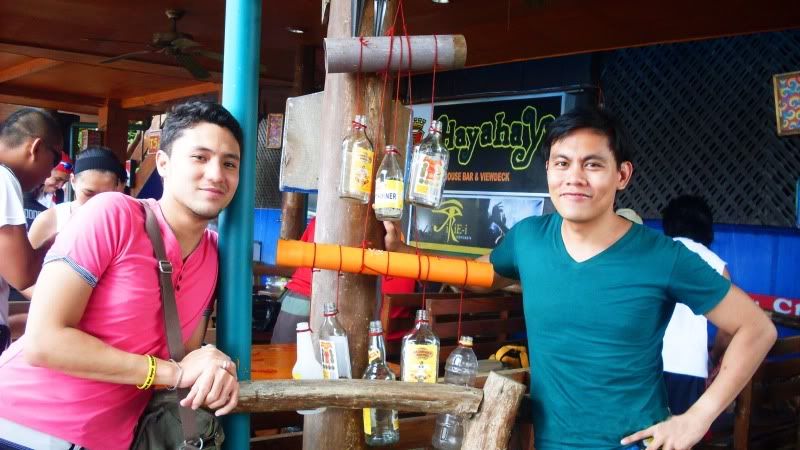
Ram and I in Hayahay with our wind chimes made of Tanduay bottles.
And I thought: didn’t we always want to be part of something like this, a gripping test of physical endurance and mental work, in what is essentially a grown-up version of a treasure hunt? The versions we see played out in television promise adventure (bungee jumping! exotic places!)—but, in the final analysis, they also promise something else: a chance to gauge oneself in a series of trials. Finishing the test becomes a kind of affirmation akin to a rite of passage. Eons ago, the young of Sparta and other ancient societies were sent out to the wilderness where they must learn survival and fight off the encroachment of beasts and all manners of evil—and then they come back after the ordeal to be proclaimed adults worthy of a place in their world. These days, we don’t do that anymore: instead, we join beauty pageants, go to war, or take the board exam.
Or run races.
It had been Gelo de la Cruz’s idea to transfer the concept of the race to Dumaguete, and on 29 November 2009, the first ever Race Across Dumaguete was held, concentrated mainly around the downtown area. According to the official site, “ten teams signed up [and] seven teams showed up,” and by the end of the day the team of Aryan and Cris Carlo won.
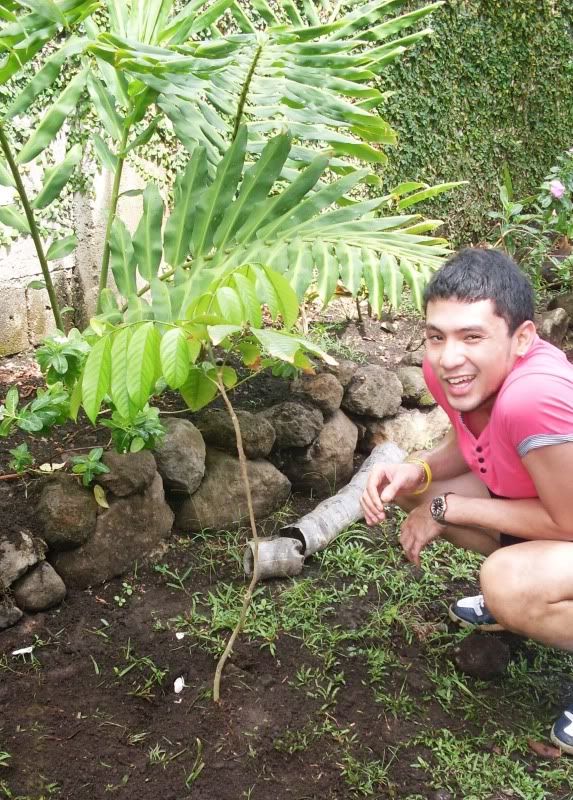
Ram planting a tree in Valencia.
I was amazed, and immediately wanted to join the next event.
“When? When?” I pestered Angeline all throughout the new year, until finally, by February, she had gathered the necessary group of people together to organize an entirely new race, sans Gelo, who was by then working in Germany.
This time around, they built the event around Earth Day—with clues and tasks that had something to do with conservation, ecology, and what-not. And so, last Sunday, April 18, fifteen teams gathered around Ninoy Aquino’s bust in Freedom Park at around 8:30 in the morning, ready to race.
Relaxing for a bit in Hayahay during our lunch pit stop.
I partnered with friend and student Ramuel Reambonanza Jr., and we called ourselves The Hive—after the name of the group of friends that we shared. The rest that pumped thigh muscles with us on that starting line included the Koreans Hyunsung Kim and Yeong Ho Kim, Team Gammans Karl Raciene Coyoca and Marvin Luther Tan, Team Song Lawrence Nodado and Sarah Jane Sibala, Team Flowrsie Arsie Cris Duran and Flowr Therese Bana, Negros Tri Team Dennis Lagahit Jr. and Welbert Laurecio, Team Baka Baki Alf Campos and Anthro Kadipunan, Team Amagaeru Kemuel Lazalita and Cheri Mae Amistoso, Team Eco Warriors Felix Araula II and [son] Sean Philip Araula, Team Swallow Rex Oliver Tan and John Philip Sanchez, Team Bang Lyndon Lorence Borromeo and Lea Therese Marino, Team Diveworx Glenn John Carballo and [son] John Thomas Carballo, Team Tachycardia Chantal Mae Diao and Jerry Ortaliz, and Team Green Acers Michelle Alcantara and Eve Queennie May Balbon.
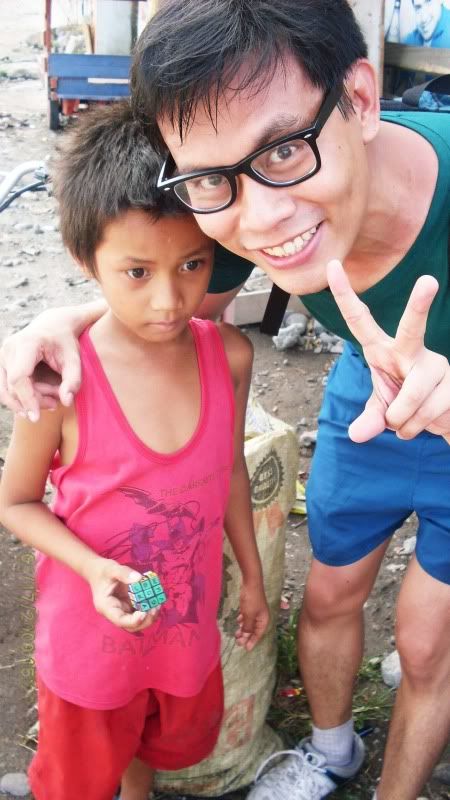
With a Lo-oc kid with a solved Rubik Cube puzzle.
We were told we could not bring wallets or coins or cellphones. We were told to bring a windbreaker or umbrella, just in case it would rain. We were told to bring our own drinking water or energy drinks, and some snacks, in case we got hungry before we could reach any of the checkpoints. We were told to bring a digital camera, a ball pen, some paper, and a hand sanitizer or alcohol—which soon proved essential. We were told to be in our most comfortable sportswear as we would be active throughout the day. We were told to put on sunblock. We were told to practice good sportsmanship, and told that we were not allowed to seek help from anyone, unless clearly specified.
And then, on that early Sunday morning, past 9 a.m., our grueling day began with that shout of “Go!” The moment I started running, the thought came to me: “Oh, dear God. This is for real.”
We went on an impromptu sack race across Freedom Park, then carefully counted 637 kernels of rice [miscounting meant doing the entire thing all over again], then raced on foot to the public market 3 kilometers away to find Manang Lolit’s stall in the middle of the market’s maze, then ate five big cubes of ice in less than 90 seconds [my mouth was soon numb, and the inside of my cheeks were bleeding…], then, given only P24, raced to Valencia town after haggling with a jeepney driver who was determined to wait for more passengers while we were determined to just go [which meant us going around, cajoling people to ride, now na!], then we planted a tree sapling in the mayor’s brother’s yard where we also collected non-biodegradable garbage in a black bag, then we took a quiz about composting, then we dug into a huge pot full of earthworms, then we solved another clue using cellphone codes which gave us instructions on where to go next, then we begged a habal-habal driver for a P24 ride to Hayahay [which is worth P100 on ordinary days], then we ate pizza for lunch, then we made wind chimes out of the Tanduay of bottles we gathered in Valencia, then we solved an intricate pictorial puzzle about garbage disposal, then we raced to Mercury Drug and then I ran [while Ram rode the potpot] for more than 10 kilometers to the city dumpsite while picking up garbage along the way [this could be said to be the leg of the race that was invented in Hell], then we threw said garbage to the city dumpsite, then we raced back to the city on the same backbreaking route, then we went shopping and haggled for P30-worth of children’s clothes at the ukay, then we ran another 3 kilometers to a specific basketball court in Lo-oc to give said ukay to a poor kid, then we were told to solve a Rubiks cube which contained the next clue, then we ran to the Boulevard, and then, for our final task, garnered twenty signed petitions from total strangers promising to do something good for the environment.
Ram and I learned to beg and haggle that day. We learned to knock on strangers’ doors that day, begging for a drink of cold water. We learned to go around the metro for the entire day with only P24 in our pockets. We learned strategy. We learned to go beyond body pain and the unfortunate instance of a potpot tumbling over along the highway.
We have never ran as much and walked as much from all our lives. But we did all these with humor and so much good will. We laughed a lot, and we had each other’s back. That’s what mattered most. And at the end of the day, our bodies were tired and broken and achy. We were red from the sun. But it was all worth it.
So, how was your day last Sunday?
Ram and I in Don Atilano after the race and a shower, red from the sun, bone-tired, but happy.
2:25 PM |
Writing Fellows of the 49th Silliman University National Writers Workshop
National Writers Workshop Director-in-Residence Rowena Tiempo Torrevillas, the National Commission for Culture and the Arts, and Silliman University are pleased to announce that the following young writers have been accepted as fellows for the 49th National Writers Workshop scheduled on 3-21 May 2010:
For Poetry
Gian Paolo Simeon Lao (Ateneo de Manila University) Dominique Allison Santos (University of Santo Tomas) Jacob Dominguez (University of Santo Tomas) Oscar Serquina Jr. (University of the Philippines-Diliman)
For Fiction
Aaron James Jalalon (University of the Philippines–Mindanao) Jenette Ethel Vizcocho (University of the Philippines-Diliman) Gilda Ysobel Galang (Ateneo de Manila University) Anne Carly Abad (Ateneo de Manila University) Gino Francis Dizon (Ateneo de Manila University) Jose Carlo Flordeliza (De La Salle University) Ida Anita Del Mundo (De La Salle University) Samantha Echavez (University of the Philippines-Diliman)
For Creative Non-Fiction
Kelly Marie Tulio Conlon (University of the Philippine–Mindanao) Miro Frances Capili (University of the Philippines-Diliman) Christina Mae del Rosario (Ateneo de Manila University)
Today, with good friend and partner Ramuel Benedicto Reambonanza, I went on a sack race in Freedom Park, counted 635 kernels of rice, raced to the public market 3km away to find Manang Lolit's stall in the middle of the market maze, ate five big cubes of ice in less than 90 seconds, raced to Valencia town after haggling with a jeepney, planted a tree in the mayor's brother's yard where he also collected non-biodegradable garbage, took a quiz about composting, dug into a huge pot full of earthworms, solved a clue using cellphone codes, then begged a habal-habal for a P24 ride to Hayahay [which is worth P100 on ordinary days], ate pizza for lunch, made wind chimes out of Tanduay bottles, solved a puzzle about garbage, raced to Mercury Drug and ran more than 10km to the city dumpsite while picking up garbage on the way [while Ram rode a potpot], threw said garbage to the city dumpsite, raced back to the city on the same backbreaking route, haggled for P30-worth of children's clothes at the ukay, ran 3km to Looc to give ukay to a poor kid, solved a Rubiks cube, ran to the Boulevard, and finally obtained 20 ecological petitions from total strangers.
"What will you do in bed? Stare at each other? That is supposed to make her happy?" ~ Patrick Seagrove
I am beginning to believe that those who like to throw around, with such careless abandon, the much-abused phrase "I don't believe in labels" are actually lazy idiots who think they can get by in the world in spineless namelessness. For example: "I'm not gay. I'm not straight. I just believe in love. Why label love?" Fuck that. You're already naming that chemical reaction inside you as "love." That's labeling. You cannot get away from naming. It is a basic function of intelligence that has a link to the spiritual. "In the beginning was the Word" -- even the Bible says that. If you think hard about it, such abandon of refusing to name oneself actually most often produces unexpected hurt and pain, especially for the party that has been [or will ultimately be] fooled/hoodwinked. It's the philosophical equivalent of fence-sitting, the coward's cop out. Be gay. Be straight. Whatever. Just deal with it. Don't live in the world that is full of shadows and call it paradise.
Over lunch in Jutsz Cafe, where I have my favorite dish of garlic fish fillet with salad, I begin filling out the calculations for my red mixed income form from the Bureau of Internal Revenue, which came with the regular income tax return. Michael, our English Department secretary who knows his accounting stuff, had earlier done the complicated mathematics for me—all those numbers swimming in my eyes signifying nothing.
Already that morning, I had dutifully made my annual pilgrimage to City Hall to get my CTC, my cedula.
In my head, the route for the rest of the afternoon is well-laid. I’d stop over at the BIR main office near the Capitol to have my documents checked. Then I’d scoot over to the nearest bank and pay whatever penalties I am supposed to pay. I’ve done this ritual every April for so many years. The only hassle I have ever encountered was once forgetting the filing deadline in 2007, and I had to frantically do the required legwork precious minutes before the banks closed. Afterwards, I think, I’d go home, pick up my laptop, go straight to class, lecture on Contemporary Philippine Literature, go to the gym, go home and shower, go to Maoai Benitez’s birthday party, and then watch Broken Hearts Club with The Hive. Perfect.
The BIR office is friendly enough. Entering its premises, I find a gigantic poster of the BIR head commissioner in a pose gesturing welcome. I think it funny how our high officials find it always necessary to put their visages on such things.
Inside the BIR, I joke around with fellow Silliman University employees who are, like me, doing their filing at the 11th hour. The nice BIR office lady tells me everything in my documents seems in order, but tells me only to change my entries in my red form from pencil marks to ink. I say thank you, and I proceed to redo the form in ink.
“Where can I pay my mixed income tax?” I ask later.
She smiles and says, “Well, there’s Landbank, and there’s DBP.”
I think: DBP is just a little too far, near the Boulevard. Landbank, on the other hand, is only a stone’s throw away from the Capitol Area. So I go down from the BIR building to the highway—and there I realize that there is no tricycle headed in the direction of Landbank. The DPWH has closed the strip to do repairs on the road, and public transportation has been routed somewhere else. “Great,” I think of the public works being demonstrated right in front of me. “This is my tax pesos at work.”
I decide to walk the length between the Capitol Area and Landbank. It’s not too far, I think. Under the 1:30 sun, I walk and brown in the sweltering summer heat.
I arrive in Landbank. I ask the guard on duty, “Where do I file my income tax?”
He nods towards the teller, “Go straight over there.”
I go to the teller. “Is this where I file my income tax?”
She says, “Go to the BIR representative over there. He will first approve your documents.” She points at his direction with her lips formed into a snout.
The BIR representative stationed in Landbank turns out to be an overeager asshole who gives me an unnecessary hard time.
I give him my forms, the same forms the people in the BIR main office have already gone over.
“You need to change this red form to the blue form,” he says, in a tone of such bright overeagerness it borders on the infuriating know-it-all.
“But I’ve always used this red form for my mixed income.”
“No,” he insists, “you have to.”
I look over the new form. “But the calculations are not the same anymore then, and my accountant has already filled in the calculations. Do you expect me to recalculate all this?”
“It’s the same,” he insists.
“But I have always used this form.”
“If you insist on using the red form, you will be liable for a tax audit.”
A tax audit? On a fixed income?
I sit down and study the difference between the two forms.
I text Michael at the department and my friend Jacqueline at the Silliman Business and Finance. These people will know what to do, I think. They breathe these things. But they tell me to just follow the BIR rep’s suggestion.
I study the forms some more. “But the boxes for the amounts are no longer the same,” I tell the overeager BIR rep.
This goes on for more than ten minutes.
“But they are the same,” he says.
“They’re not.”
“They are.”
“They’re not.” I become exasperated. I sit down, and try to fill out the new blue form anyway. They are not the same.
I think: I can get out of the bank, and have Michael recalculate this. Or, or...
Or go to another bank.
I immediately stand up and get out of Landbank, planning on a quick transfer to DBP.
Thirty minutes have elapsed.
There are no tricycles headed that way. So I walk again, under the heat of the sun, from Landbank to the Boulevard Area. I tan with each ticking second.
I arrive at the DBP. It is past 2 pm. The guard stops me. I tell him I am there to file my taxes. He asks, “How many sets of payments?”
I blink. “What do you mean?”
He takes my forms and starts counting. “One...,” he intones, “two... three... You have to fill out these three individual payment forms.”
An older guard suddenly comes out of the bank’s doors. “Are you sure?” he asks the first guard. He, too, counts my forms. “He only needs one payment form to fill,” he says.
“Oh,” the first guard says. “Okay then.”
I take the new form.
“Here’s your number,” the first guard says. “They will call you with this number.”
My number is 82.
“Do you have a cellphone?” he asks.
“Yes,” I say. “Why?”
“Leave it here with me. You can’t bring it inside,” he says, and then gives me another number. It is a claim tag. It is numbered 8.
“Okay,” I say, giving him my cellphone. “Where do I go after this?”
“Fill out the payment form first, and then go to that BIR representative stationed over there,” he says.
Yes, another BIR representative.
“Okay,” I say.
I sit down at the nearest couch and fill out the new form. It is mercifully short.
Then I go to the BIR representative seated at her table. She looks over my forms, including the OLD red one I had refused to change, and then she tells me, “Everything is in order. Please wait for your number to be called.”
In my head, I am screaming: What? What? What? What exactly was the problem with that other BIR representative in Landbank? How can two BIR representatives disagree on procedure?
I sit down and wait for my return. It turns out to be a long, long, long wait. But the electronic call number above the tellers’ heads does not seem to be working, and the numbers they are calling out do not seem to make sense with my own number. I am 82. They are calling out digits immediately after 10. Surely I am not supposed to be here in the bank forever! I go back to the guard outside.
“Are you sure this is the right number?” I ask.
He looks down at his work station—and on top of it was a merry pile of other numbers. He picks out a smaller one. Now I am No. 38.
Such system! I laugh inside. I am slowly being torn to pieces by the madness of it all.
I go back to the air-conditioned interiors of the DBP, wanting only to laugh at the absurdity, at the randomness of everything. I feel like I am in a Kafka story.
The minutes drag. I fall asleep where I sit.
I must have been inside that bank for more or less two hours.
And then finally, a voice rings out. “Number 35, 36, 37, 38, 39, 40...” and so on and so forth.
I rush towards where the voice is, and the kind-looking teller takes my form. “Please wait to be called again, sir,” she says.
I wait for thirty more minutes.
And then finally, my name, ringing out from another teller’s mouth.
I pay my taxes.
Soon I drag my feet out of the bank. I claim my cellphone from the guard’s desk. I begin to send out cranky messages to the rest of the world. I look at my watch. It is past 3:30. I am late for my class. And I no longer have any plans for going, or partying later in the night. I am exhausted.
While I pause to take a breather right outside the bank, a motorcycle screeches to a stop outside the entrance. An old woman alights from the passenger’s side, and goes straight to the doors.
She knocks.
The bank guard peeks out. “Ma’am, sorry. The bank closes at 3 pm.”
“But,” she begins with a voice laced with worry, “I have to pay this. This is my BIR income tax form. If I don’t pay this today, I will have to pay the penalty.”
“Ma’am, sorry,” the guard insists. “The bank closes at 3 pm.”
I quickly walk away from the scene, hoping for a quick tricycle ride home.
5:00 PM |
Why Love is Like Raccoons in Burning Chimneys
"The thing to remember about love affairs," says Simone, "is that they are all like having raccoons in your chimney.... We have raccoons sometimes in our chimney.... And once we tried to smoke them out. We lit a fire, knowing they were there, but we hoped the smoke would cause them to scurry out the top and never come back. Instead, they caught on fire and came crashing down into our living room, all charred and in flames and running madly around until they dropped dead." Simone swallows some wine. "Love affairs are like that," she says. "They are all like that."
"We are built to suffer terribly when love fails -- first to protest the departure and try to win the beloved back, and later, to give up utterly, dust ourselves off and redirect our energy to fall in love again."
“Sitting quietly, doing nothing, spring comes, and the grass grows by itself.” —ZEN PROVERB
I don’t know who it was who first told me that one sure way to calm yourself in the frenetic whirlwind of days is to stop and just look at a flower.
Imagine this. You command yourself to stare at the bloom, to feel all your undivided attention focus on the intricacies of its petals and the sure tuck of its sepals. See how it folds at some edges, and then how it flares just so at the others. See the creeping diffusion of hues. You soon feel its colors begin to pulsate, you feel the wonderful symmetry of its biology...
Almost always, perhaps because you will it so, the world begins to shrink away. And then there is only you and the flower, a quiet invisible cocoon shedding you from the cacophony of everything else. You. And a flower. And the bliss of a full flowing concentration.
Sometimes all we really want, in the best of days, is quiet.
In Muriel Barbery’s intelligent and deeply affecting novel The Elegance of the Hedgehog, which is about a trio of geniuses “in hiding” in some rich Parisian apartment building, we find that the precocious child genius Paloma Josse is always in search of a hiding place, away from the bourgeois “barbarians” who are her family and neighbors. She wants to get away from everyday disturbances to nurture quiet, which breeds what she calls “profound thoughts” about the “movements of the world.” She rarely gets it, but in the end she finds it in the loge of Mme. Renée Michel, their squat concierge, who fiercely hides a formidable intelligence by embodying for everybody else in the building the stereotype of an unthinking blue-collar worker. But perhaps Adlai Stevenson said it best, when he once declared: “In quiet places, reason abounds.”
This is true.
Not everybody can appreciate that kind of quiet, of course. They often mistake it for boredom. Perhaps this is because we have grown so used to increasing decibels as an everyday thing in all our lives. It has almost become the new make-up of the world.
My music mentor, the radiant Elizabeth Susan Vista-Suarez, once told me that she believed most of the world has gone increasingly deaf over the years. She has found that what were once perfectly acceptable (and hearable) levels of sound—especially during concerts at the Claire Isabel McGill Luce Auditorium—have fallen on increasingly unhearing ears.
“It’s not even about the acoustics anymore,” she said. “People are just becoming hard of hearing these days.” She knows why. The world has become a playground of noise.
And I know this for sure in my life. You see, it has become a bit harder for me to hear sound in “normal” levels—the music that I play in my apartment, for example, nears maximum volume, but I play the denial game by convincing myself that my stereo’s volume dial is calibrated for soft sound, even at maximum.
It is the same for the sound coming from my television. And it is perfectly reflective of how I have become inured to noise that I cannot fall asleep without the television turned on. I nod off to its disembodied sounds. That and the flickering blue that it emits into the walls of my darkened bedroom becomes my kind of lullaby. I sleep to the sound of CNN anchors, to the silly chatter of MTV veejays, to the chatter of unseen adventurers of Discovery Channel.
It is as if we have come to truly believe that all the universe is made of this fabric of sonance—honking cars horns and screaming children and blaring televisions and puffing politicians and screeching car wheels navigating the asphalt jungles of our lives.
And so, when suddenly we find ourselves in the green solitude of mountains or at some secluded beach, we take to the quiet that pervades like it was an alien thing, which we can amuse ourselves with. It is something decidedly different for us that it borders what we make for novelty. “Quiet,” for a lack of a better description, has become quaint.
Over the Holy Week, as Dumaguete dissolved into the doldrums and I surfed the Internet to distract myself from watching too much television, I found people begin to make noise online with the same whine: “I’m bored.”
Over and over—in Facebook status updates, in Twitter shoutouts, in Tumblr posts—it was essentially the same thing and the same concern: “It’s too quiet. I’m bored.” There were Boracay wishes and invitations to escape the sweltering heat to the cooler enclaves of the mall or Baguio or Valencia town—such fuss because there was none of that comforting din people were used to. Outside, there were no tricycles trolling the streets. There was no rush of people. There was only quiet.
And then, once again, that whine: “I’m bored. It’s too quiet.”
Even I, child of noise, had to react to this tiresome litany. And so I wrote in my Facebook and my Twitter pages: “That’s not boredom, people. That’s a chance for rare quiet in this noisy world, and a chance to listen to what the depths of your heart can tell you.” It was a corny note, but I felt it was calculated enough to make some of the whining stop.
And for the most part, it did. At least for a few hours, anyway. That note miraculously snowballed into a chance of reflection among some of my friends. One eventually wrote back: “That made me rethink what I am exactly doing now. Thanks for the perspective shift.”
Later on, I too began to believe in my own mantra. I turned off my television, closed the laptop to break away from the “chatter” of the unceasing online world. I settled for a book, and in low volume, I played “Thy hand, Belinda; darkness shades me” from Purcell’s opera Dido and Aeneas. This, according to the fictional Mme. Michel, the heroine of Barbery’s world, is “the most beautiful music for the human voice on earth...”
Barbery continues in Mme. Michel’s voice: “It is beyond beautiful, it is sublime, because of the incredibly dense succession of sounds, as if each were linked to the next by an invisible force and, while each one remains distinct, they all melt into one another, at the edge of the human voice, verging on an animal cry. But there is beauty in these sounds that no animal cry can ever attain, a beauty born of the subversion of phonetic articulation and the transgression of the careful verbal language that ordinarily creates distinct sounds. Broken steps, melting sounds. Art is life, playing to other rhythms.”
Melting sounds. Life in rhythm. Things you can hear only when all else is quiet and you are in tune with how the universe hums without the distraction of the noises we make.


 4:23 PM |
Life is Like a Box of Chocolate...
4:23 PM |
Life is Like a Box of Chocolate...