Celebration: An Anthology to Commemorate the 50th Anniversary of the Silliman University National Writers Workshop Sands and Coral, 2011-2013
Silliman University, 2013
And I'm back. I've been having been Internet problems at home so I couldn't blog for the longest time. The Globelines technicians seem to take their sweet time coming around to my place to fix the problem -- even when they boast of their "24-hour immediate service." Bastards. They certainly put a kink to my work schedule.
But anyway... These are the new fellows for the 46th National Writers Workshop in Dumaguete. For the first time since 2000, Sillimanians -- five of them -- made the cut. And I'm quite happy that two of them are part of LitCritters Dumaguete. Talk about resurgence after a long drought.
Kurt Vonnegut Jr., "whose dark comic talent and urgent moral vision in novels like Slaughterhouse-Five, Cat's Cradle and God Bless You, Mr. Rosewater caught the temper of his times and the imagination of a generation, died last night in Manhattan," reports the New York Times.
In honor of the great writer, here's one of his more famous short stories: "Harrison Bergeron" makes us (and especially the liberal in all of us) confront the uncomfortable, and lets us question the idea of human equality, stripping it down to what he perceives to be a very dangerous naivete. This was the first Vonnegut story I read. (My favorite has got to be Player Piano.)
I have to say this because it's been bothering me the day American Idol Season 6 went into its serious round. I've been keeping it to myself for so long because it sounds rude, even shallow. But I can't keep mum anymore because this week's Latin episode only reinforced what I've always thought about Phil Stacey. Listen to this. He may even be a relatively good singer, but Phil Stacey gives me the creeps. Every single week, everytime I see him sing on American Idol, it's like watching a cadaver sprung out of his coffin. He just looks like a dead guy. Or a ghost. Or the Grim Reaper. Or an emaciated refugee from Eastern Europe. Or a cancer survivor. Dear Crissy thinks he looks like Nosferatu even. Somebody else says he looks like Uncle Fester from The Addams Family. I know, I know... All these sound rude. But Phil Stacey really just gives me the creeps.
I have got to plug Cel Flores-Coscolluela's new book, because that's what friends do. (Or at least friends of husbands, and wives. Cel's Cos is a good friend from Dumaguete summer days.) Cel is a great writer, and a multiple Palanca winner at that. Her new book, published by an outfit called Cozy Reads, is an anthology of broken-heart stories aptly titled Heartbreak. I like the subtitle even more: Stories That Will Stay With You Longer Than Your Ex Did, which is four guffaws and a half. The anthology features stories from other friends (Faye Ilogon and Carljoe Javier), and some new voices in the literary scene. What kind of stories? The book's website gives us a few choice synopses: There's one about "a jaded model [who] lands a gig at a fantasy convention where she dons an Arwen costume and promptly falls for a man who calls himself Aragorn." There's another about "a woman [who] files for annulment and on the very same day loses an arm when the train she is riding is bombed." And then there's another about "a perennially single twenty-something [who] contemplates wedding invitations until her romantic prospect comes knocking on her hotel room, arm in arm with another man." Ouch. A book with "ten stories that show the tragedy and comedy that is heartbreak... a demonstration of the human propensity for getting high on an emotion that, unfortunately, also has the power to bring anyone crashing down." That should speak for all of us who has loved and who has often lost. Buy na.
Which reminds me... Whatever happened to Milflores' Sawi anthology? I have a short piece titled "How Sarah Broke Up With Me" there. Paging BJ and Rica...
Mookie Katigbak, "As Far as Cho-Fu-Sa" First Prize.
Victor Penaranda, "Josefine Sleeping" Ana Escalante Neri, "Lightscape" Second Prize (tie).
Eric Gamalinda, "Qana" Third Prize.
J. Neil C. Garcia, "Torso" Alfred Yuson, "Concealment" Joel Toledo, "New Century With Dragon" and "Ascension" Honorable Mention.
SHORT STORY
No first prize.
Anna Felicia Sanchez, "Inventories" Rhea Buela Politado, "Southbound" Second Prize (tie).
Timothy Montes, "In the Slaughterhouse" Dean Francis Alfar, "Six From Downtown" Douglas Candano, "A Visit to the Exhibition of the International Committee on Children's Rights" Third Prize (tie).
ESSAY
No first and second prizes.
Rosario Cruz Lucero, "Singer on the Mango Tree" Sandra Nicole Roldan, "How to Deal With Dying" Third Prize (tie).
It's very, very gratifying to get news of friends (and mentors!) winning. Dean has some pictures in his blog (and an excerpt from his prize-winning story). But looking at the winners list, Dean and I have noticed something else: except for Ms. Politado whom I don't know, all the winners have a Dumaguete connection -- they've been through the workshop, or in the case of Ma'am Chari, taught here in the old days. Maybe that's why I can't wait for May to start, and see the magic begin once more. Joel, congratuations... uuwi ka ba dito this summer?
[thanks to glenn mas for texting me the results as they were announced. glenn, make a new blog na]
In "Kailangan Kita," Ogie Alcasid has reached a startling maturity as composer of love songs. In this theme from the glorious movie of the same name, Mr. Alcasid reaches into the deepest reaches of drama, and gives us a song that more than touches us: we become the song. Consider its story:
Sa piling mo lang, Nadarama ang tunay na pagsinta. 'Pag yakap kita ng mahigpit, Parang ako'y nasa langit.
Ngunit ito ay panaginip lamang Pagkat ang puso mo'y labis kong nasaktan Pakiusap ko ako ay pakinggan
Kailangan kita, ngayon at kailanman Kailangang mong malaman na ikaw lamang Ang tunay kong minamahal At tangi kong hiling ay makapiling ka muli
Ngunit ito ay panaginip lamang Pagkat ang puso mo'y labis kong nasaktan Pakiusap ko ako ay pakinggan
Kailangan kita, ngayon at kailanman Kailangan mong malaman na ikaw lamang Ang tunay kong minamahal Ang lagi kong dinarasal
Kailangan kita, ngayon at kailanman Kailangan mong malaman na ikaw lamang Ang tunay kong minamahal Ang tangi kong hiling ay makapiling ka muli
It's a love song of exquisite regret. Here, the singer imagines a lover in his embrace, taunted by the knowledge that this is a dream, a hopeful one if one must qualify it. We hear a snippet of history: he has hurt the lover, and implores her (or him!) to listen to this one last plea, to this one last song. How do you not melt under the heartfelt pronouncements of "Kailangan kita, ngayon at kailanman"? That line is way up there among immortal lines from mushy love scenes, like Tom Cruise's "You complete me" speech from Cameron Crowe's Jerry Maguire.
And yet, miraculously, the sentimentality doesn't seem gratuitous. Or diabetic. Perhaps it is because the plea is rendered in an almost plaintive manner. The whole song approaches restraint, but barely: I love that kind of emotive struggle, as all martyrs probably do.
This will become a longer post, but for now, this will do. I'm finishing off the last batches of papers and exams to grade, and as usual, I am both horrified and amused by the grammatical errors of Filipino college students and their head-spinning lack of historical grounding. For one question, I asked them to imagine themselves as a shipmate of Legazpi tasked to write the King of Spain a report of progress from Las Islas Filipinas. The contemporary vein of their train of thought was jarring, and I half-suspect most of them are plagiarizing from history books and what-not. But that's not the biggest disappointment. For a question assessing Fr. Miguel Bernad's original diagnosis of Philippine literature as being "perpetually inchoate," one student identified Jose Rizal's second novel as "El Felibus Terismo."
And I'm thinking: if an iconic literary (and historical) title has become a common mistake, what kind of college students do we have now?
12:01 AM |
Call for Submission to Growing Up Filipino II
This is a call for submissions of short stories for an anthology tentatively titled, Growing Up Filipino II: Stories for Young Adults. The book will be edited by Cecilia Manguerra Brainard and will be published by both Anvil and Philippine American Literary House (PALH). Contributors will receive copies of the book as compensation for the use of their work.
The manuscript should be approximately 8-10 pages long, typed, double-spaced (approximately 1,800-2,300 words). This should be emailed to CBrainard(at)aol(dot)com. You may also send it by air mail to:
Cecilia Brainard c/o PALH PO Box 5099 Santa Monica, CA 90409 USA
This book project is a follow-up of an earlier short story collection entitled Growing Up Filipino: Stories for Young Adults, published in 2002.
Deadline for submission is 1 August 2007. Early submissions are welcome. Please send your bio (approximately 150 words) in people-friendly narrative form.
12:36 AM |
A Glimpse of Holy Week and the Mananambals of Siquijor
The three-day trek across the hills and dust roads of Siquijor -- on foot and on motorcycles under the heat of the April sun -- chasing after shamans can be both heady and exhausting. Coming back from it all, I spent the entire morning in Dumaguete sleeping off the bottled up tiredness and the excess of adrenaline and excitement. Later in tbe afternoon, it was off to Sans Rival for a little bit of civilized cake, and to Lee Cimbali for coffee, and to the new Jo's By the Sea in Sibulan for dinner of chicken. It was as if I wanted to immerse myself so quickly into my city ways.
But I can't quite forget Siquijor, and its magic, and its even more magical people so easily. This is a glimpse of the story in my head...
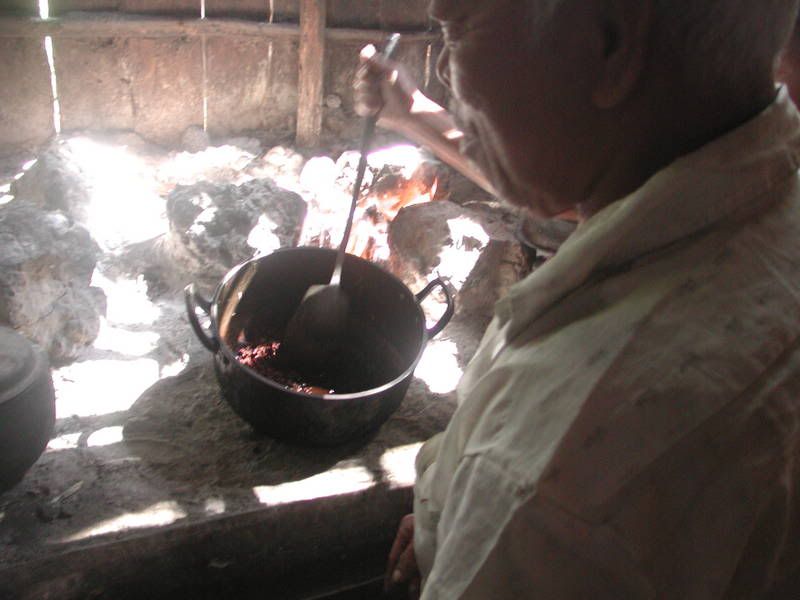
This is the mananambal from Barangay San Antonio, in Sitio Buac-Bato, Juan Ponce Dako, preparing the lana for the inadlip he will be preparing from the pangalap of seven Fridays...
This is apprentice mananambal Manong Noel chopping the forbidden ingredients for the inagdaut, or the hex potion, which includes chipped human bones which he has gathered from the old cemetery back in Siquijor town...
This is the small black pot of ingredients for the hex potion burnt to charcoal in the middle of the San Antonio jungle, ready for the masa.
But what I really want to write about is the brightness of these people, how beautiful and funny they are, how hospitable, colorful, and engaging. There's Manang Juling, for example, who engages us in banter while talking about how she once healed a young man of impotence on the eve of his wedding. There's Lola Lauriana who can divine the future and the spot of lost things, but plafully insists that people come to see her because she is the most beautiful mananambal around. (She's 88 years old.) There's Lolo Indoy whose quiet ways and unassuming manner almost makes him the poster boy for Siquijor shamanism -- and indeed he is. (GQ Cover Boy for the mananambal set? You bet.)
The thing is, so many negative things have been written (or blown up into bad horror movies starring Assunta de Rossi) about this beautiful island -- all of which have created the crudest perspectives and the weirdest superstitions which are largely untrue. That seems to be my challenge now as I begin the stories I will be submitting to Men's Health and Marie Clare and Inquirer: to dig deeper than the awful tabloid stories, and show the humanity of it all.
Timmy Cruz's "Boy" is one of those songs from the recent past (I'm not sure whether it is an 80s or an early 90s song) that you quickly dismiss for being maudlin the first time around, but whose haunting plea for love and attention sticks to and at you that you cannot help but still remember it years later, for better or for worse. Like Sheryl Cruz's "Mr. Dreamboy" or Donna Cruz's "Habang May Buhay" or Sharon Cuneta's "Mr. D.J." They are songs most especially memorable for coming from the variety of music one can easily call The Last Song Syndrome Album.
I remember the song as a radio favorite, and liked it enough to just let it go as one of those common hits that wear their hearts on their sleeves. The song came to my notice again last year when, out of the blue, Mark urged me to Limewire it to my hard disc. We were looking for "I Love You Boy" for months, and didn't find anything -- and gave up eventually. "Nobody cares about Timmy Cruz anymore," I reasoned. "Not enough to file share, anyway." A month or so ago, it again pricked my memories when the prestigious Philippine Madrigal Singers, courtesy of soloist Enrico Lagasca, picked it up as one of its novelty renditions for their Dumaguete concert, giving it a sly, and surprising, gay twist. Mark took to researching it again, and found that the title was merely one word: "Boy." One Limewire search later, and we quickly downloaded it.
Now, we listen to the song 24 hours a day, positively bothering the neighbors with Timmy Cruz's lament about a "manhid" boy who does not seem to notice somebody loving him from afar. It's the ultimate martyr song, which is the secret to its success. How does the song go? This way:
Oh what a night 'Di ako makatulog Parang tukso tanging laman ng isip Wala kundi ikaw
Bakit ganito? I can't get over you Kahit sarili ko'y ayaw maniwala Sa nangyaring ito... Oooh!
Chorus
I love you, boy If you only knew Naiinis na ako sa iyo Sobrang manhid ka At 'di mo napapansin
I love you, boy Kung alam mo lang Ang puso ko ay nagdaramdam Hanggang kailan ba ako ay maghihintay
My foolish heart Ikaw ang may kasalanan Kung ikaw ba'y tumahimik na lamang Ako'y 'di naguguluhan
Oh sayang lang If I were not a woman Sana'y noon pa ma'y aking nasabing Ika'y aking mahal
Bridge
I'm head over heels, babe I love you so much I'm going crazy
Chorus
My foolish heart Ikaw ang may kasalanan Kung ikaw ba'y tumahimik na lamang Ako'y 'di naguguluhan If you only knew..
Sometimes, though, when Timmy warbles the first two lines about not being able to sleep, I'd just shout into the air: "Take a sleeping pill!" But that does not stop me from loving the song, for real. It's a veritable classic. And testament to its pop longevity seems to be Toni Gonzaga's recent cover of the song, which is embedded below:
Is Toni Gonzaga the new Queen of Old Brilliantly Baduy Favorites? She has a cover version of "Mr. Dreamboy," too.
The best-kept secret to spending the Holy Week is staying in Siquijor. Boracay's old news. In Isla del Fuego -- literally, the Island of Fire -- you get both beaches and spirituality, of the light and dark kind.
So I'm off to the isla (how we locals call it) in search of surf and shamans, on assignment from Men's Health Magazine. I leave Wednesday, and will probably be getting back to Dumaguete on Easter Sunday. I really wanted somebody, anybody to go with me to Siquijor as a companion. (I must have asked five people.) But nobody wants to go, and now I feel really, totally alone. Doesn't matter anymore. I made my peace. I've realized life's really like that.
3:08 PM |
This Old Thing Does Not Interest Me Anymore
On receiving a note...
There are so many ways to say I'm not interested. I prefer my newfound silence instead. Look, The boat has sailed, the train has gone. But you are in your pity corner saying The martyr's prayer. I pray to no old gods, And not in the least in your old sham You call hurt. Take this advise and move on: I am not interested.
I finally got to watch the film which some of my friends are raving mad about, the way other people do when they see a Sam Milby movie.
I don't blame them for raving. There are many things to delight about The History Boys (the official website is here, and the Amazon page here), the brilliant film by Nicholas Hytner adapted from the brilliant play by Alan Bennett. There is, first of all, the almost typical British intellectual sheen in this story of schoolboys preparing for Oxford that manages to engage us emotionally, without the sentimental trifle of Peter Weir's Dead Poets Society, which -- even if it had been my favorite film for the longest time, in high school and college -- seems to grow more dated by the coming of years. (Consider also Mike Nichols' adaptation of Margaret Edson's Wit, where Emma Thompson gives a terrifyingly magnificent performance as a cancer-stricken professor and her passion over the 17th century English poet John Donne. How do the British do it?)
Then there are the undercurrents of a love story, an unrequited one that will melt the martyr in all of us.
Then there are the hints of a scandal -- but which is so cleverly drawn that it does not stoop low to the tabloid variety.
Then there is the magnificent instances of the boys singing ("Bewitched, Bothered, and Bewildered" never sounded this haunting in its longing, and "Bye, Bye Blackbird" -- traditionally a country tune -- becomes, in this film, a heart-rending paean to the memory of a beloved, underappreciated mentor). Ned, in his blog, has posted a clip from YouTube that has Posner singing a love song to Dakin, and I'm reposting it:
Then there is the intelligent perspective of how teaching is, or must be. The Baltimore Sun's Michael Srago, reviewing the play when it arrived in New York, takes note of this: "For Hector, 'knowledge is not general. It is specific -- and -- it has nothing to do with getting on.' Interlopers may be startled when Hector's French lesson takes the shape of a comic improv about bordellos, or when the tearjerking climax of Brief Encounter gets interspersed with fragments of great poetry. But Hector doesn't 'want to turn out boys who in later life had a deep love of literature, or who would talk in middle age of the lure of language and their love of words.' He wants them to savor writing as a living thing. That's why he integrates 'tosh'-like music-hall songs into his freewheeling curriculum: the 'sheer calculated silliness' of pop culture deflates reverence."
Then there are the history lessons -- and the erotic charge that comes in academic shoptalk: in this film, the moviegoer becomes a vicarious student or enraptured spectator of scintillating debates, of the relentless volley between argument and counter-argument. The professor nicknamed by the boys as Hector (played with such subtle intensity by Richard Griffiths, who is the snarky uncle in the Harry Potter movies) has it right when he proclaimed the "transer of knowledge" as basically an erotic act. I've always felt that way when I am in a class with a great professor, and surrounded with classmates who are willing to tussle, endlessly and with passion, with a cornucopeia of ideas. (Suddenly, I miss those graduate school days in Silliman when I had Ceres, Nino, and Timothy for teachers, and Jean Claire, Bombee, Douglas, and Jesselle for classmates...)
For me, the best moment in the film (and there are several very good ones) comes when Hector and Posner (played by Samuel Barnett, who has become the intelligent gay man's idea of a dreamboat -- right, Ned?) discuss a poem by Thomas Hardy ("Drummer Hodge"), in a scene that by itself is already worth the price of the admission.
Hector pauses near the end of their discussion, and says: "The best moments in readings are when you come across something -- a thought, a feeling, a way of looking at things -- that you'd thought special, particular to you, and here it is, set down by someone else, a person you've never met. Maybe even someone long dead. And it is as if a hand has come out and taken yours."
I felt that way seeing this movie. The History Boys is more than just a hand; it is an embrace willing to take me in.
Free broadband! Via your toilet! It's the new TiSP (Toilet Internet Service Provider) Beta.
But this is what I've always loved about Google. It's your search engine with the powerful bots, and a sense of humor. (Do you remember the George W. Bush + "stupid" + "I'm feeling lucky" thing?) And a sense of celebration as well. (Explore its holiday logos.) For other Google April Fool hoaxes, click here.
Hey, look. Sunday Inquirer Magazine has given out its annual hot list of recommended readings for the summer, and Cecilia Manguerra Brainard and Marily Ysip Orosa's A la Carte is one of them. Here's the capsule review from staff writer Pennie Azarcon-dela Cruz:
You'll need two vital ingredients before you start devouring this book: a full stomach and a comfortable seat some distance away from a working kitchen and a food court. Because definitely, a hungry reader will be torn between finishing the sumptuous stories and rushing off to try out the recipes offered as appetizer at the start of each chapter. The tasty morsels leave you convinced that food is more than just repast; it is also the stuff of national pride, childhood memory, romance, regret, rivalry, and even bloody murder. This book is one thick bubbling stew that satisfies one's hunger and imagination while whetting the appetite for more. Best cuts: "Wok Man" by Jose Dalisay, Jr.; "Closopen" by Janet Villa, "No Salt" by Nadine Sarreal, "Pedro and the Chickens" by Ian Rosales Casocot, "Kitchen Secrets" by Shirlie Mae Choe, and "Does It Matter What the Dead Think?" by Erwin Cabucos.
I say, yay.
While I was doing the rest of my Sunday reading of newspapers, this interview in the Lifestyle section of Philippine Daily Inquirer with Cendrillon owner Amy Besa (who co-owns the famous New York restaurant with chef Romy Dorotan) caught my eye. I've read about Cendrillon before, when New York Times food critic Frank Bruni gave it a terrific review ("... it's daring, different and a sure remedy for the malady, too widespread these days, of dining déjà vu. That has to matter, and that gives food lovers a real investment in the survival of this unconventional place") in 2005.
It trumpets, first of all, their new cookbook, Memories of Philippine Kitchens, which may be the first significant book on Philippine cuisine published by a major American publisher. (The book -- which features food photography by Neal Oshima -- has been picked by Barnes & Noble as its book of the month.) Over all, however, it's a wonderful interview with the Playtime staff, which basically covers the growing popularity and critical acceptance of Filipino cuisine in mainstream America, and a lot of hunger-causing discussion of local food. An excerpt:
Is pig's blood readily available in the US? Even in the East Coast? Yes.
How about entrails? When we do dinuguan we don't use entrails. We use pork meat. It's very difficult to clean entrails; you need to remove the smell.
How do you serve it in your restaurant to make it a bit more palatable? It's in a bowl. People love it.
With puto? We can't make puto. (Laughter) It is the most difficult thing in the whole world to do, believe me. Try it! You know when you get a good puto, appreciate it.
There are different kinds! There are so many kinds. There's the white, there's the ube, the pandan, the putong pulo, then there's Biñan, the big one. But then, you know, they put cheese. (Looks queasy then laughs)
What makes puto difficult? Puto is really a mixture of ground rice and cooked rice that you ferment, right? The secret is in the fermentation. You have like a lavadura and you mix it and you let it rise. Some people put a little yeast and some put baking powder.
Steaming is just the most difficult thing in the world. You have to steam it for the right [length of] time. If you lift that cover before [it is cooked] forget it!
It's a cliche now to even note that the 1980s was a grand repository of bad hair and great songs. But it's a beloved cliche (and something quite truthful, too). The thing is, nobody makes songs like they did in the 1980s anymore: there was just something about that decade that was magical, and raunchy, and innocent -- and sometimes all at the same time. Perhaps it was the optimism of the Reagan years, the resurgence of affluence everywhere, the hopefulness of the first EDSA... That bright hopefulness, charged with a subterfuge of greed, bled into the popular culture, and became our favorite songs and movies.
Indeed, like the songs of the era, the movies, too, had a tint to them (like vaseline on the camera lens) that I can't quite explain. Consider the color, the lights, and the almost childlike delight of E.T. The ExtraTerrestrial and Close Encounters of the Third Kind. Consider the cosmopolitan sweet vengeance of Working Girl and The Secret of My Succe$s. Consider the unalloyed joy of adventure of the Indiana Jones and Back to the Future series. Consider the panoramic vistas of Out of Africa, Gandhi, and Chariots of Fire. Consider the sweet angst-ridden explorations of Sixteen Candles, Pretty in Pink, The Breakfast Club, and Ferris Bueller's Day Off. Consider the stylish madness of Carrie, Fatal Attraction, and Dressed to Kill. Consider the unapologetic romps and comedic chops of Porky's, National Lampoon's Animal House, Coming to America, and Trading Places. Irony and pastiche in films were still a decade away, and so they were earnest and truthful. Sometimes, watching these films again, I am amazed by the depth of their intelligence. E.T., for example, was a runaway hit when it was released early in the decade: watching it now, I actually found it surprisingly contemplative. Steven Spielberg had faith that young people would grow to the story: he believed in the intelligence of the mass audience. Look at it again, it takes its time to bring us around to the grand (grand!) finish. I'm not sure audiences today -- on a steady diet of instant things -- will have the patience to enjoy such a film.
I mention these movies because one of the landmark films to come out during this time was Sidney Pollack's Tootsie (also here), which starred Dustin Hoffman as a difficult, out-of-work New York actor who finds salvation (and love) when he tries out successfully for a TV soap -- as a female actor. I love that film. It went on to gain many Oscar nominations (including Best Picture), and won a supporting trophy for Jessica Lange.
One of its nominations was for its theme song "It Might Be You" composed and written by Dave Grusin, Alan Bergman, and Marilyn Bergman, and sung by the incomparable Stephen Bishop. It was a perfect fit for the movie, and I love this song because it is in turns reflective, hopeful, and sad.
Here's the song for you to sing along...
Time, I've been passing time Watching trains go by All of my life Lying on the sand Watching seabirds fly Wishing there could be someone Waiting home for me
Something's telling me it might be you It's telling me it might be you All of my life...
Looking back as lovers go walking past All of my life Wondering how they met and what makes it last If I found the place would I recognize the face
Something's telling me it might be you It's telling me it might be you So many quiet walks to take So many dreams to wake And there's so much love to make
I think we’re gonna need some time Maybe all we need is time And it's telling me it might be you All of my life
I've been saving love songs and lullabies And there's so much more No one's ever heard before Something's telling me it might be you Yeah, it's telling me it must be you and I'm feeling it'll just be you All of my life It's you, it's you I've been waiting for all of my life Maybe it's you Maybe it's you I've been waiting for all of my life.
Listen to that earnest melody, that tone of hopefulness, that sweeping statement about waiting for love. What contemporary song comes close? Today, everybody's too busy singing, "To the left... to the left..."


 12:15 PM |
The 2007 Dumaguete Workshop Fellows
12:15 PM |
The 2007 Dumaguete Workshop Fellows

 I have to say this because it's been bothering me the day American Idol Season 6 went into its serious round. I've been keeping it to myself for so long because it sounds rude, even shallow. But I can't keep mum anymore because this week's Latin episode only reinforced what I've always thought about Phil Stacey. Listen to this. He may even be a relatively good singer, but Phil Stacey gives me the creeps. Every single week, everytime I see him sing on American Idol, it's like watching a cadaver sprung out of his coffin. He just looks like a dead guy. Or a ghost. Or the Grim Reaper. Or an emaciated refugee from Eastern Europe. Or a cancer survivor. Dear Crissy thinks he looks like Nosferatu even. Somebody else says he looks like Uncle Fester from The Addams Family. I know, I know... All these sound rude. But Phil Stacey really just gives me the creeps.
 I have got to plug Cel Flores-Coscolluela's new book, because that's what friends do. (Or at least friends of husbands, and wives. Cel's Cos is a good friend from Dumaguete summer days.) Cel is a great writer, and a multiple Palanca winner at that. Her new book, published by an outfit called Cozy Reads, is an anthology of broken-heart stories aptly titled Heartbreak. I like the subtitle even more: Stories That Will Stay With You Longer Than Your Ex Did, which is four guffaws and a half. The anthology features stories from other friends (Faye Ilogon and Carljoe Javier), and some new voices in the literary scene. What kind of stories? The book's website gives us a few choice synopses: There's one about "a jaded model [who] lands a gig at a fantasy convention where she dons an Arwen costume and promptly falls for a man who calls himself Aragorn." There's another about "a woman [who] files for annulment and on the very same day loses an arm when the train she is riding is bombed." And then there's another about "a perennially single twenty-something [who] contemplates wedding invitations until her romantic prospect comes knocking on her hotel room, arm in arm with another man." Ouch. A book with "ten stories that show the tragedy and comedy that is heartbreak... a demonstration of the human propensity for getting high on an emotion that, unfortunately, also has the power to bring anyone crashing down." That should speak for all of us who has loved and who has often lost. Buy na.