Celebration: An Anthology to Commemorate the 50th Anniversary of the Silliman University National Writers Workshop Sands and Coral, 2011-2013
Silliman University, 2013
Years ago, I was asked by the writers Gémino H. Abad and Alfred Yuson to submit to an anthology of poetry about fathers and fatherhood in the aptly titled Father Poems (Anvil, 2004). That project, I think, was timed for a Father’s Day release.
The assignment sounded simple—write about your father—but what I had to struggle with, at least initially, was the sudden uncomfortable confrontation of remembering. And remembering is an act fraught with both reconciliation and recounting of past hurts and disappointments—all the dramas any ordinary family is capable of making.
I knew I was not exactly my father’s son. I say that in the sense of familial intimacy. For the longest time, when I was growing up, he was estranged to me, first geographically, and later on, before he died when I was turning 20, emotionally. He was a distant old man who seemed to me possessed by some dark gravity, and I had no patience to understand his tantrums, why he was the way he was, or what was going on in his mind when he would wake up very early every morning and go around the house while we were still sleeping. Was he measuring out, in the dark and bluish light of dawn, what he had made of life? Did he feel that we were disappointed with him—this man who was once young and vibrant and ambitious and wealthy, but who was finally beaten down by strange circumstances to become, perhaps to his own estimation, a shadow? I was a young man in the twilight of his years, and the young never know any better about the varieties of human experience: I only knew the depths of my own narcissistic apathy and the shared disappointments I could not even begin to chart. My father’s name was Fermin. I carry that name, too. It felt then like a burden—like I was yoked to this man whom I could not understand.
Years later, I would write a short story about him titled “The Hero of the Snore Tango” (available now in my short story collection published by the University of the Philippines Press titled Beautiful Accidents) and the first few paragraphs of that story constitute something which I have yanked from reality.
I wrote:
When Father died, the family rose to play its parts as kin bereaved with loss, but rehearsed in its grieving. There was no crying, no fretful skirmishes with acknowledging tragedy—we all knew his days had to end some time. We had played his death scene each in our minds all too frequently, in variations of muted drama. I had imagined elaborations of quiet dark dawns and bursts of hysterics—the way Tagalog movies paint us all.
But it all finally came to this: a hurried waking nudge from Mother one early morning, and one sentence fraught with subdued disconsolation:
"’Gâ," she said, "Papa’s not snoring."
We hurried to his room and there he was in bed, mouth slightly open and with eyes closed, his skin already clammy to the touch.
"He’s not breathing," I said, feeling no pulse.
"Is he dead?" Mother asked.
"He’s dead."
"Why don’t you—I don’t know—why don’t you give him CPR, or something?"
"He’s dead."
The rest was my attempt in fiction to understand the man, albeit belatedly. And in retrospect, I think I have. In my growing years, I now understand the unforeseen skirmishes life brings you that can indeed cripple one’s spirit—and I know he must have fought hard and long for honor, for respect, for love.
But I did not understand yet fully all these that afternoon when I got the invitation to write poetry about him. I remember looking at the emailed invitation for what seemed like a long time, and then I sat down in front of a rented computer terminal at Scooby’s San Jose St. and wrote the following:
Because, father, there was no chance to believe In the impossible: the freshly-dug earth, now Your home, was mute as was usual, turning away Even the last howl of mourners coming near. Their black grieving did not understand, as we did, that Ties which bound could come loose as the grass that Would feast on your memory six feet above could, as Ground swallowed-in the digging for mortal remains. We are told, as the funeral flowers wilted in the sun, that Memories should be immortal, but we prayed for no ghosts. The dead should not speak. We prayed, instead: father, we Forgive you, for you have sinned. And the burial Became growing silence as we soon dispersed for lives spent In battled reflections, the muteness of years bearing down On children struggling to forget by the bottom of Beer bottles, or the occasional want for punish. Soon, we Come, year by year, to some bidding, somehow, For holy days kept precise—that last excuse—to Listen to some eternal knell your spirit might tell. Our candles now burn low to capture some Semblance of closing, the way the ghostly smoke Wisp among flowers, down to the carabao grass kept Trim. We wait, and we wait. And life and silence Become memories built on flimsy hopes, as they must, To resound to a kind of winged believing. And then we learn persistence, by the passing Of days, that even the living must learn to reclaim Their dead, to Live, to now close The prayers with which we can finally love Our dearly departed.
Imperfect poetry from a fictionist. But still. I think I wrote those lines in white heat, although the poem that originally poured from me is a little different now, after random nights spent revising lines, changing one word or four. What has not changed is the ambiguity I still sometimes feel about the man. But that has mellowed. Life itself has taught me how to understand the man.
And yet I know now that I do love this man despite his frailties. He was human. He was me. In my life he continues to live, and I know I must carry on if I want his memory to live on.
There is a picture of him that I keep on my work table at home. It is a photograph in sepia with white borders. He is a young man there—hair slicked back, face impassive but fierce and handsome, collared shirt carefully pressed—and I am struck by the fact that I very much look like him. That photograph keeps me grounded, and makes me remember that love is real, and that it can endure and even blossom even beyond death.
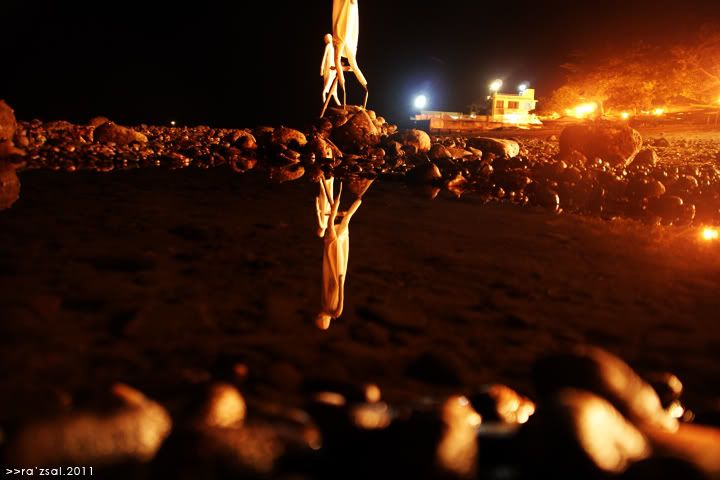
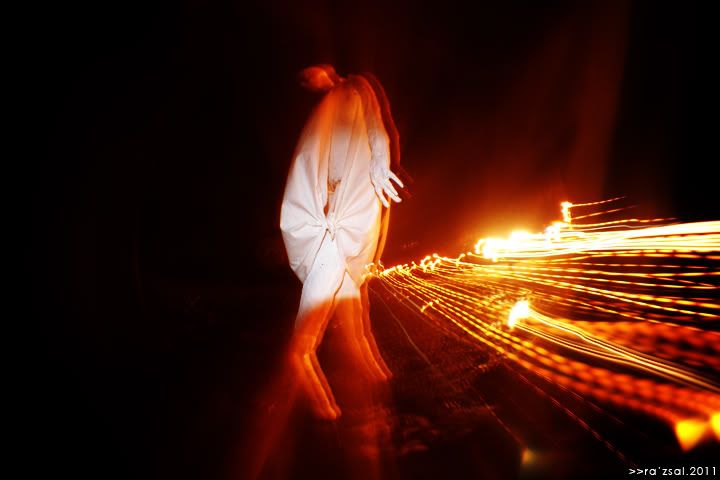
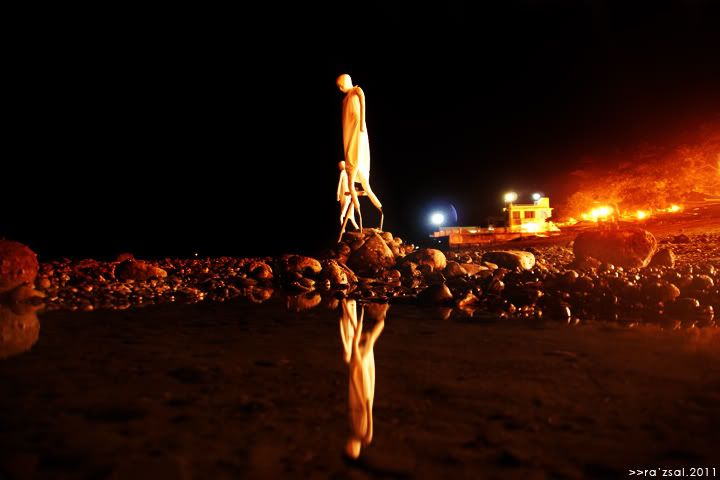
Since last Sunday night, there are spectral figures wading the shallows off the Boulevard in Dumaguete. You can see them as you cruise the street, before you turn right towards Burgos Street. They will strike you as uncanny. Perhaps. The three figures in white -- white plaster bodies in white sheaths -- are tamawos, the artists who made them tell us. To be more specific, "mga nabiyaang tamawo." Left-behind spectral figures of myths; tamawos, according to legend, are a kind of encantos, humanoid creatures of supreme powers, light-skinned, most of whom live in trees where they maintain huge (but invisible to the naked eye) kingdoms of fabulous riches, fantastic realms into which they tempt people they have fallen in love with to enter and leave the human world forever.
These tamawos on the sea, ghostly white and faceless, are somewhat of an indifferent sort: these ones turn their back to us observing them from along the shore or along the cemented walkways of the seaside promenade. Their frozen walk simulates that attentive grazing of shore in lookout for what's hidden beneath sand and beach rocks. They also seem inattentive even of each other, and that stance, looking out (but barely) into the dark vastness and oblivion of the Tañon Strait, seems sad and forlorn and beautiful and evocative of what life can be found in this lively, isolating stretch of this lovely, sad, small city. I can now imagine these figures, once the klieg lights that illuminate them are turned off, to seem ephemeral and lost in the Dumaguete darkness. And what of them in the light of morning tide? Figures wading chest-deep, still inattentive to the fact of the possibility of drowning.
Ah, my life thus far. The universe does mix it up for you, doesn't it. It puts in a measure of melancholy even in times of triumphs. Maybe it's to remind you that life is really an orchestra of sorts -- it takes all kinds of instruments to make the music hum the way it should.
I use music as a metaphor here because it seems to be the best refuge of all: it speaks for you. Without overly sentimentalizing it, your favorite music does carry your hopes and your loves and your devastations and your anger quite efficiently, and amplifies for you the exquisite drama of it all -- your own soundtrack to a private psychoanalysis, so to speak.
Right now, I am sad and I am drowning the things around me with sound only I can hear and that seeps to my bones like a beautiful kind of anger. I'm listening to The Temper Trap's Conditions album. Their music telegraphs for me an urgency in their beat that underlines a kind of bittersweet knowing. "Drum Song," to cite a particular track, is majestic in its score -- an achingly danceable bit that somehow urges you to reach from deep down, from those recesses of sorrow, all that manic energy urging you to dance and dance and dance -- perhaps on your own, in the solo comforts of your own room -- until everything, all that pain, flings away from you, or gets reduced to a dull throbbing in your chest that you mistake for your heart, the sweat that you wipe away and the breathlessness that you feel being everything that constitute a vocabulary for some things you desperately want to say -- or shout. To shout out, for example, that you love him but he does not care.
But you don't shout.
You just dance and dance and dance instead, the music becomes your dervish, the pain something you tell yourself you will have to live with like the endless refrain of a stupid, marvelous song.
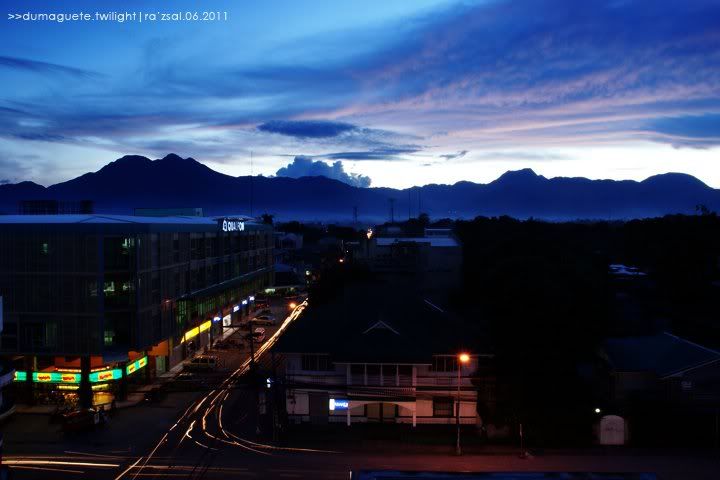
Photography by Razceljan Salvarita. Here is the city in darkness and light. A lit call center and an unlit ancestral house of the Pastor sisters across the street from each other. The Dumaguete streets at dusk darkening against the setting sky, with the Cuernos de Negros in the distance.
I have been thinking a lot about Virginia Woolf lately, for some reason. But only in the most random of ways. I'd be listening to Cesar Ruiz Aquino talking about the modernists, for example, and he'd mention the Bloomsbury Group -- although apparently he does not think much about Woolf herself. I'd be reading a literary blog and I'd come across an argument about who was the better modernist writer, Woolf or James Joyce? I'd be walking one morning down a street in Dumaguete, and I'd see a woman with a bouquet of flowers in her arms, waiting for a tricycle, and I'd think: "How very Mrs. Dalloway." And then I'd remember those days in the late 1990s when I'd sit in the grass somewhere in Tokyo and I'd read the perplexing book about the minutiae of a day in a sad woman's life. (I miss and envy those days.) I'd skim through YouTube and stumble on Tilda Swinton playing the gender-bending title character of Orlando, based on Woolf's elaborate "love letter" of a novel to Vita Sackville-West. Sometimes, I'd go around the house and stumble on my copy of Michael Cunningham's The Hours -- and I would tell myself: I have not seen Stephen Daldry's 2002 film adaptation for almost a decade now. When it first came out, I remember that it left me cold -- and I wondered: after having lived the life I've lived since then, will it find new resonance in me?
Yesterday, finally, I found in Facebook a link to this article by Cunningham in The Guardian. It felt as if the universe was compelling me to do something about this.
Today, unlike Mrs. Dalloway, I woke up quite late. But thoughtful, conscious of the minutes. I still managed to wring out a good day out of this Sunday which involved the readings of essays by Octavio Paz and F. Scott Fitzgerald and Ralph Ellison and such. There were sudden encounters and talks with a couple of friends. There was a walk around town under the wicked June half moon. There was the "unveiling" of a new art installation of tamawos -- mythical elementals -- off the Boulevard. And then I went home to watch The Hours.
It moved me afresh, and I think I understand this film much more now, being able now to see the depths of each of these women's unhappiness without a center -- Nicole Kidman's Virginia Woolf, Julianne Moore's Laura Brown, and Meryl Streep's Clarissa Vaughan. Sometimes the years do that: they make you see things your own youth cannot comprehend. What is life after ordinary madness and adult compromises? How does one deal with the sorrows of being trapped in a place you have no wish to be in, even when it includes the love of so many people? How does one recognize happiness, or does that recognition only come in hindsight?
There is a scene in The Hours between Meryl Streep's Clarissa and Claire Danes' Julia Vaughan that underscores for me something that I have been trying to understand and come to terms with recently -- like a belated answer or explanation to some of the things I am doing, and yet have found no way to explain. In this scene, Clarissa is preparing for a dinner party for a great poet friend, and her encounter with him early in the day has left her devastated -- but also thoughtful. She has been crying since then, and then her daughter Julia enters, and asks her if she is all right. They retire to the bedroom and then they start to talk...
Clarissa Vaughan: ... If you say to me, "When were you happy...?"
Julia Vaughan: Mom...
Clarissa Vaughan: ... Tell me the moment you were happiest...
Julia Vaughan: I know ... I know, it was years ago.
Clarissa Vaughan: Yeah.
Julia Vaughan: All you're saying is, you were once young.
Clarissa Vaughan:(Smiles and laughs.) I remember one morning, getting up at dawn, there was such a sense of possibility. You know, that feeling? And I remember thinking to myself, so this is the beginning of happiness. This is where it starts. And of course there will always be more. (Both laugh.) Never occurred to me it wasn't the beginning, it was happiness. It was The Moment. Right then.
And I understood, and suddenly I so wished that when I was much younger someone had taken me by the shoulders, shook me, and told me: "Live every bit of these moments. You are young. When you're older, these things will define every bit of what you will remember to be happy." Then again, when we were younger, did we ever listen? Alas, no. Youth is too preoccupied with what it thinks is the singularity of its angst. "You don't understand," we all say. But of course we soon understand that they understood. Because we've all been there.
But I am thinking more about my mother, actually. She is in her mid-70s. She's in L.A., and because of her age, she can't really move around so much because she tires out easily even when she tries to be brave about it. And sometimes I ask myself: what made her wait for so long to see the world? When she was in her teens, she made tira-tira to sell just so she could escape the stifling smallness of Bayawan town, where she was born, and dared go to evil Cebu, where, she was warned by her spinster aunts, she was likely to be "devoured." But she did it. She was so brave then -- and then not much else. She married. She stopped the dream of becoming a nurse. She married, and she had children. Was it us? Was it the task of bringing up six boys? Was she happy?
This is a post about gym, but let me start by saying that things sometimes begin because of heartbreak.
In 2008, at the tail-end of living another life, I was weighing close to 185 pounds, the heaviest I have ever been. I was, for lack of a better term, fat. The bulges were generous and spread out everywhere in my body like sly interlopers—they became stubborn residents; my belly was a balloon; my face was a rotund ball without angles; my breathing caught at the mere sight of staircases. I lost my cheekbones.
I used to be a skinny college kid, prey of the common wind, which could topple my thin frame over with a single blow. I had always been thin, and then just like that, I was fat. The slow road to obesity does not contain signposts. No warnings. The destination just happens. One day you try to tie your shoelaces and that simplest act becomes—to your utter surprise—a rigorous Olympic event.
But you get used to the heaviness over time. Its companion—an abundance of delicious food devoured indiscriminately, like one would feast on love—is a darling comforter. And sometimes food is there not just to sate physical hunger but something more. An unacknowledged craving for what one can’t have, perhaps, or a panacea for a hungry hurt. Sometimes food can take place of communication: you and your old lover, you have nothing anymore to talk about, and to fill in the gnawing silence, you go to a 24-hour diner and feast in shared delight over a sinful after-midnight meal. When that happens three or four nights every week, there is nothing else to expect except the growing blubber on your sides they have knowingly named after the handling of love. There are still incriminating photos and videos of me online that speak of that time—a strange figure who sounds exactly like me, but looks…different. Looking at an old Dumaguete episode of QTV’s Ang Pinaka…, for example, I see a guy bearing my name and my voice, but he’s darker, rounder. And sometimes my current heart aches for that guy—I know what he was living through. What I remember about that time is a kind of “comfortable” darkness. The weight I found myself in existed as a kind of symptom to what was going inside. I was, still am, a comfort binger. My weight is twin to sadness.
Before 2008 was over, a necessary breakup. (Even that comes saddled with pain.) In the haze of those December days that followed, I crawled the streets like a lost caterpillar. I was in Don Atilano one day, enjoying a cup of coffee, and an old friend dropped by. One beso beso later, I was told: “I met [named withheld]! Are you both okay now? I met the new boyfriend!” A new boyfriend? I thought. Less than a week after we broke up? My heart sank. But this is my point after this long introduction: I remember picking up my bag; I remember going home fast, following a compulsion and energy new to me; I remember changing clothes; and then I remember heading straight to gym. Under the white-lights of Cellutrim, confronting the reflection in the wall of mirrors, I swore never to be fat again.
What was gym for me? A refuge. It was my sanctuary that afforded me a time and a place to let go, for two hours each day, the painful cares of the world. It “gave” me permission to focus on myself for once. Gym took me in, blubber and all—and I was promised that, with due concentration and sweaty hard work, there would be transformation. I took that as cue to healing. Shedding the pounds was shedding the pain bit by bit. I could tell you I went to the gym for health reasons, but that would be a lie. Being fit was just a wonderful side-effect to nursing a broken heart.
This is why I like gym, and why I still go to the gym, even when sometimes life happens and there are intermissions when focus becomes lost and some pounds come raging back. But I return to it time and again, knowing full well that this how physically I can claim some form of steadfastness to a life that has a tendency for tattering.
Cellutrim, ran by the Sy family, was a good place to begin, and perhaps it still is. At that time, it was the best fitness center in town, and helped me find a good program that identified the body’s muscular regions to develop. “I don’t want muscles,” I told the instructor, “I just want to lose weight.” Cellutrim taught me the basics, although not much the proper form (the instructor, I soon found, was just too busy to tell me what was proper or not). It was a small gym, but it felt like family—and it was there that I got into what is now a familiar rhythm in gym culture: the fraught traffic for the cardio machines; the rudeness of certain foreigners who come in the early morning; the parade of carefully made-up matronas who come not really to work out but to chatter, the machines becoming their own version of the water cooler; the heavy grunts of metal fetishists; the leaner gym bunnies infatuated with mirrors; the endless skirmishes with various kinds of body odor; the constant talk about supplements and protein shakes and the like; the love-hate relationship with the weighing scale; the constant presence of body ache, which you learn to long for.
Less than a year later, I transferred to Fit for Life, ran by the Arzaga family, located at the top floor of Bandera Building. It was in a bigger space, after all; no jostling here. The machines were plentiful; no traffic here, either. And there was the exquisite view of Dumaguete from the top of the world. Have you ever pounded on the treadmill with a view of sky changing colors as day turns to dusk? It adds poetry to your craving for sweat. I met Pete here, my instructor, who told me the way to go for a better fit is a knowledge of form. That one can lift a particular load forever but without doing it right in the correct form, the effort was practically useless. Once I had been doing some lifting for a chest exercise, and found the 70-pound load effortless. “You’re doing it wrong,” he said. “Do it this way.” He demonstrated the correct form for me. And when I did it myself, there was the sudden rush of exquisite pain, totally unfamiliar, something that had the feel of chili and tamarind. “Halang ba?” he grinned. I grinned back.
All in all, I lost 34 pounds.
I go to World Fitness now, on the third floor of Portal West, where Pete has relocated. The gym is owned by two Swiss men—Hans Jorge Schallenberg and Christian Gafner—and for more than a month now, they have opened the gym’s doors for free to anyone wishing to use its premises, pending the final issuance of a permit—but also, in a sense, giving the casual gym bunny a chance to sample the place. What better advertising is there? (And being law-abiding Swiss people, they won’t let anyone pay the fee unless there is an official go-signal to start the business. It has been two months now. And I ask: is this how business can get strangled by the slowness of our bureaucracy?)
I have transferred because the gym is nearer where I live and where I work, and it is also newer, slicker, and wider than the last gym I attended. Sometimes those things do matter.
Almost every day, as much as my schedule can accommodate, I find myself there, waiting to take my turn at running the treadmill. Around me, there are the familiar sounds of people grunting, of metal plates making contact, of dumbbells being dropped on the cushioned floor… When I finally get to run, as the sweat trails across my face and everywhere else, I remember why I’ve been running the treadmill in the first place. Among other sacred places in life, gym was where you go to find yourself. For fitness, or for forgetting what pains you, this is where one kind of transformation can happen. And sometimes that is enough.
Have better uses of your anger. Learn to like, for example, how it clarifies Sometimes what passes for sunsets, And what sounds like a child Crying in the dark. Mysterious Things hide in cool Running waters. They are not Fish. Believe That sometimes everything else Clouds things as they are. Learn to seethe. Make that your oxygen.
I don't know why it must be that my occasional happiness always seems to hinge on the knowledge -- which I sometimes willfully deny, the way the moon ignores the darkness in which it must shine -- that I love you. And that I know you do think of me, sometimes. Perhaps accidentally, like a stray thought, more than anything else. And in those moments when we both cannot deny there is this secret world we share, I am most happy.
There are small things in life that I constantly wish for. Masahistas who don't constantly look into their cellphones during your massage, for example. Or security guards who don't do their small person's sense of power play. Waitresses who know the exquisite details of the food they are serving. Waiters who actually wait. Teachers who do not treat their classrooms as a version of TMZ, or a Bible study session. Tricycle drivers who wear deodorant. Taxi drivers who do not ask you for directions, or the best way towards your destination, especially in a strange city. Doctors or nurses who have impeccable bedside manners. BPO agents who speak English well. What do I ask for? For people to do their jobs, and to do them well. Anything less is just a complete and perfect waste of our time.
I love Curtis Sittenfeld's Prep. I love how this book is so engaging and delicious, like a perfectly heaped cone of vanilla and chocolate ice cream on a hot summer day. I love its sardonic but wise tone -- that of a woman in her late 20s recalling the angst-ridden minutiae of matriculating in a preppy boarding school in the East Coast, far from the rough and LMC upbringing of South Bend, Indiana. The novel, which is in many ways epic, has the feel and intimacy of a short story -- and Sittenfeld wisely cultivates that feeling by sectioning off her narrative of four years in the life of one Lee Fiora into set pieces, each one an immersive demonstration of a mood and a reflection on high school politics and romances, always with a deep and special knowing of people, places, rituals, and emotions. What keep it grounded are the all-too-human flaws of our heroine -- she is smart and observant, at first painfully shy, often bitter, often unwise, always insecure, constantly flailing to find her place in a universe of seemingly perfect people and circumstances. The book knows human nature so much, and yet also constantly surprises, and does so in prose that is littered with devastating insights, such as this: "There are people we treat wrong, and later, we’re prepared to treat other people right. Perhaps this sounds mercenary, but I feel grateful for these trial relationships, and I would like to think it all evens out — surely, unknowingly, I have served as practice for other people.” Not a lot of books leave me breathless. This is one of them.
12:57 PM |
Adventures in Caricatures and Blind Direction in a Story of a Regatta
Marco Kreuzpaintner's Sommersturm [Summer Storm, 2004] is an illustration of two persistent (but certainly not new) ideas: that art's potential greatness lies in the execution more than the message (how very Jose Garcia Villa), and that (as a refinement of the previous), if there must be message, a certainty of that message is required, or else we lose interest. I simply cannot care for the haphazard, for the hodge-podge, especially if the mess is not the message. Here is a story, for example, of a young German boy named Tobi [the uninteresting Robert Standlober, who lacks gravitas]. He is the captain of a rowing crew, and he is secretly enamored by his best friend and teammate Achim [the underused but superb Kostja Ullman]. It is all secret ache and hetero bluffing, with Tobi eventually flirting around with another teammate named Anke [Alicja Bachleda-Curuś] -- until the team finally heads out to the German countryside to train and compete in a rowing regatta for the summer. A gay rowing team arrives and soon begins stirring the simmering sexual tension growing in a camp full of teenage hormones -- soon forcing Tobi to confront his sexuality and attraction towards Achim, all against the backdrop of the titular sudden summer storm. In summary, the narrative seems tidy, but Kreuzpaintner, working from a script co-written by Thomas Bahmann, barges into this story with the sense of direction of a blind man. He creates caricatures out of both gays and straights, dives into meaningless subplots (the flirtation between the rowing coaches), and indulges into senseless mise-en-scenes (the elaborately-staged sex scene between Achim and his girlfriend Sandra, in a quaintly grassy part of the forest, at night, in the middle of a search for a lost camper, in the middle of a storm). Everyone is a stock and flat stereotype supposedly to telegraph the message more -- but what message? That homophobia is common and can only be cured by association with gay men? That unrequited love hurts, and it is foolish to fall in love with your straight best friend? That it is wrong to treat a girl as a mustache? That camaraderie is won by denial? That it is easy to forgive and forget just because the film is ending? Any one of these can be made into an interesting film, and in fact, has been. Not in this film, though. This is a film where everything is spoonfed to you -- yet everything still does not make sense for some reason. There is no shred of human reality in this film. This is a complete and utter waste of time.
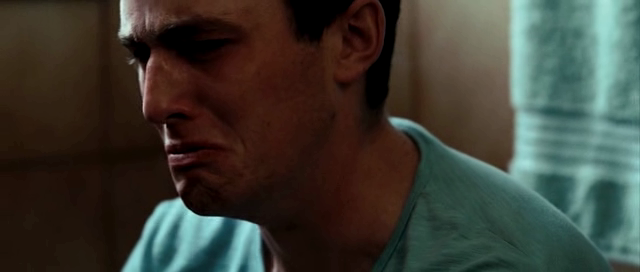
There is a reason why I've chosen the snapshot above from David Michôd's Animal Kingdom [2010], the brilliant crime film from Australia that caused much chatter in last year's cinematic bumper crop. (It won Jackie Weaver, who plays evil matriarch Smurf Cody here with such uncanny sweetness, a Best Supporting Actress nomination at the Oscars. I now understand completely the acclaim: this film had me gripping my seat from the unrelenting tension of its unspooling, that even a sequence of a car slowly backing out of a doorway seemed the stuff of utter terror.) This is J Cody [played with virtuoso command by James Frencheville], and he has just discovered something terrible and bloody. In this scene -- set in the toilet of his girlfriend's parents' house -- we witness a breakdown and a transformation: he turns from being the naive teenage boy we have come to know him for most of the film, to a young man suddenly coming to terms with his dawning realization of an encounter with evil. He has been the innocent in this portrait of a family steeped in crime, so innocent in fact that when the film opens we find him nonchalantly watching television, his mother's dead body (from a drug overdose) beside him on the sofa. Alone in the word, he is taken to live with his estranged grandmother Smurf, and he gets re-introduced to his uncles -- all of them criminals with psychopathic tendencies, with the police in the city they live in scrambling to gather evidence to put them away. The film is his story -- and the story is about his loss of innocence. I am not going to say much more about how this film goes, but it is an elegant exercise of film form. There is no needless moment in this gripping narrative; everything is essential. The cinematography by Adam Arkapaw is deliberate in its beautifully rendered tracking shots and mise-en-scene, which reminds of a predatory point-of-view. The music by Antony Partos intensifies the action and the emotional turmoil of its characters with a stalking intensity. But it is the actors who make this devastating. They are the proverbial animals in this murderous kingdom -- all preys and predators in this game where the roles are sometimes interchanged. There are good guys, too, but this is basically an anatomy of evil people. Frencheville has the tricky role here: J's naivete could have been been cloying, and a less-gifted actor would have collapsed from the sheer madness of having to tread the fine line between innocence and a wearying nose-dive to hardness. But he gets the balance right, and there are little dramas constantly erupting on Frencheville's face that assure us he has this character down pat. And then there is Weaver: her Smurf Cody is probably the most evil character I have encountered of late in film, but she embodies it with strange rightness that rivals the intensity of a Meryl Streep or a Tilda Swinton. Hers is a role of utter complexity: nurturing and caring (in a Freudian way that's quite disturbing), the way a lioness can be with her pups -- while underneath lies a dark intelligence that has no qualms with intimations of murder. She makes a kind of Sophie's choice here that shocks -- but the way she still goes on with all sweetness and light and huggable motherliness also shocks us into a recognition that in life evil disguises itself in the mundane. When the devastating ending comes, we realize it is the only way to end a film such as this. It made me cry. It made me weep for how we can be robbed of such things as humanity.
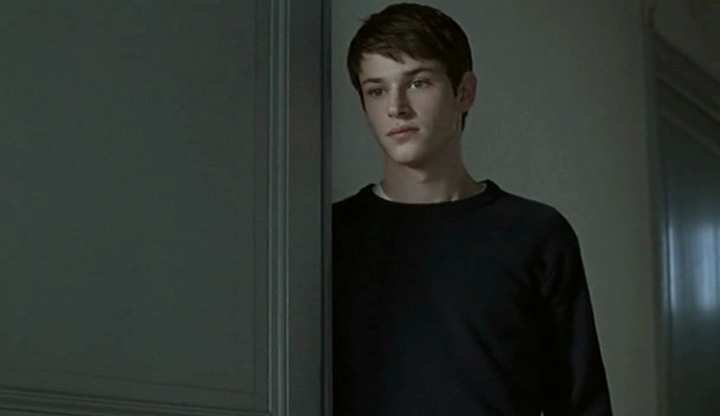
Were it not for Gaspard Ulliel's beautiful face and the strange bewitchment of Melanie Laurent, it could be said that watching Rodolphe Marconi's Le Dernier Jour [The Last Day, 2004] is a complete waste of time. Which is strange to say of a French film. But what else can I say? It is a dour, aimless exploration of a family in tatters and ends with a Deux ex machina so relentless in its own recognition of the sad and the macabre that I was left grasping for meaning, for some foreshadowing. There was none. The story itself is simplicity: a young man named Simon [Ulliel], 18 years old, an artist, makes his way back to the family living in the country and inexplicably brings home with him a beautiful girl named Louise [Laurent], whom he meets in the train, and whom everybody else thinks is his girlfriend. He does not dissuade any of them from making that assumption, but soon we take note that Simon -- always biting and sometimes ferociously sad -- may in fact be pining for his best friend Mathieu [a totally unmemorable Thibault Vinçon, who phones in a performance for an otherwise crucial role as the beloved and the betrayer] who works in the local lighthouse. He watches as Mathieu and Louise become slowly attracted to each other, even as he deals, in an offhand way, with the slow disintegration of his own family -- the sister is morose and cannot wait to get away, the father complains a lot and keeps secrets, and the mother is bored and is suddenly dealing with an unexpected lover from the past. What the film is perhaps trying to say has something to do with how people we love leave us, and how we are always left reeling in their wake. There are more complications, stripped of histrionics and melodrama the way only the French can, but we sit through each one completely uninvolved, and perhaps that may be due to Isabelle Devinck's savage and jarring editing and Marconi's unwise aesthetic choices. Why was this film made? To illustrate the ennui of abandonment? But I didn't care much.
2:32 AM |
Ang Pinaka ... Must Visit Dumaguete Spots
Wondering what to do in Dumaguete for the summer? Wonder no more! I unearthed an old episode of QTV's Ang Pinaka..., with a show on "Must See Dumaguete Spots." Rovilson Fernandez was then the new host, taking over from Pia Guanio. And there I was, twenty or so more pounds ago, with Mark. I can't believe this was already such a long time ago.
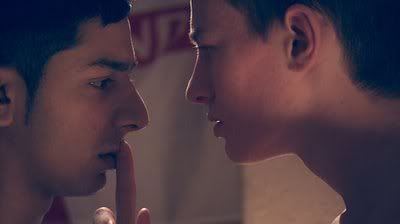
Dominic Leclerc's Protect Me From What I Want [2009] is simply told, done in broad strokes that make no attempt at depth other than what is cursorily given, and yet despite that, it is an effective small film. Saleem, a young Pakistani boy, cruises -- despite great personal misgivings and overriding guilt -- the streets of a British city, and catches the eye of Daz. He is given Daz's number after an aborted attempt at street seduction -- and then we segue to a kind of Pygmalion scene: Daz breaking through the barriers, and finally being able to give Saleem the titular thing he wants, but is scared of. The seduction is punctuated by editing that's more disruptive than artistic, giving the sequence a rushed embarrassed feel that betrays the efforts of its actors to stay true to their characters (and what we do get here is some fine acting). It all ends with an emotive plea from one character to another, which gives us ... what, hope? I'm not sure, but I smiled when it ended, and I felt my heart fuller than usual. But what does it all mean? Is this just an exercise in overly rushed erotica? A statement film on culture and deeply-inculcated homophobia? Is this a haphazardly done My Lair Lady a la Skins? The film does not exactly say anything new, but I liked it. That's my own life up there on the screen, all told in 13:32 minutes, so I appreciate its reach via the biographical, the reader-response way. But that's just me.
I like Origins stories. In the tradition of graphic literature (komiks to some of you), they're a staple in the narrative, and most superheroes come barging into our consciousness with an Origin story. There's something about knowing where a hero comes from -- what shaped him to become this something -- that's infinitely intriguing and satisfies a hungry curiosity (we all like asking, "Why?"), and when done right, they provide the meat to the mythos without reducing the hero to a caricature of easy motivations. But that's only one thing that I liked about Budjette Tan and Kajo Baldisimo's third installation in their Trese series. Mass Murders, which gives us the curious and very supernatural childhood of Tan and Baldisimo's kick-ass titular female detective of the uncanny, also gives us a look into the origins of Alexandra Trese's fast and furious sidekicks -- the Kambals, those mask-wearing half-breeds who do Trese's bidding with fierce loyalty and an extreme taste for blood. (The horror writer Yvette Tan finds them extremely hot -- and so do I.) There's also the graphic violence which not only takes off from the gut-wrenching ballets of Alan Moore and Quentin Tarantino, but also has the glorious roughness and tumble of old Filipino action movies. But what impresses me most about this volume (two other volumes precede this one) is not just Tan's tight narrative and Baldisimo's concisely conceived black and white world, but also in how they dip into local gods and fantastic monsters and assorted lower mythology creatures of the pre-Spanish Filipino netherworld. In a kind of an afterword, Tan writes: "The works of Neil Gaiman was a major influence when it came to writing Trese, most especially Sandman and American Gods. In those stories, he asked the question, 'What happened to the gods of old? Where are they now?' And he showed us a goddess of love who found her worshippers in a strip club, gods of death who now run a funeral parlor, and gods of mischief still up to their old tricks. Which made me ask the question, 'Where are the gods that were once worshipped by Filipinos before the Spaniards came? Have they found a new place in the city of Manila?'" Which is how they have come up, in this volume, with the bloodthirsty god of war, Talagbusao, whose bloody rituals and wishes to permanently wreck havoc in the mortal realm leads to this book's main plot, as well as to the explanation for the Kambal's existence. I admire this organic and pulsing attempt to bring back the ancient myths and subject them to the creativity, darkness, and demands of the modern world. It was indeed Gaiman who once told us -- when he first came up with the Philippine Graphic/Fiction Awards -- that we have a wealth of local legends and lore that are more than ready-made for explorations in local speculative fiction, and Trese is a good example of that. The last time I was this excited over a similar project was Arnold Arre's The Mythology Class. (Similarly, Dean Francis Alfar and the core LitCritters also have a cycle of stories about a land called Hinirang -- and I have long demanded an anthology of such stories, but only the future can tell whether that project comes to fruition.) And yet, despite the horror and fantasy that make stories like this ghettoed into Genreville, you see reflections of real-life issues and conflicts -- the corruption of civil government and military, the salacious criminality of small-town politicians, the clueless desperation of the law, the mud of chaos that has engulfed the country, which can only be explained through the prism of dark enchantment: this is a land bewitched and cursed, and every malevolent detail that erupts in our lives are the secret explosions of aswangs and duendes and the like. That Trese -- both mandirigma and babaylan rolled into one -- is around with the Kambals in tow gives us relief from our ordinary horrors, at least in these pages. I love this book. I bought it today, and consumed it a few hours later in one go. It is simply begging to be made into a very, very good film that does it more than justice.
9:51 PM |
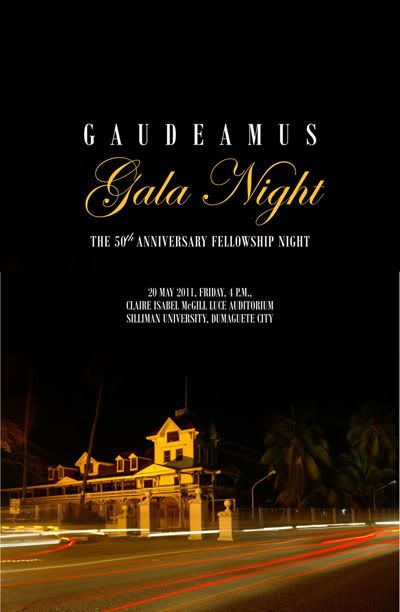
Some Stories From Fifty Years of Writing
We begin with stories of how things began.
My own love affair with the Silliman University National Writers Workshop in Dumaguete began eleven years ago, when I was one of nine young writers granted a three-week fellowship to a summer of writing and book talk.
It led me to a discovery—in a very big way—to the treasures of Philippine literature. But before that summer, like many other people of that certain age (I was just graduated from college), I knew nothing. Perhaps a tiny bit of Nick Joaquin, maybe a little Kerima Polotan. I remember reading the entirety of Edilberto Tiempo’s A Stream at Dalton Pass and Other Stories when I was 10, because there was a copy of the book in my house, for some reason—and when I was very young, I devoured all books and magazines I could find.
But I knew I liked writing. Some other people discovered that for me. My teachers in West City Elementary School’s SPED Program for Fast Learners were suitably impressed, I guess, by the compositions I churned out for our theme assignments—you know the sort, “How I Spent My Summer Vacation,” “My Best Friend,” “My Most Cherished Memory”—that they made me editor-in-chief for the school organ The Western Star, a mimeographed loose-leaf effort that had an indelible impression on me. I am now extremely sorry that cannot remember the name of the paper adviser, but she taught in the regular sections, and she was a kind woman who told me I could write. I didn’t know what she meant by that.
Later on, spurred by the very thorough language lessons of Ms. Bennie Vic Concepcion in grade school and the gentle goading of Prof. Gina Fontejon and Prof. Alejandra Bañas in Silliman High School, I was possessed with the idea that writing was my vocation. After a not-so-delightful detour through the wrong course, I ended up in a discipline that was all about practical writing and modern communications. Somewhere along the way, my college composition teacher, a fictionist by the name of Timothy Montes, one day wrote in the margins of my BC 12 essay: “You must apply to The Weekly Sillimanian.” And so I did.
Tim writes about this time in his introduction to my forthcoming short story collection Beautiful Accidents (published by the University of the Philippines Press): “In the early ‘90s when I started teaching in Silliman, when I myself was always lassoed by the label ‘a promising young writer,’ I came across an essay in my freshman English class that made me think of my own promise. For here, indeed, was someone who wrote better than I did when I was his age. When I asked the student who wrote the essay to stay after class, I was later confronted by a self-conscious impish smile that tried to hide a nerdiness, and a something-else that only teenagers are capable of exuding: a secret hunger that can only be projected onto the night.
“He was, he said, a Mass Com major, and I thought that unless he was going to have the gumption of a maximalist writer like Tom Wolfe, he was not fit to parse out his sentences for the press. For his kind of writing was more literary than journalistic, and he simply could not hide his style. I exempted him from my cut-and-dried lectures and assigned him books to read instead. In return, he submitted the obligatory expository essays even as I encouraged him to do whatever he wanted as he jazzed around in his reading and writing.
“And just as I predicted, complaints from his readers in the student paper where he wrote a column started coming in. They could not understand him; he was verbose; he was obfuscating. And as consolation, I told him he was writing from a Faulknerian tradition, and it was no use cramping his own style in the ideal of Hemingway. At that time I was reading Nabokov and thought style was all.
“I think he actually sought me out in all his English and literature classes for he was there semester after semester, feeding my teacherly ego in return for a confirmation of talent that was not not mine to bestow. I just knew he had the talent to become a writer; the rest was life and hard work. The way he used language as a supple medium made him one of those writers capable of expressing varied experiences that he would face. He was a film buff and organized the cineaste club in the university, and sometime in his junior year he went to Japan as an exchange student. All these qualities and experiences would seep into his writing…”
By the time I graduated from college, it was again Tim who gently took me aside, and said, “You must apply for a slot in the National Writers Workshop.”
I remember asking him, “Why?” when in fact the question that was in my head was “What is that?” I’ve heard only a little of the workshop when I was in college—but my world was small then, and I really knew nothing, even if, as all young people are wont to think, I thought I knew everything.
Tim told me to prepare three stories. Perhaps those stories I’ve already written for his undergraduate Creative Writing class. There was a deadline. There was the wait. Several days later, I got a letter from Dr. Edith Tiempo. It was graceful in its congratulations, and it gave me the details of the fellowship, and told me to make an appearance on the Monday of the first full week of May of 2000, at nine o’clock sharp, at the Dragon Room of the CAP Building along the Boulevard.
That Monday, at the appointed time, I showed up with Jean Claire Dy, a co-fellow from Silliman. I would soon meet the other writing fellows, of various preoccupations, from all over the Philippines and the world (one was from Hawaii, and one was studying to become a priest)— Vincenz Serrano, Isolde Amante, Alex de los Santos, Elmer Pizo, Gerald Feljandro Ramos, Noel Villaflor, Roberto Salva, Francis Ted Limpoco, Ulysses Navarro, and Wayne Mark Lopez. I would soon notice the “Mount Olympus” in the room—the head table where the writing luminaries were. They were to be our panel of writer-critics, a tableau of faces that changed from week to week.
The faces on that first day were all unfamiliar to me, but Claire seemed to know more. “That’s Ophelia Dimalanta,” she pointed out to one writer at the panelists’ table. “That’s Jimmy Abad, I love him. That’s Krip Yuson. That’s Cesar Ruiz Aquino. And that, my dear, is Mom Edith. Edith Tiempo.”
I kept nodding and nodding, filing away the names to memory.
There would be more names in the coming years—because, after that summer of 2000, I too would return to the workshop, first as an auditor wanting to reconnect with a cherished memory, then later as the unofficial yaya of several batches of fellows, and finally as a member of the organizing team at the Dumaguete Literary Arts group, and later Silliman University, that would help put out the annual editions of this longest-running creative writing workshop in Asia.
I had no idea it was going to be the summer my life changed forever.
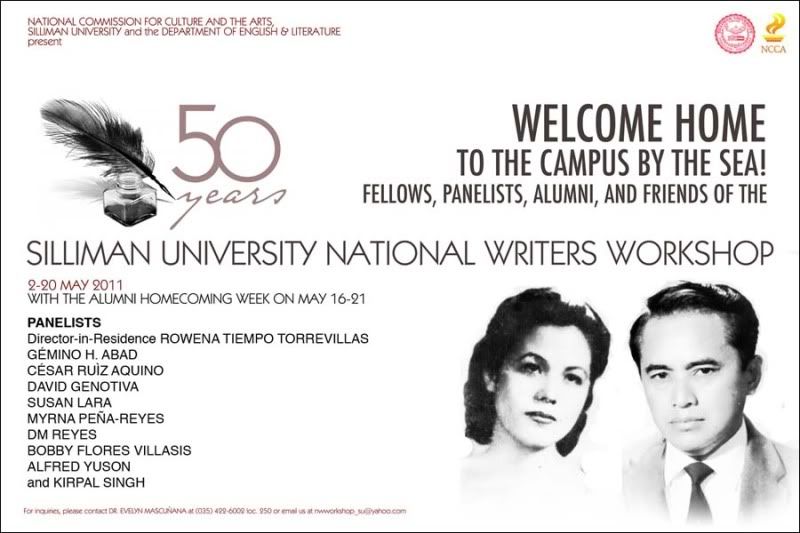
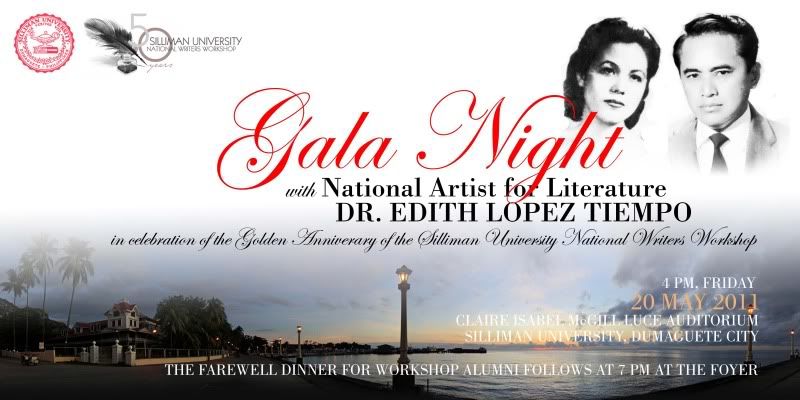
The story of the Silliman University National Writers Workshop in Dumaguete—which celebrates its fiftieth year this May—officially begins in 1962. That was the year it was founded by the late Dr. Edilberto K. Tiempo and his wife, the National Artist for Literature Edith L. Tiempo. They became simply Doc Ed and Mom Edith to several generations of Filipino writers, a sort of familiarity that says a lot about the kind of workshop Dumaguete promised.
Its influence is now legendary. The poet Cirilo Bautista once said, “The amount of learning these writers got from this workshop is incalculable, and is measurable only in the way they have contributed to the qualitative and quantitative growth of our literature. Being a pioneer, [it] occupies a premier position in the history of creative writing in the Philippines.”
The Tiempos, together with its first panelists, the National Artists Francisco Arcellana and Nick Joaquin, ushered in a golden age of writing, and Dumaguete in Negros Oriental has somehow become the heart of the country’s literature—everyone’s literary hometown.
But perhaps its true genesis goes even farther back, to the end of World War II.
“In 1946,” Rowena Tiempo-Torrevillas once wrote, “my father was offered a scholarship by the Presbyterian Board of Missions, enabling him to do graduate work in the United States, at Stanford. He was readying himself for the scholarly regimen of the classics, and doing a refresher course in Latin, among his preparations, when my father was asked what area he wanted to specialize in at Stanford. ‘Creative writing,’ he said. ‘There are a number of novels I am going to write, and I need to know if I’m writing them effectively and well.’
“’Oh,’ the Presbyterian Board officer told him, ‘then there’s only one place for you to go. Iowa.’ Dad had to look up Iowa in the encyclopedia, and he was a bit puzzled at what he read. ‘Isn’t that where…they grow corn?’”
Iowa, right smack in the cornfields and silos of the American Midwest, indeed grew corn. But Doc Ed was soon to learn there was a man there, a poet named Paul Engle, and that he ran what was and still is considered the best creative writing workshop in the world: the Iowa Writers’ Workshop at the University of Iowa. “And that is how my Dad,” Rowena Torrevillas continued, “took a freighter across the Pacific, then a train halfway across the continent from San Francisco to Iowa City. And one morning, carrying his belongings in an Army-issue duffel bag, he crossed the Pentacrest on the campus to find the postwar temporary quarters in the Nissen huts, the quonset building where Paul Engle was holding the Writers’ Workshop.”
By 1947, his wife Edith joined her husband to also take part in the program. When they returned to the Philippines in 1951, Silliman was already abuzz with creative writing. The campus was sprouting literary enthusiasts, among them Aida Rivera-Ford, Rodrigo and Dolores Feria, and Ricaredo Demetillo. The Tiempos made creative writing an area of concentration for English majors in the English Department—and soon that paved the way to preparations in 1961 to hold a workshop similar to the one they attended in Iowa. The following year, it became fully operational.
The years to come would bring future luminaries often at the very beginning of their writing careers, people such as Gregorio Brillantes, Rogelio Sicat, Ninotchka Rosca, Elsie Martinez Cosculluela, Federico Licsi Espino, Salvador Bernal, Rene Estella Amper, Virgilio Almario, Ricky Lee, Conrado de Quiros, Leoncio Deriada, Estrella Alfon, Eric Gamalinda, Marjorie Evasco, Danton Remoto, Vicente Groyon III, Ruel S. De Vera, Miguel Syjuco, Lourd Ernest de Veyra, Lakambini Sitoy, Sarge Lacuesta, Dean Alfar, Naya Valdellon, Angelo Suarez, Adam David, among many others...
Today, the workshop’s alumni number above six hundred. Their memories of three weeks in during a Dumaguete summer remain indelible. Timothy Montes writes: “It was a common story we told: meeting Doc Ed was a turning point in life. I remember him, the first time I joined the workshop, taking me aside and saying, ‘You can write.’ And I began to write seriously.”
The poet Cesar Ruiz Aquino tells the story of being the first workshopper: “We were a very young college boy when we came to Dumaguete for the first time in the summer of 1962... It was a letter from a man named Dr. Edilberto Tiempo that brought it about. The letter was an invitation to join the 1962 Workshop in April… We accepted, of course, full of madness and innocence... [He] met us at the wharf, aboard a tartanilla… It was just after dawn. We can’t recall certain details. For instance, we can’t recall how we knew it was him or how he knew it was us. We rode the tartanilla to town, to the English Department at Hibbard, to the Alumni Hall where the workshoppers would be housed, then to the Cafeteria for breakfast.
“How quiet the town was, how still. Even then it felt like memory. Time, a full, primeval river, moved in eddies... It was the morning of creation and the dawn seemed to cling to everything. In the evening, across from our window, played Vic Damone on the jukebox singing, incredibly, ‘Tender is the Night.’ And in the morning of the next day we met the next to come, Willy Sanchez who looked at us with contempt until, in no time, we began tramping through the campus, Katzenjammered the olds, crossed the hooligans, wrote lines under a cypress tree, befriended inanimate objects. Willy performed, we watched. Nick Joaquin exclaimed at the caf: ‘Franz, I think they’re writers!’”
This year, we add 15 more writers to the august list of fellows: Charmaine Carreon, Evangeline Gubat, Jeffrey Javier, Allen Samsuya, Alyza Taguilaso, Glenn Diaz, Christine Lao, Emmanuel Lava, Andrea Macalino, Marius Monsanto, Philline Donggay, Rogelio Garcia Jr., Miguel Sulangi, Elaine Tobias, and Maria Villaruel.
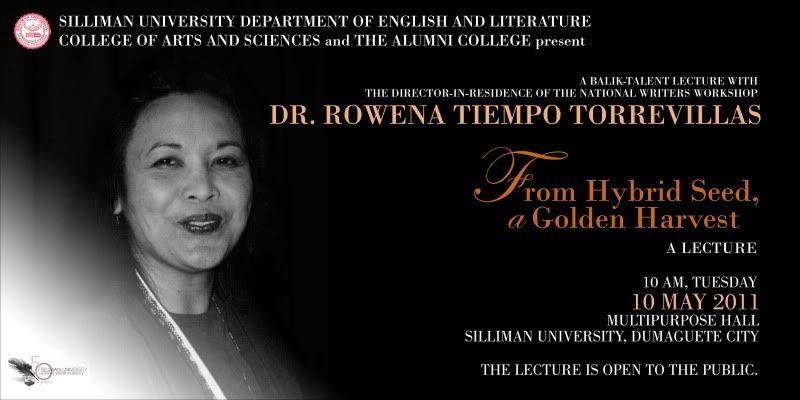
This year’s panel of critics is composed of Director-in-Residence Rowena Tiempo-Torrevillas and Dumaguete-based writers Myrna Peña Reyes, Bobby Villasis and Cesar Ruiz Aquino, as well as guest panelists Susan Lara, DM Reyes, Dave Genotiva, Ricky de Ungria, Gemino Abad, and Alfred Yuson. For this summer, internationally-acclaimed Singaporean writer Kirpal Singh will also be sitting in with the panel.
The 50th Silliman University National Writers Workshop, scheduled on May 2-20, is sponsored by the National Commission for Culture and the Arts and Silliman University, coordinated by its Department of English and Literature.
That hour, I was most myself. I had shrugged my mother slowly off, I lay there taking my first breaths, as if the air of the room was blowing me like a bubble. All I had to do was go out along the line of my gaze and back, feeling gravity, silk, the pressure of the air a caress, smelling on myself her creamy blood. The air was softly touching my skin and mouth, entering me and drawing forth the little sighs I did not know as mine. I was not afraid. I lay in the quiet and looked, and did the wordless thought, my mind was getting its oxygen direct, the rich mix by mouth. I hated no one. I gazed and gazed, and everything was interesting, I was free, not yet in love, I did not belong to anyone, I had drunk no milk yet—no one had my heart. I was not very human. I did not know there was anyone else. I lay like a god, for an hour, then they came for me and took me to my mother.
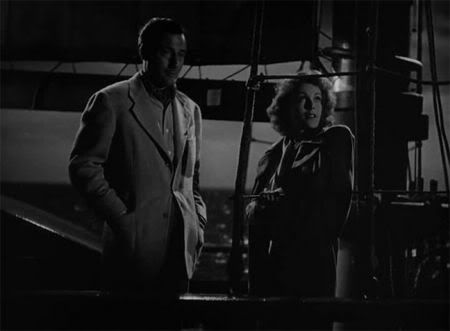
Grief and sadness are made bearable by beauty. This is why I love sad stories written by the masters: they distill the pain and make it resonate in uncanny loveliness. Jacques Tourner's I Walked With a Zombie [1943] may be a B-movie made in the schlocky tradition we equate with Roger Corman, but listen to those lovely lines. In the film, a young Canadian nurse named Betsy goes to the West Indies to take care of the sick, mentally paralyzed wife of a handsome plantation manager named Paul, whom she eventually falls for, and in her misguided love, uses voodoo to give what she thinks the man wants.
Paul Holland: It's easy enough to read the thoughts of a newcomer. Everything seems beautiful because you don't understand. Those flying fish, they're not leaping for joy, they're jumping in terror. Bigger fish want to eat them. That luminous water, it takes its gleam from millions of tiny dead bodies. The glitter of putrescence. There is no beauty here, only death and decay.
Betsy Connell: You can't really believe that.
Paul Holland: Everything good dies here. Even the stars.


 2:55 PM |
My Father in a Measure of Memory
2:55 PM |
My Father in a Measure of Memory
 Years ago, I was asked by the writers Gémino H. Abad and Alfred Yuson to submit to an anthology of poetry about fathers and fatherhood in the aptly titled Father Poems (Anvil, 2004). That project, I think, was timed for a Father’s Day release.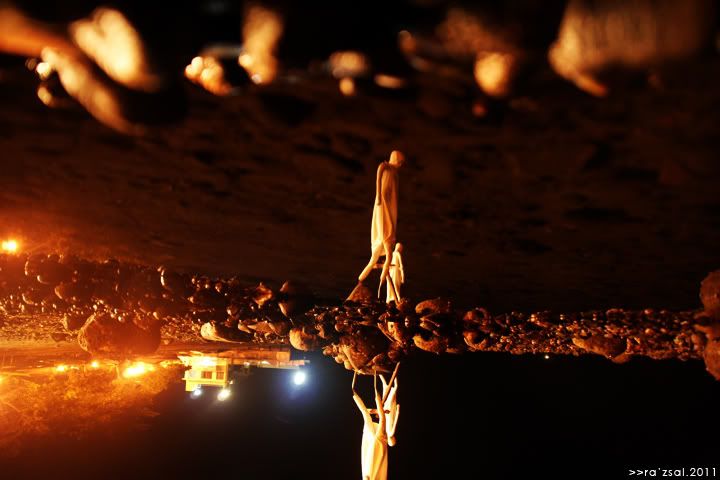


 I love Curtis Sittenfeld's Prep. I love how this book is so engaging and delicious, like a perfectly heaped cone of vanilla and chocolate ice cream on a hot summer day. I love its sardonic but wise tone -- that of a woman in her late 20s recalling the angst-ridden minutiae of matriculating in a preppy boarding school in the East Coast, far from the rough and LMC upbringing of South Bend, Indiana. The novel, which is in many ways epic, has the feel and intimacy of a short story -- and Sittenfeld wisely cultivates that feeling by sectioning off her narrative of four years in the life of one Lee Fiora into set pieces, each one an immersive demonstration of a mood and a reflection on high school politics and romances, always with a deep and special knowing of people, places, rituals, and emotions. What keep it grounded are the all-too-human flaws of our heroine -- she is smart and observant, at first painfully shy, often bitter, often unwise, always insecure, constantly flailing to find her place in a universe of seemingly perfect people and circumstances. The book knows human nature so much, and yet also constantly surprises, and does so in prose that is littered with devastating insights, such as this: "There are people we treat wrong, and later, we’re prepared to treat other people right. Perhaps this sounds mercenary, but I feel grateful for these trial relationships, and I would like to think it all evens out — surely, unknowingly, I have served as practice for other people.” Not a lot of books leave me breathless. This is one of them.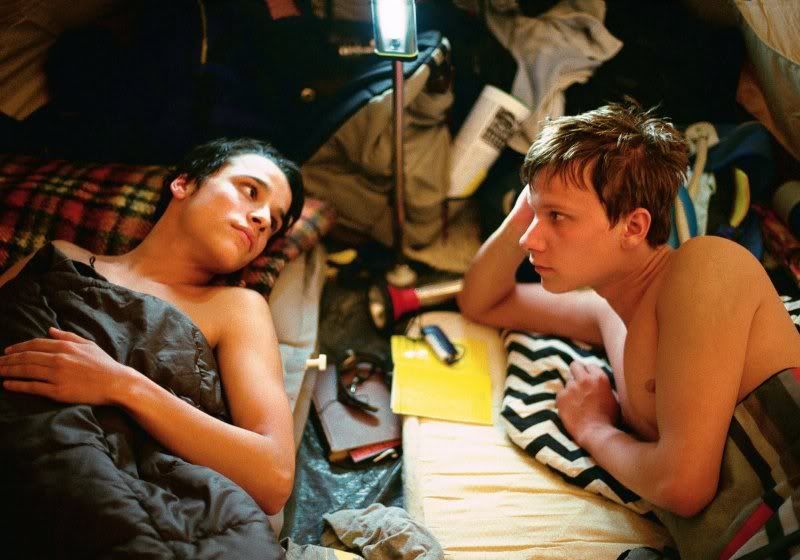
 I like Origins stories. In the tradition of graphic literature (komiks to some of you), they're a staple in the narrative, and most superheroes come barging into our consciousness with an Origin story. There's something about knowing where a hero comes from -- what shaped him to become this something -- that's infinitely intriguing and satisfies a hungry curiosity (we all like asking, "Why?"), and when done right, they provide the meat to the mythos without reducing the hero to a caricature of easy motivations. But that's only one thing that I liked about Budjette Tan and Kajo Baldisimo's third installation in their Trese series. Mass Murders, which gives us the curious and very supernatural childhood of Tan and Baldisimo's kick-ass titular female detective of the uncanny, also gives us a look into the origins of Alexandra Trese's fast and furious sidekicks -- the Kambals, those mask-wearing half-breeds who do Trese's bidding with fierce loyalty and an extreme taste for blood. (The horror writer Yvette Tan finds them extremely hot -- and so do I.) There's also the graphic violence which not only takes off from the gut-wrenching ballets of Alan Moore and Quentin Tarantino, but also has the glorious roughness and tumble of old Filipino action movies. But what impresses me most about this volume (two other volumes precede this one) is not just Tan's tight narrative and Baldisimo's concisely conceived black and white world, but also in how they dip into local gods and fantastic monsters and assorted lower mythology creatures of the pre-Spanish Filipino netherworld. In a kind of an afterword, Tan writes: "The works of Neil Gaiman was a major influence when it came to writing Trese, most especially Sandman and American Gods. In those stories, he asked the question, 'What happened to the gods of old? Where are they now?' And he showed us a goddess of love who found her worshippers in a strip club, gods of death who now run a funeral parlor, and gods of mischief still up to their old tricks. Which made me ask the question, 'Where are the gods that were once worshipped by Filipinos before the Spaniards came? Have they found a new place in the city of Manila?'" Which is how they have come up, in this volume, with the bloodthirsty god of war, Talagbusao, whose bloody rituals and wishes to permanently wreck havoc in the mortal realm leads to this book's main plot, as well as to the explanation for the Kambal's existence. I admire this organic and pulsing attempt to bring back the ancient myths and subject them to the creativity, darkness, and demands of the modern world. It was indeed Gaiman who once told us -- when he first came up with the Philippine Graphic/Fiction Awards -- that we have a wealth of local legends and lore that are more than ready-made for explorations in local speculative fiction, and Trese is a good example of that. The last time I was this excited over a similar project was Arnold Arre's The Mythology Class. (Similarly, Dean Francis Alfar and the core LitCritters also have a cycle of stories about a land called Hinirang -- and I have long demanded an anthology of such stories, but only the future can tell whether that project comes to fruition.) And yet, despite the horror and fantasy that make stories like this ghettoed into Genreville, you see reflections of real-life issues and conflicts -- the corruption of civil government and military, the salacious criminality of small-town politicians, the clueless desperation of the law, the mud of chaos that has engulfed the country, which can only be explained through the prism of dark enchantment: this is a land bewitched and cursed, and every malevolent detail that erupts in our lives are the secret explosions of aswangs and duendes and the like. That Trese -- both mandirigma and babaylan rolled into one -- is around with the Kambals in tow gives us relief from our ordinary horrors, at least in these pages. I love this book. I bought it today, and consumed it a few hours later in one go. It is simply begging to be made into a very, very good film that does it more than justice.