Celebration: An Anthology to Commemorate the 50th Anniversary of the Silliman University National Writers Workshop Sands and Coral, 2011-2013
Silliman University, 2013
3:03 AM |
Film Log 1, 2, and 3: The Night Porter, Burnt, and Walang Forever
1.
I must declare randomness for my choice of my first film of 2016, given its subject matter, but I am utterly satisfied that I would begin my personal film year with a controversial masterpiece (the film has received the Criterion treatment, after all) starring two ageless film stars: Dirk Bogarde and Charlotte Rampling. The film, of course, is Liliana Cavani's BDSM classic The Night Porter (1974), with Bogarde as a former SS officer now trying to keep a low profile as the titular figure in a Viennese hotel, and Charlotte Rampling as the concentration camp survivor he used to torture and to make love to. The Holocaust is the backdrop. This is the original Fifty Shades of Grey, but edgier than any contract signing. It shocks, of course, and is never titillating -- but it makes you wistful for the kind of brave cinema the 1970s used to churn out. ★★★☆☆
2.
Despite having read the overwhelming bad reviews that greeted its release, I came to quite like John Wells' Burnt (2015), the culinary romantic comedy starring Bradley Cooper as a talented but very hot-tempered chef in search for redemption, a second chance, and three Michelin stars. It's the necessary soufflé from Wells after helming the bitter drama of August Osage County (2014), a film which also underwhelmed many but still made Oscar conversations anyway. Burnt is not headed for the Oscars at all, but it made me very hungry. I appreciated that. Going into it with fast food expectations, I came away filled up with a relentless buffet of high cuisine and hijinks that tickled me. It made me look beyond the hammy acting and the all-too-neat resolutions that box the movie. But I've always had a weak spot for food films, so this one was baked just right to please me. ★★★☆☆
3.
The choice of my first film to see from the slate that makes up the debauchery that has been the 2015 Metro Manila Film Festival springs from the knowledge that this romantic comedy came from Dan Villegas. His sure hand in directing the surprising and satisfying Mayohan (2010), English Only, Please (2014), and The Breakup Playlist (2015) made me think this new film, #Walang Forever (2015), is a continuation of an impossibly winning streak in local film directing that has, so far, mightily impressed. I was wrong. What a messy film this is, complete with unnecessary framing devices, unnecessary cast members, and unnecessary gimmicks that only belittled their obvious inspirations (from the iconic cinematic revelation of Cinema Paradiso to the iconic dying as Deux ex machina of Love Story). It's witty in parts, and weepy in others, and the two leads -- Jericho Rosales and Jennylyn Mercado -- strive very hard to anchor the movie. But it's a slippery fish of a film: the screenplay by Paul Sta. Ana is a mess, and Mr. Villegas, talented though he may be, is reduced here to a desperate cobbler of a story that doesn't really cohere. Someone once said, "You don't applaud a tenor for sneezing." It's true here. This is Mr. Villegas coasting -- but nonetheless, I know there will be better films ahead. ★★☆☆☆
I was reminded of this missive about the New Year from Mark Twain, from in his letter to the Virginia City Territorial Enterprise on January 1863, as I was contemplating the cultural imperative to do resolutions.
In many ways, Twain is quite dismissive of our efforts to list things that could result to a better us for every annual turn of the calendar, and he is right at prescribing exactly what happens to our efforts in the weeks to come. Nobody -- except for those who gain rare exceptions -- really succeeds at resolutions. But in truth, I admire the humanity behind this enterprise. It speaks to me of an endlessness of hope, of our infinite capacity to see our selves as capable of good despite the temptations of the world and the way it forces us to compromise, to succumb to little evils, to be unkind for the sake of survival. But at the very least, we do try. And some of us do get the reprieve of having carried through the rest of the months with the year's original vision almost intact, perhaps frayed at the edges, but nonetheless whole.
But even given that, I've decided not to make a whole hopeful list of to-do's for 2016. No resolve to diet, to keep in shape, to eat the right thing. No resolve to write at least a page of prose every single day. No resolve to read x number of books per month. No resolve to be more sociable, to be more bullish at work, to be resolute in finishing projects. Last year, I began the year right -- but by February, the heaviness of my expectations, combined with circumstances that surrounded me, eventually drove me into the embrace of burn-out, and a depression that lasted an entire year. 2015 left me exhausted. I am very glad to leave it behind.
So no more resolutions except for two simple things: to try to live always in the present, and to be kind. The first eliminates worrying too much about what the future could bring (it doesn't matter) but also opens up a more concrete way of dealing with opportunities that can come knocking at my door. The second allows me to relate to other people in the most fundamental way that is not easily done. But here's to trying.
1:09 AM |
The Man in Shadows Walking Towards Me on a Dark Road Late at Night
From a distance, as I was walking along a stretch of dark road tonight, the man walking towards me looked like a furtive figure in shadows. I didn't even have to think twice about crossing to the opposite side of the street to avoid a direct encounter, the way we have been taught to sharpen our instincts in navigating city streets past midnight. I was on my way to the center of downtown from an evening reading a book and having coffee at Bo's Cafe at the Boulevard. By the way he walked and was dressed, the man struck me as a vagrant, possibly someone capable of mugging. I avoided him. And then suddenly, I heard him greeting me in a familiar tone. He knew my name. "Ian!" the man said. "Mamasko ko nimo!" That surprised me, and when he came into the light, I saw a familiar face that had become ragged at the edges. The hoodie he was wearing seemed unkempt. He looked like he hadn't taken a shower in weeks. His eyes were sunken, as were his cheeks. When he tried to smile, I could see the decay in his front teeth -- his lips concaved around them. "What happened to you?" I asked, and he told me a little bit of his story as I walked towards ChowKing, seeking the bright lights as a cocoon of safety and comfort. My instinct was to be curt and to run. This was easily done, but it was the holiday season, and it didn't seem like the most Christmassy thing to do. So I told myself to listen to his story. It was the least I could do, and I knew him after all. I had known him since grade school. And when we were in college, he had taken up Education at Silliman University. We were both editors in the yearbook staff during our senior year. The last time I heard of him, he was teaching at Foundation University, and then had become a trainer at one of the local BPOs. He had always been a bright and articulate man. So what exactly happened to him that he looked this sallow, this defeated? He was living on the streets, he said, without a tremor of shame to his confession. He was homeless. And he was just on his way to the pier, where he had been sleeping for the past three weeks. "What happened?" I asked again, because life can't possibly derail just like that, can it? Eventually he confessed: he had been using shabu and, in his words, it had destroyed his life. "But I've been free of the stuff since October this year," he swore. If only he could start his life all over again, he said, perhaps go to a different city where nobody knows him, maybe even Cebu. "I can work menial jobs," he said, "Even wash dishes, I can do that." But not here in Dumaguete, he said. Nobody here would give him another chance. He couldn't go back home to his family, he said. They had kicked him out -- him, this former student leader and campus writer. I didn't know how to help. But a hundred peso bill seemed reasonable, so I gave it to him. I thought it was enough for a small meal, but perhaps not enough for a shabu hit. I balanced things in my head like that. Even generosity can come tinted with doubt. "I'll write about you," I finally said. "That's the best way I can help you. Perhaps someone can read what I've written, and be more equipped to help you out, if in fact you're desperate to be helped." "Please do. But don't use my real name, though," he quickly said. "I won't," I replied. Then he left. I stood at the corner of San Jose and Perdices Streets for what seemed like forever, gathering my thoughts, thinking about the seismic vagaries of life. A thin line separates us from darkness and desperation, and no one can ever truly say that this can never happen to you or me. Because it can.
A sad post-script, 1 January 2016: A few days ago, I had a nocturnal encounter on the streets with an old friend who seemed to be in need of help. Life had become hard on him, because of shabu. So I did what I thought I could do to help in my own little way -- I wrote about him and his plight (see above), which I initially posted in Facebook. I was hoping somebody would read it and be in a position to help him more. I was astonished that so many friends -- people from all over the world -- messaged me wanting to help. But it turned out there were many other hidden layers to his tale -- and some of them frankly untruths. I don't want to elaborate anymore on these untruths, because it's his life and it's really none of my business. The only business I have with this is the post I'd made, but he had began messaging almost everyone who liked that post, asking them for money for him to be able to go to Cebu "for work," or "for "rehab," among other reasons. When this came to my attention from several friends, I realised what was happening and I took the immediate recourse: I took the post down. I felt used. I apologise for the bother I've made in your lives. I wanted to help him -- but I guess he needs to help himself first.
The passing of the years can astound you in the act of retrospection: it flattens everything into a single instant that you simply cannot believe all those years have indeed gone by. We ask silly questions such as, “Wasn’t it just yesterday when we were doing this or that?” or “Wasn’t it only the other week that I first saw you in this or that?” The answer, of course, is that it wasn’t yesterday or the other week. It was a full ten years ago, but our minds simply recoil from the realization that time may be insanely static in our perception but is in reality insanely fluid in unfolding action.
It has been ten years since Dessa Quesada-Palm, the doyenne of Dumaguete community theatre, founded the Youth Advocates Through Theatre Arts—YATTA to the rest of us who have followed its development over the years. It grew organically from a series of theatre workshops—then called Lambigit—that Dessa was doing for the community after having newly arrived in Dumaguete sometime in 2003. In her recollection of those early years, the Lambigit workshops should have ended with just a final theatrical activity for everyone involved—but seeing the faces of the young participants, she felt a sudden calling for doing something grander, something that went beyond the original purpose of that workshop. She remembered telling the participants: “Would you like for this to go on, if you feel like it?” The response from them was an electrifying yes—and YATTA some came to be.
Rev. Colby Palm, Dessa’s husband, remembered those years in a tribute: “In the beginning we had so little of everything but [we had] so much of fun. Every YATTA gathering felt [like] a Christmas Party. I remember because we had no office, no creative space, and everything happened at the house. The big gatherings would begin with parlor games, and the small gatherings with an exercise warm-up video… When it was time to perform we [also] had so little. I would watch YATTA pack sets, costumes, and bodies into one tricycle, [which would] rumble to the [event venue]… When performing, we had so little, and I would watch YATTA creatively share one single microphone for a whole performance… Then we would all return to the house [and] gather around the TV, all excited to watch the video of our show. [There’d be] heckling and teasing at every mistake [and] every blooper… In the beginning everyone did everything. Everyone had to act, had to sing, had to make sets, had to help write the script the songs.”
The first YATTA show I saw was Kikay Kalaykay, their small musical production about growing up dreaming of a good future while living in a dumpsite. This play first saw staging at the Fleur de Lis Hall at the Saint Paul University Dumaguete campus, which instantly became memorable for its anthem, “The Four Rs”—a rousing anthem, staged in Broadway spectacle, that quickly became a useful mnemonic for better garbage control: “reduce, re-use, recycle, recover.” That was back in 2007, but it might as well have been staged only yesterday. Where do the years go?
Last December 18, celebrating YATTA’s 10th anniversary at The Spanish Heritage, we were reminded by YATTA Board of Trustees member Glynda Timtim Descuatan that the troupe’s symbol—emblazoned proudly in its logo—is a bunch of young people flying a kite. “The kite soars,” Ms. Descuatan said, “but it soars high and constant in the wind because it is grounded by helping hands that tug at it.” In a sense, it is flight that’s molded by the hands of people who know keeping things grounded is necessary for the flying to succeed. That is YATTA’s existence in a nutshell.
For the anniversary, we were treated by YATTA’s current members to a theatrical production in vignettes, recalling some of the group’s greatest hits. It began with one of its first efforts in 2005, Koko Kaka, a small children’s play—really a monologue—that illustrated the virtues of kindness and cooperation. It ended with a restaging of the finale from Scharon Mani, its crowning achievement in 2015 with, a jubilantly composed jukebox musical which sprang from a collaboration with the indie musicians from the Belltower Project and the Silliman University Cultural Affairs Committee or CAC.
Along the way, most of us in attendance were eagerly reminded of our suddenly remembered participations in some of YATTA’s merry shenanigans. In my case, I was reminded I had been part of Kisaw, our three-year effort—between 2009 and 2011—at making the National Arts Month happen in Dumaguete. I had also actually designed their poster for Leon Kilat and Other Short Plays, their first collaboration with the CAC that saw them conquer the Luce Auditorium stage. That was one of two gentle reminders we got about YATTA. That it is about its friends and supporters being able to gather and give back to the community, and indeed we have seen how YATTA has touched many lives beyond its members, coming to involve many of Dumaguete’s brightest and most talented in the pursuit of using theatre for a social purpose.
The second reminder—and perhaps the more important one—is that YATTA is about empowering the community’s youth to get engaged in societal issues with strong imperative. This is its greatest strength. Junsly Kitay, one of its older members, is the perfect example of a YATTA success story—a young boy who hails from one of the city’s slums, whose very life at a young age seemed designed to follow the usual trajectory of failure because of poverty. Theatre, through YATTA, gave Mr. Kitay a ticket out of that arc.
He first heard about the Lambigit workshops in 2002 while watching television and saw Ms. Quesada-Palm inviting young people of all stripes from all over the city to join in. “I remember telling myself, for some reason, that someday I’d be part of that,” Mr. Kitay said. In 2006, four years later, he finally did—ending a long drought in his childhood when every avenue of artistic expression he tried to participate in—the visual arts, dance, choral music—seemed to close off on him. “You will never have to force anything that is truly meant to be,” Mr. Kitay admitted. “And yes, there is a plan, and your soul knows what it is. The world is a big machine, and you are part of it with a singular mission to fulfill—you just have to learn and be patient enough to find it. YATTA helped me find mine.”
For Mr. Kitay, what YATTA taught him is that there can be many good reasons for participating in the arts—one of which is advocacy, and having faith that young people like him can indeed do their part for society through artistic expression. “What first made us feel invested in YATTA is the way it helped us get rid of the fear of performing. And then it got us to do our little part in making costumes and making sets, all practical things that built craft and camaraderie. And then, finally, it got us to think that what we were doing was for a bigger cause beyond any consideration, even that of financial gain. Truth to tell, we were happy with just being given fare and food—as long as we were performing for an advocacy we believed in.”
In his final reflection, Mr. Kitay said: “If I had not joined YATTA, the probability would be that I would be part of the problem that you will have to solve. Now, I am only too happy to be part of the solution instead. It’s true that theater is life—through our performance, we can practice what we wish to happen and we wish to see in our society: for peaceful community, for respect for one another, for working for the good of everyone.
“In the end, I have to confess that I still have many struggles in life. I’ve seen better days, but I’ve also seen worse. I don’t have everything I want, but I do have all I need. My life may not be perfect, but I am blessed with my YATTA family. I may not be there yet [in the road to the fulfillment of all my dreams], but I am closer to it today than I was yesterday [because of YATTA].”
The 10th anniversary event ended with a touching song in Cebuano, sung by everyone clasping hands in a tight circle, which riffed on the simple theme of thankfulness and friendship. “Salamat, higala, sa inyong panahon,” the song went. “Salamat, higala, sa pulo ka tuig. Nabati namo ang inyong paghigugma’g pagtagad. Salamat, higala…”
And rightfully so: the message of that sentimental song is the very foundation of the past ten years of YATTA. Congratulations, Dessa and everyone from our little community theatre troupe that could. What you do—this is how you make a difference.
1:40 AM |
Music as a Means of Seeing Inside Ourselves
“Our culture deliberately drives people to focus outside [of themselves] so it can control them. Because if you can make people slaves of consumerism, slaves of success, slaves of status, you can manipulate them completely. So the role of music in our culture is crucial because music is the art most sacredly capable of helping us get in touch with the deepest passions and compassions, and the deepest understanding of our ourselves.”
~ religious scholar Andrew Harvey to pianist Seymour Bernstein in Ethan Hawke’s Seymour: An Introduction (2014)
I finally finished this book yesterday. For me, the delight of Bill Bryson's A Short History of Nearly Everything, first published in 2003, is its clear-sighted exploration of the sciences -- biology, physics, chemistry -- that made possible the likes of us and the world around us, delving deep into astronomy, geology, evolution, the cell and DNA, and others with the intrepid curiosity of an involved layman, and in the process attempts to clarify science from the mist of jargon and mathematical formula that often bedevil our attempt at understanding it. In other words, the book is a triumph of popularising science, and for me, it wins by its uncanny sense of levity. It's a funny book -- and that's a commendation for a book about science. The humour comes about, of course, from the witticism Bryson spews, and mostly results from his observations of the various human interactions throughout history in the name of answering the basic questions about life, the world, and the universe. The great scientists and thinkers are great because they had vision and temerity to strive to answer questions about the world and our existence in it -- but they are also human beings, and thus are prone to petty squabbling, unfortunate misjudgment, and for some, the persistence of sheer unluckiness. Told in a tone that is just a tad higher than gossipy, these stories make for giggly episodes that will have the reader ask, "How on earth were we able to arrive at such fantastic science given all these shenanigans?" The entire book can be summed up by a line in Bryson's book: "There are three stages in scientific discovery: first, people deny that it is true; then they deny that it is important; finally they credit the wrong person." The distillation of this in A Short History of Nearly Everything results to an accidental comedy that makes the book not at all a chore of reading. I wished this was my science textbook in high school. If I had read this as a teenager, I think I might have become a scientist myself.
But the book ends with a sobering note. The final chapter, titled "Good-bye," is Bryson's way of making the previous chapters come to bear on our reality as human beings, and lays the responsibility of the world on our feet. Here is that entire last chapter, and tell me if you're not moved, and saddened, by it...
In the early 1680s, at just about the time that Edmond Halley and his friends Christopher Wren and Robert Hooke were settling down in a London coffeehouse and embarking on the casual wager that would result eventually in Isaac Newton’s Principia , Henry Cavendish’s weighing of the Earth, and many of the other inspired and commendable undertakings that have occupied us for much of the past four hundred pages, a rather less desirable milestone was being passed on the island of Mauritius, far out in the Indian Ocean some eight hundred miles off the east coast of Madagascar. There, some forgotten sailor or sailor’s pet was harrying to death the last of the dodos, the famously flightless bird whose dim but trusting nature and lack of leggy zip made it a rather irresistible target for bored young tars on shore leave. Millions of years of peaceful isolation had not prepared it for the erratic and deeply unnerving behavior of human beings. We don’t know precisely the circumstances, or even year, attending the last moments of the last dodo, so we don’t know which arrived first, a world that contained a Principia or one that had no dodos, but we do know that they happened at more or less the same time. You would be hard pressed, I would submit, to find a better pairing of occurrences to illustrate the divine and felonious nature of the human being—a species of organism that is capable of unpicking the deepest secrets of the heavens while at the same time pounding into extinction, for no purpose at all, a creature that never did us any harm and wasn’t even remotely capable of understanding what we were doing to it as we did it. Indeed, dodos were so spectacularly short on insight, it is reported, that if you wished to find all the dodos in a vicinity you had only to catch one and set it to squawking, and all the others would waddle along to see what was up. The indignities to the poor dodo didn’t end quite there. In 1755, some seventy years after the last dodo’s death, the director of the Ashmolean Museum in Oxford decided that the institution’s stuffed dodo was becoming unpleasantly musty and ordered it tossed on a bonfire. This was a surprising decision as it was by this time the only dodo in existence, stuffed or otherwise. A passing employee, aghast, tried to rescue the bird but could save only its head and part of one limb. As a result of this and other departures from common sense, we are not now entirely sure what a living dodo was like. We possess much less information than most people suppose—a handful of crude descriptions by “unscientific voyagers, three or four oil paintings, and a few scattered osseous fragments,” in the somewhat aggrieved words of the nineteenth-century naturalist H. E. Strickland. As Strickland wistfully observed, we have more physical evidence of some ancient sea monsters and lumbering saurapods than we do of a bird that lived into modern times and required nothing of us to survive except our absence. So what is known of the dodo is this: it lived on Mauritius, was plump but not tasty, and was the biggest-ever member of the pigeon family, though by quite what margin is unknown as its weight was never accurately recorded. Extrapolations from Strickland’s “osseous fragments” and the Ashmolean’s modest remains show that it was a little over two and a half feet tall and about the same distance from beak tip to backside. Being flightless, it nested on the ground, leaving its eggs and chicks tragically easy prey for pigs, dogs, and monkeys brought to the island by outsiders. It was probably extinct by 1683 and was most certainly gone by 1693. Beyond that we know almost nothing except of course that we will not see its like again. We know nothing of its reproductive habits and diet, where it ranged, what sounds it made in tranquility or alarm. We don’t possess a single dodo egg. From beginning to end our acquaintance with animate dodos lasted just seventy years. That is a breathtakingly scanty period—though it must be said that by this point in our history we did have thousands of years of practice behind us in the matter of irreversible eliminations. Nobody knows quite how destructive human beings are, but it is a fact that over the last fifty thousand years or so wherever we have gone animals have tended to vanish, in often astonishingly large numbers. In America, thirty genera of large animals—some very large indeed—disappeared practically at a stroke after the arrival of modern humans on the continent between ten and twenty thousand years ago. Altogether North and South America between them lost about three quarters of their big animals once man the hunter arrived with his flint-headed spears and keen organizational capabilities. Europe and Asia, where the animals had had longer to evolve a useful wariness of humans, lost between a third and a half of their big creatures. Australia, for exactly the opposite reasons, lost no less than 95 percent. Because the early hunter populations were comparatively small and the animal populations truly monumental—as many as ten million mammoth carcasses are thought to lie frozen in the tundra of northern Siberia alone—some authorities think there must be other explanations, possibly involving climate change or some kind of pandemic. As Ross MacPhee of the American Museum of Natural History put it: “There’s no material benefit to hunting dangerous animals more often than you need to—there are only so many mammoth steaks you can eat.” Others believe it may have been almost criminally easy to catch and clobber prey. “In Australia and the Americas,” says Tim Flannery, “the animals probably didn’t know enough to run away.” Some of the creatures that were lost were singularly spectacular and would take a little managing if they were still around. Imagine ground sloths that could look into an upstairs window, tortoises nearly the size of a small Fiat, monitor lizards twenty feet long basking beside desert highways in Western Australia. Alas, they are gone and we live on a much diminished planet. Today, across the whole world, only four types of really hefty (a metric ton or more) land animals survive: elephants, rhinos, hippos, and giraffes. Not for tens of millions of years has life on Earth been so diminutive and tame. The question that arises is whether the disappearances of the Stone Age and disappearances of more recent times are in effect part of a single extinction event—whether, in short, humans are inherently bad news for other living things. The sad likelihood is that we may well be. According to the University of Chicago paleontologist David Raup, the background rate of extinction on Earth throughout biological history has been one species lost every four years on average. According to one recent calculation, human-caused extinction now may be running as much as 120,000 times that level. In the mid-1990s, the Australian naturalist Tim Flannery, now head of the South Australian Museum in Adelaide, became struck by how little we seemed to know about many extinctions, including relatively recent ones. “Wherever you looked, there seemed to be gaps in the records—pieces missing, as with the dodo, or not recorded at all,” he told me when I met him in Melbourne a year or so ago. Flannery recruited his friend Peter Schouten, an artist and fellow Australian, and together they embarked on a slightly obsessive quest to scour the world’s major collections to find out what was lost, what was left, and what had never been known at all. They spent four years picking through old skins, musty specimens, old drawings, and written descriptions—whatever was available. Schouten made life-sized paintings of every animal they could reasonably re-create, and Flannery wrote the words. The result was an extraordinary book called A Gap in Nature, constituting the most complete—and, it must be said, moving—catalog of animal extinctions from the last three hundred years. For some animals, records were good, but nobody had done anything much with them, sometimes for years, sometimes forever. Steller’s sea cow, a walrus-like creature related to the dugong, was one of the last really big animals to go extinct. It was truly enormous—an adult could reach lengths of nearly thirty feet and weigh ten tons—but we are acquainted with it only because in 1741 a Russian expedition happened to be shipwrecked on the only place where the creatures still survived in any numbers, the remote and foggy Commander Islands in the Bering Sea. Happily, the expedition had a naturalist, Georg Steller, who was fascinated by the animal. “He took the most copious notes,” says Flannery. “He even measured the diameter of its whiskers. The only thing he wouldn’t describe was the male genitals—though, for some reason, he was happy enough to do the female’s. He even saved a piece of skin, so we had a good idea of its texture. We weren’t always so lucky.” The one thing Steller couldn’t do was save the sea cow itself. Already hunted to the brink of extinction, it would be gone altogether within twenty-seven years of Steller’s discovery of it. Many other animals, however, couldn’t be included because too little is known about them. The Darling Downs hopping mouse, Chatham Islands swan, Ascension Island flightless crake, at least five types of large turtle, and many others are forever lost to us except as names. A great deal of extinction, Flannery and Schouten discovered, hasn’t been cruel or wanton, but just kind of majestically foolish. In 1894, when a lighthouse was built on a lonely rock called Stephens Island, in the tempestuous strait between the North and South Islands of New Zealand, the lighthouse keeper’s cat kept bringing him strange little birds that it had caught. The keeper dutifully sent some specimens to the museum in Wellington. There a curator grew very excited because the bird was a relic species of flightless wrens—the only example of a flightless perching bird ever found anywhere. He set off at once for the island, but by the time he got there the cat had killed them all. Twelve stuffed museum species of the Stephens Island flightless wren are all that now exist. At least we have those. All too often, it turns out, we are not much better at looking after species after they have gone than we were before they went. Take the case of the lovely Carolina parakeet. Emerald green, with a golden head, it was arguably the most striking and beautiful bird ever to live in North America—parrots don’t usually venture so far north, as you may have noticed—and at its peak it existed in vast numbers, exceeded only by the passenger pigeon. But the Carolina parakeet was also considered a pest by farmers and easily hunted because it flocked tightly and had a peculiar habit of flying up at the sound of gunfire (as you would expect), but then returning almost at once to check on fallen comrades. In his classic American Omithology, written in the early nineteenth century, Charles Willson Peale describes an occasion in which he repeatedly empties a shotgun into a tree in which they roost: “At each successive discharge, though showers of them fell, yet the affection of the survivors seemed rather to increase; for, after a few circuits around the place, they again alighted near me, looking down on their slaughtered companions with such manifest symptoms of sympathy and concern, as entirely disarmed me.” By the second decade of the twentieth century, the birds had been so relentlessly hunted that only a few remained alive in captivity. The last one, named Inca, died in the Cincinnati Zoo in 1918 (not quite four years after the last passenger pigeon died in the same zoo) and was reverently stuffed. And where would you go to see poor Inca now? Nobody knows. The zoo lost it. What is both most intriguing and puzzling about the story above is that Peale was a lover of birds, and yet did not hesitate to kill them in large numbers for no better reason than that it interested him to do so. It is a truly astounding fact that for the longest time the people who were most intensely interested in the world’s living things were the ones most likely to extinguish them. No one represented this position on a larger scale (in every sense) than Lionel Walter Rothschild, the second Baron Rothschild. Scion of the great banking family, Rothschild was a strange and reclusive fellow. He lived his entire life in the nursery wing of his home at Tring, in Buckinghamshire, using the furniture of his childhood—even sleeping in his childhood bed, though eventually he weighed three hundred pounds. His passion was natural history and he became a devoted accumulator of objects. He sent hordes of trained men—as many as four hundred at a time—to every quarter of the globe to clamber over mountains and hack their way through jungles in the pursuit of new specimens—particularly things that flew. These were crated or boxed up and sent back to Rothschild’s estate at Tring, where he and a battalion of assistants exhaustively logged and analyzed everything that came before them, producing a constant stream of books, papers, and monographs—some twelve hundred in all. Altogether, Rothschild’s natural history factory processed well over two million specimens and added five thousand species of creature to the scientific archive. Remarkably, Rothschild’s collecting efforts were neither the most extensive nor the most generously funded of the nineteenth century. That title almost certainly belongs to a slightly earlier but also very wealthy British collector named Hugh Cuming, who became so preoccupied with accumulating objects that he built a large oceangoing ship and employed a crew to sail the world full-time, picking up whatever they could find—birds, plants, animals of all types, and especially shells. It was his unrivaled collection of barnacles that passed to Darwin and served as the basis for his seminal study. However, Rothschild was easily the most scientific collector of his age, though also the most regrettably lethal, for in the 1890s he became interested in Hawaii, perhaps the most temptingly vulnerable environment Earth has yet produced. Millions of years of isolation had allowed Hawaii to evolve 8,800 unique species of animals and plants. Of particular interest to Rothschild were the islands’ colorful and distinctive birds, often consisting of very small populations inhabiting extremely specific ranges. The tragedy for many Hawaiian birds was that they were not only distinctive, desirable, and rare—a dangerous combination in the best of circumstances—but also often heartbreakingly easy to take. The greater koa finch, an innocuous member of the honeycreeper family, lurked shyly in the canopies of koa trees, but if someone imitated its song it would abandon its cover at once and fly down in a show of welcome. The last of the species vanished in 1896, killed by Rothschild’s ace collector Harry Palmer, five years after the disappearance of its cousin the lesser koa finch, a bird so sublimely rare that only one has ever been seen: the one shot for Rothschild’s collection. Altogether during the decade or so of Rothschild’s most intensive collecting, at least nine species of Hawaiian birds vanished, but it may have been more. Rothschild was by no means alone in his zeal to capture birds at more or less any cost. Others in fact were more ruthless. In 1907 when a well-known collector named Alanson Bryan realized that he had shot the last three specimens of black mamos, a species of forest bird that had only been discovered the previous decade, he noted that the news filled him with “joy.” It was, in short, a difficult age to fathom—a time when almost any animal was persecuted if it was deemed the least bit intrusive. In 1890, New York State paid out over one hundred bounties for eastern mountain lions even though it was clear that the much-harassed creatures were on the brink of extinction. Right up until the 1940s many states continued to pay bounties for almost any kind of predatory creature. West Virginia gave out an annual college scholarship to whoever brought in the most dead pests—and “pests” was liberally interpreted to mean almost anything that wasn’t grown on farms or kept as pets. Perhaps nothing speaks more vividly for the strangeness of the times than the fate of the lovely little Bachman’s warbler. A native of the southern United States, the warbler was famous for its unusually thrilling song, but its population numbers, never robust, gradually dwindled until by the 1930s the warbler vanished altogether and went unseen for many years. Then in 1939, by happy coincidence two separate birding enthusiasts, in widely separated locations, came across lone survivors just two days apart. They both shot the birds, and that was the last that was ever seen of Bachman’s warblers. The impulse to exterminate was by no means exclusively American. In Australia, bounties were paid on the Tasmanian tiger (properly the thylacine), a doglike creature with distinctive “tiger” stripes across its back, until shortly before the last one died, forlorn and nameless, in a private Hobart zoo in 1936. Go to the Tasmanian Museum today and ask to see the last of this species—the only large carnivorous marsupial to live into modern times—and all they can show you are photographs. The last surviving thylacine was thrown out with the weekly trash. I mention all this to make the point that if you were designing an organism to look after life in our lonely cosmos, to monitor where it is going and keep a record of where it has been, you wouldn’t choose human beings for the job. But here’s an extremely salient point: we have been chosen, by fate or Providence or whatever you wish to call it. As far as we can tell, we are the best there is. We may be all there is. It’s an unnerving thought that we may be the living universe’s supreme achievement and its worst nightmare simultaneously. Because we are so remarkably careless about looking after things, both when alive and when not, we have no idea—really none at all—about how many things have died off permanently, or may soon, or may never, and what role we have played in any part of the process. In 1979, in the book The Sinking Ark, the author Norman Myers suggested that human activities were causing about two extinctions a week on the planet. By the early 1990s he had raised the figure to some six hundred per week. (That’s extinctions of all types—plants, insects, and so on as well as animals.) Others have put the figure even higher—to well over a thousand a week. A United Nations report of 1995, on the other hand, put the total number of known extinctions in the last four hundred years at slightly under 500 for animals and slightly over 650 for plants—while allowing that this was “almost certainly an underestimate,” particularly with regard to tropical species. A few interpreters think most extinction figures are grossly inflated. The fact is, we don’t know. Don’t have any idea. We don’t know when we started doing many of the things we’ve done. We don’t know what we are doing right now or how our present actions will affect the future. What we do know is that there is only one planet to do it on, and only one species of being capable of making a considered difference. Edward O. Wilson expressed it with unimprovable brevity in The Diversity of Life: “One planet, one experiment.” If this book has a lesson, it is that we are awfully lucky to be here—and by “we” I mean every living thing. To attain any kind of life in this universe of ours appears to be quite an achievement. As humans we are doubly lucky, of course: We enjoy not only the privilege of existence but also the singular ability to appreciate it and even, in a multitude of ways, to make it better. It is a talent we have only barely begun to grasp. We have arrived at this position of eminence in a stunningly short time. Behaviorally modern human beings—that is, people who can speak and make art and organize complex activities—have existed for only about 0.0001 percent of Earth’s history. But surviving for even that little while has required a nearly endless string of good fortune. We really are at the beginning of it all. The trick, of course, is to make sure we never find the end. And that, almost certainly, will require a good deal more than lucky breaks.
Outside Rocky Balboa's restaurant, before an open van.
Rocky Balboa: I told you before, I just don't want to do it, kid.
Adonis Creed: That's cool, but maybe you could just give me some drills.
Rocky Balboa: Drills?
Adonis Creed: Yeah, things I could do on my own.
Rocky Balboa: You don't stop, do you. You're like a woodpecker. My God. (After a beat.) All right, I got a few. But that's it, okay?
Adonis Creed: Of course.
Rocky Balboa:(Sits down to write on a bond paper.) Five rounds of jumping rope... Three rounds on each of the bags... When you get to the heavy bag, just don't keep throwing your hands because you can hurt them. It's also about using your legs, all right? And then five rounds of ... shadow...
Adonis Creed: "O.W."
Rocky Balboa: There's a "W." Boxing.
Adonis Creed: Boxing, yeah.
Rocky Balboa: And that's it. (After a beat.) All right?
Adonis Creed: Yeah.
Rocky Balboa:(Hands Creed the paper.) There you go.
Adonis Creed: That's perfect. (Takes a photo of the paper with his phone.)
Rocky Balboa: Good luck with that.
Adonis Creed: All right, got it. Hold that real quick. (Hands Rocky both paper and phone. Gets the bag of food purchases from Rocky's van and hands it to the waiting assistant while Rocky looks on. He takes back the phone but not the paper from Rocky.) All right, man. (He starts walking away.)
Rocky Balboa: Wait, you don't want this?
Adonis Creed:(Holds up the phone as he walks.) I got it right here.
Rocky Balboa: What if you lose that thing or it breaks?
Adonis Creed: It's already up in the cloud.
Rocky Balboa:(Looks up, bewildered.) What cloud? What cloud?
“Our mythology is rich. Everything in our world—plants and animals, the sun and stars—has a voice. On our map of the universe, we called the East ‘the space without time.’ We had a Paleolithic skill set yet a boundless imagination. They both existed with a high degree of social conformity. Long after we dispersed, we preserved our beliefs. One precious thing, to me, about the language is its vocabulary of words for love. They change according to the age, sex, and kinship of the speakers and the nature of the emotion. There are things you can’t say in Spanish.”
~ Keyuk, the last speaker of the Selk’nam language
2:01 PM |
Scene From Sidney Lumet's Murder on the Orient Express (1974)
Mrs. Hubbard:(Butting in) And I was nearest to his murderer.
M. Bianchi: You mean you saw the man? You can identify the murderer?
Mrs. Hubbard: I mean nothing of the kind. I mean there was a man in my compartment last night. It was pitch dark of course and my eyes were closed in terror…
M. Bianchi: Then how did you know it was a man?
Mrs. Hubbard: Because I have enjoyed very warm relationships with both my husbands.
9:00 PM |
Maria Taniguchi and the 2015 Hugo Boss Asia Art Award
Congratulations to Dumaguete artist Maria Taniguchi for winning the 2015 Hugo Boss Asia Art Award!
She won the award for emerging Asian artists, beating two other artists from China and three from Taiwan, Myanmar, and Cambodia. Starting in 2013, the award is given out every two years to contemporary artists in the early stages of their artistic creation and exhibition practices.
The 34-year-old Sillimanian alumna, who is known for her large-scale monochromatic brick paintings (all referred to as Untitled), was singled out by the jury for her "very singular, humble, but extremely focused practice of painting and video." The art of Taniguchi, explains Silverlens Gallery which represents her, is highly concerned with structure, history, and artistic strategies. Apart from paintings, Taniguchi also makes videos and sculptures. Her works, said Larys Frogier, chair of the Hugo Boss Asia Art jury, "enriched the realm of media and raised a unique sensitivity of making the picture with infinite possibilities of meaning." Taniguchi's Untitled paintings, two video works, I See, It Feels and Figure Study, and a sculptural work, Untitled (ram dram sram), are on show at the Rockbund Art Museum in Shanghai, China, until January 3.
I quite liked Cathy Garcia Molina's A Second Chance, much to my surprise. I was prepared to dislike it, given the iconic nature of the 2007 film and the high expectations we often bring to the follow up -- but as it unfurled for me, it revealed its appropriateness as a sequel.
This is Popoy and Basha post-honeymoon, and it is to the film's credit that it decidedly went for an uncommon conflict that's not often dished out by cinematic factories like StarCinema. No queridas here, and no complicated love triangles to warrant a search for yet another chance at making things right. The problem that faces our favourite couple is grittier than those hoary teleserye staples of a problem, and perhaps touches on something a bit more pragmatic: it's being P80 million in debt, and trying to stay liquid. (Ack.)
There were scenes from the film that made for uncomfortable viewing, simply because they hit the right notes about what it's like, really, about being grown up: we're all just flailing as we go, hoping the decisions we make are the right decisions, although deep inside, we really have no idea what we are doing. I guess it's more or less a grown-up film in the sense that it doesn't shy away from confronting issues of adult failures and missed chances. (Ack.)
In tackling the unraveling of a marriage, the film readily reminded me of Richard Linklater's Before Midnight and Ingmar Bergman's Scenes From a Marriage -- but Garcia-Molina takes the influences from both and mixes it with quote-worthy pathos the way Pinoys like their spaghetti: sweet and easy to digest. It works. Even when the actors strain for the credible with lines such as "It’s brave to ask 'what if,' [but] I think it’s braver to ask 'what is'" -- perfectly tailored for the sobbing masses to quote and requote forever -- there is sincerity somewhat in the endeavour that it is able to skirt what could easily be maudlin.
Garcia-Molina, of course, has never really been a cinematic director, and so we don't really get a film that's beautiful to watch. But she is a very capable craftsperson, and she ably stitches shots together and paces all the other elements in such a way that hits the right notes and does its job in selling just enough a story to make it compelling. It works in satisfying the most basic of our expectations, and I'm glad I got to see Popoy and Basha again. Although I'm #TeamTrisha forever. (No Tricia in the film though. Ack.)
I have a thing for documentaries about artists pursuing and crafting their passions, may it be about sushi masters (Jiro Dreams of Sushi!) or typeface designers (Helvetica!) or dancers (Pina!) or comic book artists (Crumb!) or magazine editors (The September Issue!) or graffiti artists (Style Wars!) or animators (Waking Sleeping Beauty!) or filmmakers (Jodorowsky's Dune!) or writers (Regarding Susan Sontag!) or photographers (Bill Cunningham New York!) or back-up singers (20 Feet from Stardom!) or painters (Cutie and the Boxer!) or fashion designers (Unzipped! and Dior and I!).
To start the week before school starts, it's Jody Lee Lipes' Ballet 422 (2014) for me, his immersive look into Justin Peck's creation of the 422nd ballet for the New York City Ballet. Peck (in photo), at 25, has been called ballet's 'boy wonder': although still a member of the corps de ballet, City Ballet’s lowest rank of dancers, he has been choreographing for many of its principal stars. Delicious documentary (and subject, ehehe).
The most powerful moment for me in the film comes right at the very end when Mr. Peck's inaugural work for City Ballet, Paz de la Jolla, ends to rapturous applause, and we find the young choreographer making his way to the stage to take a bow with the rest of the company. You would think the film will end there, right at that moment of triumph. But no. The camera soon follows Mr. Peck backstage -- and you wonder where he is going -- then we find him making his way to his dressing room, to suit up and prepare for the next portion of the program, where he is just one member of the corps. It comes as a pleasant shock: the film comes full circle in that sequence -- and it tells us this is really a film about an artist learning to make his way into his world, and that there is always a time in the artist's life where humble beginnings and the start of something big fade into each other. In Vulture's article about Mr. Peck, Mr. Lipes gives us a way of seeing the film: “With Justin, we wanted to capture that moment in an artist’s career when things are starting to happen, but they’re still learning.” Powerful stuff. Inspiring and humbling at the same time.
It has been a long time since I last finished a really long book. (I don't have the time or the patience anymore.) But I just finished one. All 778 pages of Hanya Yanagihara's A Little Life, recently shortlisted for the Man Booker Prize and recipient of so many great reviews. You know how it is when you're reading a beautiful book and you don't want to get to the ending because you don't want the story to end? This is not that book. I have never wished for something to end so very soon, and turning that last page was such a relief. And yet I cannot deny the book's beauty and elegance -- how perceptive it is, how deeply connected to what is human. It was a gripping, involving read. So many times, reading it, I had to put it down and say, "How does it know so much?" And not just about being human, and about love and friendship, which is the story's core: there are scintillating bits about mathematics, too, and the law, and architecture, and medicine, and the visual arts, and filmmaking, and cooking, and travel, and New York. It feels like a book where the author has given all of herself into its making, each word a corpuscle from her own bloodstream. It is that alive and arresting. It is also very sadistic, and very brutal. When I was swimming in the middle of it, I had thought: what a fascinating book this is -- equal parts brutality and tenderness. Later I thought the tenderness was there to make the overwhelming brutality transcend even its limits: this is a book where even the bruises have bruises. Sometimes, I paused to ponder things like a change for a proper title. "This book should be titled The Complete Guide to Cutting Yourself," I'd think. "Or How to Be Depressed But Be Surrounded By Good People You Don't Deserve. Or The Graphic Guide to Abuse and Molestation." You know how it is in creative writing we are taught to push the stakes higher for the characters? I'm not sure the author follows that simplistically: it's not the stakes she pushes harder for her main character, Jude: she gives him pain, and thinks of even greater pain to inflict him with -- and after that, still another round of excruciating pain, an endlessness of pain that after a while it becomes repetitive. Somewhere around the 600th page, I told myself, "If Jude says sorry one more time, I'm going to throw this book against the wall." I couldn't do that, of course: I was reading an e-book in my iPad. Was I looking for redemption? Perhaps I was. Even Job in the Bible got one. (Alas, Job has nothing on Jude, named after the saint of lost causes. This is not a spoiler.) A Little Life does not easily succumb to our expectations -- and perhaps that is the book's strength. Also this: that it could contain so much darkness, and yet we still end up believing, somehow, in the pinpricks of light it allows to let in. But how endlessly beautiful this book was, with prose I couldn't help highlighting again and again. It comes down to that in the final analysis. It is a worthy read: it won't be an easy read, but you couldn't put it down anyway.
I like finding scraps of my writing in often surprising places, in old notebooks, on pad papers, in the folders of old cellphones. They could be anything. Old shopping lists, reminders to diet, beginnings of abandoned short stories, brief observations from an hour of eavesdropping on other people, witticisms that were only funny for fifteen minutes. In the Notes app of my iPad, I find that I apparently wrote this on 15 June 2013, at 11:13 AM: "It is always disconcerting to hear a cock crow when you're eating chicken."
There was a time in my social media life -- two or four years ago? -- where I found myself envying the "Ian" I saw on my own Facebook, Twitter, Instagram, Tumblr, etc. Last month, an acquaintance also told me she loved the life I was living as she perceived it of course on my social media -- and I cringed. Both made for bouts of unsettling feeling.
It wasn't that I was posting lies through photos and status updates. They were all true. But they were also a highly curated assemblage of images I was more or less, consciously or unconsciously projecting to the world. In reality, life is hard, and most times I'm just winging it, always hoping for the good times to come. Not every moment is an Instagram moment. You don't see me or anyone posting photos of ourselves staring into space, wondering or panicking over what to do next. Sometimes I too get sucked into the vicious cycle of envy as I follow my friends' lives as they unfurl in my newsfeed -- and it takes some pinching by reality to drum into my head that theirs are curated lives as well. We're all sad and frightened little creatures just putting on our best social media smiles -- and it's perfectly all right, too. (Just don't get into debt, though.)
9:05 PM |
The Fascination for Fascism and the Fear of Freedom
Talk of politics is a slippery slope of a topic I never wish to engage in. Its nature is very much like the morbid reality of Internet comments—you just don’t go there if you wish for your sanity to prevail. You don’t go there either if you want friendships to be preserved.
But—with the national elections just around the corner—it is the high season for all things politics. I will allow myself this singular instance to dip myself in the murky waters. It will never happen again.
But I think you know what I mean when you are tight with someone, for example, and one day, that someone proclaims in Facebook: “Marcos was a good President—and I’m voting for his son Bongbong for Vice President.” Or: “Binay is our savior.” Or: “I’m all for Poe.” Or: “Roxas is the man.” And you are left reeling, asking the bewildered question: Who are you, and what have you done with my friend?
In other words, politics is the lens with which we demonize ourselves to other people.
The truth of the matter is, human nature and the way we have come to shape our principles—a sense of politics included—is a dark mystery for which we can only begin to understand by invoking this cliché: the heart wants what it wants. Reason or logic is not part and parcel of this. You can do a long litany of the many provable abuses committed by the Marcos regime, and the diehard Marcosian will still turn a deaf ear till he’s blue in the face. You can cite the shenanigans of Miriam Defensor-Santiago during the impeachment trial versus Joseph Estrada, and her fans will throw copies of Stupid is Forever at your face in righteous indignation.
Nobody wants facts (or platforms) in politics. The heart just wants what it wants.
Which is why I actually do get the widespread support for Rodrigo Duterte or the lingering longing for the Marcos dictatorship among many of my friends—many of whom are close to me, and whom I know are perfectly decent human beings. I, of course, will always raise an eyebrow when any of them proclaim their [suspect] politics with such ferocity on social media—but I also understand that they probably do the same to mine. (You’re probably reading this right now, and muttering: “This is utter bullshit, Ian.”)
But if you really want to understand where these two particular stirrings for Duterte or Marcos come from, it’s important to study history and psychology.
In the first instance, I invite you to take a close look at the crippling post-First World War conditions in Germany that gave rise, especially among the youths, to a widespread longing for “national dignity.” This culminated in the eventual popularity of Adolf Hitler, who promised order and embodied tough charisma.
Read Jon Savage’s Teenage: The Creation of Youth Culture (2008) for this. In his book, Savage paints a portrait of German youths demoralized and frustrated with the decay of social systems and the seemingly unmanageable culture of graft and corruption in government, so much so that being German had become a sullied identity. (Sounds familiar?) There was no sense of national pride. It was also the same in pre-World War II Italy, which saw the rise of Benito Mussolini. These two fascist dictators rose to massive fame on separate but identical platforms of tough-mindedness that bordered on militaristic hysteria—and the young of Italy and Germany, all of them in need of a superhero, lapped it up and were the first to embrace the spectacle of their toughness. Mussolini and Hitler knew that the way to control the destiny of their nations was through their nation’s youths—and both did indeed bring back a sense of pride of being Italian and German, but the bloody aftermath of World War II would, of course, show the high price that was paid for the fascism that they embodied.
In the second instance, it is also wise to understand why most people are actually scared of “freedom.” It pays to read Erich Fromm’s seminal The Fear of Freedom (1941) to understand what seems to be a conundrum of a thesis—because who doesn’t love freedom? Isn’t it an ideal we all long for and fight for? But to quote Alexey Yanovski: “Freedom is uncomfortable. Freedom is unknown, which is scary. Very few people actually want freedom. They prefer formulas.” This is true. In his pathbreaking book, Fromm posits that in the process of becoming freed from an iron-fisted authority (say, Marcos), we are often left with feelings of hopelessness that will not abate until we develop some form of replacement of the old order (say, Marcos Jr.).
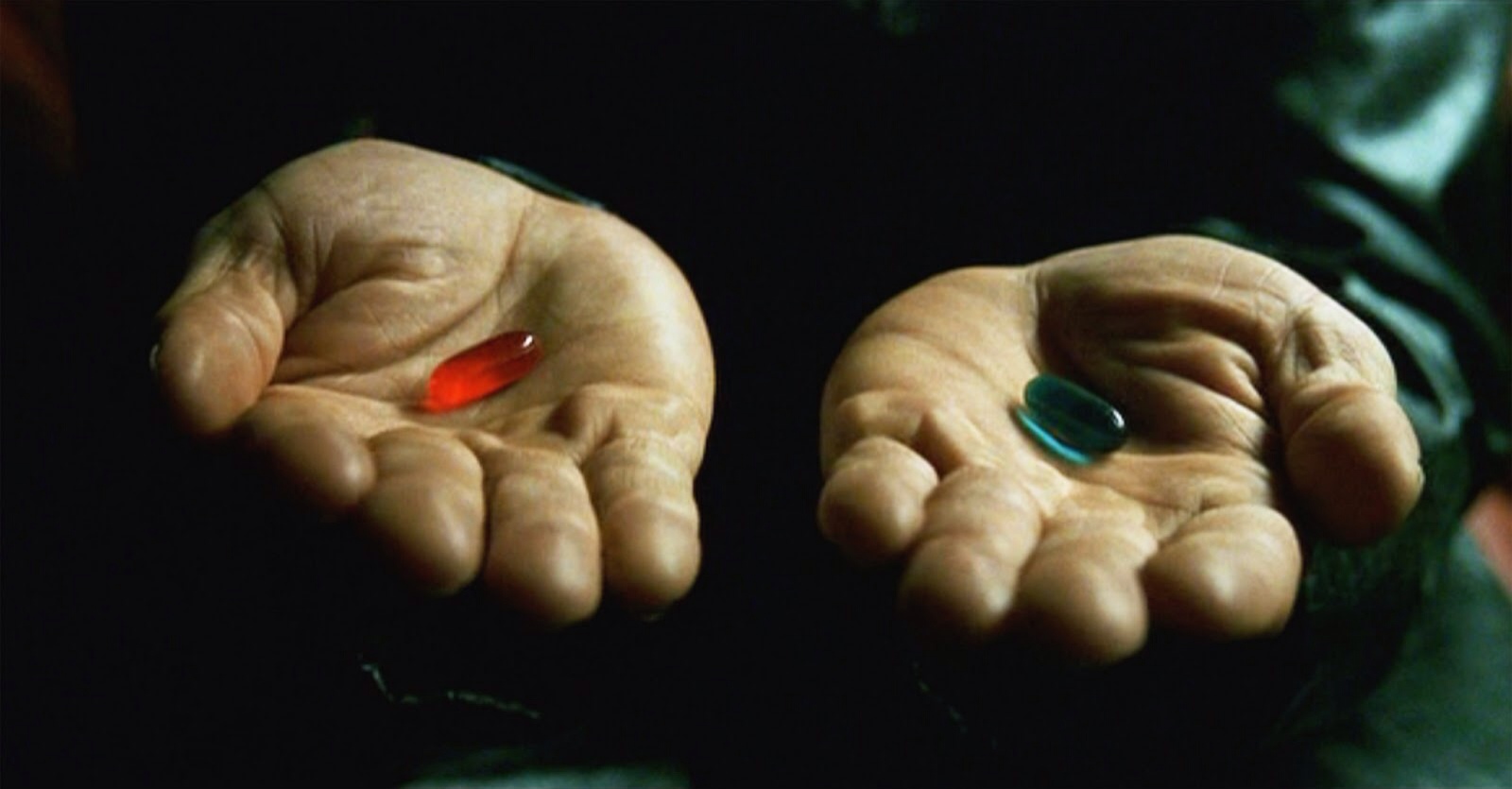
The best way, perhaps, for anyone to understand this is to recall the movie The Matrix, directed by Andy and Lana Wachowski in 1999. Think about Neo’s (Keanu Reeves) ultimate choice in that film, as intoned by Morpheus (Laurence Fishburne): “This is your last chance,” Morpheus tells Neo in the inciting incident of the story. “After this, there is no turning back. You take the blue pill—the story ends, you wake up in your bed and believe whatever you want to believe. You take the red pill—you stay in Wonderland and I show you how deep the rabbit-hole goes.”
The red pill is freedom—but freedom also means the horror and bitterness of knowing for real what has become of humanity—i.e., batteries for harvesting by robot overlords—and surrendering to a life where nothing remains constant, and everything is fraught with danger. The blue pill is remaining in the trap of the Matrix—a prison, yes, but it is a comfortable prison, a dream really, where “life” seems to go on in the ordinary ways it unfolds.
I think, given the tough choice, most people would choose the blue pill, freedom forfeited. Only the truly strong will take the red pill and everything that freedom promises—a life of uncertainty and inheriting the terrible charge of having to truly shape, by yourself, your own path and destiny. According to Fromm, psychology-speaking, human beings are hardwired to want to be told what to do, to be herded around like sheep by a higher authority.
The films of Chantal Akerman are not an easy to like, just as much as their creator had been famously prickly in real life. (She was kinda homophobic, too, and had apparently died a suicide.) And she had disdained, for example, the labelling of her films as feminist tomes -- although feminists are her biggest champions because her films say so much about the experience of being woman alone in the traffic of the contemporary world. One of her most accessible films is also one that can test the patience of any regular moviegoer: Jeanne Dielman, 23 Quai du Commerce, 1080 Bruxelles (1975) -- and yes, thats the full title -- is famously slow and lengthy, clocking in at more than three hours in its matter-of-fact documentation of the daily life of the titular character as she goes about her regular business of keeping house, baking potatoes for dinner, and entertaining johns in her sideline as apparent prostitute -- and responding to all these with the same sense of clockwork precision and ritual bordering on resignation, until the twist in the last third of the film. (I watched this film last year by doing housework myself, and it was a strange and immersive meta-experience.)
Saute Ma Ville (1968) is her first film, made when she was just 18 -- and in this short film, she had already established that voice singular to her. It may be a pseudo-comedy of a young woman trapping herself in her own apartment, but its implications and its end are shocking and sad.
And here's a revealing interview Akerman did for the Criterion Collection, where she talks about the seed for Jeanne Dielman -- and those last words she uttered, as she thought back to the acclaim she won at 25 over that film, are chilling and insightful.
Rest in peace, Ms. Akerman. You have been needing that peace for quite a while now. And thank you for your strange films.
I was reading this fascinating article in The Atlantic Monthly where writer Selena Hoy muses over a cultural observation: that Japanese kids—often as young as six years old—are such a common sight on Japanese mass transit, and posits that “even in big cities like Tokyo, small children take the subway and run errands by themselves, [and the] reason has a lot to do with group dynamics.”
Hoy continues: “It’s a common sight on Japanese mass transit: Children troop through train cars, singly or in small groups, looking for seats. They wear knee socks, polished patent-leather shoes, and plaid jumpers, with wide-brimmed hats fastened under the chin and train passes pinned to their backpacks. The kids are as young as 6 or 7, on their way to and from school, and there is nary a guardian in sight. A popular television show called Hajimete no Otsukai, or My First Errand, features children as young as two or three being sent out to do a task for their family. As they tentatively make their way to the greengrocer or bakery, their progress is secretly filmed by a camera crew. The show has been running for more than 25 years.”
I think this still bears some resemblance to small town life in the Philippines. I can still remember my own childhood in Dumaguete where I was sent to do various errands (mostly having to do with buying stuff from the local sari-sari store) by my parents and a whole barracks full of elder brothers—five of them, in fact. But I think it is a slowly disappearing part of family culture among Filipinos, with our increasing urbanization and the plethora of maids we have around to do our bidding.
I think of the bigger cities we have in the Philippines, something comparable to Tokyo, and I admit to a kind of unease. Because to be honest, I’ve always felt safer in Tokyo in a way I can never feel safe in Manila, for example. I’ve lived in Tokyo in my early 20s and this barest fact about life in that Japanese city has always been apparent to me. Even with the problem of language (and the fact that Tokyo is a megalopolis), I know I can go from point A to point B without too much trouble. In Manila, even when I take a taxi, my guard is up, waaaay up, it is quite stressful—and I can only conclude with this question: Will I ever feel safe navigating around my own country’s capital? The answer seems to be, given the realities. What’s up with that?
Hoy explains why the opposite seems to be the fact of life in Japan: “Taking responsibility for shared spaces means that [Japanese] children have pride of ownership and understand in a concrete way the consequences of making a mess, since they’ll have to clean it up themselves. This ethic extends to public space more broadly (one reason Japanese streets are generally so clean). A child out in public knows he can rely on the group to help in an emergency.”
Perhaps that’s what’s lacking with Filipinos in the Philippines [and I make that as a clear distinction, because we’re totally different creatures abroad]: we don’t take responsibility for our shared public spaces. And there are many instances of this neglect.
We use our sidewalks as garbage bins. (There are no actual garbage bins, for one thing.) We don’t make it a point to keep to the right in public escalators, to give space for those who may be in a hurry. We barely line up for anything, preferring to cluster around and using palakasan as key to facilitate things. We leave the tables in the restaurants we frequent with remains of meals that resemble a sty. We snarl our traffic with devil-may-care driving selfishness. And we make excuses for these by justifying to ourselves that others are not following rules—so why should we?
There are even bigger instances of our misuse of public spaces. We build ugly infrastructure and buildings without any thought to whether the immediate community needs it. (That overpass near Silliman High School is a glaring example). Or whether it blends well with the environment. (That strange rectangular contraption cum billboard along the Rizal Boulevard near the tempurahan which is apparently meant to invite the framing of photos of passing tourists—as if it’s a perfectly good idea for anyone to want to do that). We also consistently elect public officials who sleepwalk over issues of the public good (like public transit).
And lastly, we treat our public parks and monuments like afterthoughts. We have been luckier in this respect in Dumaguete—but elsewhere, it has been a glaring problem. The artist Paulo Alcarazen once posted on Facebook a series of photos of the monument along Roxas Boulevard in Manila dedicated to our OFWs. Each photo in a set of three was taken within a few years of each other. Taken all at once, the series presents a sad study in devolution and heartbreak: the monument over time becomes surrounded by suspicious development, with the greenery that initially surrounded it over time becoming an ugly sea of concrete. And the statues comprising the monument themselves have become compromised. The original monument consisted of five figures in bronze—a mother, an elder daughter, a younger son, and their dog in a gesture of excited welcome to a returning OFW father. But over the years, some of the figures have totally disappeared (perhaps shanghaied by bakal boys), and what has remained of the monument now is just the figures of the mother and the daughter, both sans limbs.
There is a famous explication about public safety that is popularly called the “broken windows theory.” It is a criminological theory of the norm-setting and signaling effect of urban disorder and vandalism as markers for crime and anti-social behavior. In that theory, a hypothetical community where the buildings have perpetually neglected broken windows is said to invite a rise in criminality and anti-social behavior in that community.
And we have so many “broken windows” in Dumaguete.
The trash on our streets.
The chaos of our traffic.
The devaluation of our public parks.
The uneven sidewalks running along our city streets.
And we keep complaining why our city is no longer the “city of gentle people” of yore? Why there are unsolved killings in our midst? Why our youths turn to drugs? Why there is a pervasive lack of public love for our local heritage?
Responsibility for public spaces and public safety. Everything connects.
A history of the athletics in this part of the Philippines, I think, is something some local sports scholar should seriously consider studying. There's a ton of information out there. For example, there's the fascinating story of Sillimanian high jumper Simeon Toribio, one of the country's first Olympians, who won the Bronze Medal at the 1932 Summer Olympics in Los Angeles. In 1928, he wrote a letter back home to Dumaguete [subsequently published in the August 1 issue of The Sillimanian], where he talks about arriving at Port Said in Egypt on the way to the Amsterdam Olympics: "By way of practice, we have endeavoured to keep ourselves in condition. At every port the boat calls, we set out for some jogging. It is difficult to find any jumping pit. On board, we have made a cushion for my landing so that with my rubber shoes, I can practice jumping with no danger."
Toribio was also a campus poet. This is one of his poems, published in 1927, and already heavy with sports metaphors:
The Hurdler
O'er the hurdles you go for the tape at the goal,
O'er these hindering bars from your starting foot-hole,
With the cheers and the cries in your front, at your back,
At the left and the right of the track.
Now you keep your fast gait and keep on stepping right,
Then a pebble that lies on the way of your flight,
Your alighting foot sprains, and lowers your nat'ral speed,
For it does e'en to any race steed.
Up and down! up and down! up and down! what a force!
From the start to the goal, can there be any worse?
But you never would stop and while onward you go,
A good lesson you teach -- don't you know?
That like jumping o'er hurdles in life we are bound
With our rooters unseen, -- but with hope so profound;
We should clear the high hurdles steadier,
So we breast our life tape the earlier.


 3:29 AM |
The Unforgettable Natalie Cole, 1950-2015
3:29 AM |
The Unforgettable Natalie Cole, 1950-2015