Celebration: An Anthology to Commemorate the 50th Anniversary of the Silliman University National Writers Workshop Sands and Coral, 2011-2013
Silliman University, 2013
My former journalism mentor in high school—she’s the current Dean of the College of Education at Silliman University—was effusive upon seeing Ballet Manila’s production of Swan Lake last week, on its final night at the Claire Isabel McGill Luce Auditorium: “I was in tears when I left the Luce tonight, overwhelmed by a mix of emotions,” Dr. Gina Fontejon-Bonior wrote on Facebook. “I needed this moment at the Luce, immersed in an evening of love, beauty, and grace—after a long workweek, and a heartbreaking news about the health condition of someone I deeply care about. Salamat kaayo, Silliman University Culture and Arts Council, for bringing the artistic creation of Lisa Macuja-Elizalde back to Dumaguete, … for the breath of hope and grace.”
That kind of testimony lingers more than most, I think. More than actual reviews even—which is why I have opted to center this column with Dr. Bonior’s emotive impressions of the ballet. And how do I even begin to review Ballet Manila’s Swan Lake, with Ms. Macuja-Elizalde in her creative peak? I won’t even try. I will try to write about it in a different way.
You hold on to testaments like Dr. Bonior’s it like a talisman, something to pull out when the world begins to unravel. Because the truth is, we’re all slowly unraveling. And if the ache of ordinary life, like illness or bureaucracy or the grief that never leaves you, does not do you in, it’s the quiet despair that comes from scrolling endlessly through your phone in the dead of night, seeking feeling in a world too numbed out to offer it. And then a white bird flies across a hallowed stage in Dumaguete, pirouettes in anguish, and suddenly your chest opens.
What is it about Swan Lake?
It’s a ballet that, by all measures, should be a relic: composed in 1875 by Pyotr Ilyich Tchaikovsky, borne out of the romanticism of a bygone era, stuffed with royal courts and enchanted lakes and girls turning into swans. But it survives, not just in gilded theaters in Moscow or London, but here in Dumaguete—under the shadow of acacia trees, where the salt of Bohol Sea clings to your skin even in the air-conditioned dark of the Luce.
It survives, I think, because it haunts us.
Because it is, at its core, a tragedy of transformation, of doomed love, of becoming something else entirely just to survive. And isn’t that what we all do? The ballerina, at the height of her dance, becomes the swan—and you forget that it is human limbs that tremble and leap and flutter. You see the feather, the wing, the pain of flight.
Lisa Macuja-Elizalde and Ballet Manila know this, embody this. And in Dumaguete, that knowledge is received not passively, but with deep and trembling gratitude. Here, I would like to believe that we are not jaded by art. Here, when a ballerina flutters to her death in a fog of heartbreak, someone in the back row weeps silently—and means it. [This is very true! In the performance that I saw, the audience I was with were rapturous when our swan leapt to its romantic demise!] Maybe that’s why Dumaguete is still the kind of city where a ballet like Swan Lake matters. Because we haven’t lost our capacity to believe in beauty. Or to mourn it.
As a teenage high schooler working for The Junior Sillimanian, I was taught by Dr. Bonior [always Ma’am Gina to me] to be precise in my reporting, to sum up a story best in a perfect opening paragraph. She taught me to feel with structured language. And now here she is, decades later, watching a girl in a tutu die for love and magic, and sobbing in the darkness. I think there’s poetry in that.
There’s a kind of redemption in being allowed to feel deeply. It doesn’t happen enough.
Maybe that’s what Swan Lake offers: not just its well-worn story of Prince Siegfried and the cursed Odette and her dark double Odile and the malevolent Von Rothbart, but the whole aching ritual of it. The careful discipline of classical ballet, with its merciless demands on the human body [Ballet Manila, for Dumaguete, did the unthinkable and danced a punishing total of six shows in a row in four days!], and its impossible grace. Every movement honed through pain. Every step a sacrifice. And yet, it is through that rigor a transcendence arrives.
Lisa Macuja-Elizalde, who once danced these roles herself, has now given her dancers the gift of that same transcendence that we, in Dumaguete, got to witness, which is nothing short of a blessing. A miracle, even. Because we are far from the cultural centers of the country. We do not have the reach of Manila, or the glitter of CCP galas. But we have the Luce. We have the Silliman University Culture and Arts Council and its indefatigable leader, Diomar Abrio, with his stubborn devotion to the idea that Silliman University and Dumaguete deserve to see the best this country has to offer. That we are not too small. That art is not a luxury—it is the lifeline.
And so this is why Swan Lake endures, at least for us. Not because of nostalgia, but because of its ability to speak to us across centuries and geographies, across languages and generations. It tells us that love can redeem, even if too late. That betrayal can destroy, but also set one free. That sometimes, becoming a swan is the only way to escape.
And here, in this seaside university town where students still write poetry on napkins in cafés, where strangers say thank you after watching a play, where grief is softened by music echoing from the Rizal Boulevard, Swan Lake finds an audience that doesn’t just watch—but listens. Feels. Believes.
So yes, bring back Odette to our stage. Let her dance again and again in our city. Let her leap and fall, rise and vanish. We will always watch. We will always weep. And somewhere in that act, in that collective surrender to beauty, we are healed. Even if just for one night. Because in Dumaguete, Swan Lake doesn’t end with a curtain call. It stays.
7:00 AM |
In Dumaguete, The Arts Flourish Part 10: Diving Into Dance
Picture a space—a narrow corridor, a hideaway, a cloister—and then picture a flood of darkness filling up the frame. With the striking strum of a melancholy guitar, a figure wakes up in it, drenched in a cascade of water. We get snippets of her body in the dim light, awash in rivulets of liquid, and then the dance begins. She senses the claustrophobic space she is in, and there is a pained acceptance of that on her face—and then she moves in and out of the shadows, her hands and her body in a flurry recalling Martha Graham or Alice Reyes, in an acknowledgement of the confinement and in rhythm to the plaintive guitar score.
The dance is sad, moving, and transfixing. The music is by Dumaguete composer Hendrix Paul Tubil, and the dancer/choreographer is Cheenee Vasquez Limuaco. The short piece is titled “Salom”—Ms. Limuaco’s winning entry to the 2020 edition of the WiFi Body choreography series for the solo/duet form by the Cultural Center of the Philippines, which for the first time since its inception held its competition online—an acknowledgment of the pandemic still raging like wildfire in the middle of 2020. WifiBody director Myra Beltran rethought the competition for that year, and decided that 2020’s virtual edition should focus on the domestic space or the lockdown site of their participants—thus “stretching the possibilities and visions of budding choreographers,” as well as “questioned the modes of production brought about by the pandemic.”
Ms. Limuaco’s piece, a thesis on swimming [literally and figuratively] against the odds, was a perfect capsule of lockdown anxiety, but in its magnificent execution provided a light into how dance could be done with all the restrictions—physical, psychological, and spiritual—that the pandemic demanded. In response to her piece, Nes Jardin, acclaimed dance artist, educator, and arts manager, observed: “The piece won for its solid composition, and powerful cinematic imagery based on a concept marked by simplicity and raw emotion. It is also outstanding for its effective and dramatic use of limited space and its innovative interplay of movements, light, and lilting guitar music.”
Innovation was truly the gamechanger for dance artists in Dumaguete during the lockdown. For many of them, the usual performances they had always relied on were suddenly taken away from them. Most of them also relied on teaching for their livelihood—and just like that, their schools were closed down, and the question that loomed for their survival became, “Can I teach dance through Zoom?”
The Kahayag Dance Company, for example, had always thrived as a folk dance group with constant invitations to participate in many festivals nationally and internationally. In Dumaguete, they spearheaded a community program for the City Tourism Office titled “Bansayaw,” which regularly showcased their repertoire through mini-concerts in public spaces around Dumaguete—particularly the Pantawan fronting Silliman Hall. For Arts Month in 2020, they performed for a series of “Bansayaw” presentations, culminating on February 23. And then the long wait for the lockdown to be over began—but if all one needed to dance was space, then virtual space was enough.
By April 29, on International Dance Day, they embraced the restrictions and put on a dance concert, with participants dancing Philippine folk dances in their bedrooms, in their salas, out in their gardens. They would do an encore by the next month, this time together with dancers from the MEV Dance Studio, Dance in Motion, Dauntless Brothers, Skip Dance Family, and others—dancing up a storm in a concert video in their lockdown spaces. Aiken Quipot, Kahayag’s creative director, would say: “This pandemic has greatly affected the dance industry and the artists who solely rely on dance as their means of living. It’s a big challenge to keep our passion burning as we find alternative ways to earn and get through each day at a time. Despite all of this, we continue to dance. We refuse to let this pandemic put out the flame, and we will not allow it to take away the only thing that keeps us happy, alive, and sane. Dance in your room, the backyard, the streets, wherever you want—because when this is all over, we will celebrate and dance together!”
They participated in KapitTinig in June, virtually, and celebrated their 16th anniversary in August with the no end to the pandemic in sight. A break from the virtual realm came in September, when the Dumaguete City Tourism Office decided to showcase Dumaguete culture and the arts in Paghimamat—joining other cultural groups at an empty Luce Auditorium in a videotaped performance to bolster the sagging spirits of Dumaguetnons. They launched videotaped concerts with better production values—such as the Pagliwaliw sa Lupang Hinirang in March 2021, out of the DIY confines of lockdown spaces into venues more attuned to artistic flourish.
But 2021 was also cocooning time, with many elements starting to fall into place behind the scenes—a permanent rehearsal and performance space is finally secured [which also served as venue for classes once lockdown restrictions relaxed] and a continuing alliance with other dance groups and artist collaborators is strengthened, paving the way for a fruitful return to form in 2022.
The Sidlakan Dance Company, meanwhile, had just returned to Dumaguete after a successful participation at the 2019 Horticultural Exposition at Beijing, China [dubbed as the Flower Festival of the World], which closed on October—basking in the flush of that international invitation. The group, led by artistic director Vic June Rich Nocete, would carry that excitement into their participation at Kisaw 2020, the National Arts Month celebration of Dumaguete—and then when the lockdown happened, there was nothing. There was some stirring by November, when the group was included in the Visayan line-up for Dance Xchange on Air 2020, a program by the National Commission for Culture and the Arts—appearing on Episode 11 of the video series. [They would appear again in the 2022 edition.] But by 2021, there was a restlessness to regroup, to take part in shows—which resulted in a video series they produced titled Suroy a tenth anniversary production that aimed to “travel” the various regions of the Philippines via the medium of folk dance. That undampened spirit paid off, and in January 2023, they were chosen to be the official Philippine delegate to the 19th Nova Prata International Folk Festival.
Its institutional foundation has always made the Silliman University Dance Troupe luckier than most dance groups—because for as long as Silliman University exists as an educational institution, SUDT will always be along for the ride as a vital part of the university’s cultural mandate. Led by choreographer Angelo Sayson, SUDT remained a reliable mainstay in many cultural programs put out by the Silliman University Culture and Arts Council, and just right before the pandemic lockdown, it participated in the 2020 edition of Musikapuluhan: Himig at Sayaw the annual cultural showcase of traditional music and dance at Silliman. A lull immediately followed the pronouncement of the pandemic—with SUDT finally surfacing when it took part in the virtual staging of the musical revue The Story of Dumpawa's Lullaby in September 2020, and then at Silliman Performs also performed online. They would participate in NCCA’s Dance Xchange 2021, and launched a virtual dance concert titled Salingtuod in February 2021. They also participated that month in Bailar Sin Arco, a concert featuring the Silliman University Orkestra Sin Arco and Kwerdas. By March, they also participated in CCP’s Tuloy Po Kayo—an online festival meant to encourage Filipino artists to continue to create during the pandemic. Throughout most of 2021, SUDT would also present assorted videos of their repertoire on their Facebook page, with student dancers in full Filipiniana regalia performing dances in various spaces on campus—culminating in a concert of Visayan folk dance and music, Bisayaw, in October, together with the Silliman University Rondalla, and representing the Philippines at the Sarawak International Festival of Music and Arts in November, together with the SU Orkestra Sin Arco. On February 2022, SUDT would up the ante by presenting a rigorously produced online dance concert titled Musika Mo, Sayaw Ko, with a repertoire inspired by Original Pilipino Music [OPM], and then, on the same month, took part in CCP’s Pasinaya, a showcase of various folk dances from Luzon, Visayas and Mindanao featuring selected video productions from the 2021 Kalinga ng Sining [KNS] Subsistence Grants Program. This led to their participation in AirAsia Super App’s Fiesta Series in April. They would also perform in Cantate Domino, the 2022 edition of Silliman Performs in August. By November, they would return to a live performance at the Luce Auditorium with Babaylan, billed as their 60th dance show.
Negros Oriental State University’s Kabilin Dance Company, meanwhile, started 2020 in high spirits, with new members to invigorate the group and brandishing new official rehearsal shirts to bolster the vision of artistic director Stephen Labrador Intong. What differentiates KDC from their counterparts in Dumaguete is a repertoire consisting mostly of street/hiphop and contemporary dances, and when the lockdown hit, many KDC members hit TikTok to showcase their dance moves in that vein, often giving messages of hope and resilience through dance. They even opened a dance competition on online video platforms with a nod towards frontliners, and with the organizers recognizing that “dance [can be] used as [a medium of] communication between body and soul.” But TikTok could only do so much, and KDC would soon join other Dumaguete dance groups in participating in various online dance festivals, including NCCA’s Dance Xchange on Air in 2020, and Sayaw Pinoy Goes Virtual in 2021, usually performing “Inagta,” which had become the company’s signature folk dance—and all in the name of perseverance. As Intong explained then: “For the last two years, life has been tough and times are changing. But instead of looking at life hopelessly, let’s continue to give life and colors to our culture and the arts.” In May 2021, they presented a special dance performance titled “Bagani,” in tribute to frontliners during the pandemic. By June, they would host a series of video dance performances in tribute to Jose Rizal, choreographed by various members of the troupe., and in July they would organize a competition, Kabilin Dance Company Got Talent—Goes Virtual, over Google Meets. The group would also open auditions for people with disabilities [PWD], and one of their members would go on to found the Dauin Dance Artists group.
Prime Machine perhaps Dumaguete’s most well-known modern dance group [primarily due to an appearance in ABS-CBN’s Showtime in 2011], had always been a main draw in many local events—such as cultural shows in fiesta, beauty pageants, school presentations, and the like—and 2019 had ended with their slate full of the usual invitations, including a stint for Pasko sa Kapitolyo for the Negros Oriental Provincial Government. There would be more of the same at the beginning of 2020—but by the time lockdown hit, most of the members would spend the long beginning stretch of the pandemic invading TikTok, foremost among them Ralph Allen Piñero, Teamoy Caluscusan, Rock Vincent Viente, and Jay Lou Rapana Merced. [Prime Machine would only officially launch itself on Tiktok in March 2021.] Some dance gigs would trickle in, like school events such as the Silliman University Senior High School Online Acquaintance Concert in September 2020, with Prime Machine sharing the virtual stage with other modern dance groups such as Corps D’Elite and The Lifestyle. By 2021, they went for something a little more polished: dancing in well-polished music videos, such as “The PUNKdemic,” which they launched in Hayahay in February 2021.
The dance video, with the group dancing to Suzi Wu’s “Eat Them Apple” in a routine choreographed by Don Mar Teves, is a full-scale production perhaps never before seen among Dumaguete dance crews, made with assist from the Dumaguete City Tourism Office. The ambition paid off in a handsome production that begins ominously with a stranger walking the lockdown-ravaged Dumaguete downtown at midnight, and then witnessing a facemask-wearing gang converging to do their dance moves. The result was electrifying; it was also a much-needed jolt in the doldrums of the pandemic. When they posted the video on social media, it went viral. That video led to commissions with the group doing video dances for private parties and other bookings, or doing backup dancing for local musicians such as Chuckoy Vicuña, who would release his “Hilas” music video on July 2021. There were competitions to join, too—not always successfully: that October, they signed up to join the Buglasan Festival Modern Dance Competition [Open Category], but had to back out when one member contracted COVID-19. They would be a mainstay in city-sponsored cultural events such as the Tayada sa Pantawan, and they kept busy with bookings for various gigs, including dancing for an election-related music video for politicians running for various offices in Bacong town and others, or dancing for openings of business establishments like Miniso. On 26 June 2022, Prime Machine would celebrate their 25th anniversary.
Prime Machine, of course, is not the only dance crew in Dumaguete. There are a host of others, many of them priming themselves during the pandemic. For many years they regularly converged to compete in the annual Negros Best Dance Crew competition, which bills itself as “the biggest dance competition of its kind around Negros Island.” But the sixth edition of the competition, slated on October 2020, had to be cancelled “due to a rise of COVID-19 cases in Negros Oriental,” per the statement released by organizers, maintaining that “it is our best interest to prioritize the safety of the community.” Two years later, in 2022, they announced their return, scheduling auditions for both Negros provinces in November—and eventually announcing the following participating dance crews: AOG6100, Super Villains Crew, Skip Dance Family, Chicana, Galaxy Dance Tribe, Prime Machine, The Majesty, BNT Just Vibe, Coco Brandy, Quicksound, The Lifestyle, Menace Dance Crew, Nice One Family, Dauntless Brotherz, SD6 Explosion, Royalty, D-Acceptance, Assassin Dance Family, and Classical Dance Crew—with the first thirteen qualifying for the finals, slated on 28 January 2023 at the Macias Sports Complex. Skip Dance Family, a dance crew founded in 2007 in Dumaguete by Jeffrey Regalado, emerged as the champion.
Skip Dance Family has built a steady fandom before the pandemic by winning many dance crew competitions, and posting dance videos regularly on their Facebook and Instagram pages and YouTube channel, often to songs by local groups like Daro Boyz. They’re savvy online, and produce even their own merchandise [such as print shirts]—and their 2020 began with them expanding to include more members, and had spent January in team-building efforts. When the pandemic hit, they would ramp up the video productions more, like many other local crews—but with a regularity that’s daunting, sometimes 3 to 4 videos a month, in the middle of a lockdown. Most of these would be simple, no-frills dance videos, with the crew dancing on the street and other public places, but they racked up considerable likes and shares, an increasing number of admirers with each new video posted. They would do this for the rest of 2020, culminating in their joining of Domination PH Reload, a nationwide dance competition held online, where they ranked #7 out of 37 dance crews participating. They would do more of the same in 2021, joining online dance competitions when they could, but also making time for community outreach programs. When they would prepare for upcoming competitions—such as the HappyFive DigiTv Hataw Dance Competition and World Supremacy Battle—they would post videos of their progress online, gaining more fans. They would place second runner-up at the HappyFive contest in June 2021, their first pandemic-era award. They would also place the same at the cell division for World Supremacy Battle in August 2021. There will be other competitions, and more placements, including championships—and growth: they would form NEOS, an all-boys hiphop group, and Chicana, an all-girls hiphop group, during the pandemic. In 2022, they would dominate several categories of the World Supremacy Battle Visayas-Mindanao qualifier in Cebu, and started joining competitions in other cities in the country, winning second place in the MassKara Hiphop Challenge in Bacolod in October. When they won the sixth edition of Negros Best Dance Crew, it was like a coming home—they were also the champion in 2018, in the competition’s fourth edition. With the successful return of the Negros Best Dance Crew competition in 2022 also comes the hope that street/crew dancing has weathered the worst of the pandemic, and is back.
It is with such events that we gauge a return to normalcy. In 27 November 2022, the Limuaco-Gaston Dance in Motion Company, the Dumaguete City DanceSport Team, Kahayag Dance Company, MEV Dance Company, Kabilin Dance Company, Sidlakan Dance Company, and the Silliman University Dance Troupe came together at the Pantawan for a showcase of Dumaguete dance titled Hiusang Sayaw, an unprecedented—and live—performance spearheaded by the Dumaguete City Tourism Office. The pandemic was still raging in the world, but the dancing had returned.
* * *
One specific dance showcase borne out of the pandemic is Lapyahan, an occasional performance exhibition spearheaded by the Dance in Motion Company of the Limuaco-Gaston Dance Studio, sometimes in collaboration with Kahayag Dance Troupe. First staged on 27 February 2022, it astounds with the fullness of its conception: a small-scale show by a handful of dancers, often in limited space with limited capacity for audience members who are invited to be in intimate reach with the performers, and allowed to range around the venue, sometimes following the lead of the dancers as they take the audiences to witness specific numbers from one spot in the venue to another. What’s more, each show is virtually performed on the fly, with the dancers armed only with broad strokes of dance moves, some choreographed movements, and the general knowledge of what music will be playing. In one series in 2022, specifically titled State of Limbo, three performances choreographed by Ian Nick Gelladuga Tiba, Jonee Rodriguez Jibes, and Dylzaree Recentes [under the artistic direction of Cheenee Limuaco] were announced—August 27, September 3, and September 10 at their permanent studio at the Catarata Compound along Calle San Jose; but avid audience members would soon notice that it was best to see all shows, because each one was vastly different from the one that came before. That uniqueness was by design—a concept Ms. Limuaco insisted on, bearing in mind the unexpected flows she had to bear to make her dance studio stay afloat in the worst of the pandemic months.
Cheenee Limuaco hails from Bacolod, Negros Occidental—but her parents were loyal Silliman University alumni, which meant going to school in Dumaguete. She had spent her formative years studying at St. Scholastica Academy in Bacolod until high school, and she found herself in Dumaguete pursuing a nursing degree. It was what was considered practical—something her parents insisted on—although Ms. Limuaco knew her heart was not in it. She loved dance. She had studied ballet at the Lydia M. Gaston School of Dance from the age of six, falling in love with it because of how “princessy” ballet was. “I loved the costumes, I loved how I was taught to hold my head up high. I loved the whole package, the ballet experience,” she tells me. The tuition was expensive, but her lola paid for it, and when she finally couldn’t, the school director herself, Lydia Gaston, stepped in. “She saw potential in me,” Ms. Limuaco said, “and she offered me a scholarship.” The intense training did not start until she was in first year high school. She loved the challenge. Remarkably, Ms. Gaston also began training her to teach dance—how to teach it, and what to look for in a ballet student.
She gravitated towards dancing at Silliman, joining the Kahayag Dance Company [which was the new name for the Silliman University Dance Troupe, before Kahayag members left the corps and formed an independent dance company bearing that name in 2013]. Kahayag’s then artistic director, Ronnie Mirabuena, approached her and asked her if she could teach ballet since he knew she had been teaching it in Bacolod. This was in 2006. She agreed. She had fifteen dancers to teach, and persevered with her nursing studies—two extremes that were clashing in her life. After three years, she was sent back to Bacolod, and was given an ultimatum by her parents: if she wanted to dance, she had to come back to Bacolod, where you could continue her ballet training, and study nursing at the same time. She needed to finish her degree and pass the nursing board—and only then could she do whatever she wanted. So agreed, simply because she wanted to continue dancing.
But there was a snag: her heart was in Dumaguete.
“I love Dumaguete,” Ms. Limuaco says. “When I came here for college, I fell in love right away, and I did not want to go home to Bacolod, even during summer vacations. It was just so chill, so me—wearing just shorts and a shirt and a pair of tsinelas. The people here are really more gentle and loving, especially with children. This has been my experience. It’s the vibe that made me want to stay here in Dumaguete.”
As soon as she finished her studies in Bacolod, she ran right back to Dumaguete, and get right into dancing. She found herself teaching ballet for the College of Performing and Visual Arts at Silliman, the ballet studio at the Luce Auditorium her base. But she maintained a dream of founding her own school: “I kept telling myself that with my own company, I would work it in a way that would make Dumaguete truly a center of dance. Manila is already crowded, and many of its dance artists are looking for other places to do their art in. Dumaguete can be that place. And we have many resources here. And it is possible that the dance scene here will really bloom.”
In 2019, she made a choice to quit Silliman University, inching her way to a dream of having her own company. She remembers the instance of conception: “I had a friend who’s from Likha PH, he’s from Iloilo. One time we were talking where I shared that I wanted to set up my own studio because I had so many ideas. They were overflowing. And I wanted to be able to do them na, because I felt I was ready. He asked me: what is it that I wanted to do? What is it that I wanted my studio to accomplish besides just teaching dance steps? And I said that I wanted my prospective students to discover and understand that in every movement that we do we can convert that to dance. Hence, Dance in Motion.”
That conversation propelled her to take concrete steps towards her dream, trepidation aside. She named her studio Limuaco-Gaston Dance Studio, “Gaston” being the family name of her business partner, the son of her mentor Lydia Gaston.
“I was still with Silliman at that time, but I was already looking for a studio,” she says. “I felt like I had to have my own place because I had all these ideas, and I needed to let them out. Or else I was going to explode. And then I saw a sign for a space rental near UCPB [along Real Street, fronting City Burger] and just for a lark, I called the number. And someone answered, and told me he was ready to meet me in five minutes. And just like that, I got a tour of the place—and things just flowed: the tour of the place, the rental agreement, the contract signing.”
The way things happened fast scared her, but she was determined to follow through. “I also asked for things I needed for a workable dance studio, and the owner agreed to everything I wanted,” she says. “And I thought: is this a sign? I couldn’t say ‘no’ anymore. Financially, I saved up a little for this eventuality. But it still remained a challenge—but my partner was very supportive.”
Dwight Rodrigaso, another mentor, also gave her some useful advise because he saw she was overflowing with too many ideas. “You can’t hold it in,” Ms. Limuaco remembers. “You have to share it. If you don’t share it, it will just die. And he really pushed me to open a studio.”
When the studio opened, she was overwhelmed. She was soon overseeing sixty students, so her recourse was just to train, and then to go into competition.
“This was my initial goal when I opened the studio. But then the pandemic happened,” she says.
The pandemic realigned things for her—and Ms. Limuaco realized life was far too short to just keep training people for competitions. “I lost the sense of fun,” she says. And so the pandemic halting everything around her became a kind of a blessing. “I realized how much I was missing when I was so much into just training. I realized the kids would learn more if they had fun. So I had to reset the program. I made another syllabus that would encourage kids to dance and to move, but also to have fun. I knew they would learn better that way. And so we began doing unconventional classes. Sometimes, we use tambourines in class, for example. Classes became memorable. We’re still working on this, but it has been really nice to see the bright faces of my kids.”
But the realities of the pandemic immediately bared its fangs. She had signed a 5-year lease with her first studio, but operations in that venue did not even reach a year because of the lockdown. “All the investments I made were suddenly gone,” Ms. Limuaco says. “I went into depression at that time. Why was this happening to me? Why did I invest in this? But I couldn’t see the full impact of the pandemic yet. We were still renting, but we couldn’t use the space because of the pandemic restrictions—so we had no choice but to close up. It was heartbreaking.”
She ended her contract in December 2020, and then went into depression mode for a few months.
But by March 2021, an unlikely savior came in the form of sound and light designer Jerry Angelo Z. Catarata. “He came to me,” Ms. Limuaco says, “and he was offering me a space—a garage in their family compound in Taclobo which he was trying to convert into a studio. He asked if I could rent the space out—and I cried. I knew it was God-sent.”
Slowly, they made plans for the space—and thought that aside from it becoming a venue for training and rehearsals, they could also use it as a space for public performances. The venue was the spark that started the new Dance in Motion Company. “The pandemic took out a lot,”she says in hindsight, “but it also paved the way for a lot.”
With the Lapyahan series, she has found a new way to connect with people through dance. “It was incredible. Not only were the audience members crying, so were the performers. When I look back to that, I still get teary-eyed. It was our first performance during the pandemic. While we continued havng classes during the pandemic, it came to a point where I began asking myself: What am I doing? What is this for? But because of the discipline that we learned, we just told ourselves: just keep on training, chill lang. But then, when we started preparing for Lapyahan, it felt like we had a purpose again. The studio felt alive again. It was like we were asleep during the pandemic, more or less, but it was really hard to find purpose. But with Lapyahan, we felt like our heart was jumpstarted: this is performance. This is live work. It really was memorable for us, the performers. And it felt good to get people’s feedback.”
The Dance in Motion Company is still in its infancy, of course—but Ms. Limuaco envisions it as a group of artists they can train for the international stage, whether a competition or performance or workshops. “We would like to show the people of Dumaguete that there is a future in dance, because we want to counter the long-held notion that there is no future in it, no career in it. But there is,” she insists. “We want to train dancers so that when they’re ready, they can move on to audition for international companies, for Broadway, for cruise ships, and others. At the same time, we want Dumaguete to be known as a hub for budding dance artists. Who knows, we can soon get young artists from Mindanao, from the rest of the Visayas, even from Luzon to come here and train. Who knows?”
Her dreams for the studio and for the company excite her. “I knew what I had to do: the dance school first, for the training, and then the dance company next,” she says. “Then we can create shows with a regular season, and I want to reach a point that when visitors come to Dumaguete, they can expect shows like this, which they can watch as part of their travel itinerary. And for the locals as well.”
What a journey it has been for Cheenee Limuaco in the pandemic years.
In a way, her WifiBody piece, “Salom,” is actually her story of what she had gone through because of the pandemic: “I felt like I lost everything. I lost my studio lease. But a friend came around, offering another space. And I had a choice: to stay floating in that space where I was, or to dive once more into a new chapter, a new adventure, a new place. I chose to dive. To ‘salom.’ It was my dance testimony. It bore witness to what the studio was going through because of the pandemic. It was a good decision nga ni salom ko. The studio is doing well now. We finally have face-to-face classes. We have programs once again. We have auditions for the dance company.”
12:51 PM |
A Grand Finale to the 2022 CCP Arts Academy
Have you ever had that feeling that you've done your best, and now it's up to the fates for that one last go to end up at least satisfactorily? We — the mentors for literature, dance, theatre, visual arts, music, and film — workshopped and workshopped and workshopped for five days straight, and now it came to this: a recital involving all the participants for the closing ceremony.
With barely half-a-day of rehearsals to iron out the kinks and to determine what needed to be done [choreography, choice of pieces, etc.], we were in it because everyone wanted it. In fact, we started the week thinking a final performance was going to be optional for each workshop. By Wednesday, all the mentors were keen to do at least something. By Thursday afternoon, we had some idea about what to do. By Friday morning, the rehearsals began. By Friday afternoon, the performances were on the slot.
AND IT WAS TREMENDOUS. It was like watching a concert of all the arts coming together in a spectacular and unexpected grand finale, with everybody doing their best to make everything work. You couldn't tell that most of the dances — sometimes paired with poets or with theatre artists — were improvised on the spot. It was just all seamless, certainly not without its flaws [a missing cue, a missing mic, etc.], but altogether fantastic. This is why in this video, as the last performers took a bow, we are all so generous with our applause, because we recognized that we just did something magical — and that all that hard work actually went to something tangible.
I think I echo my other co-mentors when I repeat what I said to myself at the end of the program: "Oh my God, they all actually learned something from us." We actually observed that our participants — 188 teachers from all over the Philippines — were hungry to learn, were willing to absorb something new and challenging, and most of all were generous to share their [sometimes newfound] talent in front of everyone. We made them dance, write, act, direct, make music, make art — and in the end, we were all very happy.
Thank you, Cultural Center of the Philippines Arts Academy [Chris Millado / Ron B. Mirabuena] and Silliman University Culture and Arts Council [Diomar Abrio] for making this possible. And congratulations to all my co-mentors [Dessa Quesada-Palm, Cheenee Vasquez Limuaco, Angelo Sayson, Aiken Quipot, Elvert Bañares, Juni Jay Tinambacan, Joseph Albert Perez Basa, W Don Flores, Ramon del Prado, and AK Ocol] for forming such a formidable group of resource speakers.
For me, the idea of freedom is being in the middle of the dance floor, unmindful of everyone else, eyes closed, and dancing with abandon to your own rhythm.
In the beginning—this was sometime in 2009—we just wanted to know if we could defy the odds and put up a National Arts Month celebration in Dumaguete. It hadn’t been done before, and the logistics of putting together a month’s worth of events dedicated to all of the arts was formidable. Plus we were working from a budget of zero pesos. But when Dessa Quesada-Palm—Dumaguete’s transplanted resident theater maven and tireless cultural worker—gathered a group of local artists and culture advocates that year, she—and Glynda Descuatan pushed what was possible, essentially urging us to go for the equivalent of that great grade school staple of “Let’s put on a show!”
The plan was to gather, as much as possible, all cultural groups mushrooming in their secret corners all over the province, and put them together during one week of intense celebration of the arts—from dance to music, from literature to the visual arts. Thus was Kisaw 2009 born—a “pasundayag sa bulan sa sining.”
We settled on a tagline: “Mag-mugna ta!” Mugna, after all, seemed the right word to describe the endeavor. It is the Cebuano word, after all, for “create,” but the word has also taken this street lingo connotation of friends gathering together to create something, anything in the spirit of fun, and in the light of communal effort. “Mag-mugna ta!” sounded like a spirited battle-cry, with the benefit of a smile and a wink.
People asked us: why exactly put on a show? Because February was National Arts Month—and it was becoming too strange to note that, no matter how much we hype Dumaguete City as the “Cultural Center of the South,” the city—and in a larger context, the province of Negros Oriental—had yet to undertake something as culturally all-encompassing as this particular celebration.
The rest of the country—particularly in stronger cultural centers such as Manila, Cebu, Davao, and Baguio—has been celebrating it for almost every year of the past decade, courtesy of the provisions of Proclamation No. 683, which has declared February of every year as National Arts Month. It is an official recognition of the role of the arts in reflecting, affirming, critiquing, and shaping our society—and, Dessa tells us, “it is a time when artists can take claim on public spaces, to engage with each other and with its communities, to create.”
Because art is truly a human right—something that only the most pedestrian cannot understand. And art truly has a function to fulfill as a beacon for the development in any community, something I have already explored in previous columns.
Alas, after 2010, we took a rest, for some reason or other. It took a while to revive the spirit, but in 2016, we’re back, and we’re still doing an exploration of art in public spaces, using the parks, the tempurahan, the boulevard, the kampanaryo, and the streets as venues for the arts to engage with the people.
It’s a more streamlined set of events, covering two days—February 26 and 27—although satellite events, such as the various Tayadas sa Plaza helmed by various schools around town, dot the rest of the month. For Balak, Balitaw, ug Uban Pa sa Tempurahan, slated on February 26, we pay tribute to Dumaguete as a literary capital of the Philippines with an earnest performance of the best of balak and balitaw, the traditional poetic forms of the region. For Huni ug Himig sa Kampanaryo, slated on February 27, local music takes a boost in a spectacular concert of some of the best musical groups and singers of the city. And for Puting Tabil sa Kampanaryo, also on the 27th, cinema—long considered as the favorite entertainment mode of Filipinos—is taken to the more public realm in a rare showcase of the best of local short films.
It promises to be a veritable celebration of our artistic wealth—a good enough return to Kisaw for what is hopefully a truly annual celebration locally. Good enough, even with its marvelous kinks, given that this has always been a thing conceived on the fly, and with almost no budget or institutional sponsorships—only magnificent scruples and a great love for culture by all those who come to participate.
When I was sick, this mashup video of dance clips from a grand array of classic movies edited by Michael Binder, author of A Light Affliction: a History of Film Preservation and Restoration [Amazon], was welcome comfort. The choice of Mark Ronson and Bruno Mars' "Uptown Funk" as the musical thread of the clips is inspired and strangely appropriate. It's even better and apt than the more contemporary version of the mashup. Here you go...
I have a thing for documentaries about artists pursuing and crafting their passions, may it be about sushi masters (Jiro Dreams of Sushi!) or typeface designers (Helvetica!) or dancers (Pina!) or comic book artists (Crumb!) or magazine editors (The September Issue!) or graffiti artists (Style Wars!) or animators (Waking Sleeping Beauty!) or filmmakers (Jodorowsky's Dune!) or writers (Regarding Susan Sontag!) or photographers (Bill Cunningham New York!) or back-up singers (20 Feet from Stardom!) or painters (Cutie and the Boxer!) or fashion designers (Unzipped! and Dior and I!).
To start the week before school starts, it's Jody Lee Lipes' Ballet 422 (2014) for me, his immersive look into Justin Peck's creation of the 422nd ballet for the New York City Ballet. Peck (in photo), at 25, has been called ballet's 'boy wonder': although still a member of the corps de ballet, City Ballet’s lowest rank of dancers, he has been choreographing for many of its principal stars. Delicious documentary (and subject, ehehe).
The most powerful moment for me in the film comes right at the very end when Mr. Peck's inaugural work for City Ballet, Paz de la Jolla, ends to rapturous applause, and we find the young choreographer making his way to the stage to take a bow with the rest of the company. You would think the film will end there, right at that moment of triumph. But no. The camera soon follows Mr. Peck backstage -- and you wonder where he is going -- then we find him making his way to his dressing room, to suit up and prepare for the next portion of the program, where he is just one member of the corps. It comes as a pleasant shock: the film comes full circle in that sequence -- and it tells us this is really a film about an artist learning to make his way into his world, and that there is always a time in the artist's life where humble beginnings and the start of something big fade into each other. In Vulture's article about Mr. Peck, Mr. Lipes gives us a way of seeing the film: “With Justin, we wanted to capture that moment in an artist’s career when things are starting to happen, but they’re still learning.” Powerful stuff. Inspiring and humbling at the same time.
What took me so long to watch this? Tony Silver's Style Wars (1983), the iconic documentary on the early days of hiphop as seen through graffiti, rap music, and breakdancing in early 1980s New York, is a perfect complement to Jennie Livingston's Paris is Burning (1990). Between these two films, they've captured a seething and decadent decade, which was also vibrant because of the subculture it was spawning: art and expression from the margins meant to subvert and flip the mainstream. (Sadly, the mainstream always works to consume even the marginal. And will always win.)
12:02 AM |
Hit Me With Your Best Shot: Jennie Livingston's Paris is Burning (1990)
Jennie Livingston's Paris is Burning (1990) has remained for me an essential title for the ultimate in film experience since I first saw it. When I am asked what my favourite documentaries are, this is one of the top five titles I could readily rattle off my head, alongside Microcosmos, Helvetica, Diana Vreeland: The Eye Has to Travel, and The Celluloid Closet. It is a cult film for understandable reasons: it demands repeat viewing, if only for one to spot certain details or drama you've never paid much attention to before; and there is of course its status as a cultural fountainhead. For those of us who became enthralled with Madonna's Vogue music video, directed with incredible panache by David Fincher, this was the film to excavate to find out where the mainstream culled its dance moves from the underground culture it was cribbing.
I see this film perhaps once a year, and often despite myself. I love it, but it is ultimately a sad, heartbreaking documentary, albeit a riveting one. In wanting to capture the underground ball culture of Black Harlem in late 1980s New York, Livingston also managed to capture in film the grittiness of the everyday lives of her subjects, the eventual hopelessness of their dreams and wishes, and the murderous end of some of them. And yet, despite all these, what keeps me returning to this film is the memory I have of how strangely warm this film is, how loving of its subjects, how curious and respectful of their foibles and their glittery lives. Its contradictions are also equally riveting: it is a spectacularly rough film, but also undeniably elegant.
Going through it once more for Nathaniel Rogers' Hit Me With Your Best Shot series over at The Film Experience, I took note of the shots that somehow made me pause, and I realised these were of scenes that underlined for me the film's themes...
The alienation of so many street-bred youths in a city that does not want them, for example, and the search for non-traditional families that would accept for who they are...
The yearning for elegance and beauty that seem perpetually out-of-reach...
The delightful raunchiness of the balls they indulge in, where they all compete in the name of escape, and in the name of being able to live the upper-class dream denied of them...
The sheer inventiveness they have in the language of dance as a showcase for a totally different kind of fighting...
The universality of our fervent pipe dreams...
And the longing for freedom, for becoming comfortable in the skin we want to live in...
But my choice of best shot is this...
A casual shot of one of the film's unlikely heroines -- Venus Xtravaganza of the House of Xtravaganza -- walking down the streets of New York with a determined look on her face even as her eyes betray an innate sense of being lost in a cruel world. The filmmaker's shadow hovers over her figure -- the only time we truly see Livingston's meticulously unobtrusive presence in the film. And somehow the shot also foreshadows the film's one great tragedy. (But no spoilers here.)
It still confuses me how this film missed out on a much-deserved Oscar nomination. Perhaps the queer subject matter derailed its chances? But time is the ultimate arbiter for a cultural product's longevity. Twenty-five years after its release, Paris is Burning still remains relevant and riveting.
I like it how dance can sometimes be used in film to telegraph drama. And for the movies, the tango seems to be the one type of dance to do exactly that. And it always seems to be "Por una Cabeza," the popular 1935 tango song with music by Carlos Gardel. There's something about this piece that seems to invite filmmakers to try to render their sense of drama and tension into the scene, man and woman battling it out on the dance floor.
The most popular example seems to be Al Pacino and Gabrielle Anwar's dance in Martin Brest's Scene of a Woman (1992), where the tango becomes a lesson in life.
In James Cameron's True Lies (1994), it becomes an introduction for deceit between Arnold Schwarzenegger and Tia Carrere, offset later on by the comical rendition between him and Jamie Lee Curtis who plays his wife...
But it doesn't always have to be "Por una Cabeza," as in this crazy love dance between Raul Julia and Anjelica Huston in Barry Sonnenfeld's Addams Family Values (1993)...
Or in Stephan Elliot's Easy Virtue (2008) where the tango, at least for Colin Firth and Jessica Biel, becomes a gesture of salvation for a woman's reputation...
And sometimes, it doesn't even have to be the tango. Sometimes there's also waltz to signify a blossoming love affair, and a descent into scandal, as Joe Wright skilfully shows it in a virtuoso scene between Keira Knightley and Aaron Taylor-Johnson in Anna Karenina (2012)...
On November 21, a Thursday, we are going to launch the coffee table book, Handulantaw: Celebrating 50 Years of Culture and the Arts in Silliman University, at 5:30 PM at the Claire Isabel McGill Luce Auditorium Foyer. In attendance will be some of Silliman University’s cultural icons over the years, including theatre actor Junix Inocian, dancer Lucy Jumawan, writers Myrna Pena-Reyes, Lorna Makil, and Cesar Ruiz Aquino, theatre producer Luna Inocian, animator Ramon del Prado, painter Kitty Taniguchi, among others. The event culminates a year of relentless research and writing for many of us in Silliman, under the generous sponsorship of Julio Sy Jr. and the Tao Foundation. It will be a signal for me, at the very least, to finally get some proper sleep.
But I am reminded of what Albert Camus once said: “Without culture, and the relative freedom it implies, society, even when perfect, is but a jungle. This is why any authentic creation is a gift to the future.” It was this clear-eyed perspective of what culture means to society that has kept me going the past year, and kept me sane as I—and editors Warlito Caturay Jr., Sherro Lee Lagrimas, Diomar Abrio, Annabelle Lee-Adriano, Leo Mamicpic, Moses Joshua Atega, Ron Jacob Calumpang, among others—struggled with a project that has consumed us through the best of times and, alas, also through the worst of times.
In 2009, two years before the Cultural Affairs Committee of Silliman University celebrated its golden anniversary, I made an innocent suggestion to the organization that perhaps we needed to take an ambitious step in our commemoration of the 50th anniversary and spearhead a project that would document the rich cultural history of this university.
“Why not make a coffee table?” I said. Alas, in life, the one who speaks out almost always gets the painstaking job of making true what has been hatched in words.
Needless to say, I got the chief editor’s job of compiling, and overseeing, a work of putting together in one volume not just fifty years of the CAC, but also a hundred years of culture and the arts in Silliman. Would I have said anything in 2009 if I had known what it would be actually like to undertake a project like this? Well, if I had only known, I would have quaked in my shoes: but I didn’t know, and for the most part, an ignorance of what was entailed indeed ironically gave birth to this book.
This book, indeed, constitutes a collective act of remembering. As a work of cultural history, it contains significant fragments of the past fifty years and even more—assembling a cultural mosaic of the locale that paints an unfolding story: over all these years, it continues to shape, instruct, and inspire generations of artists and cultural workers in its own being and becoming. This book, in that sense, thus becomes a work that also invites a necessary conversation involving retrospection and looking forward. Hence, we have titled this book Handulantaw—a deliberate connection of the Cebuano words handum/handumanan (“reminisce/keepsake”) and lantaw (“looking forward”). The handum part of that spirit is evident enough in this project. The volume is a work that is devoted, first and foremost, to chronicle two things…
First, we aimed to chart, with the persistence of ferocious researchers and archivists, the vibrant history of culture and the arts in Silliman since its founding by Presbyterian missionaries in 1901, when it was still known as Silliman Institute. This includes the ripples that history has made not only in Dumaguete City in Negros Oriental, but also the Philippines and the world. The undertaking of this task has not been easy, however. Much of the data and artifacts of this specifically local cultural history remains unarchived, uncatalogued, and unresearched, which meant we had to search and sift through hundreds of photographs, programs, memoranda, and so on and so forth that have lain undisturbed and covered with dust in countless rotting photo albums and scrapbooks in many houses as well as in dim storage rooms around campus. A herculean task, indeed—for how to shape all of that which we have gathered into a coherent story of Silliman’s cultural tradition? For the most part, what we have also done is to engage in conversation many of the people who have contributed to that cultural tradition over the course of the last century, their voices constituting a veritable oral history of art and culture in Silliman University. We caught National Artist for Film Eddie Romero in his house in Quezon City early in 2013, for example—just a few short months before he died. His story and the stories of Silliman’s other artists and cultural workers were more than ripe for this project. We felt it was about time to record these before many of the bearers of the cultural narrative, too, passed away.
Second, we have compiled a work (which includes essays, profiles, photographs, and graphic design by some of the best writers and artists working in the university and Dumaguete today) that celebrates the first fifty years of Silliman’s Cultural Affairs Committee, which is otherwise more popularly (and affectionately) referred to by its acronym. The salute to the CAC is fitting: it has shaped much of the university’s artistic history since 1962 into a steadfast platform of culture that has fostered local talents and showcased the best of national and international performing groups—inevitably making Dumaguete arguably the Cultural Center of Southern Philippines.
We finally started work on this book in 2012. The idea sprang from what we had perceived to be a simple need to celebrate, in a lasting way, the golden anniversary of the CAC. Fifty years, after all, is a landmark of admirable persistence for any institution: that meant a continuity of its goals, and an unending belief of what it could achieve to make the arts an integral part of the identity and transformation of the community.
Handulantaw was conceived to address an absence since much of the cultural history of this country has involved telling the story mostly from the point-of-view of Manila, the national capital. It is a narrative that paints, if unintentionally, a mute canvas of the cultural wellsprings that exist elsewhere in the country. The way our popular media and our monographs constitute the story of national art, it seems as if almost every artist and artistic production has to be located in the jungles of the capital to matter, or to make a dent in the story. Within that context, Dumaguete City becomes an interesting case study of culture in the Philippines. A small city outside of the economic league of bigger provincial cities like Cebu, Davao, Bacolod, Iloilo, Naga, Cagayan de Oro, and Baguio, it has nevertheless become an unlikely center of culture in the Philippines, helping to shape in definitive ways the literary, musical, and theatrical landscapes of the nation. What other city of its kind could boast of producing two National Artists—Romero for film and Edith Lopez Tiempo for literature? What is it about Dumaguete that makes it a geographic cultural wonder despite neglect—or perhaps just mere cultural mismanagement—by the local government? The answers are unclear, but culture thrives in Dumaguete City anyway. In 2010, the young Dumaguete filmmaker Carmen del Prado sought answers in her documentary, Dumaguete: An Artists’ Haven, and comes up with one: as a university town of a very specific geographic location (situated in a tropical bosom within the combined embrace of mountain—the Cuernos de Negros—and sea—Tañon Strait) with a very specific temperament (slow, reflexive), the place has become a “place of nurture” for those with artistic sensibilities. The academic environment unique to the place, of course, provides a solid framework for cultural growth, or least sustenance. Thus, to tell the story of culture in Dumaguete, we also have to tell the story of Silliman University. One is intrinsically intertwined with the other.
But it is ultimately the people that make the place for what it is, and in Handulantaw, we have come to an understanding that the dynamics of art and culture in Silliman and Dumaguete cannot be told fully without considering the individual personal stories behind the development of each artistic field. What is local theater, for example, without Amiel Leonardia or Ephraim Bejar? What is local literature without Edilberto and Edith Tiempo? What is local film without Eddie Romero and Ramon del Prado? What is local music without the generational efforts of the Dimaya and Vista families? This book, thus, attempts to tell the story of local culture through the prism of the lives of selected cultural movers. There are hundreds of them, of course, as is only fitting for a university that has withstood the test of time for more than a hundred years. Our choice of fifty is both arbitrary and specific: the first because all lists must eventually cap its number or risk the chaos of a flood of names without end, and the second because fifty is a good round number that coincides with this book’s celebration of the CAC’s golden anniversary. This list of “Cultural Movers” is a selection of people whom the editors have deemed to be prime movers of culture and the arts in Silliman, culled from a painstaking process that lasted almost a year, with patient consultation with various cultural stakeholders in the community.
In the final analysis, taking note of the general history of culture and the arts in Silliman University and Dumaguete City, as well as the individual stories of our Cultural Movers, we have come to understand, foremost, the passions of the artist and the lengths they go to shape that passion, to see it embodied as an artwork. Often that meant doing battle with forces, subtle or unsubtle, that hinders full expression of that consuming artistry. To paraphrase the observation of a fictional character in a popular animated film, the world is often unkind to artists. The work of culture is often both frustrating and rewarding. And sometimes, the frustration can start to break our spirits—if only temporarily. Once, while doing an Arts Month event in Dumaguete with theater actress Dessa Quesada-Palm, I turned to her with what must have been despair in my voice: “Why do we do this? Cultural work can be such a thankless job.” But she turned to me and said, “Because despite everything else, we love what we do—and we cannot help but share it with everybody else.” She is right, and this book is a chronicle of that imperative.
I am particularly happy that I work with kindred spirits in the Cultural Affairs Committee of Silliman University. Under Diomar Abrio’s savvy leadership as the University Cultural Officer, and with keen support from University President Ben S. Malayang III, the CAC has worked hard in recent years to put structure and balance to the cultural life of the university and the city. This book celebrates that striving for cultural structure and balance in CAC’s first fifty years. Those years have indeed shown remarkable consistency and unflagging faith even as the sands of time continue to shift under our feet, which is perhaps a testament to the Silliman Spirit.
In the end, the legacy of Silliman in Philippine arts and culture cannot be denied. Handulantaw is our touchstone. This is our occasion to remember and to commemorate. This is our chance to understand what immortality, especially in the arts, really means in our transient world.
But this is nevertheless an incomplete story, as any such project will always be. This story will always remain an unfolding one. But such is the grace of a rich history. The challenge is in the putting together and in the making sense of its parts, and what may seem so disparate, belonging to distant contexts of time and space, are brought together here in a narrative that becomes accessible, real, and meaningful to the present.
This is what we are celebrating: that intractable yearning in each of us to sustain life and creativity come what may. It is, indeed it is, a powerful and irresistible covenant with the Divine. (This article is slightly modified from the preface for Handulantaw.)
The entire editorial staff of Handulantaw at the Luce Auditorium.
The art and research staff of Handulantaw at the Luce Auditorium.
The writing staff of Handulantaw at the Luce Auditorium.
The members of the Cultural Affairs Committee at the Luce Auditorium.
5:32 PM |
A Decade of Sound and Dancing (and Zombie) on Hump Day
You could not escape the tenth anniversary of Reggae Wednesday at Hayahay last June 22.
Passing by Escaño, with a view of Tañon Strait dark as the night, you would not miss, for one thing, the beat and strum of local reggae bands carrying on from early evening what has become almost a tradition of this kind of sound. And for this special night, the bands were pledging their talent fees for a cause, the amount raised matched by Hayahay, with the proceeds going to various soup kitchens around town.
There was, for another thing, that sense of inevitability of a celebration. Already a regular party date on everyone’s weekly calendar (which jumpstarts, one might say, the young Dumaguete crowd’s love affair for a long weekend of surf, sound, and Zombie), celebrating Reggae Wednesday’s almost unbelievable turn a decade older was an excuse to even party harder. As Enchi’s lead singer Bembem Timtim remarked onstage before segueing to the band’s first number around midnight for the anniversary jam: “Who would have thought? Who would have thought that ten years would pass, and we’d still be here doing Reggae Wednesday?”
If you think about it, RW has indeed become an institution of sorts, and almost despite itself, too. Here is a perfect confluence of youthful rebellion, bohemian schtick, endless booze, alternative music, and frenetic dancing—and it has lasted this long. Ten years. Who would have thought?
Thus, a week before festivities even began on that stretch of party called Escaño Boulevard, the tongues were wagging in excitement around town, even as far as Facebook wall shoutouts: “Reggae Wednesday is ten years old!” And so we all went to celebrate. Enchi was playing after all, Bembem being in town from Singapore—and it has been quite a while since we last heard them play together.
You could not escape the RW anniversary anyway. Even when you chose to stay home that Wednesday night, or to stay away hostaged by faraway geography, the whole night was streaming live on video feed in the Internet. Reggae Wednesday has invaded the interwebs, and has indeed entered the digital age. Who would have thought?
But to flashback to 2001, when it all began.
There was no streaming video then. And no one thought it would last ten years. And the whole thing began, curiously enough, on a Monday.
Or at least, the first informal gig was planned for a Monday, with a bunch of friends fiddling with time, alcohol, and the search for an appropriate space to jam. All they wanted was that space—and the best time possible—for a bunch of friends to come together for a musical jam of sorts. “They” included Sande Fuentes and a bunch of his friends from both high school and college days: JM Abregana, Bembem Timtim, JJ Amparo, Gabby Flores, Oswald Singson, Kim Zerrudo, and some other buddies. “We just wanted a place to play music regularly, and back then,” Sande recalls, “the repertoire we used to play a lot consisted of Bob Marley, Sublime, 311… Mostly reggae, but with lot of punk and ska thrown in.”
One particular drinking weekend at Hayahay (which Sande now manages for the family), they all decided to give it a go. On a Monday.
“It was supposed to be Reggae Monday,” Sande says with a laugh, “but everybody was hung-over that Monday, and the easy excuse was: ‘Let’s do it mid-week.’ Do it during Hump Night Wednesday, and then we roll through towards the weekend.”
The plan was then set for Wednesday, certainly considering hangover recovery time. “We did a text brigade,” Sande recalls, “and I drew the announcement on paper napkins and we photocopied them and gave them away as flyers to a bunch to friends to distribute. A bunch of them helped. There were our El Amigo and Memento friends like Babu Wenceslao… The Cuernos de Negros boys… Micky Ybañez… There are too many to mention. A lot of friends helped us and supported us in the beginning.”
Enchi then played every other Wednesday, “and they played on the stage that is right next to the Hayahay restrooms now, beside the aquarium…,” Sande says. After the gig, the boys in the band would chip-in money for drinks, “or whatever else was the choice for the night.” The origin of RW was simply just a pursuit of fun and shared music among friends.
But the whole endeavor soon grew, bit by bit. Enchi and Reggae Wednesday veritably started the music scene for Hayahay, and they then added the Friday lineup with Kakay and the H Project playing jazz. Then there was Saturday Rock with Tracy Teves’ Last Train. And soon, San Miguel was sponsoring the Philippines’ top reggae bands to perform in Dumaguete, from Myra Ruaros-Brownbeat All Stars, Tropical Depression, Junior Kilat, Brownman Revival, and others.
“And thanks to our music friends from abroad,” Sande said, “we got our first international act with dancehall reggae phenomenon Lexie Lee from Los Angeles.” She was doing an Asian tour that included Vietnam and Thailand in 2009, and was more than happy to tuck Manila and Dumaguete in as stopovers. “Our second international act was Malaysia’s Pure Vibracion,” Sande said. “All these musicians and bands gracing our stage encouraged us to keep on playing uncompromised music—and hopefully bring to Dumagueteños even just a small sample of what’s out there musically. Recently, we have brought here some super bands from Manila, like Franco, Urban Dub, and veteran rockers Razorback.”
And what of the immediate future?
"We’re going to have Thursday Eargasm with With DJ Devnic,” Sande says, “and we will be have a peek at underground music scene for techno, house, and tribal beats.”
And Reggae Wednesday?
Easy enough to answer: it’s here to stay, as long as the take remains fresh. And Dumaguete is still willing to rock to the vibes of this sound. Perhaps for another ten years. Ten years. Who would have thought?
Photo of Hayahay by Hersley-Ven Casero. Photos of Enchi by Earnest Hope Tinambacan
If there is a thread we can pounce on with the body of work of filmmaker Darren Aronofsky, it may be this: you die, or at least suffer, for your art or your ideal. That was immediately apparent when I first saw π [Pi, 1998] years and years ago. Pi was about an obsessive number theorist named Max Cohen (Sean Gullette) who struggles to understand the string of numbers hidden in the Torah and with a mysterious 216-digit number his computer not-so-randomly spat out one day. Later on, we see Max's cinematic cousins in Ellen Burstyn's Sara Goldfarb who struggles to fit into an old red dress with the use of amphetamines in Requiem for a Dream [2000], Hugh Jackman's Tommy who struggles to find a cure for his wife's brain tumor in The Fountain [2006], and Mickey Rourke's Robin Ramzinski who struggles with an ailing heart to win one last match in The Wrestler [2008].
Now, in the terrific and terrifying Black Swan [2010], Aronofsky unveils his new obsessive in Natalie Portman's Nina Sayer, a ballet dancer known for perfect technique but not for raw uninhibition needed to truly achieve riveting dance. She begins to lose her mind, in a living nightmare reminiscent of Roman Polanski's Repulsion [1965], as she struggles to lose her straight-laced constraints to truly become the titular ballet role. Her perfection -- dull and unseductive -- slowly cracks.
Mr. Aronofsky knows. He knows the terrible beauty and the exacting nature of artistry or the search for that perfection or ideal. In his previous films, however, one does not get a close-enough cinematic depiction of the need -- or the hunger -- to achieve that artistic ideal. In Black Swan, he finally does. Take note of that transformation scene when Nina finally breathes in her terrible achievement: she glows and menaces and walks around the backstage like a predator in ecstasy. I recognized that walk, that breathing, that deadly seduction set in the eyes. I told myself, that's it -- that's the familiar high we get when we are in the very depths of the artistic zone. Mr. Aronofsky perfectly renders it. Which is why I love this film. It is not subtle, and does not aim to be -- and so one should not fault it for being the visceral assault that it is. It perfectly captures that throbbing sensuality of having to surrender, little by little, all that we are in the service of our art. And if we have to die for it, we do so with the comfort of knowing we have created something immortal in the process, the applause we get becoming a mere trifle in the exquisite bloodletting it requires.
1:03 AM |
Lucy Patrimonio Jumawan-Sauer: A Lifetime in Dance
For more than five decades, Mrs. Lucy Patromonio Jumawan Sauer has been an innovator and catalyst for dance development in both the Philippines and Australia. “I hope that someday, people will understand where I am coming from,” she has said. “That dance is very important because it comes from the soul, and that there is a division between performance and entertainment. It’s nice to do the traditional. If you are learned, trained, and you have the ability to incorporate, then do it. There is no limitation. Through time, you find your skill and you become wiser and always aspire for a higher standard.”
Mrs. Sauer was a student of Silliman University, a graduate of its grade school and high school. She discovered an affinity for dance at an early age. By the time she was 17, she had already established her own dance studio—the Lucy Patrimonio Dance School. She studied classical ballet with the Anita Kane School in Manila from 1954-1957, and soon she was making her graceful way to the heart of the country’s dance scene. She grabbed the sought-after role as a soloist dancer in Swan Lake and The Nutcracker, dancing with Alexandra Danilova, then one of only four of the world’s most renowned prima ballerinas, at the Araneta Coliseum in 1957.
Later, she honed her classical ballet with Margaret Craske at Jacobs Pillow Dance University in Lee, Massachussetts from 1968-1969, where she also studied mime and movement, stage craft, and dance composition. She later studied modern dance with Norman Walker in New York, and between 1972 and 1974, she took up contemporary dance and jazz at the Bodenweiser Dance Center in New South Wales in Australia.
Back in 1959, she was director and choreographer of the Foundation University Dance Company. She also soon became the founder and directress of the Dance Department of the School of Music at Silliman University, where she worked from 1962 to 1972, and founded the group that is now known as the Kahayag Dance Troupe. A Ford Foundation scholarship in 1962 gave her an opportunity to do research on the tribal dances of Datu Tangkilan, the Royal Sultan of Zamboanga del Norte. She focused on the unseen dance traditions of the Suban-on Muslims in Mindanao, with special permission from the Datu. She collaborated on the project with other Sillimanian dance and music luminaries such as Bobbie Vista, Albert Faurot, Miriam Palmore, and Zoe Lopez. This enabled Mrs. Sauer to discover other forms of dances, which she later incorporated in her teachings. One distinguishing mark of her career as a dance teacher is that most of her outstanding ballet students soon became members and soloists of the Philippine Bayanihan Dance Company.
In 1972, she was guest performer of the Philippine House Consulate at Canberra in honor of Australian Prime Minister Gough Whitlam. That year, she was choreographer and director of the Philippine Dance Performance in the First Folkloric Festival at the Sydney Opera House. In 1976, then First Lady Imelda Romualdez Marcos presented the Department, under her directorship, a plaque of appreciation for its involvement in pioneering classical ballet in the Visayas and all over the Philippines.
When she soon moved to Australia, she involved herself in various socio-cultural projects, appearing as guest for a variety of TV shows in Sydney and in New Zealand. She became a teacher for Black Theater in Red Fern, New South Wales, and for the Sydney Dance Concert Group and the Bodenweiser Dance Center. She became actively involved with Australia’s Aboriginal people because of her love for Aboriginal arts and ethnic dances. She considered herself an “Aboriginal woman,” and worked closely with aboriginal elders to record their dance traditions. For thirty years, the aboriginal people gave her permission to come to their sacred places prohibited to the rest of the world. As part of her study of Aboriginal dances, she was allowed to go to Mornington Island, a very remote part of Australia where there is no talking, only strong eye contact.
In 1977, she was choreographer for Australia’s participation in the World Indigenous Dance Festival in Nigeria. In 1979, she was artistic director of the Aboriginal participation by the National Aboriginal and Islander Dance Theater in the International Dance Festival in Africa. She was featured in 1979 as the Migrant of the Year in a documentary presented on SBS Televison. She is also the founding director of Bodenweiser Dance Center’s Dances of Asia, the Philippine Arts and Cultural Society of Australia, and the Cultural Arts International and Association of Asian Artists of Australia. She is the managing director of the Contemporary Dance Association in Umina Beach, New South Wales. Throughout her years of influencing people with her art, one of the various recognitions she received was being selected as one of the Great Women of the 21st Century by the American Biographical Institute.
Mrs. Sauer believes that her education at Silliman has instilled in her a form of discipline, which she considers as “the rock that knocked off the stumbling blocks in my professional life.” From the words of Manny Diel in his “Who’s Who?” column, Mrs. Sauer, indeed, is an “icon of the Philippine performing arts—very intelligent, highly spiritual, and an inspiring woman that Filipinos should be proud of.” (Jeahan Virda De Barras with Ian Rosales Casocot)
By the time I've upload this piece here, Kisaw 2010—Dumaguete’s fledgling attempt at a celebration of the National Arts Month, which is now on its second year—would be in the last stretch, with a culminating burst of activity at Quezon Park during a special Tayada sa Plaza presentation that would also provide a showcase of all that has been done in the name of art and culture in the past month.
February was festive, indeed, like a palette of colors—if we have to be metaphorically obvious about it. Schools around town—including Holy Cross High School, St. Louis School Don Bosco, Dumaguete Science High School, and ABC Learning Center—took their best talents to the city’s main stage in a circular of performances known as Tayada sa Plaza. There was a parade of local filmmaking talents in a special screening of short films in Puting Tabing sa Parke, of masters in song in Huni sa Kampanaryo, of Filipino theater in Teatro Bente Uno, and of works by some of our best local visual artists in Kulay at Hugis sa Robinson’s. There was a celebration of Cebuano and Tagalog verse and naughtiness in lyrical prose in Balak, Balitaw, ug Uban Pa sa Boulevard. There were stand-alone shows and events of epic cultural moments that awed audiences—including Ballet Philippines in Masterworks, Razceljan Salvarita in his installation exhibit Damgo Quatros Kantos Artboxes Project, Joey Ayala in Raw the Concert, Youth Advocates Through Theater Arts (YATTA) in Leon Kilat and Other Short Plays, and a colorful retelling in drama and dance of the great Visayan epic Hinilawod. My dynamic hometown of Bayawan, through the Character First! Bayawanihan Technical Working Group, got into the act this year by playing host to some inventive cultural fare that bodes well the ascendance of a true art movement from that city in the south.
That we are doing this for a second year in a row is testament worthy of both shock and hope. Hope, because—while the organizers are coursing through the events with barely a budget and a marketing plan—the whole celebration seems to be stirring local imagination, and its battlecry of “Magmuga Ta!” has become increasingly infections, so much so that this year, there is finally a ground-swelling of institutional support from the Dumaguete City Hall and the Negros Orienrtal Provincial Capitol. While all are still quite in an inchoate stage of coordination and support, there is much to hope for—and a lot of promise to finally see bear into beautiful fruition.
But also this: shock—because why did it take any of us so long to institutionalize something like this? Art and culture is the conscience of any nation, a wise man once said. It is the truest measure of how we fare as a people and as a civilization—certainly not politics or religion, which are tainted with the presence of alligators and snakes and blind men and magician fools. But it did take Dumaguete 18 years—18 years!—to get its cultural act together. It was way back in 1991, after all, when the late President Corazon Aquino declared February as National Arts Month through Proclamation No. 683, “to promote arts and culture in our country, and nurturing the Filipino creativity and imagination.”
This isn’t always an easy to do in Dumaguete, contrary to what most of us might believe. The art and culture scene in the city is “vibrant” here, yes, but this is akin to a miracle of a flower blooming in the desert, given circumstance and context. Years hanging around the cultural beat has given some of us amusing insights about how things really go and yet remained unreported.
Local artists, for example, constantly bicker in hazy quarrels that sometimes exhibits become virtual chess moves in an invisible war where everybody is polite but carry bloodied paintbrushes. It is telling, for example, that no official association of creatives has ever gone beyond the two-year mark without dissolving into nothingness. The reason? An endless clash of ideas and creative direction and personalities who see the petty, not the general picture. (Tell that to the Baguio artists.)
Institutional support and recognition, too, most often come in trickles (with the exception of Silliman University and its unique cultural development program), and official pageants in culture are almost always dipped in the vomitus of politics.
Then there is local patronage to the art scene. It is not on the wane, and there are certainly serious audiences and collectors in our midst—but on the whole, it is a largely absent thing.
And the local high society that is usually taken in our culture as the expected benefactors and pursuers of a local art renaissance—the way the Zobel de Ayalas and their ilk are, for example—is simply content in withering away in nostalgia and dwindling relevance. Most of us are ready to champion Dumaguete as being on the forefront of culture in our region—and I’ve been one of these for the longest time. But it’s not. And what’s worse, nobody really seems to care even.
Still, in 2009, a group of Dumaguete artists, media practitioners, and young people passionate about arts and culture—led by the indefatigable Dessa Quesada-Palm of YATTA and Glynda Descuatan of SkyCable—met and resolved to give the Proclamation its rightful recognition by celebrating it and bringing the arts into public spaces where people from all walks of life are given a glimpse into the creative wealth that our local artists and our cultural heritage can offer. We dubbed the entire celebration as Kisaw—Magmuga Ta!, and we thought of the whole celebration as an embodiment of “the generous spirit of artists who see their arts as a powerful medium and process of reflecting, shaping, and inspiring our lives as a people.”
Last year’s edition was a success, despite an organization on the run and a budget that defied even categorization as something remotely shoe-string. That success begat our efforts this year, and our theme, “Handu-Lantaw—Pagdugtong sa Handumanan sa Pagpanglantaw sa Unahan (Bridging the Past into the Future),” can also be read as a hope for a continuity, while at the same time attempts to create a conversation between works created from our past and how they continue to be of relevance to our realities today.
I’ve asked Dessa once why we do what we do—given that we really don’t get anything from all this, except the headache of organization and logistics, but also the flush of success and the knowledge of a job done well, as well as the pleasure of giving an ounce of culture and a push for talent in an age that seems stingy on all these. She said, “Because we think we’re Superman! Because we will die if we don’t!” She laughed, and then turned serious: “And we will die soon anyway, so we might as well use the time that we have to create something essential for our sense of humanity.”
Such strong words, but what she said reached within me and has given me good foundation for why I do the things I do in the name of Dumaguete art and culture, even when sometimes I just want to give up because “nobody cares anyway.” But in the end everything in my life as a creative—whether as a writer, theater director, and graphic artist—will have to lead me to a full-measured desire to have art and culture as an inborn advocacy. If I won’t fight for it, who can fight for me? All artists must, if they know what’s good for them—and I have no respect for those who don’t. A community that has developed strong roots and traditions in art and culture benefits greatly from that exposure, even including the economic.
And the artist can only gain from this in the long run.
... Because that was how it really was, in the beginning, when Dessa Quesada-Palm — Dumaguete’s transplanted resident theater maven and tireless cultural worker — gathered a group of local artists and culture advocates (among them, Glynda Descuatan, Ronnie Mirabuena, Sharon Rose Dadang-Rafols, Jean Cuanan-Nalam, Joji Benitez, Ditz Villas, Nicky Dumapit, Claudio Ramos, and yours truly) last January, and gave us what could be the equivalent of that great grade school staple of “Let’s put on a show!”
The plan was to gather, as much as possible, all cultural groups mushrooming in their secret corners all over the province, and put them together during one week of intense celebration of the arts—from dance to music, from literature to the visual arts. Thus was Kisaw 2009 born—a “pasundayag sa bulan sa sining.”
“Mugna” seemed the right tag line to describe the endeavor. It is the Cebuano word, after all, for “create,” but the word has also—of late—taken this street lingo connotation of friends gathering together to create something, anything in the spirit of fun, and in the light of communal effort. “Mag-mugna ta!” sounded like a spirited battle-cry, with the benefit of a smile and a wink.
But why exactly put on a show? Because February was National Arts Month—and it was becoming too strange to note that, no matter how much we hype Dumaguete City as the “Cultural Center of the South,” the city—and in a larger context, the province of Negros Oriental—had yet to undertake something as culturally all-encompassing as this particular celebration.
The rest of the country—particularly in stronger cultural centers such as Manila, Cebu, Davao, and Baguio—has been celebrating it for almost every year of the past decade, courtesy of the provisions of Proclamation No. 683, which has declared February of every year as National Arts Month. It is an official recognition of the role of the arts in reflecting, affirming, critiquing, and shaping our society—and, Dessa tells us, “it is a time when artists can take claim on public spaces, to engage with each other and with its communities, to create.”
Thus was Gihay Artists in Action, or GAIA, born—the new collective of local artists that was, and still will, spearhead the local effort to make art matter in the community. Its creed for the year: “We, artists from the disciplines of the visual arts, music, literature, dance, and theater, wish to contribute to celebrating the wealth of Philippine culture and arts and work on the theme ‘Art is a Right.’ Can you imagine a world without music, no poetry nor movement, no drama and the richness of the palette? Art is a right, almost in the same breath as the right to express and create. We envision a week, from February 22nd to the 28th, gathering artists from the city and beyond, a week exploding with performances, exhibits, workshops and forum, exploring and expounding on the various perspectives and understanding of art as a right.”
Because art is truly a right—something that only the most pedestrian cannot understand. And art truly has a function to fulfill as a beacon for the development in any community, something I have already explored in previous columns. For the most part, the GAIA group’s push to do something of this magnitude is encapsulated in America’s Public Broadcasting Service’s acknowledgment of its cultural advocacy: “For art is, at its core, about true freedom, about untrammeled speech, unbridled expression of the spiritual and the relentless search of conscience. Art explores our every corner—high, low, sublime and sorry alike; it is the mirror of humanity. And we have come to see cultural democracy as a right, just like economic and political democracy. It is a right that can be the foundation of change, wherein self-expression is a prerequisite for self-empowerment. In that sense, then, human rights, is at the core of artistic practice, in all its difference and breadth.”
The past week the, has been an exploration of art in public spaces, using the parks, the tempurahan, the boulevard, the kampanaryo, the wet markets, and the streets as venues for the arts to engage with the people.
In Tayada Kada Adlaw sa Parke, we took note of Tayada sa Plaza as having been the sole cultural showcase of the City of Gentle People, regularly featuring amateur and professional performances of talents. For Arts Week, various performing groups from all over Negros Oriental—including Youth Advocates of Theater Arts (YATTA), UGKAT, Silliman University Kahayag Dance Troupe, the Silliman University Campus Choristers, Asyano, as well as dance troupes from St. Paul University Dumaguete and Negros Oriental State University—gathered together in the heart of Quezon Park in Dumaguete, for a week of drama, dance, and music, in a public celebration of the cultural heritage of the city and the province.
For Balak ug Balitaw sa Tempurahan last Friday, we paid tribute to Dumaguete as a literary capital of the Philippines. Acclaimed writers and lovers of the literary arts from all over Negros Oriental gathered together at the junction of Silliman Hall and the Tempura Area of the Boulevard to give a spirited rendition of Cebuano poetry and balitaw (courtesy of Enriquita Alcaide and Veronico Duran), with a sprinkling of Cebuano love songs from some of the best local talents.
For Hugis ug Dibuho sa Boulevard, the visual arts heritage of the province was showcased in a public art exhibition by some of the best artists in Negros Oriental, including Sharon Dadang-Rafols, Razceljan Salvarita, Susan Canoy, Jana Jumalon, Amihan Jumalon-Fernandez, Jutze Pamate, Yvette Malahay-Kim, and Babu Wenceslao.
For Huni ug Sayaw sa Kampanaryo last Wednesday, local music took a boost in a spectacular concert of some of the best musical groups and singers of the city, including Kwerdas, Quddus Ronnie Padilla, Earnest Hope Tinambacan, Sharon Dadang-Rafols, Kakay Pamaran, Naddie Orillana, and others.
For Puting Tabil sa Tiangge, cinema—long considered as the favorite entertainment mode of Filipinos—was taken to the more public realm in a rare showcase of the best of Filipino short films, projected on the walls of Building II.
For Hinabi sa Sidlakan, renowned composer, theater director and impresario Gardy Labad, now of Bohol, shared his wealth of experience and wisdom on the topic “Art is a Right: Examples of Bohol People’s Organizations Initiatives in Sustainable Tourism” at the Sidlakang Negros.
It was a veritable celebration of our artistic wealth—a good enough beginning for what is hopefully an annual celebration locally. Good enough, even with its marvelous kinks, given that this was conceived on the fly, and with absolutely no budget or institutional sponsorships—only magnificent scruples and a great love for culture by all those who participated.
In behalf of everybody in GAIA, I would like to thank everybody for making Kisaw 2009, our Arts Week in Dumaguete, a success. Here’s looking forward to Kisaw 2010.


 10:00 PM |
Swans Descending in Dumaguete
10:00 PM |
Swans Descending in Dumaguete


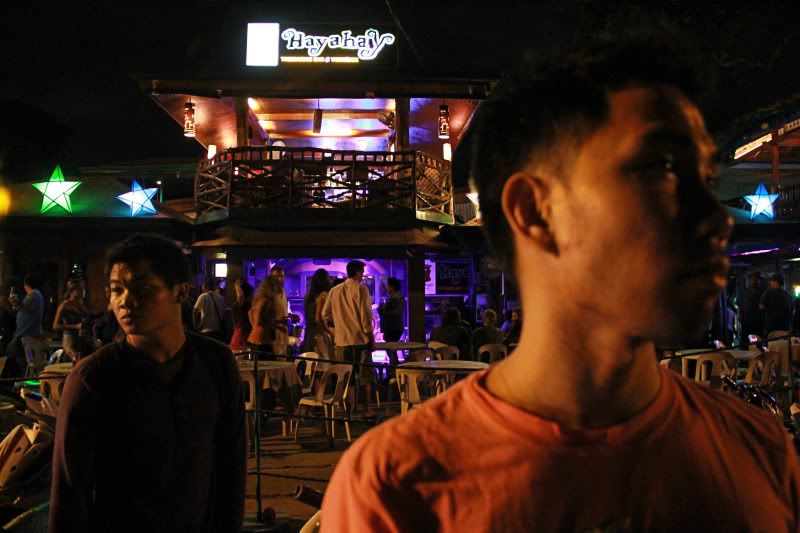
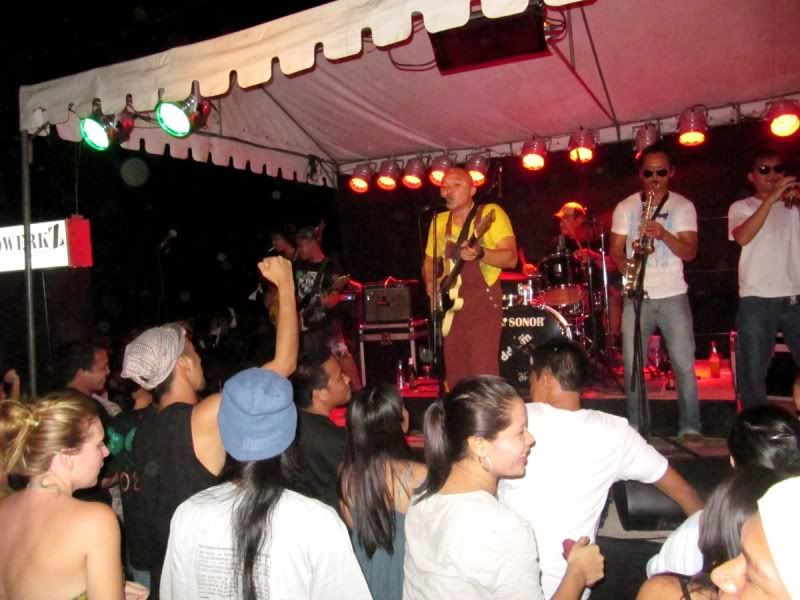
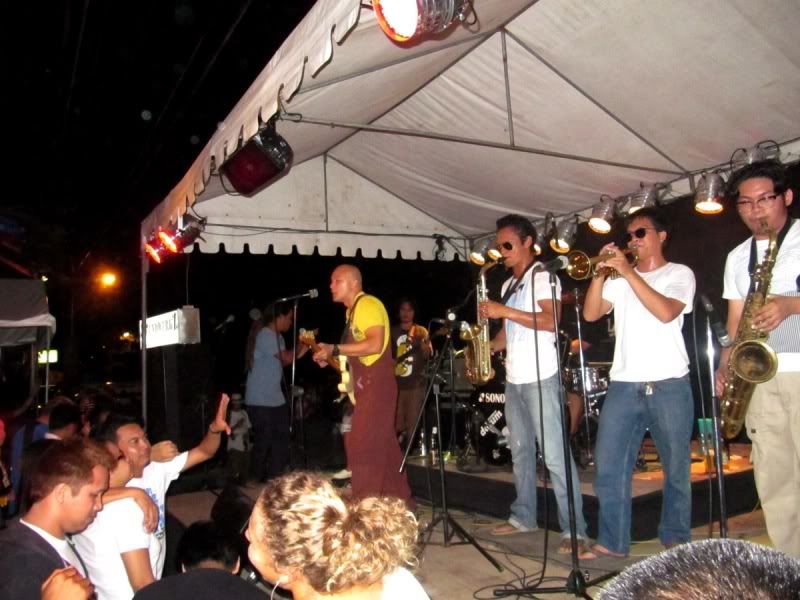

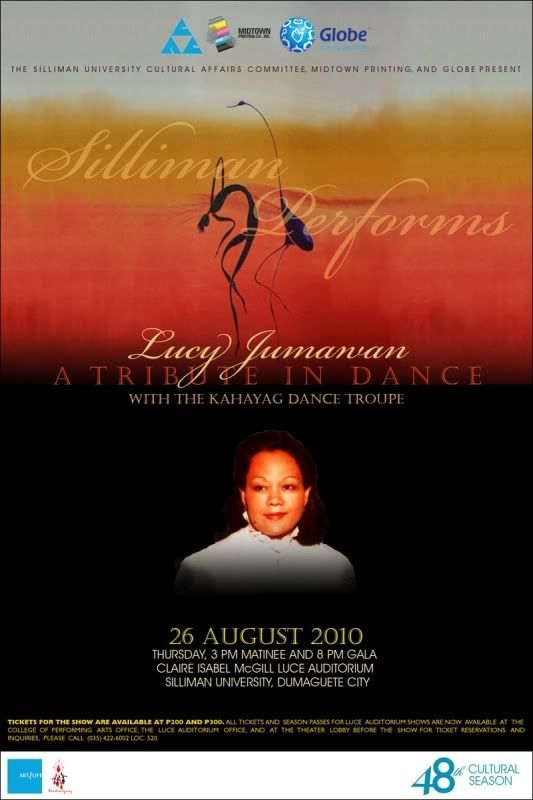

 ... Because that was how it really was, in the beginning, when Dessa Quesada-Palm — Dumaguete’s transplanted resident theater maven and tireless cultural worker — gathered a group of local artists and culture advocates (among them, Glynda Descuatan, Ronnie Mirabuena, Sharon Rose Dadang-Rafols, Jean Cuanan-Nalam, Joji Benitez, Ditz Villas, Nicky Dumapit, Claudio Ramos, and yours truly) last January, and gave us what could be the equivalent of that great grade school staple of “Let’s put on a show!”