Celebration: An Anthology to Commemorate the 50th Anniversary of the Silliman University National Writers Workshop Sands and Coral, 2011-2013
Silliman University, 2013
I’ve been in workshop mode for two [maybe three?] weeks now, and it has been exhausting, sometimes exhilarating. [I’m energized when a particular manuscript is unexpectedly well-wrought.] But there are deadlines and expectations to meet and this has to be done. Padayon.
Things take time. Just came from my fiction workshop, where we tackled the second draft of their first short story required in class. Call me satisfied! Admittedly, my rhythm for teaching workshop was kinda off when I came back to teaching last year, because I had to relearn everything again, especially the process, after three pandemic years of not doing it. But it does come back, slowly. Today I’m satisfied.
7:40 PM |
Murphy’s Law Thursday for Online Classes
Internet connectivity at its worst this semester, I can’t even. Home wifi was soooo slow today, nothing would load, so I decided to go to a cafe to hold my first class—but still, it was plagued with tech problems, like no sound and glitchy video. [How many times did I restart that class?] But I had to go home for my next class because the cafe I was in started playing loud music. And then I had to walk home because I couldn’t catch a ride. Finally got home, but the slowness of the wifi remained. And Zoom kept crashing. Makabuang.
I like online class. It also means cats on the prowl jumping on someone’s lap, dog sounds sometimes mistaken for a baby crying, [sometimes the sound of a baby crying when there is no baby at all], frozen faces captured in mid-blink, voices chopped up they sound Chinese, the househelp suddenly streaking across the screen, a faceless avatar [“My camera is not working, sir”], the whirr of distant chainsaw, an archipelago in one Zoom call, the disembodied din of everything in a submarine, the professor in short shorts striving for meaning—bridging distance and hoping the lesson arrives fully in the pods of each one’s anxious seclusion.
I finally had good, uninterrupted sleep last night after having done away with assessing the stories in my fiction workshop and checking papers in my literature classes. [Today, I start with the last drafts of my playwriting workshop.] It felt great waking up this morning without the feeling of dread. Plus the day's overcast, so that helps. I could take it easy, of course; people keep telling me that. No staged readings, no final anthologies, no research defences, no final papers. But it wouldn't feel right. Plus there’s a design to all these: it’s all about reviving, researching, archiving Negros Oriental writings — my research focus for the past few years. So yeah, The Grading Crunch is heavy, but it feels like it’s worth it.
Crunched through the third and final drafts of three stories of my fiction class the entire day today. Going through their first batch of stories was, well, excruciating -- even after two grueling workshops. [They were basically throwing everything into the mix and forgot what I've been telling them all semester to do: to raise the stakes for their characters, and to make crucial decisions to cull the unnecessary.]
And then, AND THEN: they soon found their footing, their voices, their secret narrative quirks in the second and third batches stories. I found myself delighting at their inventions, things I didn't see in the second drafts of both batches.
This was a tiring day -- but I end it with some satisfaction.
He wore the green shirt in Four Play, a quartet distinguished by the sharp primary colors of their collared shirts—yellow, blue, red, and green—for every gig they were invited to perform in those early years of the 2000s. I remember this very well. Four Play, when it made its debut in 2004, was Dumaguete’s answer to the boy band phenomenon that briefly captured the interest and attention of so many. When they sang—a selection of heart-fluttering covers of All4One’s “So in Love,” 3 PM’s “Sukiyaki,” and Boys II Men’s “Four Seasons of Loneliness”—they sang to much screaming and adulation in auditoriums and makeshift performance spaces everywhere. I remember that.
Hope doesn’t want me to remember that. “This is so embarrassing,” he tells me now, twelve years later. Today, in his longish hair and blue tank top and plaid porontong, lounging with his cup of mint tea and open laptop at our table here in El Amigo, he is playfully aghast at my recollections. But one does not readily shake off the first memories of someone who ultimately becomes one of your closest friends. Longtime friends have been invented, I believe, to torment you with memories of youthful shenanigans—but also, I think, as a ready chronicler for the voyages our lives become.
In 2001, transplanted in Dumaguete from Oroquieta for his college education in Silliman University, Hope readily stood out for his height and his very lanky frame. Later, he stood out for the uncanny bass his singing voice promised as a member of the Men’s Glee Club. Much later, he stood out again for being a boy-bander, a clean-cut crooner. In the years since those precocious 2000s, Earnest Hope Tinambacan would stand out again for a variety of reasons—inventive music man, theatre boy, cultural worker with a social bite. Hope would also become more known as Hopia, like the delicacy, and with that, a persona has been sculpted from the bohemian type with a Bisaya sensibility. His life, young as it is, is an illustration of constant evolution, but always one with a heart beating for the arts. One never forgets this.
There is another journey ahead for Hopia, another turning point in his evolution—and it is a pursuit for higher academic studies, in particular a Professional Diploma in Intercultural Theatre (with a concentration on acting) at the Intercultural Theatre Institute (ITI) in Singapore. It is all part and parcel of his life’s evolution: “If you have followed my work and advocacies,” he wrote me once, “whether through theatre or music, you would have noticed that it has always been my vision to help raise the status of the culture and arts in the community. This has always been my driving force, and it is from this same urgency that I am going to ITI.”
It is a fitting new journey for him. He has always fully embodied for me an intuitive and creative spirit in the various worlds he circles in—be it in cultural activism, in creative writing (he writes poetry, or balak, in Cebuano); in theatre (he directs, he acts, and he writes plays, and is notably a senior member and mentor in Youth Advocates Through Theate Arts of YATTA, Dumaguete’s premiere community theatre group); and in music (he composes, he is the lead singer of HOPIA, a popular multi-genre band that he founded, and he directs The Belltower Project, an organization of local independent musicians, through which they have successful launched four anthology albums in four years, essentially mapping the development of local music, of the so-called “Dumaguete sound).
He has worn all these hats with the fire of a committed creative, and he has constantly astonished me with how he does all these things with an energy and creativity anybody would rightfully envy. In other words, he delivers.
It is in theatre, however, that we have become colleagues, and thus this field is my ready arsenal for an assessment of Hope’s legacy thus far. We have worked together on various occasions—we have acted together (he played my brother Franco in Elsa Martinez Coscolluela’s In My Father’s House, directed by the great Amiel Leonardia), and he has directed me (for The V Manologues)—all of these a way for me to witness how committed he is to the development of local theatre, and how he has shown a willingness to learn almost every facet of the craft just to be able to be truly professional in it.
As an actor, he has essayed with finesse roles in The King and I (2003), Man of La Mancha (2005), New Yorker in Tondo (2011), Ang Tiririt ng Ibong Adarna (2011), In My Father’s House (2013), among others, including various YATTA’s productions of Kikay Kalaykay, Salmo ni Kikay, Leon Kilat, Hoy Mata Na!, Taytayan ni Fabian, Kaluwasan sa Damgo ni Greta, Popoy Boknoy, Lawig, Adventures of Kuya Bogs, and Aah Bakus. He took part in ARMmut in Stuttgart, Germany, an international production that gathered performers from all over the world in 2010.
As a director, he has shown great ability in commanding compelling performances in various iterations of The Vagina Monologues (2013, 2014, and 2016) and Alkanseng Alkansya (2014 and 2015), as well as other productions such as Pepe and Me (2011) and Scharon Mani (2016).
As a playwright, he has shown great authorial voice in various one-act plays including Adventures of Kuya Bog, We Accept Boarders, Sa Pulang Tulay, and Alkanseng Alkansya.
He has been an active member of YATTA from 2008 until the present, and has functioned in various capacities for that community theatre group—as actor, director, playwright, and mentor. He has participated in an assortment of theatre workshops in the Philippines and elsewhere.
And he has facilitated just as many, especially in terms of using theatre arts as a tool for community development—using drama as an aid for stemming criminality among youths, for advocating for better health care, for stirring awareness for environmental issues, and for disseminating proper reproductive health information.
On weekends, he is a rock star.
He is excited about Singapore and three-year stay it entails to complete his studies at ITI. But Hope very much takes all of that in bigger perspective: “The knowledge and skills I will learn from ITI will certainly ripple through the communities that YATTA is serving, and will continue to serve,” he tells me. “YATTA has taught me that theatre is not only an art form but also a way of life. We are dedicated to helping young people discover and utilize their full potentials as community leaders through the different art forms, and my further studies with ITI will help in that regard. The dramatic arts program of ITI, as well as its prestige, will certainly equip me with the necessary training and experience that will be very helpful in my pursuit of professional theatre, which I have seen in the works of ITI’s Filipino graduates.”
Still, this new road in his journey is not without its challenges. Upon the completion of his audition, ITI readily offered him a slot in the very competitive international program—but there is still the matter of tuition, and board, and lodging. “I am a freelance artist, and I know for certain that studying abroad will be very difficult—and my personal savings will not be enough to sustain myself through the entire three-year duration of the program,” Hope says. “I have committed myself to community theatre and cultural and development work for almost ten years now. I also do not come from a well-off family. My parents are both church workers and community organizers who have dedicated their lives to serving the poor people, and it is from them where I got the passion for community service.”
Still, Hopia is ready to embrace the opportunity, come what may. Somebody bought him his plane ticket to Singapore, and many others came to his gig last December 19 at the Harold’s Mansion Rooftop for the release of his EP Mao Na Ni, a fundraiser for his new journey.
It is all investment, I think, for the promise of his eventual return—and how much more he can give our community through theatre and music that help society in the long run of things. Culture is a powerful tool for social engagement, and Hopia is an agent, a drama king for our times.
We bid Hopia all the best in this journey.
If you want to help Hopia Tinambacan in funding his studies, please email him at e.hopetinambacan(at)gmail(dot)com. His bank details are as follows: Earnest Hope Tinambacan, Account No. 1089-3215-96, Bank of the Philippine Islands (BPI), Dumaguete City Perdices Branch. You can also buy copies of Mao Na Ni at El Amigo. He will be keeping everyone—friends, family, and supporters—updated on the progress of his studies through a blog that he means to use as documentation and chronicle for this grand new adventure.
Today, for my summer Philippine literature classes that last for one hour and thirty minutes each, all I did was talk about Edith Tiempo's "Bonsai." Which was a beautiful coincidence, since today is Mom Edith's birthday. I thought I'd be able to talk about other poems as well (there's two by Myrna Peña-Reyes and Ricardo de Ungria that I love very much) -- but there's just so much to unpack in "Bonsai," one and a half hours is not enough. Sometimes I talk about "Lament for the Littlest Fellow" as an alternative -- which actually gives me more ground in terms of discussing metaphor and insight -- but I like the paradox that is at the heart of "Bonsai." So, Mom, here's to you. You're missed immensely by all of us.
Eleven short films by student filmmakers from Silliman University are slated to make their premieres on 11 March 2013 for StorySpace: The Fourth 61 Short Film Festival at the Audio-Visual Theater 1 of the Multimedia Center.
The short film festival, which is sponsored by the College of Mass Communication, the Societe des Cinephiles, and the Cultural Affairs Committee, brings together the works by students from various colleges in the university.
In Jo Simone Vale's Ugma na Lang, six-year-old Clarence has decided to run away. As he steps out of the comforts of his home, he is daunted by what lies beyond the protection of their gate. In the end, it's up to Clarence to discover how far he can indeed run.
In Greena Pesalbon's Trust, Jonathan and Sarah are newly engaged and totally in love. But there's a bump in their relationship when Sarah goes missing. It is now up to Jonathan to find his lost love ... or is it?
In Tara de Leon's Temperomine, graduating senior Mark dela Cruz isn't a model student. In fact, he might not be graduating at all. An opportunity he can't refuse presents itself, but will it be really worth it?
In Pamela Lazalita's Sinking Hearts, Rhea meets Chris in the summer. It is love at first sight for the both of them. Everything seems to be going perfectly but a devastating truth will soon crush their entire relationship.
In Henzonly Alboroto's Shutterlife, Max lives and breathes pictures. Faced with problems which he feels he can barely take, he seeks the comfort of photography -- but soon discovers that it’s going to take more than pressing buttons to save himself.
In Handen Cadiente's One Way Out, Krista is dying to escape from two things: her rocky relationship with Michael and her nightmare of a crazy woman who seems to want to kill her. When a car ride goes awry, it is up to Krista to save herself, or die trying.
In Jennis Miranda's John, the title character is contented with his life. He doesn’t mind that his room is a pathetic excuse for a dumpster, that his aunt seems to never let him have any fun, or that his best friend seems to never run out of things to talk about. Then he meets Leslie.
In Melissa Pal's Jeepney, Casey goes to work aboard a jeepney thinking it would be another ordinary day. Little does she know that destiny has a few tricks up its sleeves: she has to face the word "closure."
In Raymond Cutillar's F*ed, Alixander is a graduating student but he has just received an F from a particularly trying teacher. Now he hatches some plans, most of them desperate, to redeem himself, to get a grade, and to finally graduate.
In Nolan Rhey Saraña's Evelyn, a young man gets his heart broken by his cheating girlfriend. He escapes the city, but soon finds himself attracted to a mournful spirit which has trapped him in a world where only the two of them exist. How does he escape Evelyn's spell?
And finally in Stephen Abanto's Dagit: Have You Got Time for a Story?, Esteban and Manu meet, and a spark of something electric seems to overwhelm them. Then one of them starts to tell the other a story of epic proportions -- which will decide ultimately what is going to happen.
The event marks another turning point in creating a film community in Dumaguete City. I believe many of the entries of this year’s festival ups the ante in terms of quality and imagination. It is high time that Dumaguete starts becoming known as a film hub in the region. Film from previous editions of the festival, such as Mahogany Rae Bacon’s Marry Me, Stephen Abanto’s Café Les Back, and Razceljan Salvarita’s I Am Patience, have represented Dumaguete City in CinemaRehiyon, the annual festival of regional films.
The jury for this year’s festival includes Maria Cecilia Genove, Annabelle Lee-Adriano, Moses Joshua Atega, Earnest Hope Tinambacan, Sonia SyGaco, Brian Arbas Rimer, Yvette Malahay-Kim, and Marx Itturalde. The winning entries will represent Dumaguete in next year’s CinemaRehiyon.
Admission to the festival is free.
UPDATED:
The following films were adjudged winners of the various categories in StorySpace: The 4th Sixty-One Short Film Festival held last March 11, Monday at 7 PM at the Audio-Visual Theater 1 at the Multimedia Center:
Best Short Film:Ugma na Lang, with director Johannes Simone Vale Winner of the Special Jury Prize:Jeepney, with director Melissa Pal Achievement in the Cinematic Arts:Dagit: Have You Got Time for a Story?, with director Stephen Abanto Audience Choice Award:Ugma na Lang, with director Johannes Simone Vale Best Director:Melissa Pal for Jeepney Best Actor in a Leading Role: [TIE] Steven Joseph Credo in F*ed and Mardie Gabriel Limbaga Erojo in Ugma na Lang Best Actress in a Leading Role: Jhenzee Jardin in Jeepney Best Actor in a Supporting Role: Noel Canobas in F*ed Best Actress in a Supporting Role: Johannes Simone Vale in Shutterlife Best Screenplay: Raymond Vincent Cutillar for F*ed Best Editing: Stephen Abanto, Jed James Wasawas, Henzonly Alboroto, and Johannes Simone Vale for Ugma na Lang Best Cinematography: Stephen Abanto for Dagit: Have You Got Time for a Story? Best Original Musical Score: Kokoi Guinto for Ugma na Lang Best Original Song: Finpot for Shutterlife Best Sound Design and Editing: Jerry Angelo Catarata for Ugma na Lang Best Production Design: Melissa Pal for Jeepney Best Costume Design: Miguel Salvania for Dagit: Have You Got Time for a Story? Best Make-up Design: Nicole Villanueva for Dagit: Have You Got Time for a Story? Best Poster Design:F*ed
It’s past midnight in the McDonald’s along Perdices Street, and I cannot think. They have turned the music up much too loud for some reason I suspect borders on the diabolical. How else can it be? The sounds pounding my ears are designed for repulsion, perfectly tuned to keep my residency in this establishment to the barest minimum, its welcome extending only as far as lining up at the cashier. We want your money, the blasting music says, but please go away soon. It is indeed sound designed not to make you feel welcome—and I resent that. I have just ordered my tumbler of perfectly banal iced coffee, and have just settled on one table planning to read a few essays for Monday’s nonfiction class. But I cannot read. I cannot think.
I call over one of its busgirls. “Can you please turn down the volume of your music?” I ask.
“Yes, sir,” she says in that tired way that betrays she has heard this request before, and has no intention of ever doing.
True enough, I wait five more minutes—and nothing happens. The infernal racket McDonald’s calls music continues.
So I make it win the battle. I give up. I get up, and I go home.
You do not stay in a place that does not make you feel welcome. The only way anyone can repay such discourtesy is not to give it your
business.
Truth be told, it took me forever -- about eleven years -- to obtain my MA degree. Somewhere along the way, I lost direction. First, my Graduate School teachers moved to other universities, some to other countries. Then work, and more work, happened. Then love happened. Life happened. So many excuses. And then after a while, finishing my degree didn't seem to matter anymore. But something (in fact, many things) happened to me in between 2008 and 2009 that put things in perspective, and made me realize what I considered truly important in this life. I've written considerably about my Christ Year and its aftermath, which culminated on that lovely quiet spot on top of a hill in Sagada.
That Sagada experience has finally translated to this: a diploma. And a degree.
Of course, these things are never done, or finished, without other people to lean on to for support and encouragement. The writing of a master’s thesis is almost always fraught with drama and self-doubt, and these are the ones who made the unbearable bearable.
In my moments of utter chaos, there was one kind of stillness that I counted on time and again—God in His infinite graciousness and kindness. Sometimes I call Him the Universe, which is one and the same thing. He guided me through the hard times, and answered my prayers with such generosity, teaching me always to trust in His plans.
In my acknowledgment, I thanked a thousand people for getting me through the tough work. But I would like to specifically thank in this blog the following people for their help and guidance (as well as the much-needed tough love) in finishing this thesis: Dr. Ceres Pioquinto, Dr. Ben S. Malayang III, Dr. Margaret Helen Udarbe-Alvarez, Dr. Betty Cernol-McCann, Dr. Betsy Joy Bustamante-Tan, Dr. Laurie Raymundo, Dr. Elizabeth Susan Vista-Suarez, Dr. Gladys Rio-Malayang, Prof. Leonor Briones, and Prof. Gina Fontejon-Bonior. Quite a formidable bunch to compose my own pressure cooker. But these were the people who persevered with me for close to a decade, giving me just the right amount of encouragement to get me going, especially through the tough times when I was ready to give up. My panel has been most helpful in giving shape—and giving encouraging insights—to this thesis: my adviser Dr. César Ruìz Aquino (from whom I’ve learned much about the magic of creative writing), Prof. Philip Van Peel, Dr. Evelyn Mascuñana, Dr. Maria Teresita Sy-Sinda, and Dr. Andrea Gomez-Soluta in whose literary research class actually was planted the seeds of this thesis. I would like to thank my other professors in Graduate School—Prof. Timothy Montes (who got me started on creative writing), Prof. Eva Rose Repollo-Washburn, and Prof. Antonino de Veyra—for the guidance.
In particular, I would like to thank the great poet and critic J. Neil C. Garcia, whose many ideas on Philippine-specific queer theorizing fill this thesis.
I would like to thank Ron Jacob Calumpang for egging me on constantly, and for being the constant presence that anchored my often wandering mind.And finally, I would like to thank [Dev] who absolutely has no idea how much he has influenced the completion of this thesis. Thank you.
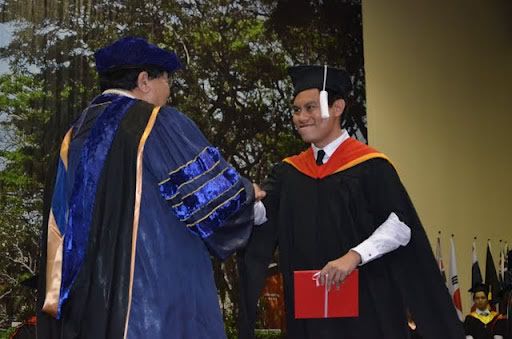
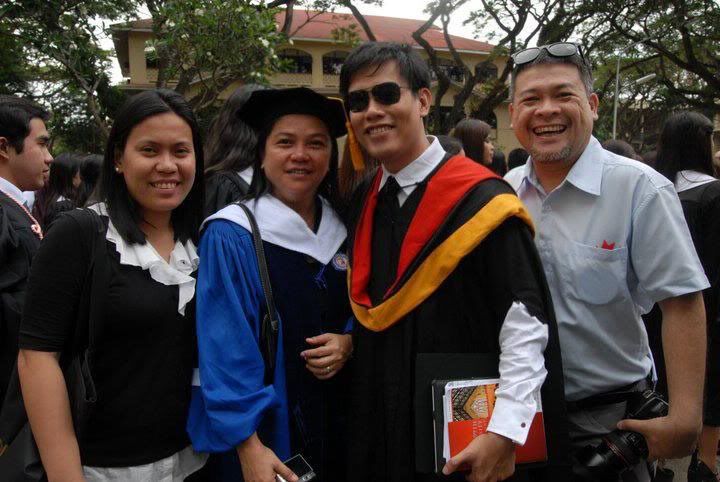
The thing they don't tell you about graduation is this: the bliss of an afternoon clad in a toga is quick and shallow. The commencement speech is boring, and you feel that the summer sun, which is blistering hot, is laughing at you. It still doesn't quite register that a great chapter in your life is over -- college, you will soon realize, was a time when you had all the chance to explore, and do, all that you can be without adult recriminations -- and then you realize it rang away so quickly and unexpectedly, just like the sound of a misfired shot gun.
Four years are quick. The future is long.
And then this bullet of a realization suddenly gets to you: it's all over. You finally say to yourself, in a sudden acknowledgment of what's to come: "Okay... what now?" You're sweaty in your toga, and all you get is silence. Your mother smiles at you. She expects you to get a job fast.
"I have a friend who owns a college," your mother says. "I want you to stay in our hometown. Be with me."
You feel yourself wilt inside.
The very next day, you realize you can't really ask for an allowance anymore.
“The way to criticize a movie is to make another movie.” —Jean-Luc Godard
To make a film is the province of mad people. And the director in the midst of it all—the circus ringmaster, if you will—is the king of mad men. You will have to be when you consider an art form that demands a magician’s patience for dealing with the intricate battles of a collaborative project and the careful attention to billions of details—What motivation must an actor take for a scene to work? Is that actor even cast right? Is this piece of prop provided by the production designer true to the milieu demanded by the story? What angle or what lens or what lighting design should the cameraman settle for to distill the emotion of a particular set-up? Does the scriptwriter need to change this line? Should the editor take the dailies now and begin cutting? What kind of musical theme is appropriate for the entire picture? Where’s craft for the crew’s food? Where is the producer with the promise of new investment?
Real filmmaking is not glamorous. We only think that it is, given the attention we give to it in blogs and TV shows and newspaper lifestyle column inches. Most of us don’t know this—and that is the eternal appeal of moviemaking: the illusion of glamour in front and behind the camera. But when you are bitten by the moviemaking bug, you stay bitten and obsessed by it all. It is like a drug. In the 1973 film Day for Night by François Truffaut, we are introduced to a film crew in their daily struggles to put to celluloid a film called “Meet Pamela,” and in the process we get a glimpse of the drama of filmmaking—the temperamental actors and their eccentricities as well as the rest of the crew. Slowly, we begin to see that for most of them, the final product—the finished film itself—is often the concern they are least invested in. They’re there on the set not for the sake of the film but for the sake of being in the set. They love the temporary bubble of camaraderie that a collaborative project like this brings.
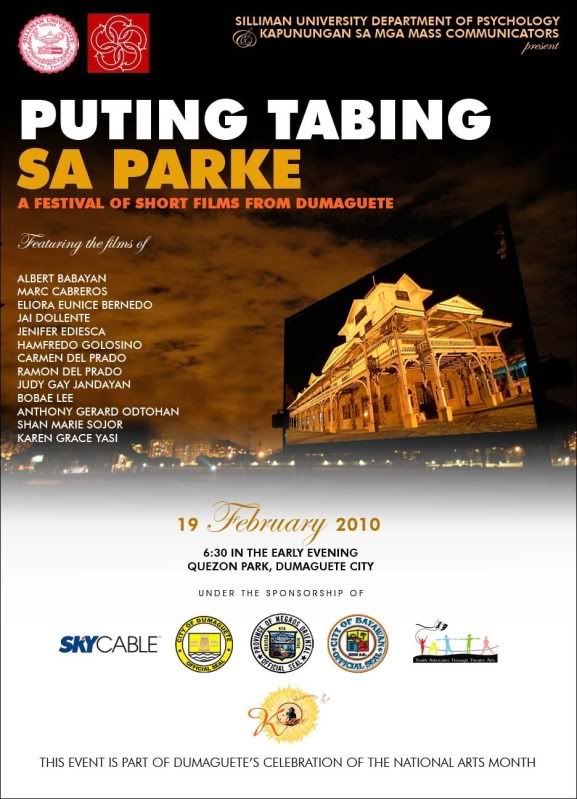
I was reminded of that when I watched my Film Appreciation class in Silliman University—composed of Mass Communication majors Anthony Gerard Odtohan, Eliora Eunice Bernedo, Albert Babaylan, Shan Marie Sojor, Karen Grace Yasi, Marc Cabreros, Hamfredo Golosino, Judy Gay Jandayan, Jenifer Ediesca, and Bobae Lee—struggle with the challenge I gave them last semester. We were learning all throughout the semester the basics of film aesthetics, which included a passing mastery of acting, directing, screenwriting, editing, cinematography, production design, sound, and music. They knew the film elements, but I reminded them quickly that all these would be just stock knowledge they would soon easily forget—unless they put it to use by making films themselves. The great French director Jean-Luc Godard, who gave us such classics as Breathless, once famously said that the best critical take on the movies should not rest merely on the pages of magazines or newspapers filled with movie reviews—it was the very act of filmmaking itself.
And so I told them to make their own short films.
It was the first time for all of them. And the odds were even more challenging beyond their amateur status as filmmakers. With barely any working budget, how do they cram pre-production, production, and post-production in the span of three weeks, before they are supposed to show their finished products on a date I set for them for a mini-film festival of sorts? I had already recruited a motley crew of judges—people from the community who had working knowledge on various aspects of film production—who would render their take on their efforts for that final screening.
And yet—busy and frazzled they might have been in the process—I think they all came out of that experiment richer for the experience. I asked them a series of questions…
What was the experience of filmmaking like? Did you learn anything new about cinema from the experience?
Eliora Eunice Bernedo (who made the polished The Birds, the Bees, and All the In-Betweens, a comic look at four teenagers who confront their own brush with sexuality as they munch popcorn and drink soda to an afternoon viewing of Sin City): Filmmaking was like war—probably because I was treading on virgin territory. I somehow had to bleed my mind out just to finish what I started, and couldn’t possibly foresee all of the things that could go wrong.
Albert Babaylan (who made Coffee, an existential story about a guitarist bored with his day, and the surprise can bring for somebody trapped with writer's block): Making the short film opened my mind to certain things I pre-conceived about filmmaking. I learned that film isn’t just about putting things in front of a camera, but that it’s a medium for hard storytelling. It was hard for me, personally, because I had very little help from anyone. All I had was my camera, my other actor, and my girlfriend during the shooting. And it was just me and a friend who recorded the musical score.
Hamfredo Golosino (who made the surprisingly effective Kugi, the story of a hardworking student assistant): When I was young, I wanted to make my own movie without thinking of the things to consider in their making. But now, here it was: I was making my own film with much effort.
Shan Marie Sojor (who made the artsy story of love lost and love found in The Gallery): Filmmaking was a very good experience for me—the bonds of friendship we made, the fun, everything. I was even interested in making another film. Yes, I learned that cinema is not just filming someone act. It is more that that.
Judy Gay Jandayan (who made a romantic story out of a computer gamer and his long-suffering girlfriend in DOTA): Filmmaking is really exhausting. And it is even more exhausting if you’re the writer, director, producer and cameraman all rolled into one. Watching the movie is very different from actually making it.
Hamfredo: I realized that making film isn’t that easy. It needs ample time to produce. I did not have enough funds as well, considering that I was just a self-supporting student. I had questions, too: What kind of movie should I produce? Who would be my actors? Where I should take my film? Where could I look for the equipment? Do I have enough money? For a first-timer like me, those queries were inescapable. But during the taping, we all had this adrenaline rush to shoot because my actors also had other priorities, and I couldn’t compel them to stay longer. And balancing work and study was not a simple thing to do for me. I felt like being chased by a train wanting to bump me. So I needed to run as fast as I could. But I’m simply a human being and not a machine.
Bobae Lee: Making a film is like ruling a kingdom. You can do whatever you want, but you also have all the responsibilities of doing so. Especially, in our case we are both the director and scriptwriter. Every single decision I make has a huge impact on the result of the movie. I learned how to use the shots that I learned in class and saw in movies to deliver to the audience what I had in mind in certain scenes. I also learned the importance of weather, light, time, and PR in filmmaking.
Jenifer Ediesca (who made the ghostly love story 7 Days about a couple and the poetry that binds them): Such opportunity doesn’t always happen. I didn’t have enough sleep in the two weeks I made the film. Even in my sleep, I was haunted by the film, but the bright side was taking the challenge, and doing my best—and getting the self-fulfillment that followed after.
Eliora: I can say for sure that filmmaking, especially no budget filmmaking, is riddled with obstacles. Also, the need to sleep is only one of many.
Marc Cabreros (who made the bright, episodic, and comic The Web Cam, a take on four college students and what they do online): I was always behind the camera in most of my film projects, but this was the first time I was REQUIRED to make an actual film. I learned that I was hard in making things right, and making five or more people fit into a small screen. That was hard!
Karen Grace Yasi (who made the quirky The Anniversary, a tale about a guy who encounters all sorts of problem while he goes about his day trying to make a perfect anniversary date for his girlfriend): “Great” would be an understatement for the experience. It was my first time to ever make a film, and everything was just so new to me. I’ve always been a laid-back, procrastinating kind of person and this filmmaking experience totally changed my routine. I’ve learned that filmmaking is definitely not as easy as I first thought it would be. It took a great amount of talent to come up with something—a story that could captivate an audience. And even more so: talent to bring this story to life.
Anthony Gerard Odtohan (who made a very good documentary about an American running a local orphanage in Papa Mike and the Rainbow Village): It was a challenging project in all areas, especially considering that I opted to go for a documentary. Technically, I’m a rookie although I’ve had minimal experience using video editing software. Psychologically, I was overwhelmed with the whole idea of going on a solo project for a 15-20 minute film. Emotionally, I would picture out scenes and scenarios in my head for multiple times during the day. I guess I was being so hard on myself and taking things so seriously. Physically, I had to log in close to 50 hours (or even more) for the production since I was practically grasping in the dark for creativity as well as sleeping awfully late. Spiritually, I was in constant prayer and even felt moments of despair for my inability. Overall, I realized that documentary filmmakers have no control over what happens on film. You simple have to be there and make sure that the camera is rolling, otherwise you will lose a picture-perfect moment. Also, you have to go through literally hours of footage to pick out what best aids the narrative. When editing, it’s utterly important to remain focused on the centrality of the dramatic structure so that you won’t get lost in the middle of all the clutter (I used Syd Field’s three-act structure as a skeleton). Of course, I am by no means an expert now though I gained a deeper appreciation for the immense difficulty of coming up with a documentary.
Albert: But making the film was fun in the overall. I would never consider what I did as “work.” It was art, and I was like an artist shaping an image into my captured shots.
Judy Gay: If you are part of the audience, you can just critique the film all you want but when you’re the one doing it, you can only hope, pray, and try so hard just so you can come up with at least a viewable and decent output.
What did you learn about yourself from the entire endeavor?
Judy Gay: I learned that you cannot be a filmmaker in just one day or in just a blink of an eye...
Jenifer: I won’t choose to be a director!
Judy Gay: ... You really need to have the proper education, the passion, and the utmost patience to produce a movie of your own.
Marc: I was actually patient... and nice.
Jenifer:I learned patience. Nothing happens over time. And this is the time where you have to have a lot of charisma, and tough guts, especially if you’re in the grips of desperation.
Albert: I learned that I love the art of filmmaking, and I look forward to learning more of the craft. It’s a very rewarding art, I’ve always been a fan of anything with a good story—may it be literature, films, music… but it’s a very different thing when you yourself are at the helm of the story.
Hamfredo: I learned that attitude is very important for someone who leads the production. This means patience—towards my actors’ attitude, and most of all, towards myself as director. I also learned to be organized and systematic.
Bobae: I knew that I love music but I also learned I’m very sensitive when it comes to sound. Ever since we were entitled to make our own film, every time I listen to a song I thought: Can I use this song in my movie? If I can, which part and with what kind of shot shall I use? Every time I watch a movie, my antenna for sound effects goes through the roof. Also, I learned that life is a movie without a script. Instead of a script, we all have our special scriptwriter, which is called choice.
Marc: I never thought I could be so polite in times of pressure! I mean, I have always been sarcastic and arrogant to my friends, but this made me so unreasonably calm. I guess I’m a good person after all!
Eliora: I learned that it is good to be wrong every once in awhile and not be afraid to admit it. I couldn’t just lie to myself. Also, more importantly, if I learned that if didn't surround myself with the proper support system (crew) the obstacles could go from challenging to a living hell very quickly. By that I mean – delegation is key. I had to surround myself with eager, imaginative, supportive people that I could depend on so obstacles would seem more like something we could handle together and less like the reason of secretly fantasizing about hitching a ride to space with the hope that my film would never find me.
Anthony: I never realized that I could come up with a documentary on my own as well as being able to edit the film by myself. The project pushed the limits of my creative threshold.
Karen: I have learned—and I will keep this lesson for as long as I live—that the amount of pressure, anxiety, and paranoia one feels when she is in the process of filmmaking is directly proportional to the amount of relief and satisfaction she feels when the movie is shown. A very important lesson on delayed gratification.
Albert: When you are the one telling the story, and having someone grasp at least a bit of what you put out, is an amazing feeling. In my film, the goal was to leave people confused and freaked out a bit, and I remember a few people asking me about my film and telling me they were confused. The feeling of actually getting through your desired effect was great.
Shan: I learned that I can do films, and that I can do more beyond painting. Filmmaking is another form of art that I’m beginning to love.
Anthony:I realized too that prayer and faith in God is crucial in holding me together throughout the entire process.
Do you think that what Jean-Luc Godard said about filmmaking is true? Why?
Albert: Godard is indeed right. To fully understand the complex processes involved in making a 1-minute shot of a film is the only way you can fully and credibly criticize that 1-minute shot. One must understand how filmmaking works and how a film is made before he can criticize any film. This is because filmmaking is an art form that involves so many different techniques, perspectives, processes, etc.
Judy Gay: Godard is right in some ways, but in some manner overly ambitious and challenging. You cannot just make the film you really want if you lack the materials needed to produce such a film. You also have to consider the money you will invest and the actors you will cast.
Marc: It’s hard to make films, most especially if you don’t pay your crew or cast. I feel like I do not have the right to tell them what to do. I also had to make the script and direct the whole thing. It’s also hard to make it all come together, for what I wrote and what I imagined came out differently in filming! I had to learn that the hard way, with time pressure, busy schedule, and all the peer pressure! Sheesh! Next time I make a movie, I will make sure I won’t do it alone!
Hamfred: He is absolutely wrong! Can’t we criticize a film without making one? Doesn’t he know that learning can’t only be acquired through experience, but also through observation?
Bobae: Well, for me, I think what he said is true. First, you cannot imagine enough how hard it is to make a film. When I heard I needed to make a film at the end of the semester, I was so shocked, astonished, surprised, as was everybody in my class. But it was one of the great challenges in my life. Second, you get to know deeper about the filmmaking process.
Shan: Experience is the best teacher. We can’t criticize something if we don’t know the whole process.
Bobae: Yeah, to criticize something, you need to know why it had to be criticized. For example, you may not like particular shots of a movie. But it doesn’t mean you can just criticize it because you didn’t like it. Maybe the director used that shot to emphasize the situation, or to get certain reactions from the audience. Now, I cannot really criticize easily, like before. I didn’t know this much about film.
Karen: I believe that the beauty of a film is not only seen when we watch it, but when we realize how the people behind the film were able to gather all creativity and come up with something worth watching. It’s really easy to criticize a film when you just look at it in the audience’s perspective, but when you’re exposed to all the challenges the process of filmmaking comes with, you’ll eventually learn to appreciate a good movie when you see one.
Jenifer: Me, I vow to never ever again criticize a movie, no matter how banga it is. It is an all-out effort for all concerned. If one fails, the movie fails as well.
Eliora: I would critique films before without even thinking. I’d fail to see the whole experience (from its technicalities, good acting, etc). I can certainly say now that ignorance is not bliss—it’s a waste. Because doing almost everything caused me to see things in a clearer and different light. When my turn came, the criticism was like an avalanche, each of my amateurish mistakes rolling off my friends’ tongues was clobbering me at the back of the head. I was blown wide open. It was hard to be able to separate myself from the work and it hurt. But it felt so satisfying as well when it was praised.
Anthony: Still, I don’t think it’s necessarily true that you have to make your own film as the only license to be a good critic. I’m sure that there are some critics out there who have that gift. However, I’m not one of them. I think that if one involves himself in the actual process of filmmaking, from start to finish, there will be deeper insights gained. There will be a sharpening of the critical eye to see the intentionality of the director and the cinematic methods used (type of shots, lights, sound, etc) which overall can affect the value (or non-value) of a film.
11:35 PM |
Live Facebooking BC 25 Requirements Marking, or How Plageralism is Bad for Research
This week, everywhere in the Philippines, teachers will be burning the midnight candle and slurping coffee by the truckload as we prepare for the Apocalypse that is graduation and final exams.
I went from frustration to sadistic enjoyment as I checked my Research Writing students' requirements today. I guess I had to be very philosophical about it, or else lose my sanity. And while I checked their papers and exams this Sunday, I Facebooked what I did and found into a veritable gold mine of what the future looks like:
9:26 am. Ian is off to have Sunday brunch. I just feel like it. :)
11:20 am. Ian said this yesterday after a group of students presented their video report: "I would rather Facebook than watch that video."
12:15 pm. Ian is having hickory rubbed grilled chicken for lunch in Don Atilano, before attacking the pile of student papers to be checked. The lunch softens the deal.
6:02 pm. Ian is going crazy over late BC 25 submissions! Muntik na akong mag-explode.
6:30 pm. Ian is pausing for a bit from checking all these red-marked submissions. For sanity's sake.
7:10 pm. Ian shows an example of a BC 25 exam answer that boggles the mind: Give an example of a topic to avoid. "Topics that shows [sic] immoral acts." AHHHHHHHHHH!
7:56 pm. Ian is wondering: can you teach a research class proper research skills when some of them spell "plagiarism" as "plagorism"? I fear for our future.
8:19 pm. Ian : When do you use direct quotations? "When their are quotation marks." Wehehehehe. I think the only way out of this dilemma is to laugh na lang. Wehehehe.
8:23 pm. Ian : I have to edit that! The answer is actually: "When their are quotation mark." WAHAHAHAHA!
8:29 pm. Ian : What are the possible dangers when paraphrasing is used incorrectly? "One can be in prison for plagiarism." Wehehehe.
8:49 pm. Ian : Here's another one: "plageralism." WTF?
9:24 pm. Ian is shocked: his red pen gave up on him, and will not give out ink anymore. Symbolic ba?
9:46 pm. Ian is finished with BC 25! Yey!
11:00 pm. Ian is home. He's tired, but feels like he has accomplished something, like climbing Everest.
12:46 PM |
Because I Will Actually Miss The Mokongs. (Damn Graduation!)
The past two years, come graduation time, have been hard. I've grown very close kasi to a number of students I could very well call my friends. After this year, there will only be a few left. Those who already have (Dirgy, RJ, Michelle, Lyde, Jazz, Clyde, Lycar, Ray Donn, Aiken, Hope, The Dulnuan Bunch, Magenta, and so many others) or will soon be passing through the portals of Silliman to exit towards their own post-collegiate lives will become part of an irretrievable past no amount of reunions can ever make happen again. And it's sad. But also happy, the fact that I have somehow become part of some young people's lives.
So guys -- Jordan, Marianne, Cessy, Pong, Micah, Matti, Kim, Bryan, Marvin and the rest of the Physics Boys, Gerard, Dom, RC, and all the rest -- you know I mean this with the deepest love and affection: maayo unta'g mangahagbong mong tanan.Wahahaha! (Wink.)
The school term has just ended, and summer vacation beckons outside my window. I can smell the sand and the surf from kilometers away. Today, I've marked and graded the last exam and the last paper (on Dean Francis Alfar's Salamanca) from my Philippine literature classes, and while I'm pooped from the vigorous reading and my fumbling with the calculator (and dizzy, too, from the parade of caffeine that kept me awake), I feel that I have accomplished so much with this rigorous schedule I'm giving myself. Thing is, I promised myself in the beginning of the semester that I'd do away with the procrastinator in me, and so far I'm right on track. I'm almost done with all my grades, and I have just one more deadline tomorrow for my research writing classes. I should be submitting the grading sheets to the office very soon, and way ahead of the deadline, too -- the first time ever in memory.
There's also the prospect of not teaching this summer, the first time I'm getting a break since starting to teach years ago. (I begged off my nine-unit load.) But summer will not be all play. In fact, it will be all work -- but work to finish the things I've been wanting to finish. I have a grant to finish the incompletes for my MA courses, and another grant to finish that anthology of Silliman fictionists. There are also the other books that I have to finish editing, and the stories that I have to write for all these contests and what-not. And, of course, the U.P. National Writers Workshop in Baguio this April. It will be a very busy summer for me. But at least I'm not teaching!
So back to the mines for me. I'm quite excited though.
Today I know only mixture: it’s graduation day for Silliman University—and I am both happy and somehow sad. I talk in the capacity of college teacher, and the duality of how to feel about this Sunday first came to mind when Lycar Flores, an old student who is now finally graduating into the real world, greeted me during a meeting earlier last week and noted how ambiguous I seemed to be when I talked of things “commencement.”
She finally said, “You really like our batch, ‘di ba, sir?” And when I considered that, I had to admit what she said was true.
I am happy that her batch will be graduating, to soon contribute to a society that needs good people; yet I am also sad in the way a father wallows at the prospect of an empty nest. What can I say, they’re my favorite class of college students so far.
I do like her batch—this precocious class of 2008—because so many of them (when they were studying in my literature, research, or film classes) gave me more than a glimmer of hope for the future, despite the occasional murkiness that threaten to overwhelm. Best of all, these students also taught me that to teach well you must go beyond the mustiness of a lecture hall, and bring a different kind of vibe to the whole business of education. They have proven one adage not often banded about in a society increasingly fed on academic low expectations, spoon-feeding, rote learning, and an inflated sense of grade consciousness without merit: good students actually make good teachers.
Of course, when you become a teacher, the first thing you need to tell yourself if you want to stay objective and true to your vocation is that there must be no playing favorites among your students. But the classroom is not a static place: there are unseen dynamics that come to play every single day that you teach, and often there are some classes that inspire, and some that simply don’t. The class of 2008 was mostly inspiration.
Teachers are not made of stone, and more often than not the best of students bring out the best mentor in all of us. Imagine coming into a classroom with students willing enough to take up your challenge to learn something more about the world beyond the pages of textbooks. Their enthusiasm is infectious, and I actually liked the feeling of being on my toes every time I embarked on another lesson, knowing that there will be questions, knowing that some actually eat Hegel and Hemingway for breakfast.
In the years to come when they’re much older and are no longer your students, they sometimes email or text you to express some form of thanks. These are the rare rewards in an often underappreciated profession—to know that somehow, as teacher, you’ve made an impact on a young life.
I speak now of teaching in the most romantic sense. I have to admit, however, that there are many days when many of us in the profession just want to throw in the towel, sometimes because of the sheer overwork and underappreciation, and sometimes because burnout comes in quick cycles. There are days when nothing seems to work in the classroom, and students are still bringing in unimproved work despite one’s best efforts. A fellow teacher from another university—a multi-awarded writer of enormous renown—confided to me once about having trouble with a student/beauty queen who peppers her essays with safe inanities, and expects tumbling great grades. When she tells the student to revise, the teacher is only met with disdain and a raised eyebrow. Ouch. And how do you teach, for example, the protest literature from the Marcos years when somebody asks you, “Who’s Martial? And why does he have a law?” There are also those days when you give an announced exam, and the marked test papers become a harvest of eggs, and those days when you point out somebody’s plagiarized work, only to be repaid by drama and a chair thrown at you.
There are also days when you are told you are a “terror” teacher—not because you shout and rant in the classroom, but only because you demand quality work, on deadline. February, for example, was a strange month for me: in the Weekly Sillimanian, I had to give my two cents’ worth to a feature article about being a “terror” teacher in research writing, and a few weeks later, the same features pages declared me a runner-up in the paper’s search for favorite teachers, voted on by students. It was pure existentialist dilemma, and I had to ask Anthony Odtohan, the editor-in-chief and a former student, what all that meant, and he said, “… Only to those who don’t appreciate the fact that college life should be taken to its fullest extent. Don’t worry, sir, you’re a terror to those who aren’t exactly cut out for a college education.”
It’s a sad irony: in our typical boast for the kind of education we have, we flaunt one’s university having “quality education,” but don’t take heed the fact that achieving that actually takes hard work and discipline.
What I cannot understand is that by demanding excellence, one is willfully labeled a terrorist.
Then again, consider the deterioration of education in most of the country. We are behind many things, and the educated class now lives largely abroad, leaving us with the likes of Tim Yap. In the Philippines, there are many colleges that have simply vanished into the black hole of diploma milling. We used to boast of being an English-speaking country, but now there are reports of call centers closing down simply because the workforce can’t speak English to save their lives.
Watching the recent Bb. Pilipinas pageant, for example, I grappled with Bb. Pilipinas World Janina San Miguel’s reality as Mass Communication major in the University of the East, with her answer to a pageant question that went to the stratosphere of cluelessness, broadcast quickly via YouTube to the rest of the world: “Well, my family’s role for me is so important because there was the wa— their, they was the one whose… very … hahahaha … Oh, I’m so sorry, Ahhmm … My pamily … My family … Oh my God ... I’m … Okay, I’m so sorry… I … I told you that I’m so conpident … Eto, Ahhmm, Wait … Hahahaha! Ahmmm, Sorry guys because this was really my first pageant ever because I’m only 17 years old and … hahaha! … I … I did not expect that I came from, I came from one of the Top 10. Hmmm, so … but I said that my family is the most important persons in my life. Thank you.”
Thank God, I had mostly none of that from the class of 2008. And so—to Lycar Flores, Michelle Eve de Guzman, Robert Jed Malayang, Justine Yu, Rodrigo Bolivar, Christie Balansag, Aiken Quipot, Lyde Gerard Villanueva, Primy Joy Cane, Noel Valente, John Boaz Lee, Danielle Zamar, Anthony Odtohan, Romar Natividad, and the many others who made classroom life more interesting—thank you for making my teaching worthwhile.
Of course, formal occasions such as commencement ceremonies often tempts too many people—especially those given a space on the entablado—to offer placid and long-winded advise, bordering on bromides, on the metaphorical significance of graduation as “a portal” to our graduates’ soon-to-be-unspooling real lives.
In fact, the humorist Garry Trudeau jokes of that very nature of graduation exercises: “Commencement speeches were invented largely in the belief that outgoing college students should never be released into the world until they have been properly sedated.”
You may have heard it all. “Today is the first day of the rest of your lives.” “Commencement is a beginning, a starting point from which you can now finally claim a responsible stake for all of humanity.” “Each diploma is a lighted match, and each one of you is a fuse.” And from Tom Brokaw: “You are educated. Your certification is in your degree. You may think of it as the ticket to the good life. Let me ask you to think of an alternative. Think of it as your ticket to change the world.”
The familiar quotes about graduation go on and on—and while we know that the heart is, more or less, true for each one of them, we all still somehow seek a kind of unvarnished truth for why we choose to gather in a university lawn or an auditorium in the first place, to toast the graduates in a rite as old as Oxford University.
To attempt just that, I want to quote Joann C. Jones who once gave an insightful account about what it means to gain an education, and then taking it to use in the world: “During my second year of nursing school,” Ms. Jones wrote, “our professor gave us a quiz. I breezed through the questions until I read the last one: ‘What is the first name of the woman who cleans the school?’ Surely this was a joke. I had seen the cleaning woman several times, but how would I know her name? I handed in my paper, leaving the last question blank. Before the class ended, one student asked if the last question would count toward our grade. ‘Absolutely,’ the professor said. ‘In your careers, you will meet many people. All are significant. They deserve your attention and care, even if all you do is smile and say hello.’ I've never forgotten that lesson. I also learned the cleaning woman’s name was Dorothy.”
It is exactly this philosophy that we, as teachers, hope we have inculcated in all our students over the course of their studies here in Silliman University—or in any other school for that matter. It is something that we truly hope our students can take with them as the very core of “quality Christian education,” something that lays an inner foundation that holds students and keeps them resolute when they leave the portals of the school and its hallowed halls, “to roam the world o’er near and far,” as the Silliman Song goes.
I’d like to remind them not to forget that this foundation we talk of can only be the result of steadfast edification that comes from a barrage of learning that springs from classroom, from church, from community, from court, and from culture—the five C’s that make them unique as Sillimanians, and as citizens of the world. This is the very map of their Silliman education: theory and expressive debate within the four-walls of a lecture hall, spirituality and praise in the pews and under the spires, practice and a chance to give back in the backyards and winding roads of neighborhoods, sweat and brawn in the pool or the playing ground, and finally, music and the arts in the theaters of our imagination.
I am thinking of all these just as we hold Silliman’s graduation ceremonies in a new venue. We are in a place that is the perfect metaphor for the Silliman education I have just defined: we are in the middle of the amphitheater—the site of old Shakespeare plays from years past; surrounding us is the city that hum into our every day hearts, and also the classrooms tucked into these old nearby buildings which are testaments to Silliman’s evolution as a place of learning; and finally, before us is the Silliman Church, where, so the cornerstone proclaimed, “the foundation of God standeth sure.” The venue, indeed, as confluence.
The final analysis is that to graduate from Silliman University must and should be, for all togaed hopefuls for graduation, a towering achievement built on wholistic development, a total education that hones every student into individuals of supreme competence and impeccable character, both of which is bonded and made more pure and strong by a sheer consideration of faith in Jesus Christ.
Graduation day is a reckoning for them all, to remind these old students of how far they have come from that shy young freshman of four or five years ago. Graduation day is a day of change for them as well, but change they must learn embrace with heart, because it is the precursor for all growth.
And graduation day is the day they finally learn, before they are bidden success in each of their future endeavors, that the confluence of competence, character, and faith will become the measure of who they are in the world.
And like what Ms. Jones reminded us, all of that comes to play the moment they realize that their education will ultimately matter when they make significant the people from all walks of life they will meet in their journeys hereafter. Say hello, smile, know their names…
My name is Ian, by the way, and to all graduates, congratulations.


 3:47 PM |
Workshop Mode
3:47 PM |
Workshop Mode