Friday, September 30, 2011
 1:31 AM |
The Long Goodbye
1:31 AM |
The Long Goodbye
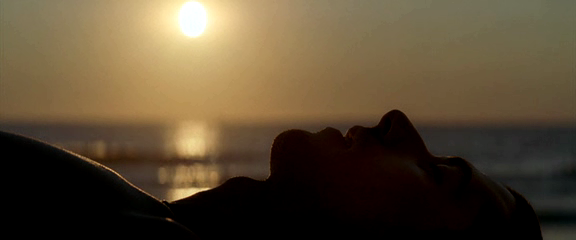
François Ozon's
Le Temps Qui Reste [
Time to Leave, 2005] is a beautiful film about learning to accept life even as one learns to accept certain death. In it, Melville Poupaud delivers a bravura performance -- which goes from cocky to douchebaggy to affected to frail but triumphant -- as a gay photographer who discovers he has terminal cancer, refuses chemotherapy, quits his job, and proceeds to alienate his family and dump his lover. And then somehow, from the unquiet emotional dreck he puts himself in, he finds his humanity. I make it sound melodramatic. It's not. This is an Ozon film after all, and this prolific fimmaker has never ever been melodramatic. He could be sly and perverted and comedic, but never melodramatic, not even in the fantastic
Swimming Pool [2003]. But this is an Ozon film that seems most straitlaced and emotionally raw, even as it tries to haul in the sentimentality with a restraint that shows. Nevertheless. That last sequence on the beach as Poupaid's Romain sees the sunset for the last time is a masterwork of empathy. A painful film to watch, but oh so beautiful.
Labels: death, film, queer
[0] This is Where You Bite the Sandwich
Thursday, September 29, 2011
10:51 PM |
The Dangers of Comfort, The Theater of Dinner Conversation
And I don’t mean the pedestrian gossip that slakes over our dinner tables most of these days—although that, too, has its own perverted pleasures. The thrill of finding frail humanity among our kind. Schadenfreude as drama.
“Did you know so-and-so and so-and-so got together over the weekend?”
“Seriously? But what about so-and-so? Aren’t they living together?”
“Well, a little birdie told me that so-and-so has done this-and-that.”
“Oh. Em. Gee.”
Not that.
What I mean is dinner conversation of the illuminating kind—not about politics or religion, those two deadly bores. But about the place of humanity in the scheme of the universe, in philosophy—leavened, of course, by anecdotes from personal experience. Imagine a conversation about art, a painting or sculpture or what-not a friend of yours have seen in a museum which has touched him, which has given him fodder for thought. Imagine that friend as an impresario of talk. Over a three-course meal, pushed by the sweet intoxication of red wine, you hear him give a dramatic musing of what he has seen. You are both surrounded by kindred spirits, and the talk becomes organic, more philosophical, a little bit tipsy from the wine. There are affirmations, counter-arguments, jokes and laughter, more illuminating anecdotes. You leave that dinner table knowing you have learned a little bit more about the nature of humanity. You become, at least for a few hours during and after that dinner, a better human being—because you have partaken of a strange communion, a mix of food and words and friends.
I find myself in rare instances of this in Dumaguete. When the chance presents itself—usually in the delightful company of Dessa Quesada-Palm, Arlene Delloso-Uypitching, Esther Windler, Cecilia Hoffman, Annabelle Lee-Adriano, Laurie Raymundo, Margaret Helen Udarbe, Betty McCann, Moses Joshua Atega, Patrick Chua, Myrish Antonio-Cadapan, Jacqueline Veloso-Antonio, Leo Mamicpic, Ben Malayang III and his wife Gladys, Myrna Pena-Reyes, Tata and Simon Stack, John Stevenson, and assorted artists/friends from Manila and elsewhere who would join us—I grab it, and I prepare for a night of scintillating talk, knowing it is good for the soul, and for the mind.

I thought as much when I saw the filmed dinner conversation between André Gregory and Wallace Shawn, playing versions of themselves in Louis Malle’s
My Dinner with André [1981]. This film, hailed as a unique cinematic experiment and is considered one of the best films to come out of the 1980s, is ripe with witticism, philosophical musings, and provocative thoughts, but this one strain of dialogue between the two struck me the most:
ANDRE: I mean, if you don't have that electric blanket, and your apartment is cold, and you need to put on another blanket or go into the closet and pile up coats on top of the blanket you have, well then you know it's cold. And that sets up a link of things: you have compassion for the p-- ... well, is the person next to you cold? Are there other people in the world who are cold? What a cold night! I like the cold, my God, I never realized, I don't want a blanket, it's fun being cold, I can snuggle up against you even more because it's cold! All sorts of things occur to you. Turn on that electric blanket and it's like taking a tranquilizer, it's like being lobotomized by watching television. I think you enter the dream world again. I mean, what does it do to us, Wally, living in an environment where something as massive as the seasons or winter or cold don't in any way affect us? I mean, we're animals after all. I mean, what does that mean? I think that means that instead of living under the sun and the moon and the sky and the stars we're living in a fantasy world of our own making.
WALLY: Yeah, but I mean, I would never give up my electric blanket, André. I mean, because New York is cold in the winter, I mean, our apartment is cold. It's a difficult environment! I mean, our lives are tough enough as it is, I'm not looking for ways to get rid of the few things that provide relief and comfort, I mean, on the contrary! I'm looking for more comfort, because the world is very abrasive, I mean, I'm trying to protect myself, because really there are these abrasive beatings to be avoided everywhere you look.
ANDRE: Yeah, but Wally, don't you see that comfort can be dangerous? I mean, you like to be comfortable and I like to be comfortable, too. But comfort can lull you into a dangerous tranquility. I mean, my mother knew a woman, Lady Hatfield, who was one of the richest women in the world, and she died of starvation because all she would eat was chicken. I mean, she just liked chicken, Wally, and that was all she would eat, and actually, her body was starving but she didn't know it 'cause she was quite happy eating her chicken and so, she finally died! See, I honestly believe that we're all like Lady Hatfield now, we're having a lovely, comfortable time with our electric blankets and our chicken, and meanwhile we're starving because we're so cut off from contact with reality that we're not getting any real sustenance. 'Cause we don't see the world. We don't see ourselves. We don't see how our actions affect other people.
[The transcript of the film can be read here.]
End scene.
The dangers of comfort. That made me take pause. Because I have been thinking about this for some days now. And there it was, the whole notion of it, discussed at length in one of the best films of all time. And I have just stumbled on it, like the “omens” they talk about in the film. Is this film my own form of Wally’s fortune cookie?
A few days ago, I posted this status update in my Facebook wall: “I don’t know what the Universe is trying to tell me these days, but I’m willing to listen.” The things is, I have been out-of-sorts lately, bombarded by tiny problems with magnificent wings which I can’t talk about to anybody, trying to make sense out of ... something. I had no idea what was bothering me, but I have been feeling odd. Strangely sad, feeling blue. And so I popped in this film like I have always promised myself I would. And I’m glad I did.
And what a beautiful film it is. When it ended, I just stared and stared off into space as the end titles rolled over Erik Satie’s
Gymnopédie No. 1, and I was thinking about the things they were talking about: theater, domesticity, the imprisonment of comfort, how life must be lived when one realizes how we have forgotten to connect... I think this is one film one should watch when one turns 36 (Wallace’s age when this was made). I’m 36 now, and I love the film because I feel it now, more thoroughly, because of having have lived. Because the questions it asks are things I have come to know through all those years. I wouldn’t have gotten this film when I was 21.
Amy Taubin
in the Criterion website captures exactly what I felt upon finishing: “And then the dinner is over. Nothing is concluded—not for Wally or André, and certainly not for the audience. But on the way home, Wally is surprised to find that something has changed in the way he attends to the city as he sees it from the taxi window. And that slight shift in consciousness is what André ... would have applauded. And we might do the same as the image fades to black.”
The film finally reminds me that I need to have dinner with my good people again. Because you need these little events of gab to go beyond the vapidity of everyday life, the drone of television, the mindless cares of zombies around you. A dinner conversation is a small strike against the electric blanket of life. It is rare when the right talk chemistry sparks, and so when it happens, one has to be of mind to cherish it.
Labels: film, life, philosophy, theater, travel
[0] This is Where You Bite the Sandwich
Thursday, September 22, 2011
2:16 AM |
The Threshold of Age
I have a thirtysomething's fear of growing old: the threshold is coming nearer, yet one still feels incredibly young in a body increasingly betraying itself. Old men have the pleasure of having succumbed to age. Young men have the bliss of ignorance, that exquisite blind faith that old age can never happen to them. The man in his thirties, alas, lives in a constant state of terror and denial.
Labels: life
[1] This is Where You Bite the Sandwich
Thursday, September 15, 2011
5:59 PM |
Charming Devils
You know what they say about experience, right? That you learn from it? If that is the case, I'd be foolish then not to learn from this realization: charming people -- incredibly polite, outwardly gentle -- are the spawns of the devil. I still hope to find myself in the wrong here, but I'm talking from experience. How many times have I been surprised to find that the many charming people I've come to know are, in private, capable of unfathomable nastiness that borders almost on evil? There's this one guy I used to know who's quite lovable, he charms the hell out of you with such careless
pa-cuteness. In private, however, I know him as someone who can carry hours of hateful litany about every person he knows, his paranoia deep, his neurosis almost psychotic. And then he goes out the door brightening like the very sunshine itself. I know many others, seemingly harmless, always soft-spoken, even polite to a fault -- and then you discover in them that wellspring of darkness.
What's up with that?
Then again, let's consider the long list of people who have been described as charismatic, they mesmerize you in their presence: Charles Manson. Rafael Leónidas Trujillo. Muamar Gaddafi. Adolf Hitler. Lucifer.
Fear charming people. They seduce your soul, in order to eat it.
Labels: life
[1] This is Where You Bite the Sandwich
Tuesday, September 13, 2011
7:46 PM |
I Know That Man
I still feel for that man who mourned. Looking at him, from this distance defined by time, I can see that his heart was so big. So big, I understand why he felt it needed filling. I can understand why he thought he had found the very thing to fill it -- there was lightness, there was laughter, there were the silly promises of kisses, all things we mistake for love. I understand the dark days, where they come from. I understand the swift belief in madness: it was the only available kind of logic. Or so it seemed. I understand. And I understand the mourning, most of all. He mourned for the longest time, that man I see. I can come closer now, see how he deflected all that with rehearsed nonchalance; he wanted the world to know nothing; and so it knew nothing. But his eyes. Look at his eyes. There's a language there that's a cross between deadness and a scream. I see him. Somehow I know though that he knew I'd be here, my own eyes keen on retrospection, a little more grounded, removed beyond mere increments from knowledge of pain. How do I know? Because I look at him now, and he stares straight at me with that tiny dark glow of knowledge. He does not "see" me of course, not from behind that glaze of what should be falling tears -- oh, but he would not cry, that man, not that common drama. Everything surged beneath, all quiet rage, that searching hollowness that screamed, those unanswered questions streaming through his head that began with "Why?" and ended only with echoes, that bitter prayer that demanded a definition of love and loving and was answered only with a certainty of loss. I know that man. But I do not pity him. He would weather all that, I know. I know.
Labels: life, love
[0] This is Where You Bite the Sandwich
2:00 AM |
Confounding Fables
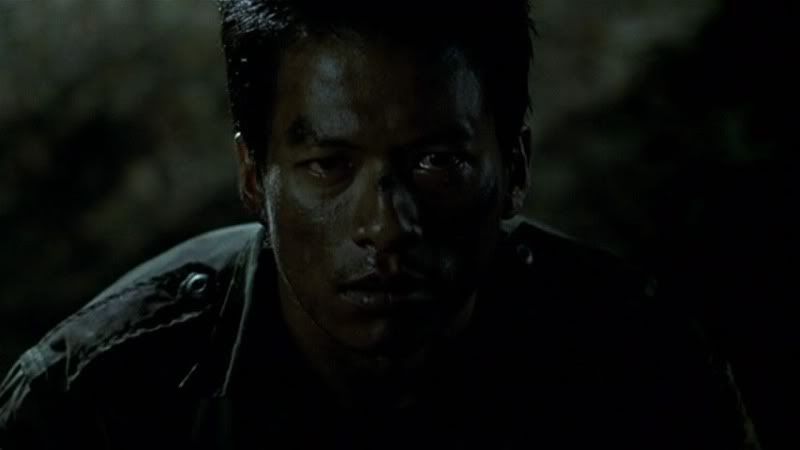
Apichatpong Weerasethakul’s สัตว์ประหลาด [
Tropical Malady, 2004] divided audiences when it premiered in Cannes more than half a decade ago — and understandably so. It is a confounding experience. The film is the story of two characters (a soldier and a country boy) who inhabit two different worlds and two different storylines in the same film, each one starkly different from the other in narrative and tone — and yet we are asked to regard both halves as organic to each other. And yet one can make the argument for the film’s simplicity. The first half is a simple love story about two men in coy courtship, and the second half is a simple fable about a soldier lost in the forest, placed under a spell by a shape-shifting shaman. And then you, the viewer, read what you can of it. A poetic Rorschach test done in cinematic form, if you ask me. I am not bothered by my confoundment, my logical reach for “What does it all mean?” In its depiction of rural Thai life, in its rumination of a brewing love, in its love affair with fable, in its unspooling of quiet tension in a dark forest tinged with magic, I find enough to be happy about, meaning be damned.
Labels: film, queer
[0] This is Where You Bite the Sandwich
1:55 AM |
An Accidental John Waters Freak Show, Without John Waters' Wit

Australian director Ed Aldridge’s
Tan Lines [2007] is just the kind of ineptness in filmmaking that gets under your skin simply because this is just the type of film you want to root for but it does every single infuriating thing to shake your very faith in cinema. It is, in other words, a subtly hateful, confused mess of a film that does not know whether it wants to be a surfer film, an angst-ridden coming-of-age film, a gay love story, a social commentary on small lives barely hanging on, a psychedelic fantasia with strange animated sequences of Catholic saints talking, or a John Waters film filled with unbearable, out-of-place grotesques. Don’t take all that in. To understand this kind of confoundment is unworthy of any effort. And yet, at its core,
Tan Lines is a simple story about a gangly teenage boy named Midget Hollows (played with deadpan coyness mingled with naivete by a winning Jack Baxter, who alas cannot save this film) who lives in a seaside Australian town and dreams of getting out, to “see the world and shit.” He has reasons to. He is poor and lives in a cramped apartment and shares the same bed with his mother (always seen sleeping, covered with a blanket, with only her long manicured nails to signal there’s life under that slothfulness). His best friend and the rest of their friends are content with an endless cycle of nothingness, surfing, longboarding, and partying. And then Cass, his best friend’s older brother, arrives — a gay boy who ran away from home four years ago. Midget soon finds himself attracted to Cass — but don’t let this development fool you into thinking this will be a film about self-discovery, forbidden love, growing up, or the triumph of friendship through acceptance. It is none of that. It meanders instead into strange anecdotes about freaky adults — there’s a sinister older woman with a penchant for formal tea parties complete with a session of cunnilingus for her niece; there’s a band of elderly couples playing a kind of drunken stripping game after midnight in public; there’s an older female duo out for regular morning exercise complete with conversations running the gamut of sexual hijinks… The whole film seems an indictment against adulthood, and yet it is not heroic of the young either: the older folk are crazy, but the young are aimless zombies with zero ambition, and if they’re not, they’re wont to indulge in manipulation or violence. And yet one continues to root for a semblance of logic, or humanity, in this film — and that may be because beholding Mr. Baxter in such a waste of a role can’t seem possible. But in the end, he is truly wasted, and one ultimately has to throw up one’s hands and proclaim the entire film unwatchable. The acting of the entire supporting cast is worse than horrendous, the script is written on soiled tissue paper, the editing is non-existent, the cinematography is atrocious, the direction is aimless. A similar story, minus the freak show, can be found in Jonah Markowitz’s
Shelter [2007]. Forget this one, and find redemption in that one instead.
Labels: film, queer
[0] This is Where You Bite the Sandwich
Sunday, September 11, 2011
10:59 PM |
Serious People.

Emoting with SPIT Manila. Because we can.
From left, clockwise. Diomar Abrio, Ian Rosales Casocot, Hallona Ember, Linwell Bongcasan, Earnest Hope Tinambacan, Maliksi Zaragoza, Dingdong Rosales, Hendri Go, Dessa Quesada-Palm, Ariel Diccion, Gabe Mercado, Happy Ferraren, Kenneth Keng, Akong Bongcaras, and Aryn Cristobal.
[Claire Isabel McGill Luce Auditorium, 10 September 2011. Photo by Darrell Bryan Rosales.]
Labels: art and culture, comedians, cultural affairs committee, dumaguete, life, photography, silliman
[0] This is Where You Bite the Sandwich
9:38 PM |
A Quick Appraisal of a City on the Verge

The thing about Dumaguete is this: it is so small that all kinds of drama here collide. The personal and the grand spectacles of the world play out before your eyes, each touching the other in the way of a caress. Last Monday, for example, was it only by chance that I decided to have dinner at the new digs of El Amigo—
the pesto steak is to die for, by the way—and while the great Filipino poetesses Merlie Alunan and Myrna Peña-Reyes were in the next table spending a quiet evening together with some friends (oh, to be a fly on the wall for that conversation), I had to spend time with two beautiful young friends—former students, actually—dealing with the matters of their romance, about which they have come to me for some advice? (I have no idea why young people come to me for love advice. Is it because I am a veteran from that endless battle?)
And it came to me, slowly at first, that this was how Dumaguete plays out its dramas. The small and the grand converge—the simmering quiet of our city streets is a sweet deception. All the world’s a stage, and its name is Dumaguete. The Palanca-winning poet Mikael Co, visiting Dumaguete over the weekend, said as much. Which was why he felt the need to come back after having been a summer writing fellow here years ago. “I tried to book a flight for Mom Edith’s funeral,” he said, “but it was impossible to get a single plane seat.” All the world’s coming to Dumaguete a lot these days, it seems. That Monday, for lunch, we both had joined Philippine
Star columnist and poet Krip Yuson who came to visit the grave of the National Artist for Literature, and with him were the Singaporean writer Kirpal Singh and Dumaguete’s first daughter of literature, Rowena Tiempo-Torrevillas. Over the spare ribs and the maya-maya, our conversations mingled and stirred right onto the walls of KRI, kissing the newly-mounted paintings of Hersley Ven Casero.
Later, I would get a message to join Presidential Spokesperson Edwin Lacierda for a media get-together on Tuesday night at Casablanca. There I would meet, for the first time, Manuel L. Quezon III—a longtime online friend. “Let’s have dinner tomorrow,” Manolo tells me. I said yes: “I know just a perfect place.” Of course, his Wednesday would be busy—the President of the Philippines was coming after all, and they were part of the advance party. I would shake President Noynoy Aquino’s hand the very next day during his onsite inspection of the Sy Family’s IT Park near St. Paul’s, on that lot which used to have the haunted Circular House, now gone. (Ah, the horror stories that have been subsequently razed by that very act of disappearance.) While waiting for his helicopter to land in the nearby airport, we went crazy over Ritchie Armogenia’s brownies, and we pondered the coming change in the landscape of this part of town.
And it came to me that Dumaguete is slowly changing before our very eyes. The landscape, the cityscape is changing—and we have been merrily blind to its subtle evolutions, surprised only once in a while by the sight of a shiny new building where once a dilapidated sari-sari store stood. “It’s changing, you just don’t know that it is,” Manolo told me the next night after dinner, while we strolled the Boulevard and I was giving him a quick historical tour of Dumaguete essentials—Silliman Hall, the sugar houses, why there were concrete nuns on the Boulevard, the significance of the palm trees and the acacia trees growing on the Boulevard’s grassy island. I pointed out the spots where the houses that Rizal stayed in once stood. I invoked the old tale of where we got the nickname of “city of gentle people,” although I was quick to point out it’s all hearsay. “There are no historical records of Rizal ever uttering this impression of the place,” I say.
And it came to me that I love this city after all—even with its smallness, with all its pettiness and pain, its generous memory of heartbreaks, the knowledge that the place can be a comfortable prison. But it is one-of-a-kind, and very much so. The other day, I wrote on my Facebook wall: “Welcome to Dumaguete. Where the country’s best writers gather every May for the National Writers Workshop, and the country’s best singers and songwriters gather every November for the Elements Singing and Songwriting Camp. I’m very proud of this city. (And once we get the planned annual film festival going...) Imagine the cultural possibilities. I do hope City Hall recognizes what untapped potential this cultural gold mine has in the long term...” More than fifty people immediately responded with a “like”—an avalanche of agreement over this blessing of a place.
The sociologist Lorna Peña-Reyes Makil tells me: "When we first came to Dumaguete in 1950, we felt we had found home. Twenty years later, in Honolulu for graduate studies, my heart longed for home. And from 1980 to 2002 during my sojourn in Manila, I dreamed of always coming back. Friends could not understand this—until they visited me these past years and were captivated. [But] yes, the rapid change we have now is overwhelming."
Here’s my former student Julienne Fortuna and her own take about the place on her own Facebook wall, with a very recent post: “I need to visit Dumaguete. I need to get away from the chaotic jungle that is Metro Manila and immerse myself in the simple and laidback Dumaguete life. I can already imagine myself walking around Silliman, eating in Neva’s or Habhaban, riding on former crushes’ motorcycles, snorkeling in Apo Island, and hanging out with friends at the Boulevard. After all, I’m one proud transplanted Dumagueteno.”
And then former
Weekly Sillimanian editor-in-chief Camille Celeste Go replied: “We’ve come a long way from hating Dumaguete because of how boring it is (compared to Davao), to loving it beyond words. I miss Duma-life too.” Then Julienne
posts this rejoinder: “It’s funny how we non-Dumaguetenos initially hated Dumaguete for, well, being the small city that it is. I’m sure most—if not all—of us complained to our parents about sending us there to study instead of Manila or Cebu. But after living there for four years or more, we’ve just grown to appreciate it for what it is and we all found it difficult to leave. I cried so hard about leaving twice: after graduation and when I decided not to enroll in SU Law. The irony gyud. Haaay, Dumaguete and its charm.
Guidagit jud ‘tang tanan.”
Manolo, too, told me: “I’m coming back.” And later, over text before his flight back to Manila: “I’m sad to be going!”
And there you go.
Gui-dagit.
[Photos by Hersley Ven Casero]
Labels: dumaguete, friends, life, memories, negros, writers
[0] This is Where You Bite the Sandwich
7:46 PM |
Where Were You Ten Years Ago Today?
_9-11-n_12.jpg)
It's true what they say. You never forget where you were when you know your life first changed. Late afternoon of September 11, 2011. Halfway around the world, morning just started. It was a beautiful day. It promised to be a beautiful night. I had just come back from an early dinner with some friends, among them Patrick Chua and Moses Joshua Atega. We were still in a hangover from the monthlong centennial celebrations of Silliman University, and only two days ago, we had just bid farewell to my brother Rey, who was bound back to the United States after spending August at home. That late afternoon, we all went to Cafe Tropini, the bar in Why Not? that would soon become an extension of Le Chalet. We proceeded to order beer. Everybody, we soon noted, was watching the television with profound eagerness, perhaps even excitement -- that avalanche of ambiguous feelings one feels when confronted with the unbelievable.
"What's happening?" one of us asked.
A Caucasian guy drinking beer answered: "The goddamn Twin Towers. A plane just hit one of them."
Another Caucasian guy, drunk and dismissive, answered him, "The goddamn Twin Towers are in San Francisco. This is the World Trade Center."
We didn't care for their exchange. We just looked at the images that flashed before us, and I knew the world has changed. And suddenly, I could not fathom what exactly was in store for all of us in the coming decade. What would change?
Everything changed.
We hurried home.
* * *
I remember visiting Ground Zero in New York last November. I was on my own, going around on foot in lower Manhattan, eager to see what I could of the city before flying back home to the Philippines. I decided to go to Ground Zero.
From the observatory, I could see the grounds in a furor of so much activity. In the midst of the heavy construction machinery, one couldn't help but think, "So much life lost." And for those who witnessed the horror, our own lives over a decade were inevitably reconfigured. Who didn't change?
Nobody.
We are all children of 9/11.
Labels: history, life, memories
[0] This is Where You Bite the Sandwich
Monday, August 29, 2011
8:27 PM |
Remembering Mom Edith

I have always wondered why people called National Artist for Literature Dr. Edith Lopez Tiempo “Mom Edith,” always with this measure of intimate familiarity that seems reserved for someone who is more than just a mentor. I was 20 years old when I first met her. I was a campus writer who wrote for the student paper in Silliman University—where she had taught for many years—and in 2000, I was told to apply for the National Writers Workshop.
I was told this was the oldest writing workshop in Asia, founded by her and her husband, the late Dr. Edilberto K. Tiempo. I was also told that this workshop has produced many of the best writers in contemporary Philippine literature. When I went in that fateful Monday in the Dragon Room of the College Assurance Plan building in May 2000, I saw them all around that Mount Olympus at the center of the workshop room—Gemino H. Abad, Alfred Yuson, Marjorie Evasco, Susan Lara, DM Reyes, the late Ophelia Dimalanta, Anthony Tan, Jaime An Lim, Ernesto Superal Yee, Cesar Ruiz Aquino, Bobby Villasis—and they all looked … normal. They were inexplicably down-to-earth, these gods of literature. They made it easy for me, the intimidated initiate, with my first brush with the highest literary circle of the Philippines.
But Mom Edith was special. She was affectionate, but she was also exactling. She took my juvenile short stories I submitted for that workshop—two of them of controversial graphic nature only a young man with the predictable fetish for shock can write—and she critiqued them with the fine comb and gusto of the best formalist, the standards of the most demanding teacher, and the compassion of a mother. I think she knew that I was—that we were—there to learn, and so, like all the greatest teachers in the world, she poured all knowledge of writing magic she could give and made it sound clear, reachable, if exacting. I first became a
better writer because of her. If writing is my life, then I owe much of that life to her. She led the way, she opened the door further, she made writing matter. And often, when you visit her in her house in Montemar, she gives all that with an extra measure of tender loving, complete with mango ice cream and cake.
How then can you not call someone like that “Mom”?
Years later, I too would be publishing my own works. Since 2000, I’ve always made it a point to go to her office in CAP, and later on in her house in Sibulan, where we would sit together for hours—just the two of us—and she would tell me her stories of her girlhood in Nueva Vizcaya, her short stint as a movie actress for Sampaguita Pictures, her fateful correspondence and then courtship with the man from Leyte, her move to Dumaguete, her stay in the hills of Valencia during the Second World War, her stories of Iowa, her children’s stories which she hoped would in the future be compiled into a book. I found all these fascinating, and she delighted in the telling. I must have seemed to have hungered for more, and she must have known this, because later on, in her scrawled dedication to me in her book
An Edith Tiempo Reader, she wrote: “For Ian, who likes to hear stories, not just to write them! Mom E.”
And besides the usual care for creative writing, what I have also learned from her is to never forget the people in your life. She never forgot anyone—even in her later years. Anyone could come up to her and say, expecting non-recognition: “Mom, do you remember me? I’m so-and-so. I was in the [place any year here] workshop.” And she would brighten up and say, “Welcome home, son!” or “Welcome back, my dearest!”—and then proceed to recite a line or two of
your own poetry, or an image she remembered from
your story. She was that amazing.
Years later, when I too would have my turn of going to Iowa as a writer, I almost thought of it as coming home. It was where she blossomed as a writer, and my own sojourn there seemed like a perfect salute to her dedication to us all.
Last Sunday, when I received the call that she was being revived in the emergency room of the Silliman Medical Center, I dropped whatever it was I was doing—and rushed, like a crazed man, to her side. I was five minutes too late. She was gone. But as I helped cover her body with the hospital sheet and brushed back her hair and held her hand which was still warm, I grieved.
All of Philippine literature grieved with me—and we have been grieving many days now. Because it is such deep pain to lose a mother. As a former fellow of the workshop posted only last Monday in our Facebook page: “We have been orphaned.” And that was the simplest truth. We have been orphaned of someone who kept deep faith in our being writers, who knew each one of us and each one of our names like we were always her children.
Goodbye, Mom Edith. All that you were—your fantastic life and your deepest measure of love—are things which you ran and breathlessly handed over to us, your children. And for that, we give our heartfelt thanks.
Labels: dumaguete, dumaguete writers workshop, obituary, philippine literature, writers
[2] This is Where You Bite the Sandwich
Tuesday, August 09, 2011
12:49 PM |
A Frightful Day
The world is scary today. The stock markets are plunging, the riots are breaking out, the Catholibans are beating their chests in small victories, and Imelda Marcos has become the ultimate arbiter for what's "good and beautiful." Is it safe to go outside?Labels: issues, life
[1] This is Where You Bite the Sandwich
Friday, July 29, 2011
11:52 AM |
Abandoned Rooms
 There are rooms in our houses that we shutter away for some reason. We lock the doors, we forget these spaces exist. And then comes a time -- some point in a future without definition -- when something in you feels a small need to reclaim them, and you do so little by little. Each small act becomes absolution: you open the door, and in that inch of space you make, you let the light and the air in. You go in. You remember the ghosts that live in these rooms, but they don't touch you anymore. You sweep away the cobwebs when you can, when you're ready.
Labels: life
[1] This is Where You Bite the Sandwich
Monday, July 25, 2011
12:06 AM |
Haven is a Coffee Place
Part 4 of a series on Dumaguete foodThere is a painted poster somewhere near the north entrance of Café Antonio that makes me smile every time I go there for my almost daily caffeine fix. There’s a coffee cup, and a swirling caption says: “Given enough coffee, I can rule the world.”
I always grin like there’s no tomorrow when I see it—because it smacks to me as a kind of hyperbolic truth, give or take a few palpitations. (
Coffee rules! and all that. The caffeine freaks among us, and there are legions, can attest to this.) But the theme of world domination is not something you get as a given when you’re around the comforts of Café Antonio. This is a place I come to often, to relax, to feel or to imagine the increasing stress of Dumaguete life fade away. It is a haven.
There is something about the place that speaks to me. That it borrows its charms on the general architectural motif of its building, The Spanish Heritage, does not take away anything from it: in fact, if you ask me about it, the café itself has become the building’s heart. Is it the rustic mix of brick and wood? The carefully placed Spanish-inspired finish, with the gilded edges and the baroque tone? Is it the displays of scooters
and musical instruments scattered about? In the air-conditioned confines—separated with walls of glass from the
al fresco veranda with its colored-glass windows, its Tifanny-inspired overheard lamps, and its wooden swings—the round tables with their wrought-iron chairs are always filled with a mix of the city’s people—the occasional office folk on their lunch break, the casual Caucasian tourist looking for a quiet place to read a book, the city’s photographers who seem to find in this café an excuse for a headquarters, and the hordes of laptop-armed students deep into their books. It can get crowded sometimes, this place—but when it is quiet it becomes a cocoon. When I think of Café Antonio, I think of a good combination of café latte or fraps and also deep comfort, a refuge. This is where I go to when I want to hide from the world without
really hiding from it.


One can’t help but marvel at the change of fortunes for this café, which opened many years ago and struggled for a while to find footing in what was then a largely nonexistent café culture in Dumaguete. There were constant menu changes over the years that reflected a kind of confusion in the kitchen. Then the coffee-and-cigarette crowd (which is the café society—the vocal, usually artistic types who would give the retort, “What? No cigarette over my brewed
barako? Are you nuts?”) shunned it for so long for its insistence on banning smoking from the premises. It was, and still is, a beautiful place to come to now and then, but places do develop a magical pull, resistant to formula or earnest effort, that guarantees regular foot traffic and word-of-mouth patronage. For the longest time, it didn’t have that.
And then something happened. Café Antonio, for some reason, suddenly became cool.
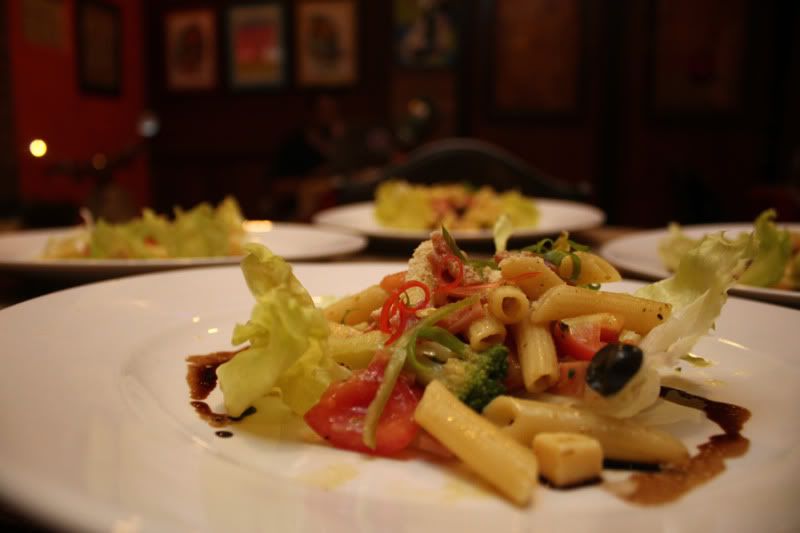


What happened? I don’t know much about this café and its efforts at evolution (I’ve started coming back to it only the past year or so), but one can bet on the efforts of the two brothers who run the place, Rochris and Rayvin Piñero, two young men who seem to have the pulse on what the city and its coffee people want—and increasingly a feel for what the rest of everyone else wants. It takes perseverance, one can guess. And also a sense for just making people happy. As Rochris once told me, “Café Antonio is about good food and good coffee, and building relationships. Food should make us happy, feel happy.”
The idea of a café sprang from something a family friend, Dixon Peralta, was mulling over. “He offered the opportunity to start a coffee shop business in the city,” Rochris said. “We started out as a coffee shop, and only that—but eventually we decided to evolve into a coffee shop
and restaurant.” And increasingly, it is the food of the place that has people coming back. Among its bestsellers—and what now constitute the signature dishes of Café Antonio—are the grilled pork ribs glazed in hickory sauce, the Cheezy Pork—strips of meat rendered in cheese cream sauce, and herb-marinated lamb steak. And then there is Jamaican grilled pork chop, tenderly marinated in herbs and spices. I can swear by the Jamaican chops: it is meat that overwhelms with a distinct herby flavor, earthy and spicy at the same time. What you now have is a whole new experiment in food, all of the entrees given certain explosive twists—the onion soup with bread and cheese, the garlic shrimp salad, the seafood paella, the grilled squid, the pasta marinara, the pesto pasta with tomato sauce, the pimiento basilica, the carbonara, and the tantalizingly sinful French toast with the caramelized banana (the mango slivers hidden in the bread was a touch of genius). The Fricadel burger with mushroom, one must say, is an experience.


The new menu is courtesy of Chef Eugene Gueverra from Cebu who whisked in, and stayed with the Piñeros for the entire month of April this year, and concocted a definitive change in the menu, and standardized the café’s process. “It was difficult because I am not a chef nor was I trained anywhere,” Rochris said. “Balancing finances and creating a product and service that satisfies the customer is a challenge.”


And then there are the Music Nights, randomly scheduled but increasingly popular. The streams of the café’s now-devoted patrons go through its glass doors unceasingly due in some part to an experiment in music the brothers have hatched. “We love music,” Rochris said, “and Music Night basically started out as an open mic night. And then slowly the members of what now constitutes our regular band got to know each other, with our regular singers Sela Saga, Alex Quilantang, and Reicha Piñero. Our plan is to make café Antonio a haven for aspiring artist, and to provide an avenue in which they could express themselves.”

Music Night is a monthly jamming among its young regulars, which started with a very successful The Beatles Night that had everybody singing “Hey, Jude” by the end. And then it continued on with some other themed nights, including the Apo Hiking Society Night, complete with Buboy Garovillo in the audience. (A Dumagueteño, Mr. Garovillo quickly obliged with everybody’s fevered expectations by singing one song with the band.)
That night, after the APO songs have been played and sung, it was time once more for open mic—and then somebody sang a fevered rendition of “Quando, Quando, Quando,” and transfixed us all with this discovery of a new voice—alluring, confident, graceful.
Who was he? But it didn’t matter. He took the song and made it his own, above our familiar memories of Frank Sinatra and Michael Buble. We all turned to him, and knew this was it: how talent can be so divine it can turn any place into a sudden venue for worship. And so, on my own or with a bunch of people all singing, Café Antonio has become what it has become: a place of such comfort, anybody here can burst out into song.
All photography by Urich CalumpangLabels: dumaguete, food, negros
[0] This is Where You Bite the Sandwich
Saturday, July 16, 2011
7:55 PM |
All That Longing
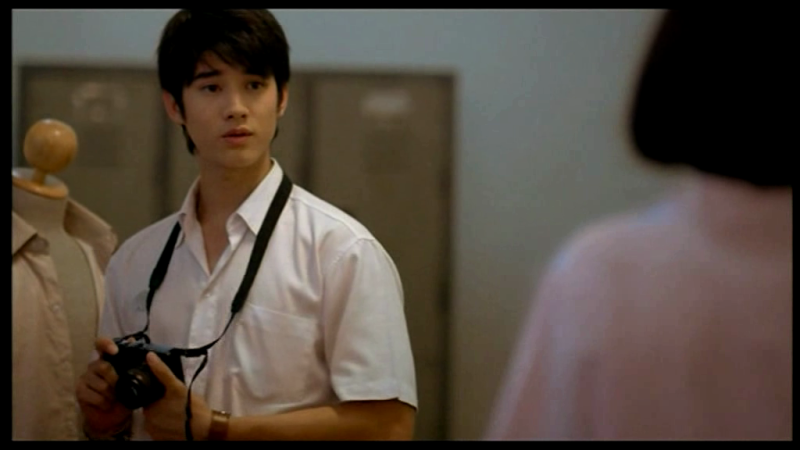
The Thais know something about longing. They capture it well on film. The mad surging, the illusion of nobility in denial, the perfect -- if short-lived -- happiness of catching a glance, a smile, or a touch from the beloved. Which is to say I have finally managed to catch Puttipong Pormsaka Na-Sakonnakorn and Wasin Pokpong's สิ่งเล็กเล็ก ที่เรียกว่า..รัก [
A Little Thing Called Love, 2010] ... egged on by the sheer popularity of the film among girls (and women) around me who are normally of the even-keeled sort but have been reduced to hysterics by the Tagalog-dubbed version of this film which aired in a network TV station a few months back.
Watching it, I understand the passion of the fans. It is certainly not a perfect film -- everywhere in its narrative, we encounter awkward bumps telling of a inferior acting or directorial or writing choice -- but the film wears its charm lightly and with frank resoluteness, it is hard not to like it. Heck, it is hard not to fall in love with it. Heck, it is hard not to feel the painful longing of Nam (played by Pimchanok Leuwisetpaiboon, who is the spitting image of Kim Chiu, without the malnourished look) as she gazes into the eyes of Shone (played by Mario Maurer), her object of desire, someone she has fallen for since the beginning of high school and has remained somehow removed from her efforts, this despite the frantic tips she gets from a booklet that promises nine sure-fire methods gleaned from cultures all over the world to get the man of her dreams. [And in that regard, we completely agree with her obsession: Mario Maurer has it in spades, and is perhaps this generation's Asian answer to Alain Delon.]
Truth be told, this is the StarCinema romcom I have always wanted to watch, if only Cathy Garcia-Molina or Olivia Lamasan had enough imagination to get away from the gutter thinking of assembly-line cinema and actually strive enough to create something whimsical like this, or at least to put an original spin on the same old formula. (There is a reason why Jessica Zafra insists that all StarCinema romantic comedies are all virtual remakes of
Notting Hill, that 1999 Roger Michell film starring Hugh Grant and Julia Roberts.) Consider that the film is essentially told from one point-of-view, that of Nam's, and her teenage desires are what drives the film and its heart -- and yet what proves wrenching is the twist in the end that subverts our own idea of who actually does all that work in longing, something reminiscent of the kissing film clips near the end of the original version of Giuseppe Tornatore's
Cinema Paradiso [1988]. The revelation had naked emotional power that had me reeling. But also like that beloved Italian film, this Thai romance also ends with a coda that goes on too long, made of course to give our protagonists their happily ever after -- but feels too calculated to be truthful. (Consider the sudden swell of music at the end of Shone's final sentence.)
But nonetheless. This is a film that knows very well the music of every lovelorn person's heart. It speaks gently of that unbearable, sweet longing -- and if only for that, it is very much welcome to enter the hidden pantheon of our guilty film favorites.
Labels: film, love
[0] This is Where You Bite the Sandwich
Friday, July 15, 2011
8:22 PM |
The Gusto of Presko
Part 2 of a series on Dumaguete foodNobody remembers—except perhaps those who have a penchant for nostalgia and have seen Dumaguete evolve over the years—that Lab-as used to be a “floating” restaurant. And not in the spot where it is now. A few meters away, in fact, where Barefoot Bistro is presently. The old
al fresco ensemble of coco lumber and wood and
nipa, with a running veranda belted around it to set the rustic tone, sat on a man-made pond, a moat really, which was seeded with fish, oyster, and crab. The effect was both visual delight, and source of fresh catch that can directly to the nearby grill and on to the plate of hungry gourmet.
It has been more than twenty years since Lab-as (the Cebuano word for “fresh catch,” or more tellingly, a “freshness of flavor”) was founded on that old spot in 1988. “Back then,” writes Vicente Fuentes of his family’s lasting contribution to Dumaguete’s culinary culture, “the vogue in the dining fare in and around [the city] was either … Chinese or Spanish … with a sprinkling of European and native dishes in some resorts and restaurants… It was thus a bold step for Lab-as to venture into seafood, in a location that was even regarded as a ‘no-no’ in business practice. [We are] situated quite a distance away from the heart of [town], where the convenience of walk-in customers—like shoppers and businessmen of the downtown commercial district—was a built-in come-on.”
The spot, near the crossroads of Escaño Boulevard and Flores Avenue, overlooking Tañon Strait, was—at least in the late 1980s—a kind of no man’s land in Dumaguete: it bordered the shanties of nearby Lo-oc, and at night, it turned into a desert of quiet darkness. It existed in a metaphorical version of the doldrums, the way places in a small city can be, unmeasured by actual standards of distance. Things have changed since then, with Escaño becoming the city’s current throbbing heart of all things you could call the night life. Lab-as might as well be the germ of that transformation. Without the Fuenteses, would life stir in Flores Avenue the way it does now? Probably not.
It was a gamble—and it paid off handsomely. And yet it was a risk that was also founded on one sure thing: there was, and still is, a visionary sumptuousness in Lab-as’ fare. They had food—fresh, delectable—you had to keep coming back to. It was worthy of repeated word-of-mouth appraisals—and it is exactly that kind of enthusiastic response from diners over all these years that has sustained the restaurant. And yet, in the beginning, all that Mr. Fuentes wanted was to create something new for Dumaguete, to offer something new for its collective palate. He writes: “We tried to ride the growing tide in health consciousness sweeping the country, to veer away from food rich in cholesterol and animal fats. We conceived of an idea of freshness in seafood, [not only as a healthy alternative but also as something truly appetizing and satisfying.] When seafood, like grilled fish or steamed crabs or oysters and prawns, are eaten
al mano—or
kamayan style—the satisfaction is doubled.”
Consider the bestsellers in this restaurant.
There’s the
talaba, always a succulent experience, which comes in cheese, basil, garlic, or
sibuyas dahon. Taken with wasabi, each bite becomes a whole buffet in one swallow. “We prepare them raw with
kalamansi or
sinamak na suka,” says Vicente’s son Sande, who is Lab-as’ current conjurer, or at least an ambassador, of culinary witchcraft. “They live off from our aqua tanks to purge them before we serve them to customers. They are grilled and then steamed with
sinamak, which is native coconut vinegar with garlic ginger,
sili, and peppercorns. And then we have them baked with garlic basil and cheese.” The secret to the delectability is that they try to keep the oysters alive—“and it is a challenge now to get big plump ones,” admits Sande, “because Bais is also now supplying restaurants in Cebu and San Carlos.”

You go next with the
crispy shrimp, seasoned in
kalamansi, salt, pepper, and garlic and then dusted with corn starch; the whole ensemble is then deep-fried quickly, so that the shrimps’ shell becomes crispy but the juiciness of the meat remains, locked in. It comes served—all in delectable crunchiness—with
bagoong, tomato, and
sibuyas, and the whole thing is best eaten from head to tail, each bite dipped in
sinamak with crushed
sili.

The
halaan or punao clear soup is a favorite starter among diners. The dish primarily consists of fresh clams sautéed in garlic and ginger. Added to the mix are onions, tomatoes, and atsal or red pepper in a clear soup, which is topped with
sili espada and
sibuyas dahon before it is served. It becomes for many an instant taste of home, something comforting and “makakalma.” Paired with grilled seafood, it becomes almost a complete meal, and also becomes a great match for Filipino guilt-inducing cholesterol-laden favorites like crispy
pata or grilled pork belly; the
halaan clear soup perfectly counters the oil of these dishes.

The
fat chili crabs—sautéed with onions, garlic, and a generous helping of milled pepper, and then served with a dash of tomato sauce (plus Lab-as’ secret hot sauce formula) and a serving of garlic rice—is an invitation to finger licking. It is another one of Lab-as’ favorites. “We keep the crabs alive, ready for the cooking,” says Sande, “and then we have them steamed, then deep fried with a lot of garlic and
guinataan....”

There are three grilled dishes in the Lab-as menu that I keep coming back to. The first is the
panga of the blue marlin or malasugi, always grilled to perfection, the tenderness of the meat mingling with a smoky flavor that is arresting. The flavors are subtle, bursting only in the back of your tongue.

The second is the
sinuglaw, which is my ready favorite in the menu. It is essentially a Dumagueteño version of
binakhaw: fresh
tangigue cut into cubes, mixed with slices of onions, ginger, and
atsal, and then with
biasing (a relative of kaffir lime, fresh from Camiguin) thrown in with a measure of fresh coconut milk (“No mayonnaise, please,” Sande says), native coco
suka and salt, finally topped with
sibuyas dahon and some crushed
sili. The final ingredient is
sugbang baboy or pork chop hot off the grill, the meat succulently chopped and layered on top of the
binakhaw. The contrast in taste and color is a feast for the senses.
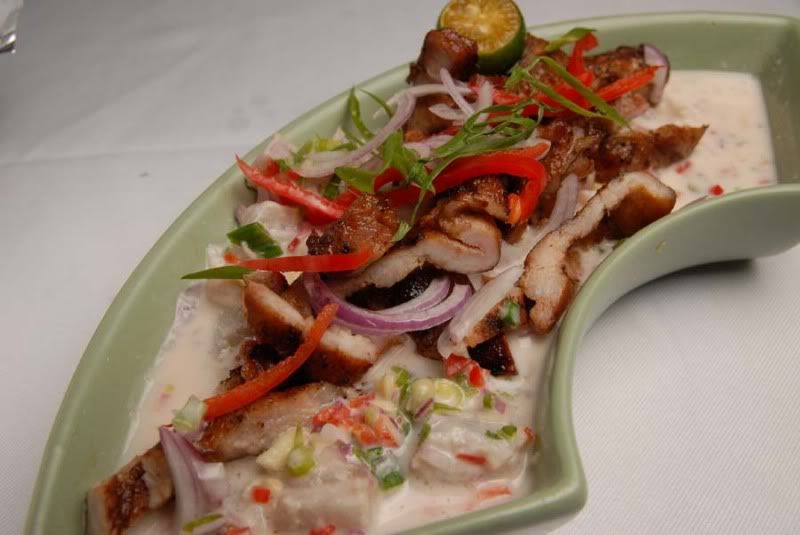
Finally, there is the popular
Dumaguete Express—Lab-as’ take on the Bicol Express, but something that is inspired by the cuisine of Camiguin—complete with slivered flesh of
botong, fish, squid, and shrimp, cooked in coconut milk with
malunggay, ginger, and onion, and then topped with
lechon kawali. “It is a complete meal,” says Sande, “and it has somehow become a favorite of backpackers…”

That mention of backpackers is testament to Lab-as’ growing popularity, not just among locals, but among traveling gourmets from all over the country, and even the world. Many food critics have proclaimed Lab-as’ menu as something that has perfected a taste for the native—which is enviable because it is a menu arrived at only with the strength of one man’s culinary philosophy. Vicente Fuentes was not a chef, just a food enthusiast who knew what “freshness” was all about. “What we have,” Sande says, “are our trusted
kusineras—our
manangs who have been with us through the years. We have two chief cooks, Manang Carmen and Manang Tasing, who have been loyal to us since 1988. It is quite a team we have, with five other cooks and what we call as the ‘
talaba boys’ and the ‘grill boys.’”
What Lab-as has is a menu that may stick to classic favorites, their quality consistent and unchanging, but is also something that evolves over time with inspiration taken from travels, including surfing and diving, that the Fuentes family does, as well as with their unceasing food trips in
karinderias in Bohol, Siargao, and Camiguin. What inspires them in these jaunts across the islands trickles down to variations in the menu, with perhaps a new dish or two to keep the culinary adventure going. And so we keep coming back to Lab-as—and one soon realizes that the beauty of Lab-as food is that it is basically the most basic of home-cooking, but taken to a level that approaches sumptuousness, the detail rich, the taste made more distinct and tantalizing.
It is hard work. “Most important in our menus is a consideration of consistent quality and the availability of seafood, like our tuna
panga and belly,” Sande says. “I’m very happy, as of the moment, with their quality. Our supplier exports to Europe. They’re local, too, straight from the seas off Bayawan and Sta. Catalina. There is less travel time when I get my stock of
lapu-lapu, maya-maya, and others.
Presko gyud.”
Presko. That singular word. Twenty years later, it is a culinary philosophy that has proven to be of the lasting kind.
[To be continued...][Photography by Greg Morales. Food styling by Arlene Delloso-Uypitching. Coordinated by Moses Joshua Atega. Thanks to Sande Fuentes for the food adventure...]
Labels: dumaguete, food, negros, travel
[0] This is Where You Bite the Sandwich
7:45 PM |
A Primer for Table-Hopping in Dumaguete
Part 1 of a series on Dumaguete foodEvery time a traveler comes to Negros Oriental, I am always asked the same two things, the first being an inquiry about the local delicacy, some edible
pasalubong to take home. That has become a kind of touristic expectation—Cebu with its
lechon and
chicharon, for example, or Bohol with its
kalamay and peanut kisses.
Such query used to vex me. What do we exactly eat in Negros Oriental that is worthy of culinary tourism?
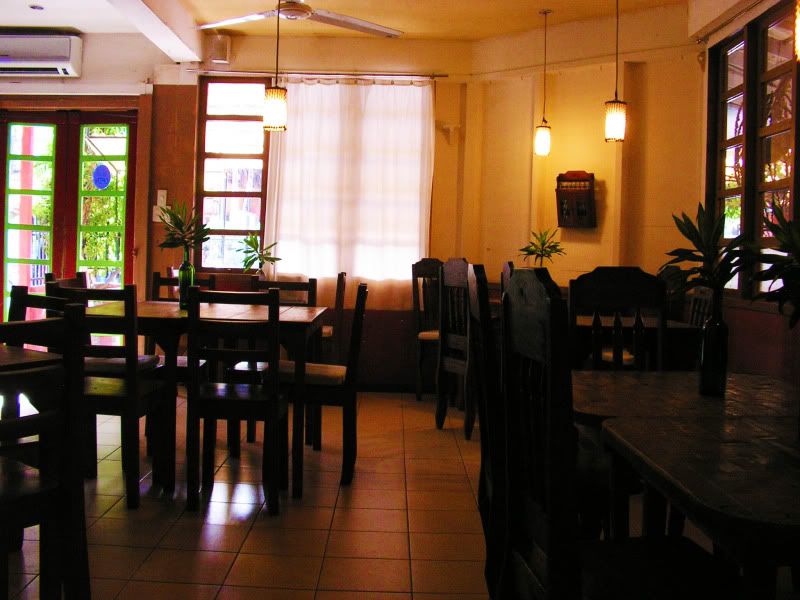
Jutsz Cafe doubles as a space for the city's artists
Over time, it has become easy to answer. My roots being Bayawan, a small city in the southern part of the island looking out towards Sulu Sea, I am ready to pronounce the gustatory delights of
baye-baye, a kind of sweet cake made of sticky rice and coconut—and thinking of it now brings on a surfeit of childhood memories. I’m imagining the burst of sticky sweetness that explodes on the tongue, and the way the paste lolls around the mouth.
Then there’s Tanjay’s
budbud named after itself or Dumaguete's
budbud kabog—the two towns' version of
puto bungbung, really. (Alas, why it’s named after the local species of bat is beyond me.)
In Dumaguete, the easy answer has come to be the silvanas from Sans Rival, that quaint cake house near the Rizal Boulevard that has found a solid way to make this frozen delicacy of a pastry last a plane ride by coming in
pasalubong variety: its powdery shell is made extra hard, which preserves the quick-melting creamy heaven inside.
The second query, still about food, has nothing to do with
pasalubongs, but everything to do with the matter of solving any current pangs of hunger. If one is a stranger to Dumaguete, where do you exactly go that would also define a sense of place? To eat where the locals gather is, in a sense, getting to know well the stirrings of every day life as it exists in this peculiar spot of geography. This one goes beyond considerations of fast food. You do not go to another place to have Jollibee.
But if “definition of a place” must be a criterion, you could always start with this one kind of fast food popular in the city: the “tempura,” a flour-coated something (definitely not shrimp—but it sure does taste a little like it), which is an unhealthy mix of MSG and deep-frying oil. But locals do gravitate towards the
tempurahan, how we call this spot at the head of the stretch of paseo, at the corner fronting old Sillliman Hall, which is the city’s picturesque Rizal Boulevard. At night, the place turns into a haven for moon-seekers, its acacia-lined stretch overlooking the dark currents of Tañon Strait lit orange by lights emanating from Corinthian lampposts that dot it. Many years ago, a city mayor once thought of doing away with the “tempura” vendors, their makeshift chairs and colorful beach umbrellas considered an “eyesore” in the midst of the Boulevard’s Spanish/American feel. And then the New York
Times, in its travel article about Dumaguete, splashed images of the
tempurahan in its pages. It became an instant curiosity of a place, a tourist spot. The order was withdrawn, and so the
tempurahan stands where it is until now, gentrified a little bit, the vendors now in uniform. (The tempura is also available with hot sauce, and coupled with a bottle of Coke, it becomes a kind of feast. One has been known to devour fifteen pieces of it in one sitting.)
Dumaguete, for some reason, is in a culinary renaissance of some sort. It is a small revolution, but it sizzles still.
Why a revolution? Consider this. There used to be a time when dining out was a perennial problem in Dumaguete. Essentially a big town with small city airs, it was a place where nobody went out for dinner—and if they did, it was mostly a family affair that was quick, usually undistinguished, lacking the pizzazz of experience the way a place with a culture of dining out has. Which is why, for the longest time, what can be said to sum up a typical Dumaguete dining experience is the outdoor grill. Jo’s Chicken Inato is iconic in that tradition—its grilled chicken, marinated with a secret recipe of herbs and a milky what-not, is almost synonymous with the city. Today, that tradition, always done al fresco, has expanded a little bit with City Burger (which is
not known for burgers, but for barbecued chicken dipped in a tantalizingly sweet sauce—a real experience, if you have the patience to spare with its gruffy and belligerent waiters and waitresses, who seem to begrudge your very presence for some reason), and with Atong Kamalig, also near the Boulevard, with its smorgasbord of grilled meat and funky-sounding bands. More recently, there’s Sundown, near the intersection that leads to Robinson’s Place—a beautifully landscaped beer garden, complete with the
alfresco feel, that transcends whatever image it wants to project to offer some of the most surprising cooking in town. Surprising because you don’t expect so much from such a small place. Still, it has the imprimatur of Santa Monica’s kitchen, which says a lot about the seriousness of its food.
In consequence, we only had a few restaurants with slim culinary imaginations, coming and going in fashion. The local cheese burger that defined Dumaguete the most had always been the one from Taster’s Delight, an institution now gone, much to the lamentations of several generations of students in this University Town for whom its delectable blend of sauce created magic with its patty. North Pole Emilia and its glorious coco flan are also gone, and so has Dockside with its late-night feasts of
tocilog and its other
-log cousins. And who remembers Blue Oyster in Sibulan? Jumong, a Korean restaurant in the bowels of Portal West, has also disappeared into kimchi hell. Then most recently, the closing of Gimmik, which prompted an overwhelming response for a sense of loss for its "perfect"
sisig, its sun-roasted pork belly, its Peruvian steak, its calamares, its
sinugbang isol...
Gone, too, is Sampan Food Haus near Don Bosco, which was the closest Dumagueteños could get to good Hong Kong-type dining—Chinese food with a street flair. Italia, that glorious Italian restaurant near Avenida Sta. Catalina, is also now gone—and all I have left of it are memories of its delicious carpaccio di Resce con verdure marinale—a thin slice of tuna with marinated vegetables that simply melted in my mouth—which I had for antipasti, and the bistecca Italia (succulent beef tenderloin sautéed in extra virgin oil, with carrots, potatoes, and herbs) and bistecca di Pepe (grilled tenderloin steak with black pepper). What proved to be its demise? Its pricey fare, in a city that is quite notorious for wanting its fine dining within the budget of a take-out from McDonald’s.
A growing city—and its increasingly ravenous appetites—changes with time. It is an inevitability. Our favorite food places come and go in fashion. Our shifting standards dictate it.
The menu is now a mess, we say.
The place has lost its charm. The toilet looks dirty and forbidding, so you can imagine how the kitchen must be. The prices are just a little too steep for what looks like a carinderia. The menu, alas, is now a mess.But we eat out more and more still, the city changing and becoming more cosmpolitan under our feet, and the restaurants continue to mushroom with much hope—and most of the time, they just vanish like stale French fries.
Some food places and their famous dishes, of course, stay for good: the
pinsik from Rago’s; the addicting cheese bread and fruit mix from Silliman Cafeteria; the spaghetti carbonara from Chantilly; the
lechon manok from Golden Roy’s and Manok ni San Pedro; the cheese de sal from Mrs. Breadworth in Lee Super Plaza; the steak from Le Chalet in Why Not; the kebab in Persian Palate (now Tandoori); the grilled squid from Mamia’s; the crispy
pata from Santa Monica; the tocino from Manang Siony’s; the pastries and cakes from Ana Maria; the cafeteria spread and dimsum from Howyang; the
batchoy and
arroz ballao from Qyosko (and sometimes its delicious
dulce de leche cheesecake, or Oreo white chocomousse, or milk chocomousse); and the homemade ice cream and organic chicken steamed rice from Panda Haus.
There is still the Rosante, along Perdices Street, which after it burned down a few years ago, became the more posh Don Roberto’s, and still serves its famous roasted chicken. La Caviteña may now be a shadow of its former self—but it’s still there, hanging on. Chin Loong, with its pseudo-Chinese menu, has had its ups and downs (and now it looks like it’s in the ups again), and CocoAmigos, with its once delightful Mexican whimsy, has been in steady decline for the past few years, its go-go musical acts on weekends becoming an Angeles City kind of attraction.
Baduy. So we stay away.
For dressy fares, you go to Fuh Garden (what used to be Mei Yan); or to Casablanca—or if you had a car, all the way to Atmosphere in Dauin, or to any of the resorts that dot that beach town. (We used to frequent this delightful little Thai restaurant called Sawasdee in Tanjay—which was quaint enough to patronize largely due to the distance and effort, and the food was truly brilliant, never mind the hangers of dreadful RTW crowding out the make-do tables and chairs. Once it made the move to Dumaguete, however, it carried its barriotic eccentricities with it, and was promptly shunned by the AB-aspirational crowd that’s the Dumaguete bourgeoisie. Everything in food, you see, rests on reputation, in a region that takes its sugarlandia air with utter seriousness.)
Most often, we go to La Residencia Hotel’s two restaurants—Don Atilano for its steak or Wakagi for its Japanese fare. I go to Don Atilano sometimes for breakfast, when I am bored and have a hankering for
tapa or
daing na bangus or
danggit or
tocino or Spanish
chorizo or double-fried adobo, peculiarly prepared the Don Atilano way. (Which is, well, snobbish.) But my most memorable dinner here was not its famous steak—which is as ordinary as they come—but with its
sake-marinated Norwegian salmon (complete with roasted shallots, mandarin orange and greens, served with soba glazed in teriyake sauce), coupled with its
lengua bordelaise (which is ox tongue braised in bordelaise sauce and cooking wine), its
bacalao (cod fish fillet sautéed and simmered in rich tomato and olive oil), its roast chicken with pesto butter, and its seared fillet of dory over shrimp ravioli sautéed on butter and shitake mushroom and topped over shrimp ravioli on heavy cream. That was one truly memorable dinner, something I shared with friends with similar tastes for culinary adventures—but since La Residencia’s latest remodeling, its old charm has been lost to its shiny new chrome and wood finish. Even its brewed coffee, which was once praised by The New York
Times as probably one of the best in this part of the world, has lost something of its magic.
Things have changed. That much can be said. The city has changed. Today, with a new Robinson’s mall south of downtown, the choices have become a little more crowded. Not in the same way that Cebu or Manila or Bacolod do it, but nevertheless it’s a stirring of sorts, perhaps a sign of better things to come. There’re already Gabby’s Bistro and Jutz’s Café (formerly Boston Café) and Neva’s and Likha and KRI and Mamia’s and Royal Suite in the mix. Sans Rival has expanded from the small pastry shop of our collective memories, to become a full-fledged restaurant, open even on Sundays. There’s even a new Thai restaurant, an affair called Ti Ban Thai along San Juan Street, a stone’s throw away from Sans Rival, where the waitresses remind me of the girls in Patpong—scantily dressed, luring in a specific kind of customer. (Here, I ordered
kai sate for appetizer and
pad thai for dinner. The
kai sate tasted like an afterthought, its meat brittle-tasting verging on the merely okay. Dipped in generous peanut paste, its
pad thai was a little more passable, its noodles had a respectable consistency, and it had the surprising earthy airiness of sprouted mung beans; the whole thing, caked in a mushy layer of fried scrambled eggs, seemed like something concocted with an eagerness to please.)
Over the past year or two, I have gone on random food adventures with three other friends, each of us equipped with a role—
Moses Joshua Atega acted as our liaison man for restaurants around town,
Greg Morales was food photographer, and
Arlene Delloso-Uypitching was newly-discovered food stylist.
The following articles in this series are an account of our tasting trips, which became, in essence, a culinary discovery of some of the best that Dumaguete had to offer.
There are two kinds of articles about food: one talks with such specificity about the dish in consideration and the reach is for the technical, an examination of ingredients and process; the other talks about the experience of the partaking, which is how I approach food appreciation. It is for me a kind of theater of gustatory delight that is part communal act (we call that a “feast”) and part individual meditation, done in bites, for the pleasures that life can offer.
This will be an attempt to do the latter...
[To be continued...]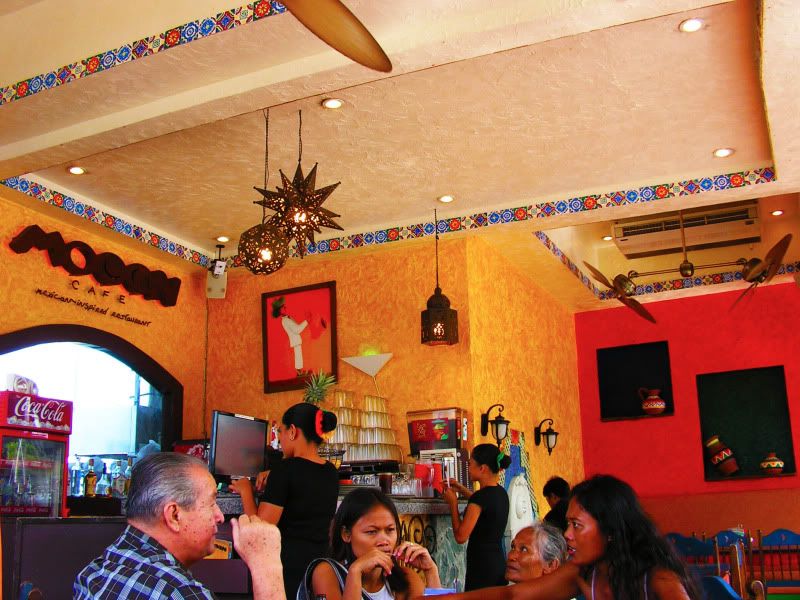
Mooon Cafe, an import from Cebu, has quickly come to capture Dumaguete with its affordable steak and what-not...
[Crossposted in a different form in
TravelBook.ph]
Labels: dumaguete, food, negros, travel
[0] This is Where You Bite the Sandwich
Monday, July 11, 2011
3:23 PM |
The Whirl and the Madness
I know that I am not the only one who knows how this feels: that sometimes you catch sight of his face, and everything else in the world becomes a whirl in an instant — and you’re so happy and you’re so sad all at the same time, you have to believe there is this one kind of madness in the world that calls itself by your name.Labels: life, love
[0] This is Where You Bite the Sandwich
Sunday, July 10, 2011

There is one simple reason why the horror stories of Yvette Tan come off with such a sense of satisfaction, and can be rightly considered as being among the best in the genre: reading her debut collection
Waking the Dead and Other Stories [Anvil, 2009], I soon realize that at their darkest hearts, these stories are really all about love and longing. The malevolence at the center of each story can be quite terrifying, but somehow Tan manages to go above the fray of mere horror to underline the human element that is at its core. This is what makes them transcendent. Consider the title story, where a lovelorn man unlocks a secret language that can summon the dead -- all to call from the other realm the woman of his affections. You read on, and you are confronted by a vast variety of horror -- both human and supernatural -- but it all goes back to this: there's one, and there's the other, and there's the longing to connect or to love, but there's the darkness between them that consumes. This is most darkly exploited in "Stella for Star," where a
tiyanak story becomes a dark fable of "motherly" love. In "Delivering the Goods," the precise and unfeeling butchering of a young boy for underworld reasons becomes a reflection for connection and fatherhood. In "Kulog," a
kapre makes a connection with a little girl, to his own detriment. In "Daddy," a father's ghost phones in, to leave one last
bilin. In "Boss, Ex?," a futuristic contraband movie chip becomes a means of dealing with the ghosts of the past, and loves lost. In the end, while you reel from the horror and the graphic details and the sense of dread of many of these stories, you are pulled in by the strange comfort of knowing that what lies beneath them is a pulsing heart -- bloodied and bruised, yes, but alive and filled with aching longing.
Labels: books, horror, philippine literature, speculative fiction, writers
[0] This is Where You Bite the Sandwich
Thursday, July 07, 2011
4:03 PM |
Decisive Moments
There are those small moments that happen to us that we know will have the pull of gravity on our lives -- and that we know will change some of the ways by which we currently go about living.
In recent memory, there was the encounter with a good friend bearing heartbreaking news in a late afternoon of 29 December 2008, in the gentle airs of Don Atilano while I was reading a book and drinking coffee, which led to a stupendous roller-coaster, which led to so many things, both bad and good, and that finally culminated in my trip to Iowa. I remember feeling a gnawing pain that pierced through me then, which made me stand up and take the first step towards a completely different life. I started with a small goal, which had repercussions on other things. All of which has led to what I have made of myself the past two years.
Today is a similar day, I think. 7 July 2011. A message from another good friend. The same kind of gnawing pain. The same reaction -- standing up from my chair while drinking latte in Cafe Antonio, and taking the first decisive step towards what I know will be a new phase in my life. I don't know what is in store for me in the immediate future, but that will be part of the adventure -- not knowing exactly, but striving towards a workable goal.
And so it goes.
Labels: life, love, work
[0] This is Where You Bite the Sandwich
GO TO OLDER POSTS
GO TO NEWER POSTS


 I have always wondered why people called National Artist for Literature Dr. Edith Lopez Tiempo “Mom Edith,” always with this measure of intimate familiarity that seems reserved for someone who is more than just a mentor. I was 20 years old when I first met her. I was a campus writer who wrote for the student paper in Silliman University—where she had taught for many years—and in 2000, I was told to apply for the National Writers Workshop.
 There is one simple reason why the horror stories of Yvette Tan come off with such a sense of satisfaction, and can be rightly considered as being among the best in the genre: reading her debut collection Waking the Dead and Other Stories [Anvil, 2009], I soon realize that at their darkest hearts, these stories are really all about love and longing. The malevolence at the center of each story can be quite terrifying, but somehow Tan manages to go above the fray of mere horror to underline the human element that is at its core. This is what makes them transcendent. Consider the title story, where a lovelorn man unlocks a secret language that can summon the dead -- all to call from the other realm the woman of his affections. You read on, and you are confronted by a vast variety of horror -- both human and supernatural -- but it all goes back to this: there's one, and there's the other, and there's the longing to connect or to love, but there's the darkness between them that consumes. This is most darkly exploited in "Stella for Star," where a tiyanak story becomes a dark fable of "motherly" love. In "Delivering the Goods," the precise and unfeeling butchering of a young boy for underworld reasons becomes a reflection for connection and fatherhood. In "Kulog," a kapre makes a connection with a little girl, to his own detriment. In "Daddy," a father's ghost phones in, to leave one last bilin. In "Boss, Ex?," a futuristic contraband movie chip becomes a means of dealing with the ghosts of the past, and loves lost. In the end, while you reel from the horror and the graphic details and the sense of dread of many of these stories, you are pulled in by the strange comfort of knowing that what lies beneath them is a pulsing heart -- bloodied and bruised, yes, but alive and filled with aching longing.