Celebration: An Anthology to Commemorate the 50th Anniversary of the Silliman University National Writers Workshop Sands and Coral, 2011-2013
Silliman University, 2013
At curtain call last Thursday night for Eve Ensler’s A Memory, A Monologue, A Rant, and A Prayer, nobody among the audience at the Claire Isabel McGill Luce Auditorium clapped. Not at first. And then only a timid few—nothing resounding the way one would applaud a circus act.
Yet that relative silence in the house at the end of the show—the tenth year offering by VDay Silliman University, which traditionally stages Ensler’s infinitely lighter The Vagina Monologues—was not an indictment of its quality. On the contrary. I think it was the fitting reception to a play that was in turns funny and harrowing—but more the latter than anything else. As Silliman President Ben S. Malayang III once put it in the 2008 staging of the same play, “I don’t know whether to clap or not at the end of each monologue. The performances were fantastic, but the issues they presented were brutally frank it felt wrong to hear the sound of applause.”
Suzanne Lu-Bascara as a Sudanese nun in "They Took All of Us."
Indeed, the performances this time around were sterling and precisely observed, distilled to uncanny identifiability and pathos by director Dessa Quesada-Palm who has outdone herself. Consider the stories we get from MMRP… Lawyer Myrish Cadapan-Antonio plays a woman questioning the sadomasochistic relationship she finds herself having with her husband in “The Perfect Marriage.” Globe marketing head Jacqueline Veloso-Antonio plays a woman remembering a violation she had to endure in childhood during soccer camp in “First Kiss.” Hochi Benitez plays a rape victim detailing, with unflinching thoroughness, her brutalization in “Groceries.” Jessica Delos Santos plays a plucky girl who decides to fight off being gang-raped in “Blueberry Hill.” Francelle Bagaforo plays a Hollywood actress who dreams of roles that go beyond beaten-up (or dead) prostitutes in “I Can’t Wait.” Arlene Delloso-Uypitching essays a plea to breaking our own patterns and cycles of violence in “True.” And Ms. Palm herself plays the allegorical role of an exhausted, unpaid, unacknowledged female workhorse (e.g., the unsung housewife) in “Woman Work.”
And those were the “lighter” monologues. When we get to Naddie May Orillana’s Guatemalan run-away wife trapped dying in a container box on the way “to a better life” in “Celia,” or Earnest Hope Tinambacan’s curiously moving story of an artist who gives his body to suffer in the hands of women who have themselves suffered much in “The Destruction Artist,” or Suzanne Lu-Bascara’s Sudanese nun begging for the lives of her girls kidnapped by a militia in “They Took All of Us,” the tone for the play was complete: this was all unsettling darkness that embraces, but also one that limns hope and light; this was a reckoning and rebuke of a world given to so much violence against women and children…
The play was a necessary purging and eye-opener for many of us in the Luce Auditorium. It is difficult material to stage, but Ms. Palm has done it with its integrity intact. The fact that she has midwifed it to the spectacular form we saw on the Luce stage last March 1 speaks of just how Ms. Palm has contributed to a revival of theater in Negros Oriental.
A revival there definitely is. The past two years have seen a boon for theater in Dumaguete, and MMRP is only one of the many productions that seemed to have sprouted in town. Even the late director Evelyn Aldecoa herself seemed to have sensed this, giving an inspired revival of Godspell in December only a few weeks before she passed away.
But we have been talking much too long about the demise of staged drama in Dumaguete. For a long time, we were content only in remembering the glory days when the likes of Ephraim Bejar, Lemuel Torrevillas, Junix Inocian, Paul Palmore, Andy Bais, Laurie Hutchison-Raymundo, Amiel Leonardia, Leoncio Deriada, Jenny Lind Aldecoa-Delorino, Bobby Flores Villasis, among others, had the city in thrall with their prolific outputs. After their generation, there has been relative silence. Of course, once in a while, some student directors—Ana Maria Borja and Claude Ramos among them—would inflame Silliman University with productions of one-act plays and manageable full-length projects, always to have this flame quenched by the fact of graduation.
And yet, I’m beginning to think this is changing. Consider, for example, the explosion of original material being put up: there was the cast-penned musical extravaganza Kabsi a few months ago, which was followed by its sequel only last January—two trifle pieces of jokes and songs that made up in craziness and fun what it lacked in substance and form; there was the original musical First Step a year ago, with music by Jai Molina Dollente and Anna Katrina Espino, which first sparked the idea in campus that original work was possible to stage; then there was Nizah Bagares’s Pepe and Me, a playful contemporary take on Jose Rizal, reimagining him for contemporary youth. As deftly directed by Mr. Tinambacan, it proved to be the most mature among the plays being created now by Silliman students—and it helps perhaps that Mr. Tinambacan has been trained by Ms. Palm in the ubiquitous Youth Advocates Through Theater Arts. YATTA, for the last few years, has been training its young thespians with playwriting work, and the effort has yielded a considerable body of theatrical works with an eye for social advocacy, from waste management to human trafficking. Consider Mr. Tinambacan’s own We Accept Boarders, staged a few weeks back by Linwell Bongcasan in Silliman Hall. A delightful farce of student dorm life, it may well prove to be the seminal work that will lead the way to a full-blown theater renaissance in Dumaguete.
There are palpable signs of this already. Only last week, the National Committee on Dramatic Arts of the National Commission for Culture and the Arts brought to Dumaguete the sixth edition of the annual Tanghal, the national university and community-based theater festival. This was in co-sponsorship with Silliman’s Cultural Affairs Committee and YATTA.
It goes without saying that the three-day festival has given local dramatics a significant boost, giving enthusiasts in Dumaguete a glimpse of the possibilities of regional theater. It has also underlined for many of us in Dumaguete a sense that a love for theater can be essential for a love of life.
There is also something about theater that unites the artists among all of us. This is the one art form that—beyond the requisite control of the action, the direction, and the subtle dramas of lighting and sound—also anticipates a consideration for other arts: there’s also music, sometimes there’s dance, there’s literature, and there’s design. To be in theater is to participate in a community of almost kindred spirits—and that is what I have witnessed with Tanghal 6.
We saw the breadth of the dramatic imagination from almost all corners of the Visayas—from Bohol, the exquisite rendition of history through the pangalay (Antequera and Punta Cruz Cultural Collective’s Tawag sa Bantayan and Tamblot); from Iloilo, the possibilities of contemporarizing classic texts for added resonance (University of San Agustin Little Theater’s Ciento Cincuenta: Mga Bagong Kabanatang Noli at Fili); from Bacolod, the staggering realism of an all-too-common reality heightened to gritty catharsis (University of St. La Salle Maskara Theater Ensemble’s Room Service), as well as the eye-opening theatrical possibilities of Pinoy hip-hop (College of San Agustin Kanlaon Theater Guild’s Circulo); from Dumaguete, the lofty reach of representational theater for social awareness—complete with music and the laughter (YATTA’s Kaluwasan sa Damgo ni Greta and Artista Sillimaniana’s Ang Tiririt ng Ibong Adarna). Theater practitioners Jojie Benitez, Glenn Sevilla Mas, Rudy Reveche, and Gardy Labad also gave workshops and shared their expertise of decades to a new generation of theater makers—which is what we most need right now: a continual act of inheritance and passing on.
For three days, what we saw was a full engagement into an art that is all-consuming, but for the better. What we saw was enough for us to know that theater is alive and well and has stronger significance in our society: it magnifies for us, after all, in more dramatic ways, how we are as human beings, and as Filipinos.
I’ve always wanted to begin a poem with the line, “I’ve always wanted to begin.” Now I have. Best to end here,
but then the universe is expanding back into its black beginnings, and space, aware of its own looming demise,
is singing of possibilities. I’m almost over, it sings, it’s almost over and sooner or later we’d be left with nothing but time. If we live that long.
Sometime before then all our dialects will have moored on the gray sands of forgetting, all our sad words will have started
to repeat themselves, as if sound didn’t dissipate into stillness, as if not everything has been said before. Here, let me tell you a joke: I am a man of faith.
Or a child, a tree, some living thing that will someday be a dead thing. What does faith have to do with it? I know;
it isn’t funny. Nothing funny about mortality, how movement bleeds into clockwork, how clockwork succumbs to its own igneous finitude.
How we aid entropy by being born. See? I only wanted to begin, now I’m humming the ghost-heavy refrain of imminent endings.
In that song about possibilities, someone is hurling an empty bottle skyward. I see you: You’re imagining it slowing towards its peak,
anticipating gravity, its ruthless duty. Stop. Don’t. Let’s go. Let’s not be around when it shatters. Let’s not wait for an ending.
Outside, the blue of the sky — it’s summer azure with none of the sultriness — should promise something grand and wonderful. It doesn’t. I cannot smell adventure in the air that’s burning from the blaze of the sun. I cannot take flight. I am not myself today. Then again I have not been myself the past few weeks. I feel like a piece of trash lost in a garbage dump. I feel like my life’s on hold, for the worse, and there’s nobody else to blame but me.
Every year, I make it a point to watch every single Oscar-nominated films (barring the short subjects) before the telecast itself, just to be in the know with the rest of the film world. Last year was a successful run, and I watched all ten best Picture nominees more than a month before the show itself. This year, I've been a bit remiss. And so, just to make sure I don't miss out on anything, I've made myself this check-list.
Best Picture
☑ The Artist
☑ The Descendants
☑ Extremely Loud and Incredibly Close
☑ The Help
☑ Hugo
☑ Midnight in Paris
☑ Moneyball
☑ The Tree of Life
☑ War Horse
My money is on The Artist. I love War Horse, but it's too traditional, and no one's betting on it. I love The Tree of Life as well, but no way's this one's going to win. Hugo, Midnight in Paris, and Moneyball left me cold, and The Descendants and The Help seem like a trifle. And I hated most of Extremely Loud & Incredibly Close.
☑ A Better Life
☑ Tinker Tailor Soldier Spy
☑ Albert Nobbs
☑ The Girl With the Dragon Tattoo
☑ The Iron Lady
☑ My Week With Marilyn
☑ Warrior
☑ Beginner
☑ Bridesmaids
☑ Margin Call
☑ A Separation
☑ The Ides of March
☑ A Cat in Paris
☑ Chico & Rita
☑ Kung Fu Panda 2
☑ Puss in Boots
☑ Rango
☑ Harry Potter and the Deathly Hallows Part 2
☑ Anonymous
☑ Jane Eyre
☐ W.E.
☐ Hell and Back Again
☐ If a Tree Falls: A Story of the Earth Liberation Front
☐ Paradise Lost 3: Purgatory
☑ Pina
☐ Undefeated
☐ Bullhead
☐ Monsieur Lazhar
☑ Footnote
☐ In Darkness
☑ Drive
☑ The Adventures of Tintin
☑ Rio
☑ The Muppets
☐ Transformers 3
☑ Rise of the Planet of the Apes
☐ Reel Steel
Thirty-six out of 46. Not a bad margin anymore. Still gotta do better. (But will I have the time at all?)
My friend, the young film critic Don Jaucian, posted this not too long in his Tumblr, and I thought it best to share it in the eve of Valentines week: “Writers are straight up, batshit insane people. You should never fall in love with them.”
He means to be cheeky, of course, himself being a writer. I found myself laughing at this because, in all honesty—and I’m probably kissing goodbye to my career as an earnest searcher for true love in Dumaguete—every bit of Don’s pronouncement is true. One can define this “insanity” of writers in so many different ways, but there are aspects to this truthiness, especially in that claim about loving them. When a writer loves you, worry: you will get immortalized as literature. If he doesn’t immortalize you, worry: you don’t move him enough for him to see a poem in you. If there are broken hearts involved, worry: you get immortalized in literature, warts and all. (Emphasis on warts.)
I think film director Marc Webb captured it best when he commandeered a quote attributed to the writer Henry Miller, and gave it to one of the characters in his film 500 Days of Summer as a piece of advice to its lovelorn hero, Tom: “The best way to get over a woman [or a man] is to turn her [or him] into literature.”
Because God know I have.
(And not always successfully.)
Once, many years ago, I had this terrible quarrel with Mark, someone I used to love and live with. We just had dinner with my ex who had decided to come back to Dumaguete to set up a restaurant. The dinner went well, but soon—on the way home—jealousy reared its ugly head. We found ourselves soon parked in a spot along Escaño Boulevard on a Monday night. Inside that green Pajero on that slow night, we had a row that was so dramatic, complete with earth-shattering dialogue, that I couldn’t help but think, in the middle of a fierce rebuttal: “I must remember this night. It sounds like a short story.”
And I did write about it, in a short story titled “Tell Him.”
Why do writers do this? Is it nothing short of airing our dirty laundry in public? Not quite. I guess one just follows the creative writing maxim of “writing what you know”—and sometimes the affairs of the hearts, compounded by its fierceness and more than considerable drama, is too compelling to refuse being set down to writing. I think of the exercise as something of a catharsis: in writing about the loves of our lives, we are somehow trying to find answers to our own unsettled questions. It also helps that in formulating the motivations for every character, especially the one clearly based on the lover, one is compelled to think of the situation from a point of view that is not yours, but theirs. You come to embody them—and in many ways, you see yourself through their eyes. Their pain also becomes your pain, and it helps in the act of moving on. Literature as psychoanalysis, if one must label it.
This may be why in all of my books, I could not seem to stop myself from dedicating each one to someone I’ve once dearly loved. If I may make a confession, in those books, I may have inscribed my own history of loving. They may be attempts to immortalize those fleeting days when love was all that seems real.
A young writer named Mik—and that is all the name I know—once wrote something wonderful in her Tumblr blog about what happens when a writer loves you. What she wrote was the most honest, most damning, most funny revelation in answer to that question. It is something I wish I had written myself. So, what happens when a writer loves you? Mik writes:
Lots of things might happen. That’s the thing about writers. They’re unpredictable. They might bring you eggs in bed for breakfast, or they might all but ignore you for days. They might bring you eggs in bed at three in the morning. Or they might wake you up for sex at three in the morning. Or make love at four in the afternoon. They might not sleep at all. Or they might sleep right through the alarm and forget to get you up for work. Or call you home from work to kill a spider. Or refuse to speak to you after finding out you’ve never seen To Kill a Mockingbird. Or spend the last of the rent money on five kinds of soap. Or sell your textbooks for cash halfway through the semester. Or leave you love notes in your pockets. Or wash you pants with Post-It notes in the pockets so your laundry comes out covered in bits of wet paper. They might cry if the Post-It notes are unread all over your pants. It’s an unpredictable life.
But what happens if a writer falls in love with you?
This is a little more predictable. You will find your hemp necklace with the glass mushroom pendant around the neck of someone at a bus stop in a short story. Your favorite shoes will mysteriously disappear, and show up in a poem. The watch you always wear, the watch you own but never wear, the fact that you’ve never worn a watch: they suddenly belong to characters you’ve never known. And yet they’re you. They’re not you; they’re someone else entirely, but they toss their hair like you. They use the same colloquialisms as you. They scratch their nose when they lie like you. Sometimes they will be narrators; sometimes protagonists, sometimes villains. Sometimes they will be nobodies, an unimportant, static prop. This might amuse you at first. Or confuse you. You might be bewildered when books turn into mirrors. You might try to see yourself how your beloved writer sees you when you read a poem about someone who has your middle name or prose about someone who has never seen To Kill a Mockingbird. These poems and novels and short stories, they will scatter into the wind. You will wonder if you’re wandering through the pages of some story you’ve never even read. There’s no way to know. And no way to erase it. Even if you leave, a part of you will always be left behind.
If a writer falls in love with you, you can never die.
Ponder on that. And Happy Valentines to one and all.
Last weekend, to mark a surge in this art and culture renaissance in Dumaguete City, we did a national media launch for the 50th anniversary of the Silliman University Cultural Affairs Committee. This is perhaps the best-organized cultural body in the city today, distinguished by the fact this may be the only university standing committee that takes in the full participation of the community, as well as other sectors—the church, the alumni, the faculty, the staff, the students, aside from kindred spirits from the community of artists in campus.
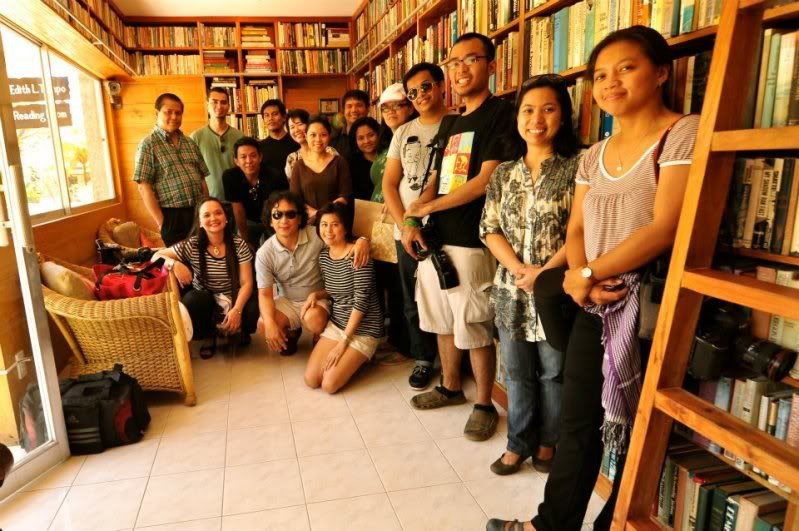
The media in the Edith Lopez Tiempo Library of Antulang Beach Resort. Photo courtesy of Annabelle Lee-Adriano.
They came from all over to witness the promises of the upcoming 50th Cultural Season, to start June 2012 all the way until May 2013—media representatives from the Philippine Daily Inquirer, Philippine Star, Manila Bulletin, Business Mirror, Cebu Pacific’s Smile Magazine, Philippine Airlines’ Mabuhay Magazine, Esquire Philippines, Good Housekeeping, ABS-CBN, Visayan Daily Star, MetroPost, and KillerBee among them. We got the help of Florentina Homes and CocoGrande to house them, and KRI, La Residencia, and Lab-as to give them an idea of the culinary culture of Dumaguete. The Silliman Campus Ambassadors gave them a cultural tour of the campus, while the Province of Negros Oriental, Sidlakang Negros, and the City of Dumaguete gave them a cultural tour around town. By the weekend, Antulang Beach Resort hosted them for a fortnight, complete with a spectacular sunset view of Tambobo Bay off artist Karl Aguila’s residence. By the end of it all, Ballet Philippines artistic director Paul Alexander Morales pronounced it “one of the best weekends” he’s had, which Philippine Opera Company’s Karla Gutierrez and the Cultural Center of the Philippines’ Raul Sunico readily agreed to.
Taking a bow during curtain call at the Luce Auditorium for Handulantaw. With Yvette Malahay-Kim, co-director Leo Mamicpic, and director Dessa Quesada-Palm. Photo by Aris Ramiro.
We gave them as well a performance of select cultural groups and artists in campus—including young pianist Alexis Pal, the Kahayag Dance Company, Kwerdas, the COPVA Rondalla, the Silliman University Gratitude and Goodwill Ambassadors, the cast of the current Godspell, among many others—in a show at the Luce Auditorium titled Handulantaw. Director Dessa Quesada-Palm wrote of the show in her program notes: “Sensorial hints of an island-terrain. Unearthed pages from decades past. Scattered texts of poetry, songs and dances. Beloved artists and mentors who left an indelible influence. Memories, musings, and insights. Handulantaw constitutes a collective act of remembering. It has fragments of the past fifty years and more, a cultural mosaic of the locale that continues to shape, instruct and inspire this generation of artists and cultural workers in its own being and becoming. It is a necessary conversation that invites retrospection and looking forward. Hence the deliberate connection of handum/handumanan (‘reminisce/keepsake’) and lantaw (‘looking forward’). And that is the grace of a rich history, that in putting together and making sense of its parts, what may seem so disparate, belonging to distant contexts of time and space, are brought together in a narrative that becomes accessible, real and meaningful to the present.”
Dessa continues, with a more somber note: “We asked ourselves whether there is wisdom in organizing the Silliman University’s 50th Cultural Season at the aftermath of the devastation wrought by Typhoon Sendong in our communities. Disasters bring a raw sensibility that is so urgent, so troubling, so compelling. It was a self-interrogation, which led us to the past again, on periods of strife and suffering, when artists did not succumb to despair and hopelessness, but instead resolutely created arts that healed, that probed, that tamed the chaos, that lifted spirits. This is what we are celebrating. That intractable yearning in each of us to sustain life and creativity come what may. It is, indeed it is, a powerful and irresistible covenant with the Divine.”
What are we celebrating? Since Silliman’s founding in 1901, a very important part of campus life has been its cultural fare. Every week, there is always a concert, a literary workshop or poetry reading, a play, a dance, an exhibit, a film showing, or some other cultural activity taking place in a number of exhibition halls and performance spaces, such as the Luce Auditorium and Foyer Gallery, the Woodward Little Theater, the Guy Hall Music Sala, the Silliman Hall Gallery, the Amphitheater, the Robert and Metta Silliman Main Library, the Gymnasium, the Audio-Visual Theater, the End House Gallery, the Silliman Church Catacombs, and others. Before the Luce’s completion in 1975, Shakespearean plays were regularly presented in the Amphitheater, and prestigious performing companies such as Le Grand Ballet Classique de France and such musical luminaries as pianist Susan Starr have performed in the Gymnasium.
In 1962, the Cultural Affairs Committee was formed under the able chairmanship of Prof. Miriam G. Palmore, who was the former director of the School of Music and Fine Arts (now the College of Performing Arts). Among the famous artists and performers in those early years (before the building of the Luce) included the Cultural Center of the Philippines Dance Company, Taipei Children’s Choir, French concert pianist Nicole Delannoy, German violinist Denes Zsigmondy, American soprano Julia Finch, Swiss pianist Nicole Wickihalder, Filipina pianist Cecile Licad, American violinist Stanley Plummer, and popular local singers such as Pilita Corrales who was then a singing superstar in Australia. With the Luce finished by 1975, culture and the arts had a permanent home in Silliman.
Silliman’s own artists and performers also dominated the cultural landscape with unique contributions to the world of arts, including the National Writers Workshop founded by Edilberto and Edith Tiempo the Men’s Glee Club founded by maestro Albert Louis Faurot, Kwerdas and the Silliman University Campus Choristers founded by Priscilla Magdamo-Abraham (the latter co-founded with Emmy Luague and Ruth Imperial-Pfeiffer), the Silliman Young Singers and the Luce Choral Society founded by Isabel Dimaya Vista, the Silliman Dance Troupe (now the Kahayag Dance Company) founded by Lucy Jumawan-Sauer and Shona Mactavish, the Aldecoa Family Ensemble, Musika Sacra founded by Elmo Makil, the Portal Players founded by Amiel Y. Leonardia.
The Cultural Affairs Committee, under the leadership of chairpersons including Prof. Miriam G. Palmore, Prof. Isabel Dimaya-Vista, Prof. Ruth Imperial-Pfeiffer, Mrs. Vienna Silorio-Jumalon, Dr. Elizabeth Susan Vista-Suarez, Dr. Laurie Hutchison-Raymundo, Prof. Eva Rose Repollo-Washburn, Prof. Joseph B. Basa, and Prof. Diomar Abrio has continued its mission to bring to Silliman University and the Dumaguete community various cultural representations aimed at exposing them, especially students, to all the arts—with a subsidized fare, perhaps the most generous of its kind in the country, allowing students and the Dumaguete community to see cultural presentations by such national companies and cultural organizations as Ballet Philippines, Philippine Educational Theater Association, the Manila Symphony Orchestra, Ballet Manila, Dulaang U.P., the Philippine Philharmonic Orchestra, the Philippine Madrigal Singers, Repertory Philippines, Tanghalang Pilipino, the Bayanihan National Dance Company, the Ramon Obusan National Dance Company, the New Voice Company, Philippine Opera Company, Little Boy Productions, British Council, Japan Foundation, and others.
It is a heady undertaking—and often rocky, too—but it is a mission. Among us members, this is a responsibility we don’t take lightly, passionate as we are about the need for a sustainable celebration of culture and the arts here in Dumaguete. As we look forward to the Golden Anniversary, we aim higher with the full knowledge that what we are celebrating in fact is the human spirit.
With Little Boy Productions' Hendrison Go, Silliman President Ben S. Malayang III, and Ballet Philippines' Paul Alexander Morales after the Handulantaw show. Photo by Darrell Rosales.
In 2008, representing Dumaguete for the Cinemalaya Film Congress, I was asked during my panel in the Cultural Center of the Philippines if there was a community of filmmaking in Dumaguete. "Sadly, no," was my reply, but vowed to get things going. So here we are, we just had Dumaguete Shorts: A Festival of Short Films By New Dumaguete Filmmakers last Friday. It was fun, the kids loved it. it's a start.
Ramon del Prado's Libingan [2007]
Eliora Eunice Bernedo's The Bird, The Bees and All the In-Betweens [2009]
Stephen Abanto's Suga [2011]
Karen Grace Yasi's Anniversary [2009]
Brian Rimer, Kim Cuevas, and Mary Aimee Leduna's Amor y Sangre [2011]
Apparently the French has a term for repeating a word continuously it finally loses meaning. They call it "jamais vu.” I think of that, and then I think of repeating your name, endlessly, until the very effort exhausts me. But I'm afraid no meaning will be lost. The act, I'm sure, will only become a kind of prayer.
These days, you can feel a palpable stirring, culture-wise, in Dumaguete City. Not that the arts are dead here. Of course not. It’s just that—starting more or less about half a decade ago—it has never been this alive. And how it sparkles in the kind of life it has now!
There was a time, especially in the early 1990s, when the cultural well seemed on the verge of going dry relatively speaking. (I play safe here, because there will be others with differing opinions. I can imagine somebody writing to me soon, thundering: “That’s not true!”) But for some reason or other, many of Dumaguete’s resident artists, writers, and cultural workers were answering the outside lure of better jobs and bigger cities. (Some stayed. Many more just faded away.) The National Writers Workshop lost the support of the university it had been part of since its founding in 1962, and it floundered like an orphan until the Tiempos found generous institutions which pledged enough to continue the revered workshop’s existence. Around the same time, the Renaissance Man himself, Albert Louis Faurot, died in Dumaguete. A relative came “to settle his affairs,” so goes one story from Moses Joshua Atega, and gathered pieces of his collection—and proceeded to burn them for reasons we can only speculate over. That bonfire seemed quite metaphorical of the state of things. Faurot’s End House, site of many recitals and poetry readings, fell into disrepair. His book collection and paintings were scattered about—and some of us would occasionally wonder during meetings, “Where are those paintings now? And those books?” I saw some of those books. Vintage hardbound copies of the best of literature—some worn to old age by silverfish and dust. Oh, those were dark days. I came into my youth in those early years of the 1990s, and for me these were wisps of once mighty names I had to get to know because largely forgotten.
And yet, look.
Nothing can be farther than the reverse of all that, these days. Our artists and writers are flocking back to Dumaguete once more, making it—in the words of Carmen del Prado’s documentary on the subject matter—“an artists’ haven.” There’s a budding community of young writers and filmmakers starting to make waves. The older visual artists may still be squabbling with each other—but consider Razceljan Salvarita and Hersley-Ven Casero, the vanguards of the new wave: they hold their heads above the vicious sway, and their art is fresh and revitalizing. We have new filmmakers in the making—Hersley’s Paper and Stephen Abanto’s Suga just made it into the roster of SineRehiyon Film Festival, representing the film scene in Dumaguete. There’s a film club in the city now, also a photography club (under the guidance of master photographer Greg Morales), and a fledgling group of young writers. The National Writers Workshop is also back with Silliman University, which has also been in the process of creating a Creative Writing Center to be named after Edilberto and Edith Tiempo. Last year, the workshop celebrated its fiftieth year with a reverent nod to how it has helped shape contemporary Philippine literature. And Faurot has a lecture series named after him, with some of the world’s top artists, writers, and cultural workers—from Pulitzer Prize winner Edward P. Jones to poet Marjorie Evasco, from composer Ryan Cayabyab to sociologist Lorna Makil—coming to the city to share their thoughts on art and culture as well as their process, all under the shadow of Faurot’s name and memory.
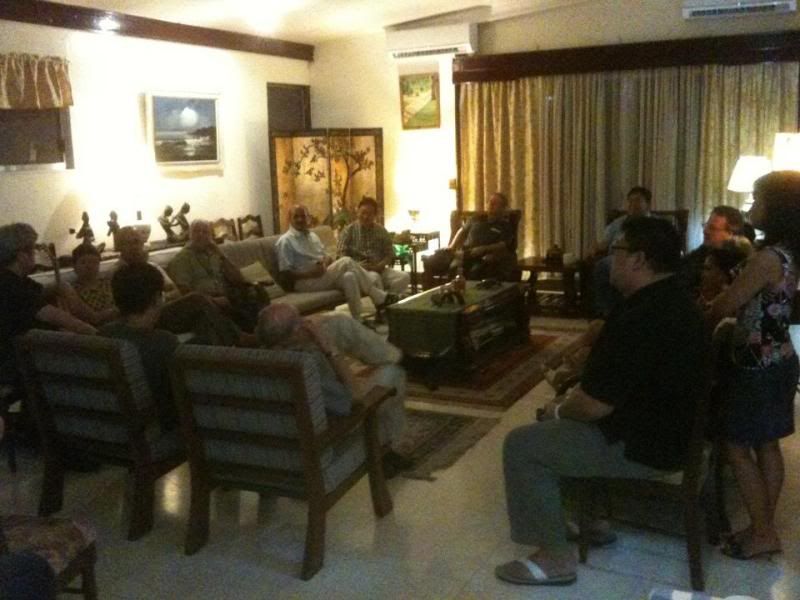
I first thought of this for real when I was invited last weekend to a dinner being held at the Silliman President’s House last Saturday. Dr. Ben Malayang III and wife Gladys were hosting, and our guest of honor was the environmentalist Nicanor Perlas who was in the city to launch a book. Chef Andreino—Dumaguete’s Pasta King—had prepared a sumptuous dinner for us, a two-course meal punctuated with great dessert and fantastic wine. And so we came: among us, there were Jojo and Myrish Antonio, Dessa Quesada-Palm, Simon and Virginia Stack, Arlene Delloso-Uypitching, Esther Windler, John Stevenson, Ian Malayang, the master classical guitarist Michael Dadap, and some others. It was a night of conversation, as scintillating as they come, fueled by the red wine. One knows how that goes. And soon enough Mr. Dadap—the brother-in-law of the cellist Yo Yo Ma—gave us a mini-concert cum lecture. “I am going to play for you two Visayan folk songs,” he said. One is happy, he said, but the song itself is really sad; the other one sounds sad, but it really is happy. “I think we do sadness with a dash of happy attitude—to mask that sadness. And we coat our happiness with a sad tone, because we don’t want other people to take away that happiness.” First he played a masterful rendition of “Dandansoy,” plucking away its melancholic tone, but with a knowing wink that this is about a man who feels assured that his love for a woman is secure enough for him to say a temporary farewell. Then he goes on with “Pobreng Alindahaw,” playfully underscoring its upbeat tone with the song’s story of a dragonfly who is swept away by the wind while flying among flowers. Somebody—I think it was Simon—asked about folk music from Luzon, and Mr. Dadap went on to play a kundiman favorite “Jocelynang Baliwag.” When we start asking him questions about the classical guitar, what we got was a brief and inspired “lecture,” with musical excerpts, escorting us to the world of the Egyptian kithara, the Spanish flamenco, and the consummate artistry of guitar giants Andrés Segovia and Agustín Pío Barrios—“whose genius,” Mr. Dadap proclaimed, “is perhaps equal to Mozart.”
I looked around the sala in the President’s House. This was also where some of us—Sir Ben, Ma’am Gladys, John, Simon, Tata, Annabelle Lee-Adriano, Bron Teves, Cesar Ruiz Aquino, Myrna Peña-Reyes, Mariglor Arnaiz, and sometimes RV Escatron and Indian scholar Annie Kuraichan—meet every Wednesday night, to talk about literature over food and drinks, and we have gone from John Donne to Robert Frost to Jorge Luis Borges to William Shakespeare to T.S. Eliot to Allen Ginsberg. A literary salon, so to speak. We have a merry time, a once-a-week exercise of our critical abilities as well as our imagination.
It seems fitting that all these stem from this house in Silliman campus. The President’s House as a center of culture, but done in a lovely fit, loose and easy-going. This is art, and its appreciation, with heart. And I am glad I live in this time, with a city buzzing with so many possibilities.
It is a good time to be an artist in Dumaguete. (To be continued…)
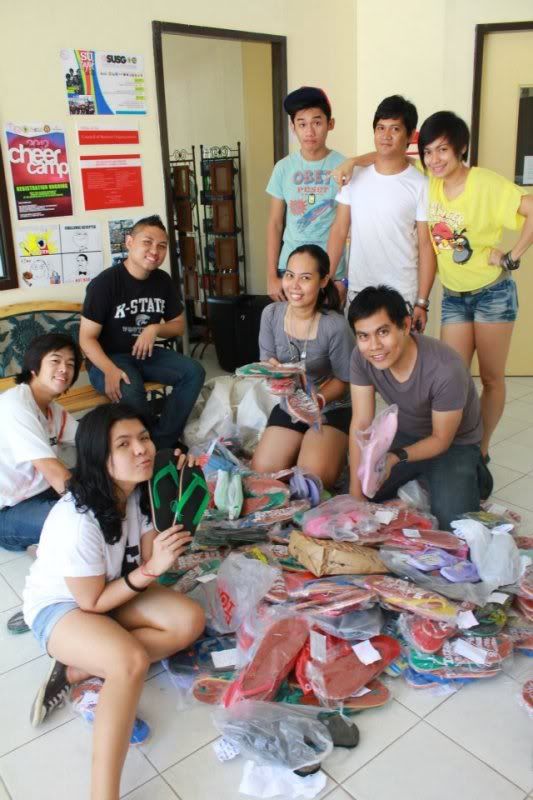
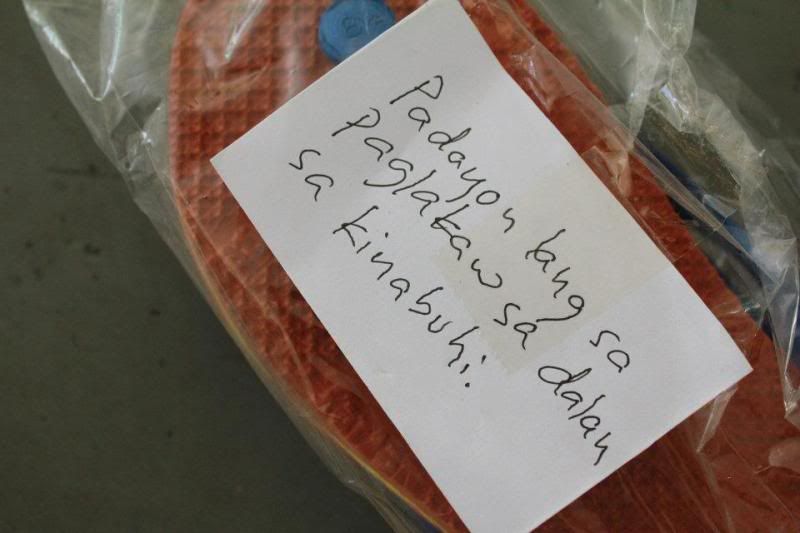
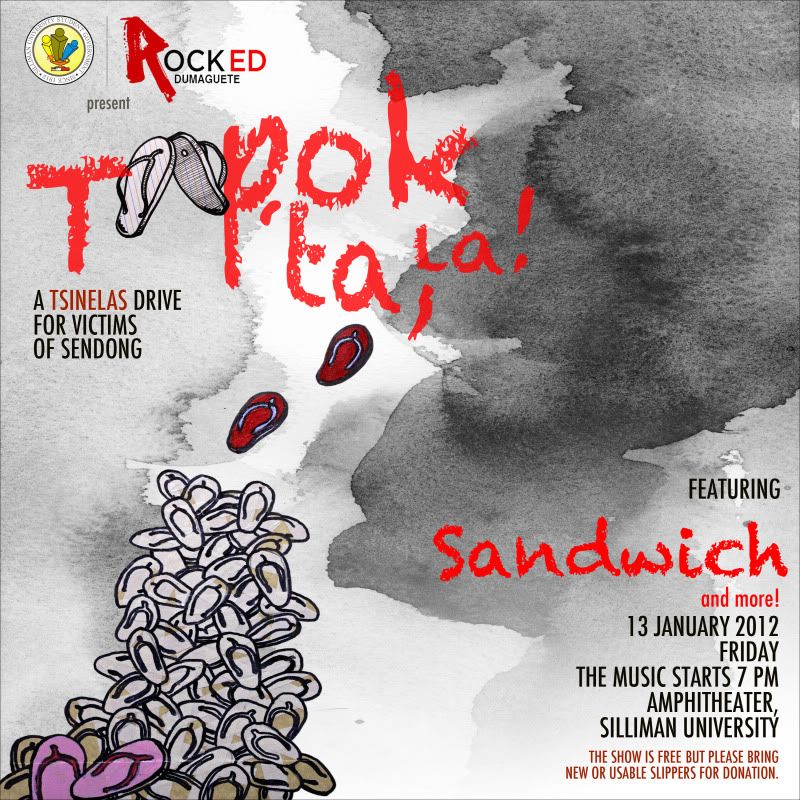
During last week's Tapok 'Ta, La! gig, Rock Ed Dumaguete volunteer Mars Edding had this idea of asking donors of slippers for Sendong victims in Negros Oriental to write a short message for their recipients. As we sorted out the donations -- 475 pairs of slippers in all! plus clothes and books and other things -- this morning at the Oriental Hall in Silliman University, we proceeded to photo-document some of these...
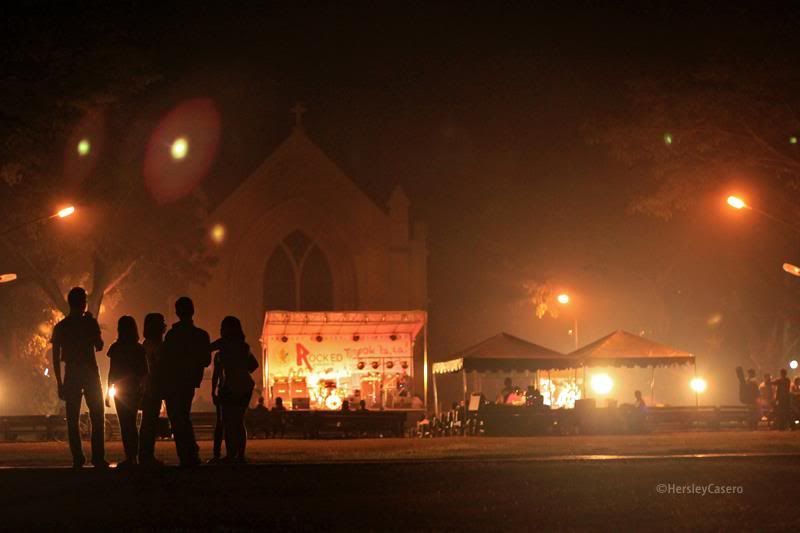
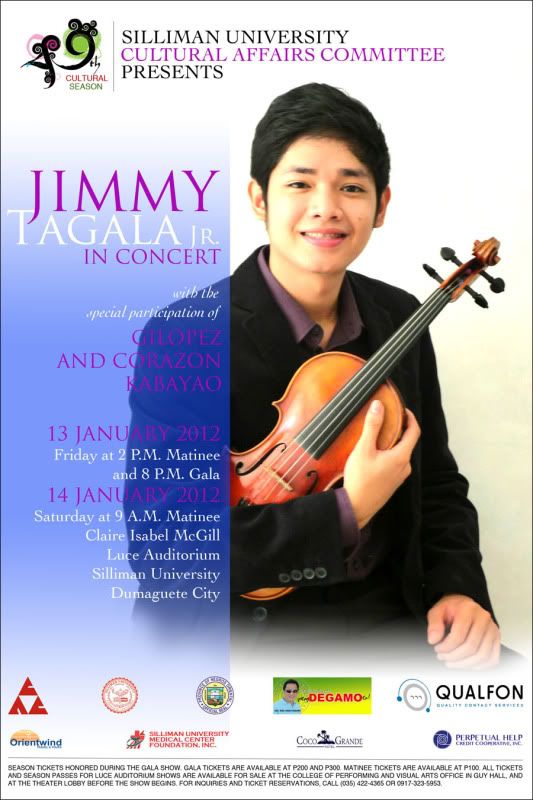
It was a delicate balance. How to divide one’s body on a Friday night when you are part of the organizing teams behind two events happening simultaneously? At the Claire Isabel McGill Luce Auditorium, for the Cultural Affairs Committee of Silliman University, the young virtuoso Jimmy Tagala Jr. was making his debut as a solo headliner, with mentors—the legendary violinist Gilopez Kabayao and pianist wife Corazon—in tow. At the Amphitheater, for Rock Ed Dumaguete’s Tsinelas for Sendong Drive, Sandwich was amping it with the pure gusto of Pinoy rock.
Two different kinds of music, poles apart. (And yet, by evening’s end, I would find out the heart for both is the same.)
It was a decision I tossed to the fates—“I would follow where my feet would lead,” I told myself. I settled for considering myself, in a way, lucky: what charmed life one must live to have front row seating to two great things. But somehow I managed to attend both, with my body intact. No dividing or cloning required, helped for the most part for the mere few hundreds of meters that divided the wild openness of the amphitheater and the hallowed hall of the Luce. My feet, it seemed, were quick enough to straddle the divide.
It was important to be at the Sandwich gig. We were raising awareness for Sendong relief, and we were inviting people to come and hear the music for free. But we were encouraging them to come and bring new or usable tsinelas for victims of Sendong. And sure enough, they came by the hordes. The boxes of tsinelas we brought over to sell—just in case anyone in the crowd felt “too lazy” to come with a pair to donate—sold out even before Sandwich took to the stage. And people were donating and donating, some in used clothing and some in money—that it was enough to restore faith in humanity. The shower of donations and good will almost brought some of the Rock Ed volunteers to tears. And there were many of them—young people from all over the city and not just Silliman University—coming in with the fullest intentions to help. I remember Gang Badoy telling me once that this was our ultimate mission in Rock Ed, to plant this seed of civic concern among the young. That it can start out small, but it will pay in big dividends in the future. The tsinelas is just a metaphor, a seed. The real goal is to reinvent people.
By 9 PM, the grounds of the amphitheater would be filled to capacity, if that was possible—but it was enough, it would seem, for lead singer Raimund Marasigan to willingly jump into the moshpit, twice. And the crowd went wild.
There are many people to thank for this, of course. The indefatigable Mahogany Rae Bacon, the irrepressible Mars Edding, the amazing Marita Ong, Rena Ochoco, and Yan Vanslembrouck. Then there’s Anna Katrina Espino, and Cole Geconcillo, Babes and Joey Utzurrum, Hersley Ven Casero, Precious Grace Heradura, Silvin Maceren, Jaimee Duran, Fe An and Fob Sy, Robbie Yasi, Ron Calumpang, Sanda and Sande Fuentes, Duds Tecson, Von Cathleen Panot, among many others. These people are the young heart of Rock Ed volunteerism.
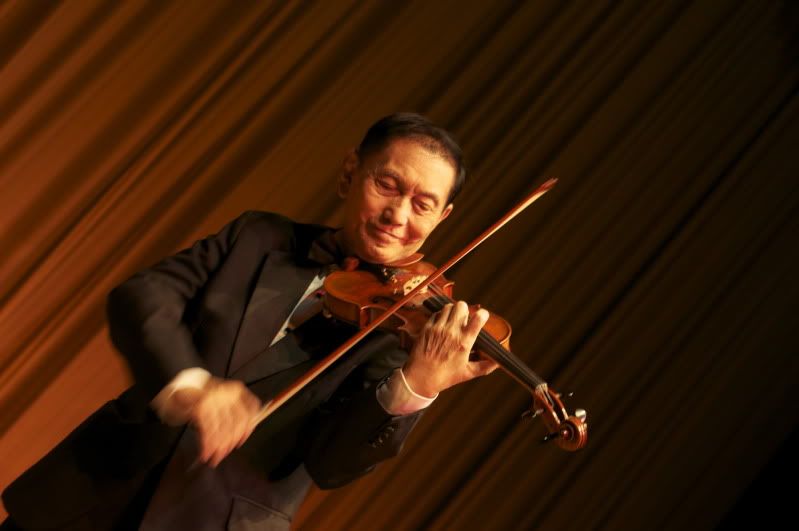
While rock music went full blast in the amphitheater, a few meters away at the Claire Isabel McGill Luce Auditorium, Gilopez Kabayao came back to his alma mater to play and to guest support his protégé, the fantastically talented virtuoso Jim-Jim Tagala. We hurried there to catch the concert in time, and to get some video footage of Mr. Kabayao for a planned video project for the fiftieth anniversary of the Cultural Affairs Committee. The pre-show photo shoot (with Annabelle Lee Adriano) went quite well, and so did the interview we did with the Kabayaos and Jim-Jim.
And when it came to Jim-Jim’s music, we were in for a pleasant shock. How many standing ovations did we give him? Quite a few, and heartily meant, too. For his youth, this violinist managed to wow the Luce crowd with uncommon dexterity and organic connection to the music. His duet with his mentor over Bach’s Concerto in D Minor for Two Violins was more than worth the price of the ticket, but Jim-Jim’s take on Tchaikovsky’s Concerto in D Major, Op. 35 brought down the house. He would bring down the house twice more, with Kabayao’s intricate arrangements of Paganini’s Caprice No. 15 as well as Abelardo’s Mutya ng Pasig and the folk song the folk song Bahay Kubo, and finally with a shattering finale with Bizet’s Carmen. To watch Jim-Jim play the violin was to see music breathing.
What a Friday night that was.
[Photos by Hersley-Ven Casero and Annabelle Lee-Adriano]
There was a reason why that polar bear—a white stuffed toy that oozed with such joy—felt special. There it was in the LBC box just newly arrived from Bacolod, glistening in its furry whiteness, in the midst of other toys (and underwear) sent in by donors from New York as well as from Negros Occidental. That Tuesday afternoon early in January, fresh off the devastations of December, some members of Rock Ed Dumaguete had gathered in Silliman Church, our meeting place before we’d leave for the mountains of Valencia to distribute the relief goods. And we all felt the strange urge to just hold the bear, to hug it.
Rock Ed Dumaguete, along with Silliman University, was collecting stuff for relief efforts, and one of our volunteers—the amazing Greg Morales, photographer par excellence—once said that during one distribution round for victims of Typhoon Sendong, one thing he had noticed was that kids in the evacuation camps he had visited were getting bored. They had lost everything in the flash flood, and they had nothing to play with. Except perhaps dirt and stones and what-not. “Boredom can be deadly,” he said.
And so when Gang Badoy of Rock Ed Philippines forwarded me a message from Jane Uymatiao, which said that she knew of a guy in Bacolod who wanted to donate toys for the relief efforts in Dumaguete, I jumped at the chance. The guy was Bugsy Bongco, and with help from LBC who waived the fee for delivering the goods, we received the boxes. They were crammed full of fantastic toys, as well as clothes and underwear for children.
Joining me that Tuesday were some Rock Ed volunteers aside from Greg—Ron Jacob Calumpang, Robbie Yasi, Mariekhan Edding, and Arlene Delloso-Uypitching who came with her young daughter Hannah. We saw the polar bear, and we all said, “We’re going to give this to somebody special.” How we would know that we left to the universe. We knew we would just know. And so we went to five barangays that afternoon. By nightfall, we found ourselves in our last stop in one Valencia barangay near Palinpinon. It was full of kids. And one of them was this wee girl, perhaps three or four years old. She was being carried by her ate, and when we saw her, something clicked. This is the kid we were waiting for.
Rock Ed Dumaguete volunteers Ron Jacob Calumpang and Hannah Delloso-Uypitching handing out toys and underwear in Valencia. Photo courtesy of Greg Morales.
Hannah quickly took the stuffed toy from the nearly empty box, and gave it to the girl. The sight of those young eyes beholding this huge toy was priceless.
We would tell Bugsy about this of course, and he felt the need to tell this story: “Ian, let me tell you something about the polar bear—and most of the stuffed toys we sent you. They’re from a very good friend of mine who works as a nanny in New York but has not come home in almost ten years. Her papers expired when she was jobless and penniless, so she’s a TNT, there up to this time. Almost everything she earns goes to her nephews and nieces and her old mom here in the Philippines. Despite all her problems, she has managed—through the years—to collect stuffed toys from her employer who allowed her to bring them home with her. She put them in her small rented room in New Jersey—and that polar bear sat at the foot of her bed for a long, long time. She did not have money to put all the toys in a balikbayan box. But finally, God being good, we found the money to have the balikbayan box shipped to me. I intended to give them to orphans and street kids, according to her instructions. But I couldn’t do it sooner because I teach. I waited for Christmas break. Typhoon Sendong came and... God showed us the way to you through Jane of Philippine Beat (whose email add I stumbled on in Twitter). My New York friend said, before she sent the polar bear here, ‘It’s time for you to have another roommate.’ I am sure she will be happy to know it went to a cute little girl in Dumaguete. Thank you again! I am not wishing for another calamity but, should the need arise, please do not hesitate to let me know and I will do my best to be able to help again.”
This just broke my heart, but in a good way. How sometimes we are moved to restore our faith in humanity because there are countless (mostly anonymous) people out there who do feel the need to reach out and help other people—even when they’re also in circumstances that is less than spectacular.
Which is why I’m quite happy to coordinate Rock Ed Dumaguete with its Manila founders—an amazing bunch that includes Gang Badoy, musician Noel Cabangon, rocker and writer Lourd de Veyra, filmmaker Pepe Diokno, publisher Ani Almario, among many, many other private citizens, entrepreneurs, and creative—visual artists, writers, musicians, and others who feel a deep personal need to help out, in fun and creative ways, the people in our country, most of whom have nothing. Part of Rock Ed’s motto is “to help make helping other people easier for most people,” in a sense to slowly create a culture and mindset of civic mindedness especially among the young. Subtlety and rocking it are all part of the package. Rock Ed’s biggest aim, of course, is alternative education beyond the classroom—essentially finding creative ways to teach people young and old about everything, from entrepreneurship to HIV awareness to solving mathematics problems. And most often with the help of music.
And so far, since Rock Ed’s inception in Dumaguete in the wake of Sendong, the response of many young people wanting to do their part—be it environmentalism or gender education or relief efforts for disasters—have been electrifying. I have never seen these many young people energized to do something for the community. I don’t think it’s just them joining in a trend. There’s genuine concern and enthusiasm here.
It is a good sight to behold, and Dumaguete is so much better for it.
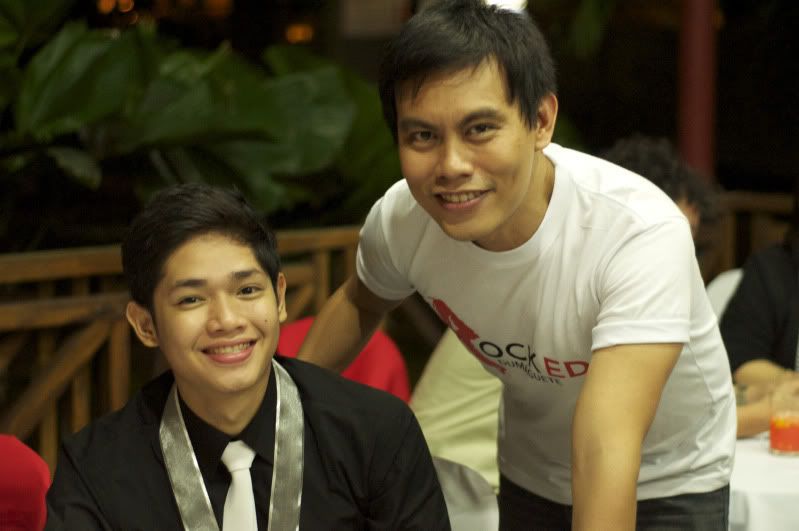
Some members of the core group of Rock Ed Dumaguete: Cole Geconcillo, Mahogany Rae Bacon, Precious Grace Heradura, Mariekhan Edding, Anna Katrina Espino, Robbie Yasi, Ian Rosales Casocot, with Gang Badoy. Photo courtesy of Ms. Badoy.
If you want to become a Rock Ed volunteer, or if you have books, clothes, and other things you can donate for our various drives, please email me at ian.casocot(at)gmail.com. Visit the Rock Ed Philippines website at www.rocked.ph. Like us in Facebook (search for RockEdDumaguete), and follow us on Twitter @RockEd_Dgte.
12:20 PM |
Today in Culture in Dumaguete: Violinist Jimmy Tagala Jr. in Concert at the Luce and Sandwich in a Benefit Concert at the Amphi
Jimmy Tagala Jr., first-prize winner of the recently concluded 2011 NAMCYA Violin Category C competitions, will be featured in a solo recital at the Claire Isabel McGill Luce Auditorium in Silliman University. The gala concert is set on 13 January 2012, Friday at 8 in the evening with a program of classical violin virtuoso works, including Concerto in D by Tschaikowsky, Caprice No. 15 by Paganini, Sonata in D minor for Violin and Piano by Brahms, Mutya ng Pasig and Bahay Kubo arrangements by Gilopez Kabayao, and Carmen Fantasy by Sarasate.
The unique feature for this concert is the special participation of Filipino violin virtuoso and musical crusader, Gilopez Kabayao, as guest artist in Scherzo Tarantelle by Wieniawski and Bach’s Concerto for Two Violins in D Minor together with the featured soloist. It is one of the rare occasions when Prof. Kabayao will once again be heard in Silliman University. Corazon Pineda Kabayao will be the assisting artist at the piano.
Mr. Tagala has been under the tutelage of Prof. Kabayao since he was 12. He was first place winner at the 2005 NAMCYA Violin Category B at 14 and at 15, and was the youngest among a hundred young musicians from Asia who were accepted to join the 2006 Asian Youth Orchestra in its concert tour of six Asian countries. At 16, Mr. Tagala gave his solo debut concert with a performance of the Beethoven and Khachaturian concertos to critical acclaim. He joined the Kabayao Family Quintet in their European concerts in 2009.
A matinee lecture-recital will be held at 2:00 in the afternoon of January 13 as part of the cultural-education program for the students. Season tickets honored during the gala show. Gala tickets are available at P200 and P300. Matinee tickets are available at P100. All tickets and season passes for Luce Auditorium shows are available for sale at the College of Performing and Visual Arts Office in Guy Hall, and at the theater lobby before the show begins. For inquiries and ticket reservations, call (035) 422-4365 or 0917-323-5953.
Popular Filipino rock band Sandwich, meanwhile, headlines a concert/donation drive for rubber slippers for the Sendong relief efforts in Negros Oriental. The Silliman University Student Government (SUSG) and Rock Ed Philippines Dumaguete Chapter co-sponsor this event to spread the word about Sendong and the relief efforts still necessary to alleviate conditions in affected areas. The concert for a cause, titled “Tapok ‘Ta, La!—A Tsinelas Drive for Victims of Sendong,” is slated at 7 P.M. at the Amphitheater. More details here.
“To know that one does not write for the other, to know that these things I am going to write will never cause me to be loved by the one I love, to know that writing compensates for nothing, sublimates nothing, that is precisely there where you [my beloved] are not—this is the beginning of writing.”
~ ROLAND BARTHES, A Lover’s Discourse
I once dedicated an entire book to declare my love for a boy. Even if he didn't love me back. That much I know, at least now. But oh the pleasures of that heartbreak—and the exquisite knowledge that this book was a singular expression of a distinct passion I would always remember. It didn't matter that he did not love me back, at least not in the way I wanted him to. He led me to words, and somehow that was enough.
I borrow freely from the dictates of Henry Miller, too: that to get over a beloved, one must turn him or her into literature. If I think hard about it, “love me, love me, love me” seems to me the biggest engine of my own writing. And so something like this from Barthes, the guru of pleasure and the text and the beloved, comes to me like a sobering reminder about the sweet and tender futility of it all. But one’s denial of that—well, it keeps me going still in writing.
1:48 PM |
Sandwich Headlines RockEd Dumaguete's Sendong Tsinelas Concert for a Cause
A drive for rubber slippers is the target for the latest Sendong relief efforts in Negros Oriental. The Silliman University Student Government (SUSG) and Rock Ed Philippines Dumaguete Chapter are spearheading a concert featuring Sandwich and other bands to spread the word about Sendong and the relief efforts still necessary to alleviate conditions in affected areas. The concert for a cause, titled “Tapok ‘Ta, La!—A Tsinelas Drive for Victims of Sendong,” is slated on Friday, 13 January 2012, at 7 P.M. at the Amphitheater.
“When we scouted around during our previous relief efforts in affected areas around the province, we noted that besides food and water, people needed other important things which we tended to overlook—this includes underwear and slippers,” says Rock Ed Dumaguete Coordinator Ian Rosales Casocot, who is also a faculty member of Silliman University.
According to SUSG President Mahogany Rae Bacon, also a Rock Ed volunteer, the concert is open for free to the public, but encourages everyone to bring donations of new or usable rubber slippers when they come to enjoy the music. “We are particularly interested in people bringing in rubber slippers of all sizes, since usable pairs for kids are usually overlooked in such drives,” Bacon said. Rubber slippers will also be on sale in the concert site to make donations easier.
Rock Ed Philippines was formed in 2005 by Gang Badoy, Noel Cabangon, Lourd de Veyra, and other creatives and private citizens to spearhead—using music and the arts—alternative education campaigns in the country and to coordinate relief efforts during disasters. The Dumaguete chapter includes many of the city’s young artists, musicians, writers, and entrepreneurs.
Local bands such as Motion will also take part in the concert-for-a-cause. The event is also co-sponsored by Globe, Florentina Homes, Bethel Guest House, McDonald’s, and ADS Unlimited.
If you want to become a Rock Ed Dumaguete volunteer, please email us at rocked.dgte@yahoo.com. Or go to our website.
1:26 PM |
Call for Submission of Manuscripts to the 51st Silliman University National Writers Workshop
The Silliman University National Writers Workshop is now accepting applications for the 51st National Writers Workshop to be held April 30 to May 18, 2012 in the Silliman University Rose Lamb Sobrepeña Writers Village.
This Writers Workshop is offering fifteen fellowships to promising writers who want to have a chance to hone their craft and refine their style. Fellows will be provided housing, a modest stipend, and a subsidy to partially defray costs of their transportation.
To be considered, applicants should submit manuscripts in English on or before 10 February 2012. All manuscripts should comply with the instructions stated below. (Failure to do so will automatically eliminate their entries):
• Manuscripts should be submitted in hard copy on short-size bond paper, using Times New Roman or Calibri in 12 pt. font type.
• Applicants for Fiction and Creative Non-Fiction fellowships should submit three to five entries. Applicants for Poetry fellowships should submit seven to ten poems.
• Applicants for Drama fellowship should submit at least a One-Act Play. For plays beyond the one-act length, a scene accompanied by a synopsis of the entire work should be included.
• Each fiction, non-fiction, or drama manuscript should not be more than 50 pages, double spaced. We encourage you to stay well below the 50 pages, since a submission half that length is more than sufficient as a critical gauge.
• Manuscripts should be accompanied by at least one letter of recommendation from a literature professor or an established writer.
Along with the manuscripts and the recommendation letter, the following requirements should also be included: resume, a notarized certification that the works are original, and two 2X2 ID pictures.
Send all applications or requests for information to Department of English and Literature, attention Dr. Evelyn F. Mascuñana, Chair, Silliman University, 6200 Dumaguete City. For inquiries, email us at nwworkshop_su@yahoo.com or call us at 035-422-6002 loc. 350.
The year that was—2011—has been a strange year. “I’m ambivalent about it,” my good friend Arlene Delloso-Uypitching tells me in a quiet note that tries to register all things in the recent past. I think back as well—and I know that I have been very happy, and I have been very sad. A seeming endlessness of both. Do we talk of the same gradient of things in the world?
And so this December ends, and the old year with it. In the waning days, when we have the strength for it, we also begin to catalogue the lives we’ve lived the past 365 days. The chill in the air is battery for remembrances and for this emotional accounting. As the bed weather—the exquisite remnant of a big storm—drags on, we find ourselves hanging on to the comforts of our beds, the only palpable joy within arm’s reach. We let the Christmas songs we play wash over us, each one underlining with a certain thoroughness what we feel. Happy. Sad. Ambivalent.
(I have taken to listening to Michael Buble’s cover of “All I Want for Christmas is You” from his Christmas album. It veers a long distance away from the manic cheer of Mariah Carey’s version of the song, and carries with it a strange mix of melancholy and hopefulness. I listen to the song in repeat mode, ten thousand times a day. I don’t know what that says about me.)
The brighter side of the year brims with good things. In that sense, it is one year I am not exactly ready to say goodbye to. And yet in the light of the disasters that have dimmed considerably the Christmas festivities, especially in my city of Dumaguete, it is also one that seems best ended, as soon as possible, if only for us to take in the phantom promise of new beginnings.
Everyone needs new beginnings. While the New Year will always be a kind of arbitrary marker—a fiction really to convince ourselves we can control and mark time and the dramatic arcs of our lives—it has become a kind of deeply-ingrained cultural convenience for blank slates. Fresh starts. Fervent resolutions. I think I have come to appreciate this very human wish to start over. The cynics among us call the effort “useless hogwash.” I can’t blame them, given human frailty and the crazy world we live in. But one learns to pity these dried up souls. Because if one has lost hope in our individual capacity to change for the better, what else is there except the abyss?
Sendong has been a sobering experience, if in retrospect. I slept through it, given the marathon of pre-Christmas parties that came before it. While I slept, the city was drowning. The riverbanks and once placid creeks were gorging up a voracious hunger of muddy water and trash. When I woke up that Saturday afternoon, post-storm, it was to an atmosphere of unbearable quiet I could not give a name to. The city was at such a stand still, and when I went out of my apartment in Tubod (which had miraculously escaped from the instant madness of a lake that swelled only a few meters away), the sun was already faintly shining in the sky.
But there was a taste of mustiness and destruction in the ether. I didn’t know it then, of course. I thought it was only a storm giving way slowly to the inevitable sunshine and the humidity that comes after. The water had subsided. I remembered feeling irritated over the closed shops and the tricycles that never materialized. When friends from afar began texting, “How are you in Dumaguete?” with concern laced all over, I innocently replied, “I’m in the mall. But I heard there was a big flood.” I would soon feel guilt, of course, when the horror stories began trickling in. How a colleague almost drowned in her own kitchen. How another colleague’s elderly mother struggled to get up to her roof as the water levels rose. How my mother’s male help had his house demolished by the mad gush of water. How a pregnant waitress we knew in our old watering hole was carried off to her death.
We became subtly schizophrenic about things. How to properly register horror and sadness, while not exactly canceling Christmas? The cheers were muted, and though we still celebrated, it was with a somber underlining to things. And so it was that we dressed to the nines—as planned—to the Sunday party with good friends, something concocted by Mariekhan Edding, Au Tabara, and Anna Katrina Espino. And so it was that we met on Monday with high school classmates as we celebrated both a house blessing and the holidays over at Niña and Eugene Kho’s. And so it was that we went to the festive and traditional Christmas party by my Wednesday reading group, and partook of ham and turkey and pecan pie, a reading of both Dr. Seuss’ How the Grinch Stole Christmas and the last chapter of Charles Dickens’ A Christmas Carol, and singing of Christmas carols till near midnight at President Ben and Gladys Malayang’s. And so it was that we spent our Christmas Eve dinner at Don and Arlene Uypitching’s for their annual holiday feast in Valencia, which was breathtaking as usual. And so it was that we spent the early hours of Christmas morning with mother over the remains of lechon, which had lovingly devoured by family.
And so it was, too, that we began helping mobilize relief efforts—which never seemed enough—for those who could not celebrate because of Sendong. And for this, we have many people to be thankful for: the people at Silliman Church, Greg and Bernie Morales, Jojo Antonio, Jacqueline Veloso-Antonio, Angeline Dy, Babes Utzurrum, among many others. There were many people who rose to the occasion and bought or gathered donations of water, food, clothing (especially underwear), toys, medicine, and distributed them to badly-hit areas all over Negros Oriental. There was also a massive injection of help from Gang Badoy and RockEd Philippines, to whom we give an infinity of thanks. It is enough to restore one’s faith in humanity.
In the final analysis, I guess ambivalence is good. Being both happy and sad, both. They underscore so thoroughly the gravity of the other—and I guess that’s the kind of lesson best learned for the New Year: to embrace all happiness, to weather all sadness, to accept that both are the very fulcrums of our fullest lives.
And for the holiday season, we owe it to ourselves to turn to each other and give great cheer above the bleakness that surrounds us, and to also extend comfort where it’s most needed. I have been blessed to find friends who are capable of doing this precarious balance. Thanks to all of you, and if only because one has friends like you one can truly say one’s year has been blessed.
Here’s to 2012 then, and God bless us all.
Those badly hit by Sendong in Dumaguete need medicine, food, clothing, and water. If you want to extend help and donate to RockEd Dumaguete’s Sendong relief efforts, please email us at ian.casocot@gmail.com. Or call 09166652214.
[Photos courtesy of Hersley Ven Casero and Natasha Irish Reambonanza.]


 12:32 PM |
Curtains Up, Lights On
12:32 PM |
Curtains Up, Lights On