Sunday, February 28, 2010
 2:01 AM |
Taking on Godard
2:01 AM |
Taking on Godard
[edited with new material]
“The way to criticize a movie is to make another movie.”
—Jean-Luc GodardTo make a film is the province of mad people. And the director in the midst of it all—the circus ringmaster, if you will—is the king of mad men. You will have to be when you consider an art form that demands a magician’s patience for dealing with the intricate battles of a collaborative project and the careful attention to billions of details—
What motivation must an actor take for a scene to work? Is that actor even cast right? Is this piece of prop provided by the production designer true to the milieu demanded by the story? What angle or what lens or what lighting design should the cameraman settle for to distill the emotion of a particular set-up? Does the scriptwriter need to change this line? Should the editor take the dailies now and begin cutting? What kind of musical theme is appropriate for the entire picture? Where’s craft for the crew’s food? Where is the producer with the promise of new investment?Real filmmaking is not glamorous. We only think that it is, given the attention we give to it in blogs and TV shows and newspaper lifestyle column inches. Most of us don’t know this—and that is the eternal appeal of moviemaking: the illusion of glamour in front and behind the camera. But when you are bitten by the moviemaking bug, you stay bitten and obsessed by it all. It is like a drug. In the 1973 film Day for Night by François Truffaut, we are introduced to a film crew in their daily struggles to put to celluloid a film called “Meet Pamela,” and in the process we get a glimpse of the drama of filmmaking—the temperamental actors and their eccentricities as well as the rest of the crew. Slowly, we begin to see that for most of them, the final product—the finished film itself—is often the concern they are least invested in. They’re there on the set not for the sake of the film but for the sake of being in the set. They love the temporary bubble of camaraderie that a collaborative project like this brings.
I was reminded of that when I watched my Film Appreciation class in Silliman University—composed of Mass Communication majors Anthony Gerard Odtohan, Eliora Eunice Bernedo, Albert Babaylan, Shan Marie Sojor, Karen Grace Yasi, Marc Cabreros, Hamfredo Golosino, Judy Gay Jandayan, Jenifer Ediesca, and Bobae Lee—struggle with the challenge I gave them last semester. We were learning all throughout the semester the basics of film aesthetics, which included a passing mastery of acting, directing, screenwriting, editing, cinematography, production design, sound, and music. They knew the film elements, but I reminded them quickly that all these would be just stock knowledge they would soon easily forget—unless they put it to use by making films themselves. The great French director Jean-Luc Godard, who gave us such classics as Breathless, once famously said that the best critical take on the movies should not rest merely on the pages of magazines or newspapers filled with movie reviews—it was the very act of filmmaking itself.
And so I told them to make their own short films.
It was the first time for all of them. And the odds were even more challenging beyond their amateur status as filmmakers. With barely any working budget, how do they cram pre-production, production, and post-production in the span of three weeks, before they are supposed to show their finished products on a date I set for them for a mini-film festival of sorts? I had already recruited a motley crew of judges—people from the community who had working knowledge on various aspects of film production—who would render their take on their efforts for that final screening.
And yet—busy and frazzled they might have been in the process—I think they all came out of that experiment richer for the experience. I asked them a series of questions…
What was the experience of filmmaking like? Did you learn anything new about cinema from the experience? Eliora Eunice Bernedo
 (who made the polished
The Birds, the Bees, and All the In-Betweens, a comic look at four teenagers who confront their own brush with sexuality as they munch popcorn and drink soda to an afternoon viewing of
Sin City)
: Filmmaking was like war—probably because I was treading on virgin territory. I somehow had to bleed my mind out just to finish what I started, and couldn’t possibly foresee all of the things that could go wrong.
 Albert Babaylan
 (who made
Coffee, an existential story about a guitarist bored with his day, and the surprise can bring for somebody trapped with writer's block)
: Making the short film opened my mind to certain things I pre-conceived about filmmaking. I learned that film isn’t just about putting things in front of a camera, but that it’s a medium for hard storytelling. It was hard for me, personally, because I had very little help from anyone. All I had was my camera, my other actor, and my girlfriend during the shooting. And it was just me and a friend who recorded the musical score.
 Hamfredo Golosino
 (who made the surprisingly effective
Kugi, the story of a hardworking student assistant)
: When I was young, I wanted to make my own movie without thinking of the things to consider in their making. But now, here it was: I was making my own film with much effort.
 Shan Marie Sojor
 (who made the artsy story of love lost and love found in
The Gallery)
: Filmmaking was a very good experience for me—the bonds of friendship we made, the fun, everything. I was even interested in making another film. Yes, I learned that cinema is not just filming someone act. It is more that that.
 Judy Gay Jandayan
 (who made a romantic story out of a computer gamer and his long-suffering girlfriend in
DOTA)
: Filmmaking is really exhausting. And it is even more exhausting if you’re the writer, director, producer and cameraman all rolled into one. Watching the movie is very different from actually making it.
Hamfredo: I realized that making film isn’t that easy. It needs ample time to produce. I did not have enough funds as well, considering that I was just a self-supporting student. I had questions, too: What kind of movie should I produce? Who would be my actors? Where I should take my film? Where could I look for the equipment? Do I have enough money? For a first-timer like me, those queries were inescapable. But during the taping, we all had this adrenaline rush to shoot because my actors also had other priorities, and I couldn’t compel them to stay longer. And balancing work and study was not a simple thing to do for me. I felt like being chased by a train wanting to bump me. So I needed to run as fast as I could. But I’m simply a human being and not a machine.
 Bobae Lee:
 Making a film is like ruling a kingdom. You can do whatever you want, but you also have all the responsibilities of doing so. Especially, in our case we are both the director and scriptwriter. Every single decision I make has a huge impact on the result of the movie. I learned how to use the shots that I learned in class and saw in movies to deliver to the audience what I had in mind in certain scenes. I also learned the importance of weather, light, time, and PR in filmmaking.
 Jenifer Ediesca
 (who made the ghostly love story
7 Days about a couple and the poetry that binds them)
: Such opportunity doesn’t always happen. I didn’t have enough sleep in the two weeks I made the film. Even in my sleep, I was haunted by the film, but the bright side was taking the challenge, and doing my best—and getting the self-fulfillment that followed after.
Eliora: I can say for sure that filmmaking, especially no budget filmmaking, is riddled with obstacles. Also, the need to sleep is only one of many.
 Marc Cabreros
 (who made the bright, episodic, and comic
The Web Cam, a take on four college students and what they do online)
: I was always behind the camera in most of my film projects, but this was the first time I was REQUIRED to make an actual film. I learned that I was hard in making things right, and making five or more people fit into a small screen. That was hard!
 Karen Grace Yasi
 (who made the quirky
The Anniversary, a tale about a guy who encounters all sorts of problem while he goes about his day trying to make a perfect anniversary date for his girlfriend)
: “Great” would be an understatement for the experience. It was my first time to ever make a film, and everything was just so new to me. I’ve always been a laid-back, procrastinating kind of person and this filmmaking experience totally changed my routine. I’ve learned that filmmaking is definitely not as easy as I first thought it would be. It took a great amount of talent to come up with something—a story that could captivate an audience. And even more so: talent to bring this story to life.
 Anthony Gerard Odtohan
 (who made a very good documentary about an American running a local orphanage in
Papa Mike and the Rainbow Village)
: It was a challenging project in all areas, especially considering that I opted to go for a documentary. Technically, I’m a rookie although I’ve had minimal experience using video editing software. Psychologically, I was overwhelmed with the whole idea of going on a solo project for a 15-20 minute film. Emotionally, I would picture out scenes and scenarios in my head for multiple times during the day. I guess I was being so hard on myself and taking things so seriously. Physically, I had to log in close to 50 hours (or even more) for the production since I was practically grasping in the dark for creativity as well as sleeping awfully late. Spiritually, I was in constant prayer and even felt moments of despair for my inability. Overall, I realized that documentary filmmakers have no control over what happens on film. You simple have to be there and make sure that the camera is rolling, otherwise you will lose a picture-perfect moment. Also, you have to go through literally hours of footage to pick out what best aids the narrative. When editing, it’s utterly important to remain focused on the centrality of the dramatic structure so that you won’t get lost in the middle of all the clutter (I used Syd Field’s three-act structure as a skeleton). Of course, I am by no means an expert now though I gained a deeper appreciation for the immense difficulty of coming up with a documentary.
Albert: But making the film was fun in the overall. I would never consider what I did as “work.” It was art, and I was like an artist shaping an image into my captured shots.
Judy Gay: If you are part of the audience, you can just critique the film all you want but when you’re the one doing it, you can only hope, pray, and try so hard just so you can come up with at least a viewable and decent output.
What did you learn about yourself from the entire endeavor?Judy Gay: I learned that you cannot be a filmmaker in just one day or in just a blink of an eye...
Jenifer: I won’t choose to be a director!
Judy Gay: ... You really need to have the proper education, the passion, and the utmost patience to produce a movie of your own.
Marc: I was actually patient... and nice.
Jenifer:I learned patience. Nothing happens over time. And this is the time where you have to have a lot of charisma, and tough guts, especially if you’re in the grips of desperation.
Albert: I learned that I love the art of filmmaking, and I look forward to learning more of the craft. It’s a very rewarding art, I’ve always been a fan of anything with a good story—may it be literature, films, music… but it’s a very different thing when you yourself are at the helm of the story.
Hamfredo: I learned that attitude is very important for someone who leads the production. This means patience—towards my actors’ attitude, and most of all, towards myself as director. I also learned to be organized and systematic.
Bobae: I knew that I love music but I also learned I’m very sensitive when it comes to sound. Ever since we were entitled to make our own film, every time I listen to a song I thought: Can I use this song in my movie? If I can, which part and with what kind of shot shall I use? Every time I watch a movie, my antenna for sound effects goes through the roof. Also, I learned that life is a movie without a script. Instead of a script, we all have our special scriptwriter, which is called choice.
Marc: I never thought I could be so polite in times of pressure! I mean, I have always been sarcastic and arrogant to my friends, but this made me so unreasonably calm. I guess I’m a good person after all!
Eliora: I learned that it is good to be wrong every once in awhile and not be afraid to admit it. I couldn’t just lie to myself. Also, more importantly, if I learned that if didn't surround myself with the proper support system (crew) the obstacles could go from challenging to a living hell very quickly. By that I mean – delegation is key. I had to surround myself with eager, imaginative, supportive people that I could depend on so obstacles would seem more like something we could handle together and less like the reason of secretly fantasizing about hitching a ride to space with the hope that my film would never find me.
Anthony: I never realized that I could come up with a documentary on my own as well as being able to edit the film by myself. The project pushed the limits of my creative threshold.
Karen: I have learned—and I will keep this lesson for as long as I live—that the amount of pressure, anxiety, and paranoia one feels when she is in the process of filmmaking is directly proportional to the amount of relief and satisfaction she feels when the movie is shown. A very important lesson on delayed gratification.
Albert: When you are the one telling the story, and having someone grasp at least a bit of what you put out, is an amazing feeling. In my film, the goal was to leave people confused and freaked out a bit, and I remember a few people asking me about my film and telling me they were confused. The feeling of actually getting through your desired effect was great.
Shan: I learned that I can do films, and that I can do more beyond painting. Filmmaking is another form of art that I’m beginning to love.
Anthony:I realized too that prayer and faith in God is crucial in holding me together throughout the entire process.
Do you think that what Jean-Luc Godard said about filmmaking is true? Why?Albert: Godard is indeed right. To fully understand the complex processes involved in making a 1-minute shot of a film is the only way you can fully and credibly criticize that 1-minute shot. One must understand how filmmaking works and how a film is made before he can criticize any film. This is because filmmaking is an art form that involves so many different techniques, perspectives, processes, etc.
Judy Gay: Godard is right in some ways, but in some manner overly ambitious and challenging. You cannot just make the film you really want if you lack the materials needed to produce such a film. You also have to consider the money you will invest and the actors you will cast.
Marc: It’s hard to make films, most especially if you don’t pay your crew or cast. I feel like I do not have the right to tell them what to do. I also had to make the script and direct the whole thing. It’s also hard to make it all come together, for what I wrote and what I imagined came out differently in filming! I had to learn that the hard way, with time pressure, busy schedule, and all the peer pressure! Sheesh! Next time I make a movie, I will make sure I won’t do it alone!
Hamfred: He is absolutely wrong! Can’t we criticize a film without making one? Doesn’t he know that learning can’t only be acquired through experience, but also through observation?
Bobae: Well, for me, I think what he said is true. First, you cannot imagine enough how hard it is to make a film. When I heard I needed to make a film at the end of the semester, I was so shocked, astonished, surprised, as was everybody in my class. But it was one of the great challenges in my life. Second, you get to know deeper about the filmmaking process.
Shan: Experience is the best teacher. We can’t criticize something if we don’t know the whole process.
Bobae: Yeah, to criticize something, you need to know why it had to be criticized. For example, you may not like particular shots of a movie. But it doesn’t mean you can just criticize it because you didn’t like it. Maybe the director used that shot to emphasize the situation, or to get certain reactions from the audience. Now, I cannot really criticize easily, like before. I didn’t know this much about film.
Karen: I believe that the beauty of a film is not only seen when we watch it, but when we realize how the people behind the film were able to gather all creativity and come up with something worth watching. It’s really easy to criticize a film when you just look at it in the audience’s perspective, but when you’re exposed to all the challenges the process of filmmaking comes with, you’ll eventually learn to appreciate a good movie when you see one.
Jenifer: Me, I vow to never ever again criticize a movie, no matter how
banga it is. It is an all-out effort for all concerned. If one fails, the movie fails as well.
Eliora: I would critique films before without even thinking. I’d fail to see the whole experience (from its technicalities, good acting, etc). I can certainly say now that ignorance is not bliss—it’s a waste. Because doing almost everything caused me to see things in a clearer and different light. When my turn came, the criticism was like an avalanche, each of my amateurish mistakes rolling off my friends’ tongues was clobbering me at the back of the head. I was blown wide open. It was hard to be able to separate myself from the work and it hurt. But it felt so satisfying as well when it was praised.
Anthony: Still, I don’t think it’s necessarily true that you have to make your own film as the only license to be a good critic. I’m sure that there are some critics out there who have that gift. However, I’m not one of them. I think that if one involves himself in the actual process of filmmaking, from start to finish, there will be deeper insights gained. There will be a sharpening of the critical eye to see the intentionality of the director and the cinematic methods used (type of shots, lights, sound, etc) which overall can affect the value (or non-value) of a film.
Labels: art and culture, dumaguete, film, school, silliman
[0] This is Where You Bite the Sandwich
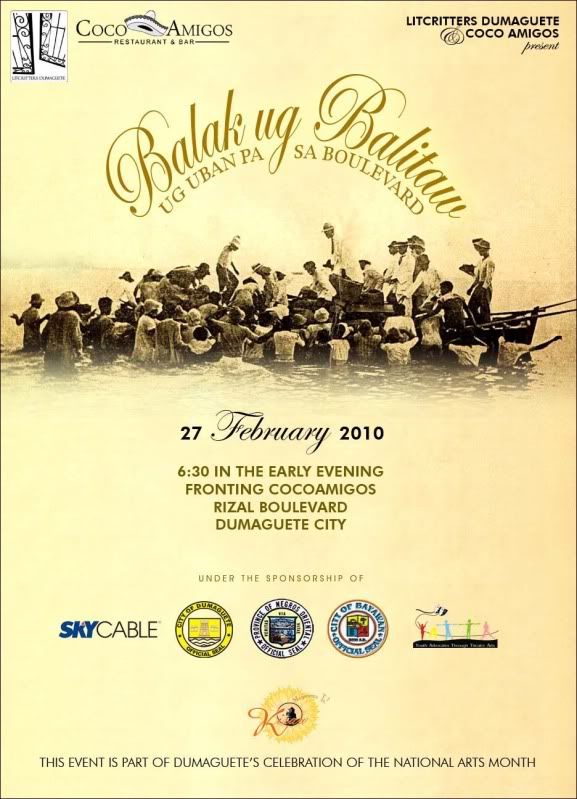
These are the other two events I've helped midwifed -- with the help of Mariekhan Edding and Bogy Lim, who really sweated big for these -- for
Kisaw 2010, the National Arts Month celebration of Dumaguete City. One is a showcase of local poetry (
balak) and folk music (
balitaw), with a little
kumparsa thrown in for good measure.
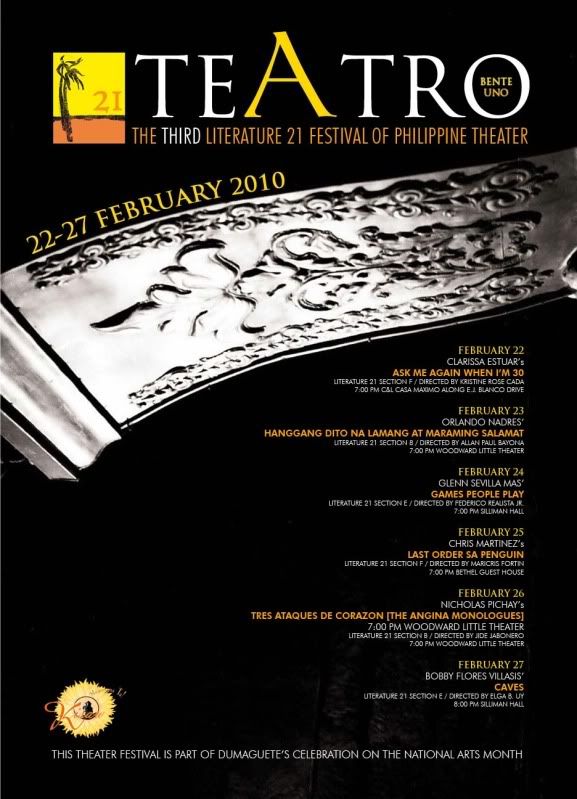
And the other is a weeklong showcase of Filipino plays produced by my Philippine literature classes in Silliman University.
I'd like to thank everybody who helped in the effort. You are all wonderful people.
Labels: art and culture, dumaguete, poetry, silliman, theater
[0] This is Where You Bite the Sandwich
Saturday, February 27, 2010
By the time I've upload this piece here,
Kisaw 2010—Dumaguete’s fledgling attempt at a celebration of the National Arts Month, which is now on its second year—would be in the last stretch, with a culminating burst of activity at Quezon Park during a special
Tayada sa Plaza presentation that would also provide a showcase of all that has been done in the name of art and culture in the past month.

February was festive, indeed, like a palette of colors—if we have to be metaphorically obvious about it. Schools around town—including Holy Cross High School, St. Louis School Don Bosco, Dumaguete Science High School, and ABC Learning Center—took their best talents to the city’s main stage in a circular of performances known as
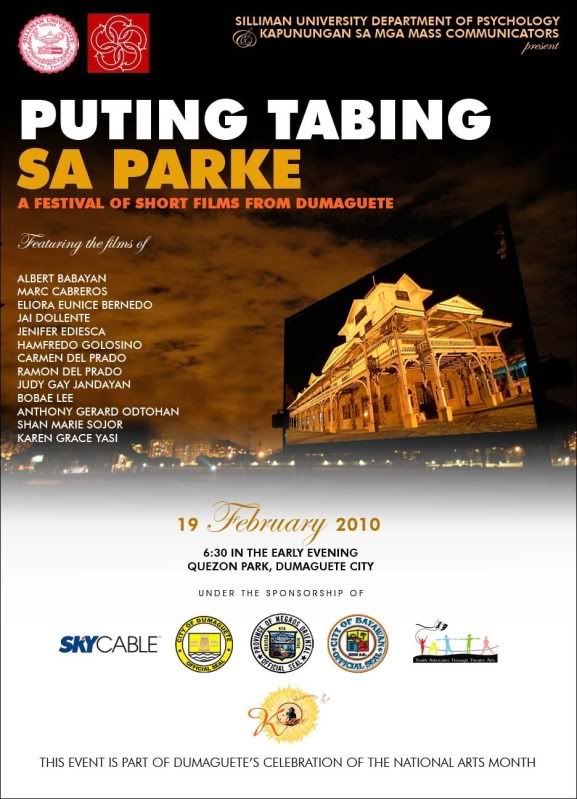
Tayada sa Plaza. There was a parade of local filmmaking talents in a special screening of short films in
Puting Tabing sa Parke, of masters in song in
Huni sa Kampanaryo, of Filipino theater in
Teatro Bente Uno, and of works by some of our best local visual artists in
Kulay at Hugis sa Robinson’s. There was a celebration of Cebuano and Tagalog verse and naughtiness in lyrical prose in
Balak, Balitaw, ug Uban Pa sa Boulevard. There were stand-alone shows and events of epic cultural moments that awed audiences—including Ballet Philippines in
Masterworks, Razceljan Salvarita in his installation exhibit
Damgo Quatros Kantos Artboxes Project, Joey Ayala in
Raw the Concert, Youth Advocates Through Theater Arts (YATTA) in
Leon Kilat and Other Short Plays, and a colorful retelling in drama and dance of the great Visayan epic
Hinilawod. My dynamic hometown of Bayawan, through the Character First! Bayawanihan Technical Working Group, got into the act this year by playing host to some inventive cultural fare that bodes well the ascendance of a true art movement from that city in the south.
That we are doing this for a second year in a row is testament worthy of both shock and hope. Hope, because—while the organizers are coursing through the events with barely a budget and a marketing plan—the whole celebration seems to be stirring local imagination, and its battlecry of “Magmuga Ta!” has become increasingly infections, so much so that this year, there is finally a ground-swelling of institutional support from the Dumaguete City Hall and the Negros Orienrtal Provincial Capitol. While all are still quite in an inchoate stage of coordination and support, there is much to hope for—and a lot of promise to finally see bear into beautiful fruition.
But also this: shock—because why did it take any of us so long to institutionalize something like this?
Art and culture is the conscience of any nation, a wise man once said. It is the truest measure of how we fare as a people and as a civilization—certainly not politics or religion, which are tainted with the presence of alligators and snakes and blind men and magician fools. But it did take Dumaguete 18 years—18 years!—to get its cultural act together. It was way back in 1991, after all, when the late President Corazon Aquino declared February as National Arts Month through Proclamation No. 683, “to promote arts and culture in our country, and nurturing the Filipino creativity and imagination.”
This isn’t always an easy to do in Dumaguete, contrary to what most of us might believe. The art and culture scene in the city is “vibrant” here,
yes, but this is akin to a miracle of a flower blooming in the desert, given circumstance and context. Years hanging around the cultural beat has given some of us amusing insights about how things really go and yet remained unreported.
Local artists, for example, constantly bicker in hazy quarrels that sometimes exhibits become virtual chess moves in an invisible war where everybody is polite but carry bloodied paintbrushes. It is telling, for example, that no official association of creatives has ever gone beyond the two-year mark without dissolving into nothingness. The reason? An endless clash of ideas and creative direction and personalities who see the petty, not the general picture. (Tell that to the Baguio artists.)
Institutional support and recognition, too, most often come in trickles (with the exception of Silliman University and its unique cultural development program), and official pageants in culture are almost always dipped in the vomitus of politics.
Then there is local patronage to the art scene. It is not on the wane, and there are certainly serious audiences and collectors in our midst—but on the whole, it is a largely absent thing.
And the local high society that is usually taken in our culture as the expected benefactors and pursuers of a local art renaissance—the way the Zobel de Ayalas and their ilk are, for example—is simply content in withering away in nostalgia and dwindling relevance. Most of us are ready to champion Dumaguete as being on the forefront of culture in our region—and I’ve been one of these for the longest time. But it’s not. And what’s worse, nobody really seems to care even.
Still, in 2009, a group of Dumaguete artists, media practitioners, and young people passionate about arts and culture—led by the indefatigable Dessa Quesada-Palm of YATTA and Glynda Descuatan of SkyCable—met and resolved to give the Proclamation its rightful recognition by celebrating it and bringing the arts into public spaces where people from all walks of life are given a glimpse into the creative wealth that our local artists and our cultural heritage can offer. We dubbed the entire celebration as
Kisaw—Magmuga Ta!, and we thought of the whole celebration as an embodiment of “the generous spirit of artists who see their arts as a powerful medium and process of reflecting, shaping, and inspiring our lives as a people.”
Last year’s edition was a success, despite an organization on the run and a budget that defied even categorization as something remotely shoe-string. That success begat our efforts this year, and our theme,
“Handu-Lantaw—Pagdugtong sa Handumanan sa Pagpanglantaw sa Unahan (Bridging the Past into the Future),” can also be read as a hope for a continuity, while at the same time attempts to create a conversation between works created from our past and how they continue to be of relevance to our realities today.
I’ve asked Dessa once why we do what we do—given that we really don’t get anything from all this, except the headache of organization and logistics, but also the flush of success and the knowledge of a job done well, as well as the pleasure of giving an ounce of culture and a push for talent in an age that seems stingy on all these. She said, “Because we think we’re Superman! Because we will die if we don’t!” She laughed, and then turned serious: “And we will die soon anyway, so we might as well use the time that we have to create something essential for our sense of humanity.”
Such strong words, but what she said reached within me and has given me good foundation for why I do the things I do in the name of Dumaguete art and culture, even when sometimes I just want to give up because “nobody cares anyway.” But in the end everything in my life as a creative—whether as a writer, theater director, and graphic artist—will have to lead me to a full-measured desire to have art and culture as an inborn advocacy. If I won’t fight for it, who can fight for me? All artists must, if they know what’s good for them—and I have no respect for those who don’t. A community that has developed strong roots and traditions in art and culture benefits greatly from that exposure, even including the economic.
And the artist can only gain from this in the long run.
Labels: art and culture, cultural affairs committee, dance, dumaguete, festivals, film, negros, poetry, theater
[0] This is Where You Bite the Sandwich
Wednesday, February 17, 2010
Manny Villar gives me the rashes, just so you know. Manny Villar is the political equivalent of suicide. Manny Villar is dirtier than a trapo, he's a pasador. That Google ad above of which I can do nothing about? I take that as a form of blog terrorism.
Labels: politics, rants
[1] This is Where You Bite the Sandwich
Wednesday, February 03, 2010
By Alice WalkerWhen I no longer have your heart
I will not request your body
your presence
or even your polite conversation.
I will go away to a far country
separated from you by the sea
-- on which I cannot walk --
and refrain even from sending
letters
describing my pain.
Labels: poetry
[1] This is Where You Bite the Sandwich
I sometimes wonder how I've come to be the way I am now -- somebody who insists on a life of writing [not something "practical" like ...
nursing], and on a life on his own terms -- despite the odds. And there are so many odds. Most people think I have it easy. They don't know anything. I have always been a vulnerable sort given my slight tendency for manic depression,
de rigeur for an introspective existence, but if a weaker person had my life, he would have called it quits a long time ago. I have somehow managed the miracle of staying sane, although just barely. Another miracle is the fact that I have managed to hide all these under a demeanor of easy-going-calmness. But I'm a theater person. Drama and make-believe are sometimes the only other way to live.
I have never had what you would call a good support system, for one thing. Sure, there are friends out there who tell you they are there for you -- and they are, in their own way,
God bless them -- but I was listening to Sandra Bullock a few days ago when she was receiving an award from the Golden Globes, and she had this to say to her husband in the audience: "I'm not surprised when my work got better when you came into my life. Because I never knew someone who's got my back." And when I heard that, I was surprised to feel that I knew exactly what she meant.
Because all my life, I have always felt alone -- which is why, every time I would have projects to do, I'd rather do it on my own. Other people always seem to have a capacity to disappoint. "If you want something done well, do it yourself." This was my mantra. [That is, up until last year, when I decided to experiment with the notion -- and ended up getting burned. But never again.]
My family, for example, God bless them, is a master of bringing on you plates of guilt gilded with the most nuanced passive aggression. They mean well, and they do give their ounces of support -- but in all honesty, I have never felt anything remotely reassuring from them. It's all just pressure and guilt and the occasional toys [a laptop, for example] to remind you of possible rewards. But never the reassurance that even if you fail, they will still have your back. They prod you with the vehemence of the over-eager, and yet they also have the infinite capacity of cutting through you. Yesterday, for example, I get a call from my brother who congratulates me for bagging the SNAAF. "But why did you get that?" he says, "You're not deserving
naman." He wants to mean it as a joke, and I laugh because I'm meant to. But the comment reaches into my very core, and makes me question all over again what I have done in my life.
My whole life has been composed of little quaking moments like this.
Still I love him, and I try to convince myself of this universal story: that all families are dysfunctional. Those who survive them with color and panache become artists.
But I remember graduating valedictorian in elementary school. When it was announced, instead of utter joy I felt a kind of guilt -- because the first thing that came to my 12-year-old head was this: "God, I hope this makes my family happy."
Because I'm never sure if anything does.
So forgive me if you all have been insisting about so many things in my life that you feel should happen. I know what good finishing this and that can do for my life. But I'm still alone in this struggle to please all of you, which I feel a fathomless incapacity for fulfilling.
Sometimes I just want to rebel by doing exactly nothing.
Labels: life
[2] This is Where You Bite the Sandwich
Tuesday, January 26, 2010
10:52 PM |
Call for Submission of Manuscripts to the 49th Silliman University National Writers Workshop
The Silliman University National Writers Workshop is now accepting applications for the 49th National Writers Workshop to be held 3-21 May 2010 in Dumaguete City.
This Writers Workshop is offering fifteen fellowships to promising young writers who would like a chance to hone their craft and refine their style. Fellows will be provided housing, a modest stipend, and a subsidy to partially defray costs of their transportation.
To be considered, applicants should submit manuscripts in English on or before
19 March 2010 (seven to ten poems; or three to five short stories; or three to five creative non-fiction essays). Manuscripts should be submitted in hard copy and on CD, preferably in MS Word, together with a resume, a recommendation letter from a literature professor or a writer of national standing, a notarized certification that the works are original, and two 2X2 ID pictures.
Send all applications or requests for information to Department of English and Literature, attention Dr. Evelyn F. Mascuñana, Chair, Silliman University, 6200 Dumaguete City.
Labels: call for submissions, dumaguete writers workshop, philippine literature, writers, writing
[0] This is Where You Bite the Sandwich
Wednesday, January 20, 2010
I'm freaking hungry, I can eat an elephant. AHAHAHA!. But must concentrate on this: Boracay... Boracay...
Labels: life
[4] This is Where You Bite the Sandwich
Tuesday, January 19, 2010
2:00 PM |
Touch, Move, Unseen
I love the invisible inventiveness of winds. They touch things, and move them, and we are the awed spectators to their ghost traces. From my table, for example, I can see the door to this room propped open to still firmness by a slight chair. And the wind—which I know is present because it touches my skin, and makes strands of my hair fly—compels it to meet its given destiny to shut close. It pushes so, and the chair moves. When the wind just as suddenly dies, everything goes back to their static stances, and we are left with the ordinary world and this tragedy: where only the visible and has mass can move and shape everything, and we are left only with the longing for cool, invisible forces. Like love.
Labels: life
[0] This is Where You Bite the Sandwich
Sunday, January 17, 2010
9:47 PM |
Vicious Cycle
Here's my stupid love story. It exists and doesn't exist. He's there, he knows. He wrecks havoc on my sanity. He knows. And goddamn it, it is difficult as fuck to love somebody who wants you to stop loving him and yet gives you every reason to do so. He's the devil, and he knows it is difficult to take to heart somebody who wants you to learn to compartmentalize -- and yet he also knows how to take down your frail boundaries with just the right word and the right glance. He wants you to learn to harden your heart, and goads you endlessly with lessons on how you do it. And yet, he plays games with those very lessons. He has the cheat sheets memorized. You want to hate him, but you don't, and you can't. And when there are those fortunate days when you start to think you've moved on, he comes around, being cute around you, setting you on fire again. And when you stupidly start to warm up -- he starts to withdraw once more. This is not healthy. This is stupid.
I'm stupid for not learning anything.
Fuck.
He is my private hell, and my secret heaven. One of these days, one of us will have to prevail. Pray that it will be me.
Labels: life, love
[2] This is Where You Bite the Sandwich
Thursday, January 14, 2010
By Padmapani L. Perez
How many times have you said to yourself
or thought out loud,
It’s been a tough year?
Tis not the years that are hard on us, my love.
For the years themselves are weathered
devotees; they are seasons come around
again and again only to see
that nothing was learned
and that we love them
less and less.
One would have to be tough indeed
to be a year.
[photo and poem courtesy of the
author]
Labels: life, philippine literature, poetry, writers
[0] This is Where You Bite the Sandwich
Thursday, January 07, 2010
I can imagine perfectly how we would meet one day. I would be doing something in a laidback cafe, in the corner of X and X, drinking my second cup of coffee. It would be a cafe near the sea, where we would feel truly the borders of worlds. It would be a bright afternoon, not too late in the day. It would be a Sunday. The air would have the breeziness of a lazy summer. The traffic would be a crawl. A man and his dog would pass by. He would also be carrying a pink parasol. A young woman would jog past him, and a young boy, about nine, would cross her path with a red bicycle some uncle just bought him for a birthday gift. I would not see any of these. Everything is telescoped into the thing that I would be doing -- something. I don't know what that would be. Perhaps I'd be reading a book. Perhaps I'd be writing on a laptop. Perhaps there would be ten ounces of worry in my hands, and there was serious contemplation to do. There would be no clouds, I suppose, only an infiniteness of blue. It is a blue that extends far to the horizon where I could only imagine a different world existing and not there, not where I would be in that forlorn cafe, doing something.
And then I would just happen to look up. Why? I don't know exactly why.
But I would look up and there you would be. We both would catch each other's eyes. Your eyes would hold me. I would not look away. I don't know who would smile first. Perhaps you -- I am eternally shy. And then I'd smile back, and go back to what I'd be doing. That something. I'd be smiling still.
The next thing I'd know, you'd be there right in front of me.
"Hello," you'd say.
When I would turn to look at you again, my smile all nervous, I'd say --
Labels: life
[3] This is Where You Bite the Sandwich
Wednesday, January 06, 2010
12:41 PM |
You Don't Wait
"You don't wait for inspiration to strike you," I always tell my writing students this. "There is no such thing as inspiration. There is only the act of getting up from your procrastinating butt and starting to pound that keyboard with your fingers!" And I realize just now, with some gravity anyway, that my scholastic rhetoric -- meant more to sound disarming to hapless students -- applies to the rest of life as well. Because I can't wait anymore for the rest of me to get on with the rest of my life. I feel I have been despondent too long, too sad ... too crippled with so much uncertainties. I don't know when exactly I started to get scared about things that surround and confound me, but I must admit there is this crippling fear without a name that hinders me from doing what I need to do. But what the fuck am I doing here endlessly waiting for me to get my "groove" back? I'm sick of my own excuses. I'm sick of my own beautiful words analyzing the gutter that I'm in. It's January, this should be a fresh start. Although I'm not much of a believer in New Year's resolutions, I guess I could do the next best thing -- and ... get ... off ... my ... lazy ... butt,
and stop feeling scared all the time. So, no more Facebook for now. No more Twitter either, or any of those precious social networking sites that eat up a life. There will only be this blog to chart my progress through the muck. I can't wait for my spirit and my body anymore to start feeling the life. Because the days are shorter, the future always uncertain, and if I don't do something about this, I'll regret not doing anything
now for the rest of my life. But in the meantime, one must learn not to panic too much:
time, it's all in the head.
Labels: life
[0] This is Where You Bite the Sandwich
Wednesday, December 30, 2009
6:48 PM |
The Year of Tumult and Transformation
“How do you measure a year?
In daylights, in sunsets,
In midnights, in cups of coffee.
In inches, in miles,
In laughter, in strife.
In 525,600 minutes.
How do you measure
A year in the life?
How about love?”
—JONATHAN LARSON,
RentThe year ends with a sigh and a blue moon.
But it began with chill. It was an uncharacteristic nippiness in the air, something wonderfully and surprisingly wintry; for once it was the kind of January we in the tropics only read about in books or seen in movies—the close huddle under thick blankets, the mist that becomes our breathing or talking, the suddenly ubiquitous scarves ‘round people’s necks as they rushed through the city’s streets in post-holiday funk.
That it didn’t come with rain was providential and surprising. There was only that terrific chilliness, and when day after day we found that it didn’t dissipate into the familiar, but now absent, Dumaguete heat, we began to wonder about such strangeness. And then, later, we began to celebrate. We remember particularly well how the cold descended without so much as a warning on our city for those seemingly endless days—two straight weeks if we remember it right. The meteorologists were reporting a rare, protracted low pressure area somewhere in the horizon. But we weren’t listening to the weather reports: we went out, and smelled the air. How fresh it felt. We were only too used to Dumaguete’s yearlong seaside humidity—and this was certainly new. It felt like a harbinger for strange, happy things in the coming Year of the Ox.
“This year is going to be wonderful year,” we told ourselves with such optimistic certainty.
And it was.
And it also wasn’t.
The year 2009 was confusing, delightful, backbreakingly hard, adventurous, murderous, beautiful, and sad. No other year in memory came close to the ride we had on that Chinese oxen’s back. We certainly rode through some strange landscape. But there was no constancy to its geography; it could not be mapped. It was all joy and all pain at the same time, like a roller coaster ride we could not understand—but we knew, deep in our guts, that it was all about something.
Something. What that was?
That’s the mystery.
Someday, we will understand the terrible beauty that was this year.
We were all transformed by 2009, and while most of us are more than eager to bid it the farewell reserved for outcasts, I can only welcome it as my year of tumult and transformation. Still, it is not as if any year is free of tumult: 2001 was more than bad enough and the repercussions of those fallen towers still reverberate today; 2004, too, unleashed its tsunamic fury right after Christmas Day. But 2009 felt different—there were of course so many external tragedies to weep to, but the tumult felt largely internal, as if we were collectively going through personal earthquakes that had no names, only degrees of disorientation. When we, however, embraced what the year brought us—both its severest pains and its startling pleasures—that led to unexpected transformations, or at least the beginnings of them. One afternoon, in one of the last days of the year, I was in Don Atilano drinking my usual cup of afternoon brewed coffee, and then, from the playlist on my Mac, Michael Giacchino’s signature musical score from
Lost, the mournful/hopeful “Life and Death” came lilting to my ears. It suddenly made me cry—I just broke down, careful to stifle and cover everything with both hands and a trusty napkin—but it was not all because I was sad. In the prayer that I uttered in that moment, I surprised myself by thanking God and saying, “I learned a lot from this year.” The year was a game-changer. I guess it taught many people a lot about themselves, often in ways that transcended even pain, but we learned from it.
It has been a year of delirious triumphs— Barack Obama winning the U.S. presidency in a historic way,
Glee coming to our lives,
Avatar bringing back the forgotten wonder of the cinematic experience, Kate Winslet finally becoming an Oscar winner, Manny Pacquiao snagging another boxing belt, Efren Peñaflorida becoming CNN’s Hero of the Year, Lady Gaga transcending her one hit wonder status with one curiously catchy tune after another….
But it was also a year of such cutting tragedy and endless streams of public stupidity—the Copenhagen climate change standoff, reality TV losers such as the Gosselins, prominent deaths—Michael Jackson’s, Francis Magalona’s, Brittany Murphy’s, Farrah Fawcett’s, John Hughes’, Patrick Swayze’s, Frank McCourt’s, Johnny Delgado’s, Marilyn French’s, Odette Alcantara’s, Maurice Jarre’s, John Updike’s, Andrew Wyeth’s, Alexis Teosico’s, Cory Aquino’s—we weren’t exactly ready for, the Hayden Kho sex scandal, the Ondoy floods, the Ampatuan massacre, the National Artist controversy, the book tax debacle, the Mayon eruption, and every action that Gloria Macapagal-Arroyo ever did that makes her, easily, the worst president we’ve ever had.
And so we echo Brooks Atkinson, who once said of old passing years: “Drop the last year into the silent limbo of the past. Let it go, for it was imperfect, and thank God that it can go.”
We were warned, of course, by those who believe in the Chinese zodiac that riding the oxen this year would be tough-going. Money would be hard, we were told for example. And it was, for a lot of people, given the worldwide recession that spared no one. There were also forecasts of a constant stream of challenges in all aspects of our lives—from work to love to family to health—that necessitated belt-tightening and other cautionary measures. Our horoscopes were even more dire: Mercury would be in retrograde for months on end, and the planets and the stars were not in a generous mood.
The fact is, one could argue about the arbitrariness of all these: a year is just a year is just a year. That a year is bad or good means nothing. “Shit just sometimes happens,” so the philosopher of randomness would say. A year is just an invented means of “control” of elusive time, and horoscopes and other forms of divination are our wishy-washy attempts to peer into the inherent unknowability of time’s relentless march through our lives. We invest the magical, I think, into any given year out of habit, or the human characteristic to just behold a pattern in the randomness. Sometimes I feel that all our collective expectations make true the predictions of how a year will be. So the Ox was supposed to be a burden for most of us. And so it was.
And we felt it in very personal ways.
I don't know your own story but I began 2009 fat and heartbroken. A five-year relationship just ended for me around Christmas time—I was famously dumped in Facebook. And I was carrying around my 5’7” frame the 185-pound result of stress eating. In hindsight, I guess everything I did this year—losing 40 pounds by relentless gym-going, rebelling against my image as a staid and strict professor, burning the reliability of an old doormat everybody could abuse because he couldn’t say “no,” living the utmost of the high life, and falling in love with the recklessness of a teenager—was probably my way of trying to move on from the constancy of half a decade. My old life bored me. A bloody revolution was in order. And I can understand all that now: when the very definition of your existence suddenly ceases to be, I guess one flounders for a while in trying to find new footing, a new paradigm for a life. This was my year of wonderful, painful floundering. In the end, what counts is that you finally find yourself, which comes after a long process of constant self-evaluation and reinvention and perfecting the art of picking one’s self up after the nth stumbling into the metaphorical blocks.
In that journey, the one difference that made it worthwhile is friends. Old ones, new ones. I lost a best friend, too—something I grieve over, but do not regret. But I gained better ones, too—mostly people you never expected to be part of your life, but came to it as beautiful additions: Mark Fabillar and Jay Altarejos, both of whom I love like my life; my college best friends—Kristyn Maslog-Levis, Beth Castillo-Winsor, Eric Joven, James Dalman, Clee Villasor, and Ted Regencia; my spiritual and artistic gurus—Arlene Delloso Uypitching, Wing del Prado, and Ces Uhing; my academic mothers who’ve tried to balance my inconstant tempests—Betsy Joy Tan, Betty Cernol-McCann, Margie Udarbe, Gina Fontejon-Bonior, Ceres Pioquinto, Laurie Raymundo, and Elizabeth Susan Vista-Suarez; my beautiful sidekicks and trusted dreamers—Annabelle Lee-Adriano, Jacqueline Veloso-Antonio, Justine Colburn, Hendri Go, and Myrish Cadapan-Antonio; my patient teaching buddies—Sherro Lee Lagrimas, Rina Hill, and Warlito Caturay; my original pink gang—Patrick Chua, Gideon Caballes, Gerard Adiong, Moses Atega, Ed Yumul, and Joey Alar—all of whom I can always count on as the foundation of deepest friendship; the Silliman High denizens of Class 1993 (and 1994, who kinda adopted me in their partying days); my former students (or students who wished,
ehem, I were their teacher) who don’t even treat me as a teacher anymore
kay feel
ra nila—Marianne Tapales, Rodrigo Bolivar, Cessy Rivera, Fred Jordan Carnice, Michelle Eve de Guzman, Robert Jed Malayang, Lyde Villanueva, Jai Dollente, Anthony Odtohan, Zusabel Digaum, Mariekhan Edding, Eliora Bernedo, Zakiyah Sidri, Jasper Lagang, Bogy Lim, Kathleen Hynson Patacsil, Angel Catada, Aiken Quipot, Jet Tumapa, Likko Tiongson, Razceljan Salvarita, and many others; my writer friends—Kit Kwe, Ginny Mata, Padmapani Perez, Rica Bolipata-Santos, Naya Valdellon, Dean Francis Alfar, Kristian Cordero, Jean Claire Dy, James Neish, Nicolas Pichay, Luis Katigbak, Frank Cimatu, J. Neil Garcia, Yvette Tan, Wendell Capili, and Tara FT Sering; my editors—Lito Zulueta, Irma Pal, and Allen del Carmen—who just let me rant on anything in this space for years and years; and a group of great friends I call The Hive—Anna Katrina Espino, Miko Tingne, Carlo Regalado, Ramuel Reambonanza, Yves Villareal, Ren Dy, Irish Reambonanza, Nice Guerrero, and Roui Faelnar—who took me in when I was floundering, and gave me a sense of community. And, of course, Federico Regencia, who promises something new.
It was, I realize, a year of great friendships. What a wonderful year it was then.
Happy New Year, everybody. And thanks for everything.
Labels: friends, holidays, life
[0] This is Where You Bite the Sandwich
Sunday, December 27, 2009
5:44 PM |
What Cannot Be Denied
My silence and my banishing you into the oblivion where you are invisible to me only serve to underscore this irony -- that you occupy every space of my breathing. And that even when I close my eyes, in the darkness that I behold, I see only you. There is no moving on. There is only living with absence.
Labels: love
[0] This is Where You Bite the Sandwich
It hardly feels like a Sunday.
Sundays are molasses. Sundays are slow afternoons bathed in yellow sunlight, the changing color of the skies a pageant by itself. Sundays are quiet cups of coffee and soft songs streaming from somewhere. There is a fragile feel to the air, as if any moment now, something or nothing will snap --
and yet, and yet...The whole city is awake today, the way a Saturday feels like. Thus the last week of the year begins, with such stirring. I wish this can only and hopefully lead to greater things, things with momentum and drive. May the rest of our coming days be the same as the days past -- only better, with wisdom as wings on our heels and a sense of heart that can make even the deepest pain feel like the cleansing fire that makes gold fine.
Labels: life
[0] This is Where You Bite the Sandwich
Saturday, December 26, 2009
2:54 AM |
Because of Orville
When you actually realize for real that you have so much of love to give, you also realize with such finality you cannot just waste it on somebody who doesn't want it in the first place. And so we move on... [Thanks, Orville.]
The Fist
By Derek WalcottThe fist clenched round my heart
loosens a little, and I gasp
brightness; but it tightens
again. When have I ever not loved
the pain of love? But this has moved
past love to mania. This has the strong
clench of the madman, this is
gripping the ledge of unreason, before
plunging howling into the abyss.
Hold hard then, heart. This way at least you live.
Labels: life, love
[0] This is Where You Bite the Sandwich
I have only one, perfectly doable resolution for the coming New Year: that I will be able to appreciate more and more the things that I am capable of and passionate about -- writing, designing, teaching, among other things -- and learn to value my place in this world. It's the first step to a happy life.
Labels: life
[0] This is Where You Bite the Sandwich
Wednesday, December 23, 2009
Ang daming maarte sa
world.
Pretentious freaks na walang utak. Well, may utak naman -- pero ang kapal ng mukha,
I just want to hurl. Sana kunin mo na sila, Lord.
Labels: life, rants
[0] This is Where You Bite the Sandwich
4:37 PM |
Recycled Posts
Honestly, there should be a name or a word for Facebook users -- perhaps newbies, eh? -- who are just
now posting the funny videos, links, pictures, etc. we were laughing at months
and months before. The Regurgitators? The Late Comers? The Oh-My-God-They're-Only-Laughing-At-That-Nows?
Yes, I'm a snob that way.
Naay mo palag?Labels: facebook, rants, web and tech
[0] This is Where You Bite the Sandwich
GO TO OLDER POSTS
GO TO NEWER POSTS


