Tuesday, June 19, 2012
 5:29 AM |
You've Been Warned
"You own everything that happened to you. Tell your stories. If people wanted you to write warmly about them, they should have behaved better."
~ Anne LamottLabels: life, quotes, writers, writing
[0] This is Where You Bite the Sandwich
One of the most awkward things one does, in a struggle for sheer survival after breaking-up with someone, is the unliking of the many things he has taught you to,
well, like. These are things beyond your usual orbits of interests, which suddenly take on some paramount importance simply because they are things -- songs, films, books, quirks -- that your Beloved loves. You figure,
how else to show one's love for this Beloved, except in learning to love the things he loves? Because when the heart is at stake, it is too easy to develop an interest. You feign when you have to, and it is all too easy to fool oneself. Gardening, for example. I have no green thumb. All the potted plants I've bought died within days of purchase. But there I was, trying to learn about the design of leaves, the cultivation of herbs, the intricacies of flowers, the many kinds of begonias. My first boyfriend taught me all these. I was a sponge, and for two years, all I thought about were plants. I knew how to make him happy. On special days, I'd go to a special shop, and buy him packets of seeds. I lived for the delight on his face every time he would get those seeds. It was uncanny, and I was in love. Everyday, after school, we would walk all the way to the makeshift "greenhouse" near City Hall, where we would spend hours upon hours looking at plants, trying to decide what to buy. And then, all that was gone. And I went back to knowing nothing about botany. Pageants and plastic surgery, my second boyfriend taught me these. (Pets, too. Fish, hamsters, mice.) I had to learn all the names of the states of Venezuela --
and their capitals -- simply because Venezuela churned out Miss Universe winners like a beauty factory.
What is the capital of Carabobo? Valencia. Not everybody knows who Osmel Sousa is.
I do. I know this pageant magician's life story like the back of my hand. Almost six years later, when it all ended, I couldn't bring myself to watch another Bb. Pilipinas telecast. I simply didn't care. Then there's Keane and BritRock and the intricacies of biology, which the third person I loved taught me. The fourth person I loved taught me genealogy. I began to read about the intricacies of family trees.
And then when the love went away, or when the heart has been blasted to pieces once and again, I learned that the first bars of an India Arie song chilled me like a hateful tune. I learned I couldn't care less with the trivia that the first Miss Universe married a Filipino. I learned I couldn't care less about the proper ways of planting a begonia. And was life any better because I knew how one family connected with another through marriage? No, life remained the same: a chronicle of hurt and hurting. I still loved Keane. But to listen to
Hopes & Fears was to invite demons and remembered pain. So I don't.
So you learn to unlike.
You force yourself to.
And it breaks you nonetheless. Makes you question who you are. Were you simply an empty vessel that took in the passions of someone else? Was that life you led with each one of them even an authentic one, or was it a mask you felt you had to wear, simply because
you loved? Does love eradicate who you truly are? I don't know.
Then you tell yourself they learned from you, too. They learned to like certain things, too. And perhaps those same things also give them pause and pain.
But no matter. Nothing matters. You learn that nothing matters at all. And perhaps, of all things in the world, this is a shattering truth you like the most.
Labels: life, love
[0] This is Where You Bite the Sandwich
Sunday, June 17, 2012
3:32 PM |
In the Name of the Father
My father, who died when I was 21, made many sacrifices in his life in the name of integrity. When I was young, and quite stupid, I never understood that, and I think he died a sad, misunderstood man. And now it’s too late for me to tell him I love him. (Love. In the present tense, as it should always be.)Labels: family, life, memories
[0] This is Where You Bite the Sandwich
2:13 PM |
When Dumaguete Saw Daniel Day-Lewis Kiss Gordon Warnecke
I remember when, in the days before cable and HBO, People’s Television (PTV), now the National Broadcasting Network, first came to town when I was a boy. The whole of Dumaguete City would wait for the young Alex Rey Pal to deliver and finish the evening news, and then the movies began, two movies every night. I remember the excited rush ripping through the city when one night they showed
The Sound of Music, everybody’s favorite musical. A year or so earlier, they had showed the film in Park Theater for its 25th anniversary, and the whole theater was packed during the film’s entire run. This film is perfectly reflective of the city’s outward show of character, especially in the 1980s: genteel, unruffled, with a penchant for the conservative this side of
Peyton’s Place. One night, they showed Stephen Frears’
My Beautiful Laundrette [1985]. I’m not sure PTV-10 knew what film it was showing, but that certainly shocked everybody.
Labels: dumaguete, film, life, memories, negros, queer, television
[0] This is Where You Bite the Sandwich
Tuesday, June 12, 2012
12:06 AM |
Truth be told...
I miss you.Labels: life, love
[0] This is Where You Bite the Sandwich
Wednesday, May 30, 2012
11:13 PM |
The Romantic Pessimist
Truth to tell, I might be a romantic pessimist. I think my worldview basically springs from two metaphors I've read about: (1) from Buddhism, we learn that from the moment we are born, we start dying; (2) and from physics, we learn that we are all made of atoms, and since atoms consist mostly of empty space, we are essentially nothingness on two legs. Fascinating, right? We are emptiness that start dying out the moment life happens. What lovely paradox.
Life is fundamentally sad, I think. But it's what makes the happy moments really happy. :)Labels: life
[0] This is Where You Bite the Sandwich
Tuesday, May 22, 2012
5:07 AM |
The Visualist of Common Sense
Part 9 of the Dumaguete Design Upstarts Series
Looking at the paintings of Paul Benzi Florendo, one immediately recalls the raw power of the works of the young Jutze Pamate or Mark Valenzuela or Razceljan Salvarita—all of earnestness and strangeness and sureness of vision that mark what may be the beginning of a fantastic career in the visual arts, right at its rawness, without strings or politics or life’s hard bargains. To look at Benzi’s paintings and see how they pulsate is to quicken once more life from the tired old critical bones, slaying the old pronouncements that “visual art in Dumaguete is dead.”
It’s certainly not.
That it is in some sort of doldrums may be something that cannot denied. But there are others like Benzi springing from an increasingly bustling art scene in Dumaguete. (That is, if “bustling” is the word.) Collectively, they constitute some hope, enough for the city to recall its prime as Visayan capital of art. The most exciting among them include Stephen Abanto, Nabil Padilla, Jess Andrew Abode, Sabrina Skye Benito, Kristine Jul Oliva, Ramon Adonis Catacutan, and Hans de Barras—and in their last group show together, for the
Third Horace B. Silliman Art Exhibit held last March, some showed a brilliant command of the artistic that went beyond the pale of the expected and the humdrum: I remember a guitar stripped, dismantled, reset, and transformed into a kind of Rorschach test; a series of still lives and what-not—a snake with a gun among them—that seemed to put some strange edginess into the representational; a set of skulls from different sorts of material that put a hint of danger to the domestic; an installation of clay and wire figures “at play” with kites that married wit with the whimsical. These were fantastic pieces by some of the city’s young artists, and one could only wish to see more of what they could do beyond plates made for classroom exercises, beyond the requisite demands of academic exhibitions. That most have not entirely burst out of their confines and rocked the city beyond the comforts of campus life is a little beyond my ken—but perhaps they are only cocooning?
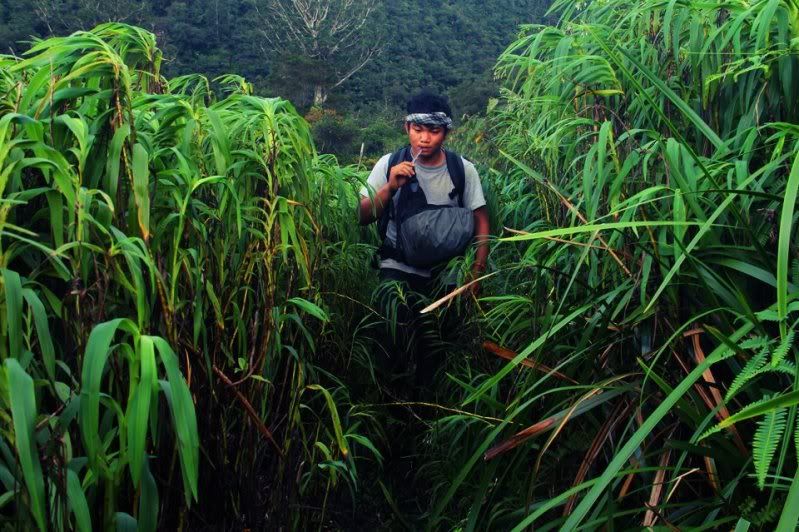
Paul Benzi Florendo
Enter Paul Benzi Florendo. A few months ago, in the makeshift exhibition walls of Canto Fresco, which is owned by the visual artist Babu Wenceslao, he debuted with his first solo exhibition—something he called
What Ya Think? The show, small though it was, featured ambitious art with a nod to the soft, strangely tender (if also unsettling) surrealism of René Magritte—but with wit completely Mr. Florendo’s own. There’s the blue teddy bear with the old man’s face, dragging a toy cart with square wheels, in diagram; there’s the masked boy astride a snail, bullhorn in hand; there’s the similarly bullhorned girl, eyes masked or pixelized, riding a giant rabbit; there is the army of boxy androids with human faces, minus the eyes, deep in empty thought-balloons; there’s the strapping youth with the baseball cap, looking up into the rainbowed sky, boxed in by some invisible diagram that include a hovering satellite… It is all very strange, and all made to make you ask—“What do you think?” The question is subtly provocative, and asks much of the viewer in terms of what they put
into the pictures.
It is the painting “Egghead” that strikes me the most though. It shows a gigantic egg hovering in an emptiness of azure, cracked in places, and through the bigger holes punched by the cracks, we see various parts of a human face—nose, lips, ears, eyes—asymmetrical, disembodied, and whole at the same. And all that, afloat, like a beautiful threat.
What do you think?
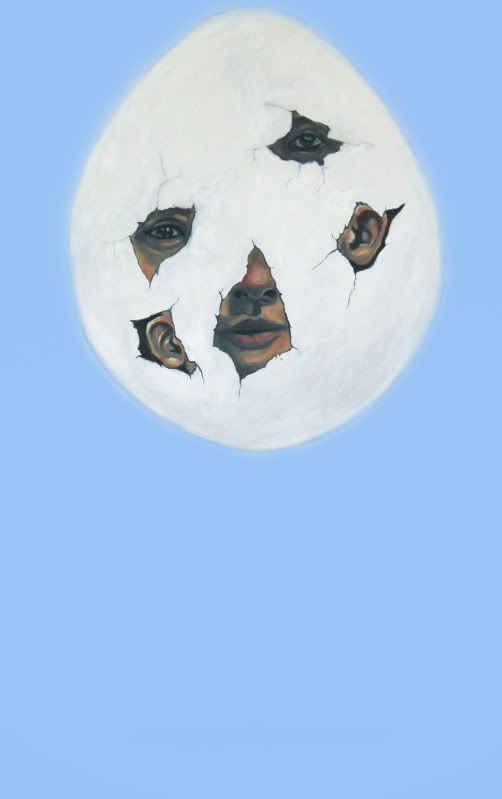
Egghead by Paul Benzi Florendo
“I always want to make people think hard when viewing my works,” Mr. Florendo explained. “I do not want the audience to just see my painting and think, ‘Oh, it’s nice,’ or conversely, ‘Oh, that’s stupid’—and just stop there. I want them to recognize something beyond what is obvious. I want them to perceive how I see life or how I tell a story of moments through my paintings—and perhaps relate these to their own lives.”
But what he also wants is a workout of sorts for his potential viewers. “I want them to feel as if their brains are going to burn up trying to think too much,” he said, “or perhaps even ultimately explode, especially when they realize that too much thinking did not have to done in the first place. I want people to be able to also use plain common sense, which is rare these days. I want to spark creativity in my viewer’s minds, and perhaps cause them to be artistic in their own ways.”
Which is perhaps putting too many eggs of expectations in one basket, but one admires that ambitious reach in the young artist: to seize that fabled opportunity to reach into the minutiae of a viewer’s head, and transform thinking through art.
What do you think?
But regardless of my mention of Magritte, Mr. Florendo does not claim to have influences in the way he marks his art. He reaches out, instead, to the common “influence” of what surrounds him: “My influences are the people around me doing what they normally do,” he said. “May it be wiping the table, playing in an orchestra, taking photos, typing on a keyboard, chewing gum, snoring, running, giving a sermon—you name it, these simple things give me a lots of ideas that can certainly be turned into something artistically complex. It’s like a simple cycle: I take ideas from what I see around me, then I give it back to the world through my paintings.”
And if this indeed is a start of something bigger, artistically speaking, what does the future entail for him? “I always wanted to do work which many people can relate to, or at least that they will be blessed by my work. But something I have always wanted to do is make people interact with my art in certain ways.” But it is that first wish for relatability that he wants the most. “I hope to achieve something big which people around me can recognize and be able to relate to. Even the simplest of people.”
Which makes common sense.
Labels: art and culture, dumaguete
[0] This is Where You Bite the Sandwich
3:29 AM |
The Three Virtuosos of the Photographic Eye
Part 8 of the Dumaguete Design Upstarts Series
Is there a glut of photographers in Dumaguete? Without batting an eyelash, my answer is yes—and not just in Dumaguete. The delusion of photographic skill is everywhere, and the evidence is flooding the feeds of our Facebook, Twitter, Instagram, Tumblr, Flickr… I’ve said it before. The exploding number of shutterbugs is a phenomenon directly proportional to the increasing democracy of digital photography, and it has become a joke in photography circles that these days anyone with an SLR seems to think he can saunter into the world and proclaim himself a “photographer.” That the vast majority do not call themselves thus is an act of mercy by the universe—amateurs thankfully in acknowledgment of their limitations. For a few that do, their sheer number often threatens to overwhelm the integrity (and asking price) of the profession, leaving the serious professionals in ridiculous competition with wannabes who invariably take commissions with a grain of salt, but don’t often deliver. As a result, the price for photographic talent may be bottoming out.
Of late, we get waves upon waves of photographic blahness—ad infinitum and ad nauseum—of leaves and flowers, sunrises and sunsets, women in bikinis, men in briefs. Most of these are slyly tweaked in Photoshop (or, heavens, Instagram) to approximate some glossy finish. Truth to tell, one or two of these pictures are beautiful all right, an accident of timing and angle; but in the context of body of work, the eye—the crucial eye—sans Photoshop is missing. Nothing draws you in beyond the initial “hmmm.” There’s no magic.
In the ocean of photographers in Dumaguete, a few do stand out. There’s Kat Banay and Hersley Ven Casero, whom I have featured in this series separately. In the front ranks, you will find Mikko Lim, DX Lapid, Clee Andro Villasor, Kim Cuevas, David Jules Mamhot, Zon Lee, Alma Zosan Alcoran, Paul Benzi Florendo, Darrell Bryan Rosales, Jerick Hernani, Aris Ramiro, Charlie Sindiong, Jaysie Tayko, Phil Calumpang—and I may be missing others, but this is by no means an exhaustive list.
Yet I keep turning to the works of three young men whose technical proficiency and hard-earned professional integrity seem to coincide with the gift of the elusive eye: the photographs of Luigi Anton Borromeo, Brian Arbas Rimer, and Urich Calumpang seem to me to be the prime examples of budding artistry in overarching mastery of medium. Whether with a regular still camera, a video, or an iPod, these three have exhibited an uncanny understanding of photographic language. They have demonstrated that it is not enough to own the proper expensive gadgets and certainly not enough to know the tweak buttons of post-processing applications. Great photography is the telling of an evocative story—and the best of them, for the lack of a better word, move you. The works of these three have moved countless people—and they know how to tell a story.
For all three, a childhood brush with the camera proved to be the push to a life-long drive to perfectly capture something of life. For Mr. Borromeo specifically, the interest had childhood roots, but it was also a late-blooming love affair. “Film was expensive,” was his explanation. He was already all of 20 years old when he really started taking photography seriously, digital this time. But the fascination had always been there; and the motivation, too. “I’m always motivated to shoot,” he said. “I get that from Ansel Adams who once said, ‘The single most important component of a camera is the twelve inches behind it.’”
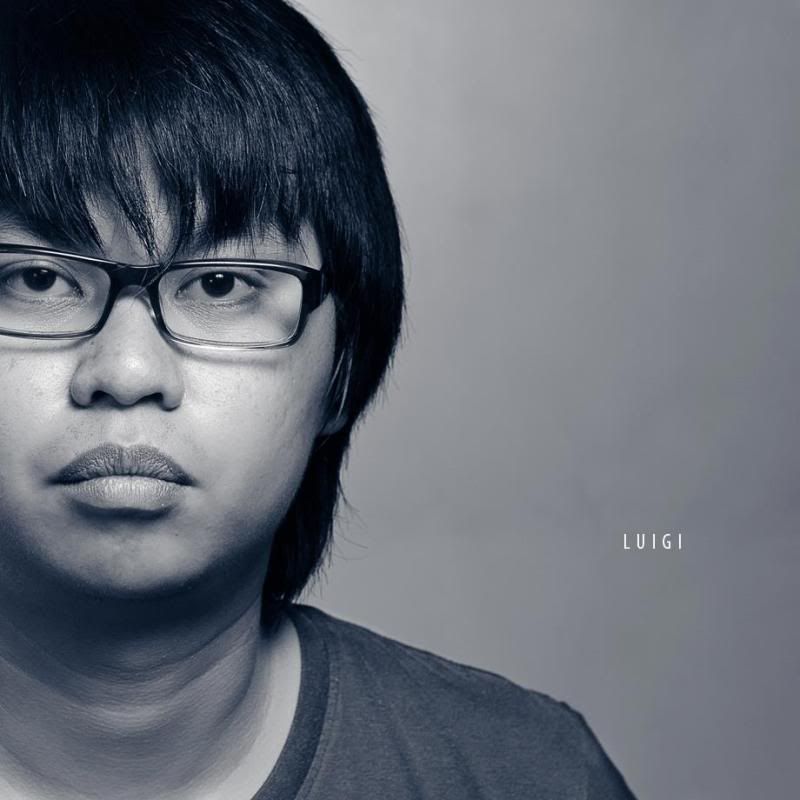
Luigi Anton Borromeo
And shoot he does, although the whole seriousness of the craft was something he had to get used to. “Intimidation is my weakness,” Mr. Borromeo said. “I easily get intimidated when I’m in a crowd of photographers who have greater experiences and have better equipment than I do. I own an entry-level digital reflex camera. So the only way I can compensate is to do my best to make a picture seem like it was shot on an expensive camera.” Which is perhaps the perfect retort to anyone who believes gadget trumps over talent. (And there are certainly a lot of them.)

Portrait of Kylie Montebon by Luigi Anton Borromeo
Mr. Borromeo’s forte is environmental portraiture. “I was inspired by Joe McNally,” he said, “especially in how he lights his subjects. He does this in very creative ways. He utilizes ambient and artificial lights very well, making the picture interesting. His technique gives his subject more dynamism and depth, without exactly going overboard.” His portrait of Kylie Montebon is a good example of that influence—lighting and depth and texture and subject’s beauty in a great mix, it cannot help but tell a story. This is not merely a girl posing. This is a girl with a story captured well—a hesitation in full make-up, wary and unfeeling at the same time. That she caresses a tree, its texture barely there, adds to an effect of obliqueness.
Brian Arbas Rimer, on the other hand, seems to have found firm footing in both still photography and video—and his own love affair with capturing image also has its roots in childhood. “My dad used to bring his camera everywhere we went, and we kind of got used to the idea of photographing every detail of our family vacations,” he said. “I got my first film camera when I was 7, and since then, I’ve fallen in love with photography.” He started devouring the pictures of Scott Kelby and the photographs he saw in National Geographic. He started aiming for what he saw in them: “a perfect shot, where one image perfectly captures an entire event.” That calls, of course, for an instinctive feel for the grand moment that is often fleeting, which is something that will inform his future work.
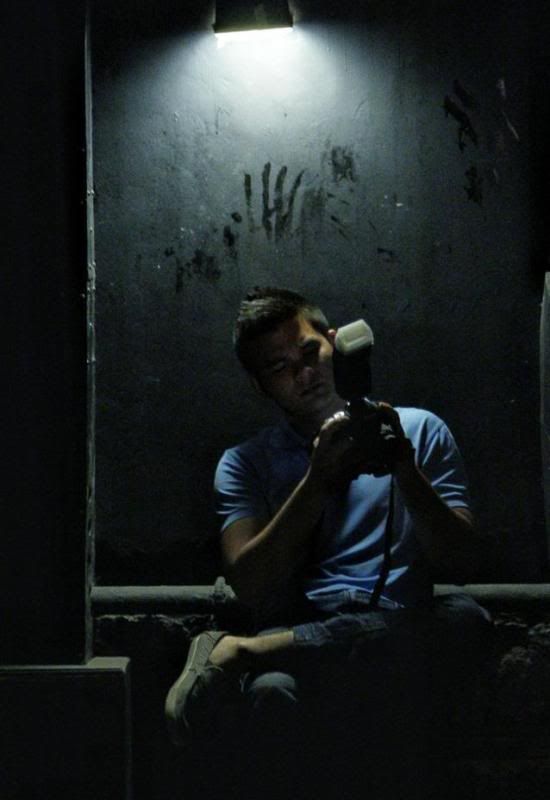
Brian Arbas Rimer
But Mr. Rimer’s real education sprang from encounters with local wedding photographers—Dino Lara, Rock Paper Scissors, Paul Vincent, and Nelwin Uy. “I noticed that they concentrated more on people’s expressions rather than on technicalities,” he said. The technicalities, for him, can often prove to be cumbersome if allowed to overwhelm the shoot. Mr. Rimer prefers instinct above all, especially the instinct to capture emotion in people that, in his own words, “can be universally understood.” “Photography,” he once said, “is the language I use to translate other cultures.”
One sees all these in his collective work that seems to celebrate the candid. “I like to take a step back and let things happen on their own rather than setting up or posing a picture,” he said.
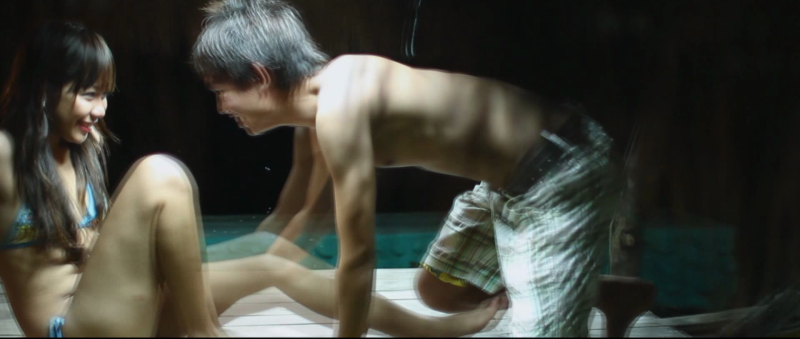
Scene from Amor y Sangre by Luigi Anton Borromeo and Kim Cuevas
With Mr. Cuevas, Mr. Rimer has also done cinematography for some local short films, notably a NORSU-produced film titled Amor y Sangre. There is a sequence in the film—of two lovers being amorous in a beach-side cottage at night—that jumps at me for the inventiveness of its tracking shot which at once relays playfulness and illicitness requisite in the scene. “I started to get interested into cinematography not that long ago since HD movie recording came out,” Mr. Rimer said. “Bringing movement to pictures was something totally new for me, a still photographer. First it started out as something I did for fun, until I began learning more techniques. It soon required new equipment, and once again it became another passion.” Of Mr. Rimer’s forays into film, he cites as influences the documentaries of Jason Magbanua, Threelogy, Mayad Studios, Chase Jarvis, and Vincent Laforet.
For Urich Calumpang, photography began as a holiday gift when he was younger. “I got my first camera from my mom as a Christmas gift,” he said. “It was a Casio point-and-shoot camera, and I started taking pictures of the usual flowers ands sunrises and sunsets. The usual macros. What was just there, I shot. I was 17. I had that camera for around a year, and soon it broke. So I got another camera, which was still a point-and-shoot one, a Kodak. But I wasn’t satisfied with my pictures, and so I worked abroad, in California, for two months, and saved up for a better camera. Which was a Canon 550D, which I use until now.”

Urich Calumpang by Francis Silva
That was when he started shooting for real: people and streets and assorted events. “It was mostly just everything I saw that interested me,” he said. “I’ve learned a lot from the photographs of Ansel Adams. And locally, the works of Hersley-Ven Casero. I soon met the most awesome photographers who mentored me and taught me a lot of things, and helped me. I learned the ethics, I learned how to take solid shots, how to cover events, how to dress appropriately. There’s Greg Morales. He’s like my second dad. And I’m most thankful that we got to know each other.”
For Mr. Calumpang, the process of taking good photographs is just letting the creative juices flow. “I have learned not to suppress it. It’s there, within you. That flows in you,” he said. And so, every single day, he brings with him anything that has a camera—a phone, an iPod, whatever. “Wherever I go, I’m always ready to take pictures of things, everyday things that people often take for granted. Some of the most wonderful photographs I’ve gotten come from the most common things usually taken for granted. But my process is quite simple: I feel it, the potential photograph. When you look at something, and you picture it in your mind…when you are able to think of that something, you can actually take that very picture.”
His regular commissioned photos, always without Photoshop, have a sparkling crispness to them that belie an instinctive feel for moment and light and angle. But when he goes for a stylistic bent, he bends color to a 70s Polaroid feel. “These photos give me that nostalgic feeling,” he said, “and a sense of euphoria.” Which may be understandable for somebody who is fond, musically, of standards and the whole Beatles repertoire. “I’ve always wondered what it must have felt like, to live in that age, when my music idols were actually very much a part of the era,” he said. And in wonderment, he tries to recapture an era with photography.
And so we thus know that Mr. Calumpang has his own stylistic quirk, often best captured in his experiments with Instagram, using his iPod.
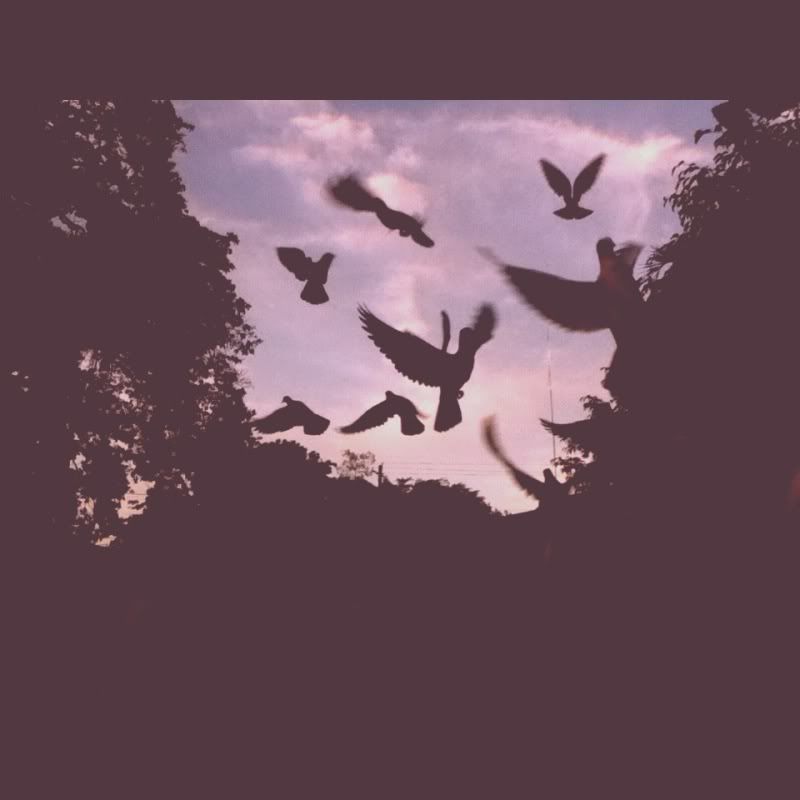
Pigeons 2, taken with Instagram, by Urich Calumpang
But his fascination for the extraordinary and the symmetrical in the common perhaps defines him best as a photographer—and you see that in his shots of architectural detail, of lines, of geometrical shapes. All these from everyday objects and scenes, of course. This appeals to the obsessive compulsive in him. “I love symmetry. I love it because it has balance, it creates a sense of completeness, which best describes my personality as an O.C. guy. I put more emphasis on balance, and seeing things that are in place makes me at ease,” he said.
A sense of balance, ease, and symmetry. A feel for light and ambience. An instinct for moments. Perhaps these are the very ingredients that define the photographic eye. In the works of these three men, we have an embodiment of the very same things.
Labels: dumaguete, film, negros, photography
[0] This is Where You Bite the Sandwich
12:46 AM |
The Designer of Film Sound
Part 7 of the Dumaguete Design Upstarts Series
Think of your favorite film, and you think of the images that compose the story. The best ones—a marriage of skillful direction and a deft cinematographic eye—give film an almost tactile heft. The best of film, after all, is sorcery in pictures in the service of story. Think of the films seared into your memory. There’s the little girl in the red dress in Steven Spielberg’s black and white
Schindler’s List. There’s Neo evading bullets in a space-bending ballet in The Wachoswki Brothers’
The Matrix. There’s the smoke billowing from the passing trains, to engulf the space of the illicit love affair of our lovers in David Lean’s
Brief Encounter…
You behold these choice mise en scenes, and you know, somehow, what their movies are specifically all about. Films are indeed constructed from a grammar of images. But sound—
and music—underlines their emotional tone.
Think about your favorite films again, and at the back of your heads, the refrains of their scores somehow become their anchors: consider John Williams’ shark-baity suspense in Spielberg’s
Jaws, Henry Mancini’s longing for a world that understands lost souls in Blake Edwards’
Breakfast at Tiffany’s, Bernard Herrman’s slashing sounds of terror in Alfred Hitchcock’s
Psycho, the Bee Gees’ disco beat underlining a dreamer’s hopes of getting away in John Badham’s
Saturday Night Fever, Michael Giacchino’s mournful limbo in J.J. Abram’s
Lost, or Gustavo Santaollala’s evocative lament for tragic cowboys in Ang Lee’s
Brokeback Mountain. Their music embody the films they are part of as a kind of emotional architecture. (Or if not “embody,” perhaps “underline”?) The quickest way to appreciate this is to watch a horror movie and have it unfold with one covering one’s ears. The result is strange: somehow, the scare is lesser, unless you are F.W. Murnau making
Nosferatu, and silence is not an impediment to a cinematic evocation of exquisite horror.
A great musical score is designed like an architecture of sound—each trill and melody composed to tease out something in us the moviegoer, and no one in Dumaguete knows this more than Ian Manuel Mercado.
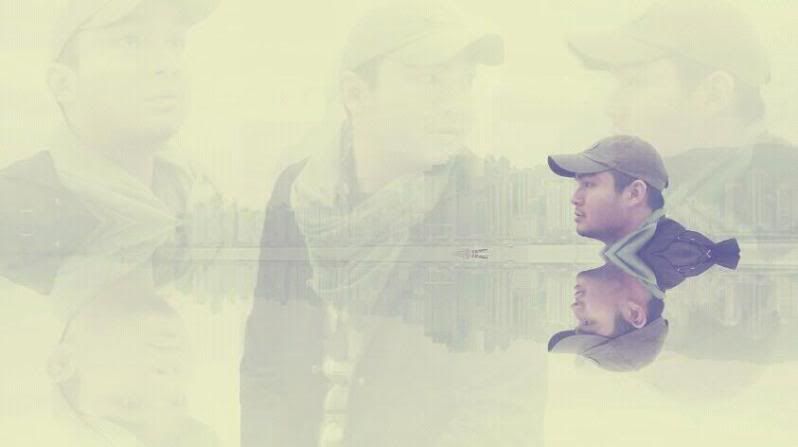
Still a music student in the College of Performing and Visual Arts in Silliman University, Mr. Mercado has somehow found a way of gaining some traction in the international world of film composing—thanks, in large part, to the Internet. And more specifically, Soundcloud, a popular music-sharing social networking site.
“Someone from UNESCO wrote to me to ask if I was interested to work for a recent project,” Mr. Mercardo said. “It was a World Heritage and Cultural Diversity promotional video, and I was to work as a film scorer together with some other amateur composers picked from around the web. The rest, as they say, is history.”
That stint led him to obtain a full merit-based membership in the Society of Composers and Lyricists, or the SCL, where he was able to meet with fellow musicians—mostly composers—notably some legends like James Newton Howard, Bryan Tyler, Steve Jablonsky, Christopher Lenertz, Bill Brown, Deane Ogdene, and many more. “I met them in one of the SCL’s composers’ symposia where we I got the chance to further develop my skills in film scoring,” Mr. Mercado said. “The SCL is also where composers get the chance to get their scores laid on some short or big films, advertising campaign and alike.”
Mr. Mercado—a talented pianist and also a member of Silliman’s Campus Choristers and Ating Pamana—has always been into music composition, but scoring for films has of late become the major focus in his early blooming career as a musician. And in that regard, he has managed to delineate the subtleties demanded by this particular craft—something leavened by the challenge of cinema: “What is it that separates a composer from a film scorer? I believe it’s the ability to look at a movie, not just from a musical perspective, but from a filmmaker’s as well,” he mused once to me in consideration of what he does. “An effective score must have the same kind of exposition and development and recapitulation that an effective script has. And if you take out elements along the way, or leave out exposition, then it doesn’t work quite as well. Moreover, there are some more other crucial viewpoints in film scoring that we should consider. Geography, for example. I always look for the geography of the film I’m working on, because I’ve found that if I can attach some cultural sensibilities to it, it’s easier for me to find my way through musically.
“Then there is theme, and there is character. I’ve also discovered that directors habitually have notions of musical themes to characterize individuals in a picture, but I’ve never really understood that, and I’ve never worked that way—unless I was really forced to. While a number of situations might combine to cause a motif to recur in situations involving the appearance of a particular character, I’d maintain that in my scores, this never has a conscious genesis for me.
“There’s also orchestration and instrumentation. For me, less can really be more in film scoring. I feel that that’s why so many short films are so impressive musically. They are often scored with just a few instruments. Although this may be the result of budgetary restrictions, personally I find that kind of thing terribly appealing. As long as you can make an effective counterpoint out of a two- or three-player ensemble in a score, it would still be as grand as an 80-piece orchestral score.”
A lot of these you can see in his score titled
Redemptionem Inter Racúndiæ, something of a favorite of mine. I like its slow build-up, announced by some bells pealing, and then a hazy percussion blend that eases into a thrilling rhythm. There is narrative movement to the music—harp, flute, and string soon ebbing and flowing to the sound of waves crashing, reminiscent of Trevor Jones or James Horner or Randy Edelman. You close your eyes, and with the music alone, your mind lends itself to a movie of your own making. Such is the power of film scoring. As complement to film, it is the element that pushes the image to a higher resonance. On its own, it creates its own narrative gravity and propulsion.
Mr. Mercado has come into his own, of course, as a study of influences. “I’d point out Gustav Mahler and John Williams if I really have to name names here,” he said. But his artistry, it seems, has enough wellspring that come from some secret personal source. “A lot of my inventiveness comes not from direct research of the various genres or people. More from my own innate feeling for a style—from medieval to modern-day music,” he said. “It’s an impressionistic kind of thing.”
That personal impressionistic feel for sound seems to work for him. The doors are certainly opening for Mr. Mercado. It won’t be too surprising to find a future movie with his name indelibly impressed on the celluloid projection with “music by” attached firmly to it.
Labels: dumaguete, film, music, silliman
[0] This is Where You Bite the Sandwich
Saturday, May 05, 2012
11:30 AM |
You Die for Stories. They are Important in Our Lives.
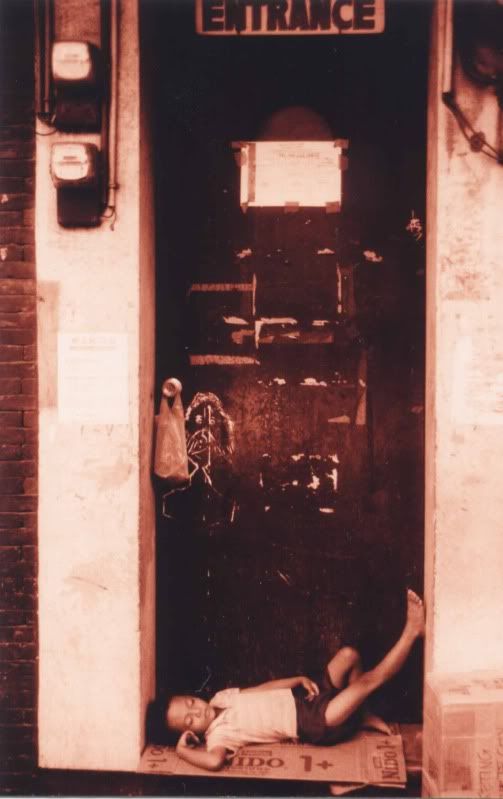 “My cousin Helen, who is in her 90s now, was in the Warsaw ghetto during World War II. She and a bunch of the girls in the ghetto had to do sewing each day. And if you were found with a book, it was an automatic death penalty. She had gotten hold of a copy of ‘Gone With the Wind’, and she would take three or four hours out of her sleeping time each night to read. And then, during the hour or so when they were sewing the next day, she would tell them all the story. These girls were risking certain death for a story. And when she told me that story herself, it actually made what I do feel more important. Because giving people stories is not a luxury. It’s actually one of the things that you live and die for.”
~ Neil Gaiman
[Art: The Guardian Post by Razceljan Salvarita]Labels: photography, writers, writing
[0] This is Where You Bite the Sandwich
Friday, May 04, 2012
12:36 AM |
The Vintage Stylist
Part 6 of the Dumaguete Design Upstarts Series
No one argues with Coco Chanel. The legendary fashion designer once said: “Dress shabbily, and they remember the dress. Dress impeccably, and they remember the woman.”
This declaration defined, with the same stylish precision of a Chanel suit, the importance of dressing well. And perhaps, rallying to this call, the truly stylish among us—and not merely the unfortunate fashion victim—aim for that impeccability of dress.
Why? To make a mark, to forge an identity, to express who we are. Fashion becomes emblematic in this regard—and perhaps this is why a particular species of enterprising people have evolved to answer that need. You know who they are. The stylists.
Stylists, especially the best ones, are avid readers of fashion. They are the able conjurers of sartorial language, which marries personality with cut fabric. On television, we get Rachel Zoe—although one might make the argument she does not exactly typify the best of such strange occupation. So forget Rachel Zoe. There’s somebody in Dumaguete who does exactly the same thing as the reality TV fixture does, but with decidedly less mugging for the camera. And decidedly with more creativity. Her name is Veronica Valente-Vicuña, and one can say she has made a life and career over her uncanny sense of what works for you, fashion-wise.
“I have always enjoyed going to flea markets and
ukay-ukay, ever since college,” Rona told me. “Being a bargain hunter, I get a rush when I find pretty items which would cost triple or more if sold in department stores. Even if the clothing item would be too big for me, I would still get it because my thinking is, I could just have it altered down to my size.”
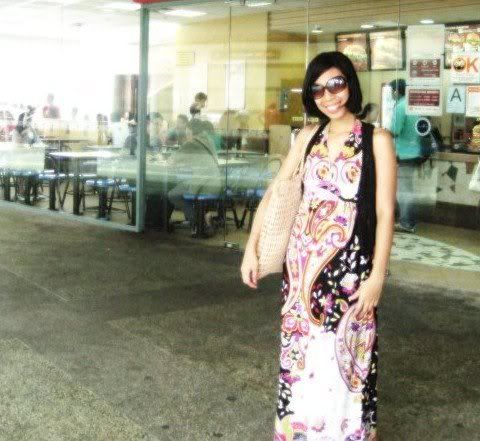
Stylist and designer Rona Valente-Vicuna
Eventually that nose for bargain and style led to a kind of fashionable hording. “Soon I had bags and bags full of dresses,” Rona remembered, “So I thought, why not sell some?”
She started toying with that idea of commercializing her sense of fashion in 2006, but it took her until February of 2007 to get things really going. She opened her online store
Veronica’s Closet, initially listing only just six choice items.
To her delighted surprise, the dresses sold out within hours. “That encouraged me more,” Rona said, “And soon, with a good client list growing, I had to make a weekly upload schedule to keep up with the customer demand.”
A few of summers ago, she found herself participating in a program for fashion designing in Cebu. “I learned quite a lot from some of Cebu’s top fashion designers,” she said. That summer program ended with a fashion show at the Waterfront, which featured the participants’ new designs, things they created for class.
This soon paved the way for better things. “Subsequently, I was invited by Anya Lim of Anthill Fabric Gallery in Cebu to display some items from my website,” Rona said. “She had been buying regularly from my site, and she wanted me to sell my re-made dresses in her fabric gallery. She encouraged me to come up with a line, where altered and reconstructed vintage dresses are showcased.” Rona chose the name
Re/Dress for the line, which meant, simply, “to re-do the dress.”
She explained the concept behind the project: “Some dresses may have beautiful fabrics, but the dress may not be worn again due to tiny rips, runs, and others. This is where I come in. I totally revamp the dress. Using what fabric can be salvaged from it, I then add new fabrics and restyle the old design.” Clearly, what had began as a hobby—transforming old dresses and making them different and more fashionably current—soon became one of her sources of income. “And relaxation, too,” Rona admitted.
What is the underlying philosophy of her work? “To provide unique dresses, which are extra-special because of the history behind it, them being vintage,” Rona said. “As a member of Anthill Fabric Gallery and Stylissimo Sessions of Cebu, I believe in thinking green. By using old materials, I can do my part in saving the environment.” This philosophy led her to become part of a fashion show in Cebu called
Greenology, where designers made dresses using
retaso and recyclable materials. “I used old neckties for the headpiece, as well as men’s blazers and pieces from an old computer keyboard,” she recalled with a smile.
But her sense of style is not without study. For Rona, her influences consist of the style icons of past, which include Audrey Hepburn. “It is because of her femininity and how she carried men’s inspired clothing,” Rona said. “Her style was never fussy. She kept it neat and clean. You can’t go wrong with that.” There is also 1960s model Twiggy, whose slender figure—being both boyish and also ultra-girlie—was an inspiration for great designers of the time. “She rocked the mod look!” Rona said. “I love mod. Floral and geometrical patterns make me happy as well as solid-colored dresses decorated with bows and ribbons, buttons and zippers!”
From such confessions, one readily sees that for Rona, the love of vintage and everything related to it is what defines her sense of style.
Take her first collection
Lavender Fields with Anthill Fabric Gallery, for example. The whole look of the series foregrounds her aesthetics, which is essentially a worship of a laid-back vibe, hippie luxe and classic vintage all at the same time. There are the flowy dresses in paisley or floral prints, dresses with gauzy or silk fabrics, dresses with billowy white peasant shirts complete with embroidery—a style that defines what for Rona is soft, fun and young. There is the dress with the printed bib and belt from a vintage 70’s blouse, to which she added a gaze faconne fabric, which is like chiffon but is a bit stretchable. “I also re-used the original buttons from the blouse,” Rona said. “This dress is BoHo-inspired.” There are more of the kind in her inventory.

Gesta Gamo models one of Rona's creations
And what does she hope the future can bring for her? “I’m taking things in stride,” she said. “For
Veronica’s Closet, I hope to have a name for myself in the local Internet market as the shop to go for vintage and vintage-inspired dresses. For
Re/Dress, I am currently laying out the beginnings of what will be my spring/summer collection. And maybe one fine day, I can get featured in Preview, my favorite magazine. I can dream right?”
Yes, Rona, you can. And fabulously, too.
Labels: design, dumaguete, fashion
[0] This is Where You Bite the Sandwich
Monday, April 30, 2012
10:43 PM |
From Nick Joaquin's May Day Eve

“And I will not lie down!” cried the rebellious Agueda, leaping to the floor. “Stay, old woman. Tell me what I have to do.”
“Tell her! Tell her!” chimed the other girls.
The old woman dropped the clothes she had gathered and approached and fixed her eyes on the girl. “You must take a candle,” she instructed, “and go into a room that is dark and that has a mirror in it and you must be alone in the room. Go up to the mirror and close your eyes and say:
Mirror, mirror,
show to me him
whose woman
I will be.
If all goes right, just above your left shoulder will appear the face of the man you will marry.”
A silence. Then: “And what if all does not go right?” asked Agueda.
“Ah, then the Lord have mercy on you!”
“Why.”
“Because you may see—the Devil!”
The girls screamed and clutched one another, shivering.
“But what nonsense!” cried Agueda. “This is the year 1847. There are no devil anymore!”
[Art from the poster for the play by Juan Ekis. Read the rest of the short story here.]Labels: fiction, philippine literature, writers
[0] This is Where You Bite the Sandwich
Tuesday, April 10, 2012
1:31 AM |
The Muscovado Documentarian
Part 5 of the Dumaguete Design Upstarts SeriesCarmen del Prado’s energy is sweet and infectious. That was my first impression of her. And time and again, every time we meet, it is that personality that strikes the most. Formidable, stealthy stuff for a documentarian, if you come to think about it.
Then again, her entire family—the Del Prados, who have made formidable business of being, all of them, artists—is largely cut from the same cloth. The fruit, so they say, never falls far from the tree. When I first got to know her, it was a Carmen still embarking on the possibilities of being a filmmaker. She was still unsure about what she wanted to do with life, considering what surrounded her in her immediate family—Dad Noy was a businessman; Mom Wing was an artist; and then there were the brothers—Miguel was already a gifted
hilot, Ramon an animator of increasing renown, and Gabriel a chef.
For Carmen perhaps, the idea of doing a documentary on Dumaguete’s artists was a way of weighing things, of seeing what was there, and finding out what could click within her. I remember that she had emailed me at the start of her project, asking for pointers and leads about whom to contact from the disparate community of artists in Dumaguete.
She began with that list, went off to work, and then a year later, she came out with the finished product—
Dumaguete: An Artists’ Haven. And for a first work by a budding documentarian, it was something else entirely: a cohesive narrative about artists in a small city, colorful by all accounts, and threaded all throughout with a confidence that proved exciting. In 2010, the film became Dumaguete’s representative to the annual CineRehiyon, the national film festival of cinematic works from around the region (except Manila). That film proved to be some kind of bellwether for her.

Which is good news because being a documentarian filmmaker is quite a rare breed in the Philippines. Almost all budding filmmakers in the country dream of doing it the fictional route, which is the usual, with their eyes firmly set on Cannes or Berlin. Or a career with StarCinema. What documentarians we do have spring mostly from the news outlets in media organizations: at the forefront of a young generation of documentarians, we have Paolo Villaluna and Patricia Evangelista at the helm of ANC’s
Storyline. Sure, there are also Ramona Diaz (
Imelda), Monster Jimenez (
Kano: An American and His Harem), and Marty Syjuco (who produced
Give Up Tomorrow)—but their number still pale considerably in comparison to the hordes of film fictionists. In Dumaguete, the only other person who has made some foray into documentary filmmaking is Anthony Gerard Odtohan, who made
Papa Mike and the Rainbow Orphanage in 2008, but Odie is now, alas Tokyo-based. (Disclosure: I’ve produced the 2011 documentary
City of Literature with Chinese filmmaker Zhao Lewis Liu, but I don’t really consider myself a full-fledged documentarian. A dabbler, at most.)
Enter Carmen into that rarified rank. That Carmen has considerably gone far at this stage of her career is beyond doubt, and already, together with her filmmaking partners Juls Rodriguez and brother Ramon, she is putting together a commissioned work for an international body, filming in different areas of the country to tell different a story about the Philippines.
“My love for art started when I was very young,” Carmen told me. “A lot of it came from my mom who taught us how to color and paint. It was only recently—in the past three years or so—that I’ve become interested in film.”
She started her film work with a few narratives made for her classes in the College of Saint Benilde—with some fun on the side making music videos with friends and family. She had no inkling then that it was going to be her consuming passion.
But passion it has since become. Her filmmaking, however, is something that she does with an underlying philosophy she compares to sugar, which is apt, since her family—part of Negros’ sugar society—owns a hacienda in Bais City. “My work is like muscovado sugar,” Carmen said, “Raw, not refined, but still sweet. In my first film, for example, I didn’t want it to be too refined or too commercial. I wanted it to be more natural and real. Instead of having the typical narration we find in documentaries, I wanted the film to narrate itself, told from the point of views directly from the local artists themselves. And I think that’s what made it interesting.”
That whirlwind of artistic points of view is something that speaks of her as a sponge for artistic ideas. “I get a lot inspiration from different cultures,” she said. “I like working in new places, meeting different artists and learning new things from them, and getting inspirations from what they do—which is exactly what I’ve done in creating my. That is why this film is something that best describes me as an artist.”
It is her brother Ramon, however, who remains her biggest influence. She said: “The biggest influences in my work are the members of my family, but especially my brother Ramon, who is also interested in film and animation. He has taught me to be the best in what I do, and we always try to team up together when we brainstorm for new projects. He’s one of the best persons whom I can really turn to since we have similar interests.”
And what of her work in the coming years? “What I would really hope to achieve with my work in the future is to become an even better filmmaker,” she said. “To travel more, and to create more films as well as promote the city where I grew up in. Hopefully, my films will become a tool for inspiration to others.”
Photo by Artu NepomucenoNext: Veronica Valente-Vicuña as the Vintage StylistLabels: art and culture, documentaries, dumaguete, film, negros
[0] This is Where You Bite the Sandwich
Monday, April 09, 2012
11:56 PM |
The Insomniac Fantasist Speaks Up
Part 4 of the Dumaguete Design Upstarts SeriesThere are many sides to Stephen Abanto. Xteve, most of us call him. Xteve is painter, multimedia artist, filmmaker, bedeviled idealist, romantic dreamer, incurable insomniac. Late nights, we sometimes get to tweeting each other some inanities about not being able to sleep, and I’d imagine he’d be in his room, trying to do stuff with his computer. Those “stuff” often become the very ingredient of some magic—be it a painting, a film, or a sculpture.
I’ve known him since he first emailed me in Facebook some years back. Out of the blue, this kid with a hairstyle borrowed from some manga character wanted to ask me about, well, “love.” As if I knew anything worthwhile about it—but then again, maybe I did. (I did title my last collection of short stories
Heartbreak & Magic, and dedicated the entire volume to someone who “gave me both heartbreak and magic.” Totally lame in retrospect—but you do what you do when you’re in love. No logic to it.)
But I’m digressing. I don’t remember what I told Xteve in my reply to his missive, but I’ve since followed his evolution as artist—from his beginnings as a dabbler in manga-like fantasies to his current fascination with film. His first short, an animated effort titled
Suga was full of promise. His second short, something he has titled
Café Les Back, about the comeuppance of dreadful gossipmongers, is something he made for my literature class. I told him at the very beginning of the term, “Enroll in my course. I know what your final project will be—a short film.” He did exactly that (and I think much to his own surprise). Right now, he’s doing another short film, something called
Dagit. The trailer is already YouTube-able, and by the looks of it, it smacks of an epic fantasy, something celebrating the city Xteve comes from—Dumaguete.

But I’d rather that Xteve talk. Because he can get loquacious, too. “I’m a proud leftie,” he once told me. “I started drawing since I could hold a pencil or any ‘marking’ media. But I don’t think I started doing anything seriously of note until a few years ago, sadly enough. For the most part, I’m self-taught, which for some people, is hard to believe. It wasn’t until Silliman offered a BFA in Painting that I’ve had ‘professional help’.”
Did he ever think about doing art seriously? “I never really considered making a career out of what I thought was just a hobby of mine,” he said. “I never really knew what I wanted to do with myself until later in college. It wasn’t until a major ‘occurrence’ came about in my life that I decided to take this hobby to a whole new level. I started actively uploading my work to the Internet about a couple of years ago. Then
bam! I was surprised by the amount of positive feedback I got from other people. They loved my work. They wanted more. I even got commissioned to do the cover art for a fantasy novel by this new author based in the U.S. But eventually I abandoned it for several reasons. Anyway, this ‘sideline’ took a toll on my academic life, as it was no longer possible for me to juggle Engineering with drawing. So, long story short, it finally dawned on me that I should follow my bliss. I shifted to BFA without parental consent, and I’ve never been happier.
“There was never a master plan as to what I wanted to be as an artist. I’m still currently trying to find a direction in my artistic compass here. I have mainly done traditional paintings and drawings before but during the process of building my portfolio, I decided to take the risk to experiment with different types of media. To be completely honest, I’m never contented with any of my works.
Ever. But isn’t that the whole point? We all strive to improve and be better than what we have already accomplished, right?
"I consider my art as an evolution. My discontentment compelled me to not stick to one medium. I believe that it would be a good opportunity to create more diverse art works, and throughout the process, I can identify which ones I’d like to stick to improving and what will take a backseat in my priority list. The older I got, the more complex the process of my works became. Say, I draw a character on paper, a pencil drawing. But I want to give it more life, so I apply color. I paint on it. But it isn’t enough. I want to render color and effects only possible through digital media. So I learn Photoshop. And here, I’ve discovered my now favorite art form—digital art. But I’m still not happy. I want to be able to display them, no longer on a flat surface of a canvas or paper, so I make action figures made of clay and papier mache. I’m still not satisfied. I want to take that even further. So I try sculpting now, using processed clay and/or plaster of Paris, with my mom’s nail pusher for a carving knife!
“I didn’t stop there. I fancied movement. No, not robotics. I entered into animation. So I made this 15-second animation on Flash. I was kinda happy with the result, but I didn’t stop there. My fascination for video and film grew. And when Miss Silliman 2010 came around, I was more than ecstatic to do the videos and be able to practice my ‘directing skills,’ or lack thereof. To be able to see my visions come alive on screen like that, in my opinion, is the ultimate form art can take. Kids today, younger artists in particular, have grown up with technology. They learn awesome techniques and abilities straight out of their diapers, it’s amazing! People are now coming up with new ways of producing art everyday. Keeping up with that trend is very difficult. But for me, an artist should accept this challenge. It can be very good for the old creative drive you know. Artists shouldn’t succumb to one art form. A true artist is open-minded about embracing changes and new developments. Versatility is the name of the game.”

From the trailer for the short film Dagit
There is this one label his art keeps getting classified under, though.
Fantasy. “I never really decided to specialize in fantasy art,” he said. “I create the art that I want, but it just happens to be classified as fantasy. Disparity between light and dark. Good and evil. These are the common themes in my art. Other than that, it’s all pretty much random churva.” He laughed. “I, however, tend to always go through the darker route with my work, without falling into the deep end. Or trying not to, anyway. I prefer darker themes, but also not to the preposterously ridiculous for the sake of being anti-’normal’ or something like that. I have to say that anything I make comes from somewhere in that spectrum, but with the intention to make people look at them differently. Characters that I draw may look like the nastiest piece of shit in the world but beneath all that crappy exterior lies something, well, good and well, beautiful. Everything isn’t always what it seems.”
What of his inspirations? “My primary sources of inspiration are from mythology,” he said. “High-fantasy stories, fashion, video games, and music. I love what I see on TV, in the movies. I love what I read in books. I know how drawn into the stories I can get, and I want to be able to do that for other people. Video games just further the notion, especially when I get my hands on a game and pray they have illustrations and concept art freebies in them. A lot of Japanese anime has also had a big impact on me. I derive inspiration from so many sources that it’s hard to really name anything too specific. I tend to draw a lot of inspiration for my design works from the greats.
“There’s J.R.R. Tolkien, the father of modern high fantasy. I’m a complete fanatic. I’ve read almost every book he ever published, memorized all of Gandalf’s lines from the movie adaptations, attempted to read and write three of the seven languages he devised for this grand tapestry he wove that is Middle Earth. There’s Peter Jackson, the master director of
The Lord of the Rings trilogy, and now currently filming
The Hobbit. ‘Nuf said. There’s Tite Kubo, a Japanese writer and illustrator of my current favorite manga series. His style and storytelling is one of the most unique I’ve seen. There’s Tim Burton. I adore his style. He makes the macabre look so…shmexy. There’s Keith Thompson, Endling, Andree Wallin, Genzoman. They make me look like I’m all-thumbs. I cannot hold any group of artists from Deviantart in higher esteem. These are definitely
the guys to beat. There’s the late Alexander McQueen, bless his soul. I simply adore his very daring and unconventional designs. They were so fascinating, full of expression and mystery. The fashion world has lost a great creative genius. There’s Lady Gaga. She’s a walking, singing, dancing, breathing artwork. And lastly, the concept artists—whoever they are—of the award-winning turn-based real-time strategy game,
Disciples. This game is without any doubt one of the major inspirations that has greatly influenced my style as an artist.”

A clip from the short film Cafe Les Back
As for his own work, Xteve says he likes all of them—although none has given him complete satisfaction. “I do like some more than others,” he said, “but they’re all still my stuff, and I feel like they’re all there to remind me how far I still need to go in terms of improvement and conceptualization. There never really is a defining artwork where I’ve thought, ‘Yeah, this is the Xteve. This is my identity.’ Each one of my artworks is me, and pretty much describes the kind of aesthetics that is repeated in thru in every one of them that pleases me.”
He has dreams of making it big as an artist, like every artist there is—but he admits to always being careful about ambitions. “They’re like dust,” he said, “They easily kick in but very hard to hold on to. But don’t get me wrong, I’m not that lazy. There are just too many factors that tend to derail many of my projects from ever reaching completion, let alone getting much of my attention. There’s school. And there’s my ever-shifting mood. Although it’s safe to say I prefer doing most of my work longer than in a single sitting—a lot of my working time involve walking in circles and long periods of staring where nothing is being put to paper or canvas at all—getting away from my work for a good expanse of time actually diminishes whatever drive I have to completing it.
But he is not one to give up. And certainly not on what we can expect from him in the future “Hopefully, everything will go smoothly. Expect edgier and more—for the lack of a better word—controversial themes in my next portfolio. I’ll probably explore more into sculpture and definitely into animation and film. There’s some more stuff coming out sooner, but I’m not sure how much I can say about them yet. I can, however, tell you that they will be epic.” Or at least he hoped, he said.
(Next: Carmen del Prado as the Muscovado Documentarian)
Labels: art and culture, dumaguete, film, negros, silliman
[0] This is Where You Bite the Sandwich
8:23 PM |
The Maker of Small Beautiful Things
Part 3 of the Dumaguete Design Upstarts SeriesThere are some surprises that I particularly like, especially ones that subtly unsettles because they defy common expectations and reveal the all-too-human shallowness that sometimes one harbors. Think of jewelry, for example, and what easily springs to mind is a womanly sort of luxury—glistening precious stones set in elaborate design dangling from a lady’s ear, or finger, or neck. Think of jewelry makers, and one thinks of some inspired mistress of ornaments toiling away at her magic assembly table, concocting the beautiful from small things, bead by bead, stone by stone, string by string. Never mind that some of the foremost jewelers in history—Harry Winston, Louis Cartier, Sotirios Voulgaris, etc.—are male. When I first encountered the jewelries of Ray Dy, I thought the pieces—locally produced and sourced—quite inspired. And I thought the maker a female. Such sensibility in the craftsmanship elaborated that.
My mistake. I was soon proven wrong, of course. Mr. Dy turned out to be the brother of a close friend, the scion of the family that owns Dumaguete’s premier shoe repair shop. But the guy has always been of a quiet sort, always smiling and friendly—and dare I say it again, quiet. Who knew this man was capable of something like painstakingly conjured jewelry?

But like most artists passionate about their work, jewelry-making was something Mr. Dy stumbled on. An accident, so to speak. And it began, of all places, in shop class. “I started with accessories design way back in high school,” Mr. Dy remembered. “It was in my T.H.E. class, which was Electronics. We twisted and soldered copper wires, and after doing those, I would create jewelry pieces from leftover copper wires and give them to friends and classmates.”
The response must have been quite enthusiastic, because sooner after that, he was getting orders. It was, however, the only workmanlike concession he has made of this “hobby”: “Right now, I only create jewelry pieces by order,” he said. “I seldom do mass productions. I want mine to be speak for each client.”
His jewelry, of course, speaks highly of that personal touch, but their design have also come about from careful study of what came before. Great art, after all, is always mindful of tradition—and great innovation only comes about from the subtle negotiations between honoring influence and struggling to go beyond it. Of that, Mr. Dy says that among his influences, four easily comes to mind: “First is Ciara Marasigan-Serumgard of Ciara Creates. Her technique on wire-beaded jewelry is just exquisite. There’s Tina Ocampo of Celestina. She just knows how to make people fall in love with her creations—they’re elegant and interesting, and they always make a statement. There’s [the late] Elizabeth Taylor with her love affairs with jewelry. And then there’s my favorite fashion designer, Alber Elbaz of Lanvin. He knows how to make woman look and feel glamorous. And I like his technique of manipulating different kinds of textiles.” But always, even with these inspirations, there is this strong voice that impels him to do something different. “Although I do wire-beaded jewelry, just like Ciara Marasigan-Serumgard, I always see to it that I use my own style and technique,” he said.
His process springs from a certain philosophy. “When I create pieces,” Mr. Dy said, “I always see to it that they have these elements: they should be elegant, they should be interesting, they should be one-of-a-kind, and they should be intricately done. I want my creations to be a statement or a conversational piece. I should first fall in love with what I create and then deliver it to my client, who I hope will also fall in love with the piece.”
“Most of my creations are done organically,” he revealed. “I seldom or even don’t do sketches for a jewelry piece. I just let my hands and my imagination—also the wire, the beads, and the crystals—do the work. If I do sketches, it’ll be just for setting down ideas that flash in my head. I do this so I won’t forget them.”

For Mr. Day, the creation that best describes his aesthetics is the cuff he calls
Serpent 1.0: “It shows how I intricately integrate the copper wire and the different kinds of beads, like lace, to become snake cuff. Every twist of the wire and the beads evokes the passion that I put into it. When I created it, the design was inspired by Tiffany lamps. It’s like Art Nouveau stained glass, but instead I used beads, with my wire-twist techniques incorporated in it.”
All this is just the beginning as he explores more and more what he can do with jewelry. “I always do my best and try to push the limits of my design as well as my techniques every time I create jewelry pieces for my clients,” Mr. Dy said. “I also love to explore and experiment with new materials and techniques—from paper to wood. I’ve explored beadwork, macramé, and even chain mail. But ultimately, I would really love to work with real precious stones and metals in the future. That’s my dream.”
(Next: Stephen Abanto as the Nocturnal Fantasist)Labels: art and culture, dumaguete, jewelry, negros
[0] This is Where You Bite the Sandwich
Sunday, April 08, 2012
12:37 AM |
The Conjurer of Deeper Things Beyond Pretty
Part 2 of the Dumaguete Design Upstarts SeriesThe world of photography—especially as it exists now with this glut of images spurred by the democracy of the digital—is a world plagued by, for lack of a better term, the disease of the pretty.
Oh, pretty can be nice. A lollipop is pretty. Something pretty is ready-made for easy appraisal. People flock to the pretty, the way most would
ohh and
ahh over something as banal as those picturesque scenes of the Filipino countryside depicted in mass-manufactured paintings hawked by third-rate department stores. Or the way a witless one would decorate a house with artificial flowers. Or blue “antique” Chinese vases. Pretty is the shallow side of what’s beautiful, and what’s more, lollipops do cause cavities.
In photography, “pretty” could mean something an untrained, undiscriminating eye would click at because they are informed by the shallow vocabulary of postcards—a generic sunset, a tired touristy shot of a kid with balloons, a ho-hum shot of a birthday candle on a cake. They’re nice to look at—but really, there’s not much there: they have nothing else to say except declare their cuteness.
And yet, in the sure hands of an artist, even the “pretty” can be elevated to something else entirely. I am reminded, for example, of the films of Douglas Sirk, whose saturated melodramas for Universal Pictures—
All That Heaven Allows, Written on the Wind, Imitation of Life, or
Magnificent Obsession—were first flippantly dismissed as shallow women’s films, but were soon revealed as subversive commentaries on 1950s rigidity. In Sirk, upon close reading, we see his pretty frames as manipulative, calculated gloss that buries an intelligent satire on a culture that unwittingly consumes these pictures as easy, tear-jerker entertainments. There is an artist’s mind behind the “prettiness,” which is only a tool to achieve something more transcendent and is never the end itself.
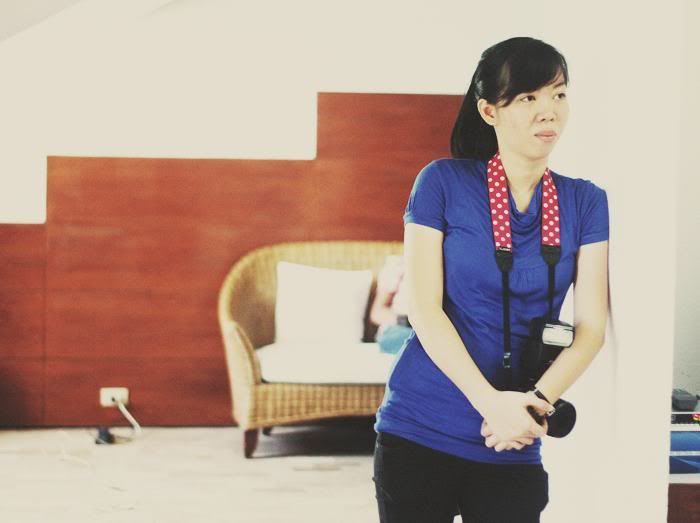
I am not sure if Kat Michelle Banay is a Sirkian manipulator of images, but I suspect there is something intelligent that lurks behind the pictures that she produces from her camera. Ms. Banay is another young photographer based in Dumaguete—somebody I have yet to meet—but the first time I came across her photography online, there was something breathtaking in their execution. Sure, what she had were pretty pictures—a cherry tree in full bloom, a wedded couple in repose, a tray of violet cupcakes, a clear bottle full of Scrabble tiles—but there was a depth to them I could not begin to articulate, or explain. Was it the haunting sadness of the cherry tree as it bloomed in full sunshine? Was it the unguarded tilt of the bride that betrayed something else other than bliss? Was it the sheer loneliness evoked by the still life of pastries? Was it the wistful manipulation of three Scrabble tiles, spelling out the word “art”?
I could ask what exactly it is about her images that strikes uncommon depths, but I doubt Ms. Banay would know the answer. The true artist never really knows where that intuition for beauty comes from. The poet Federico Garcia Llorca called it
duende, and Dumaguete photographer Hersley-Ven Casero calls it “the whisper that comes to me.”
In fact, photography was something she stumbled on as a hobby, her interest kindled in 2007 because she knew of a girl in Silliman High who “got to travel to places.” Ms. Banay recalled: “She would share photos of her escapades in Multiply. Back then, this was one of the top social networking sites. They were really just random snapshots of herself and her friends, but I found those cool. So I bought a digital camera, and took photos of me and my friends whenever we got the chance to travel. And then, months later, I realized I liked my photos better without myself in them, and so I went on and took shots of anything I found interesting or beautiful.”
Those things, of course, are the generic sort of “pretty” things—the beach, the sky, the trees. In other words, the raw materials for the budding image collector. Somewhere along the way, those images deepened into something more. They became, in a sense, a reflection of Ms. Banay’s secret self. The beach, the sky, the trees—they became metaphors for some inner surging. “Photography, like any other art, should be about self-expression,” she said. “The kind of subjects a person photographs somehow speaks something about the person behind the camera—what he likes, where he lives, what he does for a living, who he interacts with, what lifestyle he leads, how he finds beauty in the world and what it is he considers interesting. Looking at his pictures, you can tell how much deeper he sees things beyond the obvious. Anyone who is truly interested in photography will surely take pictures of things or places that he identifies with, and pictures are his ways of showing it.”
She continued: “For me, the best kinds of photographers out there are photojournalists, because they can capture the most special and meaningful moments that most people take for granted. That, plus the fact that they are able to compose well. But not every photographer has the eye of a photojournalist. And some of us just take pleasure in capturing random things around us, trying to make things more meaningful than how they appear. But whatever preference we have on subjects, what would be truly rewarding, though, is to inspire others just as others have inspired me.”
That inspiration springs from four sources—photographers Paul Vincent Photo (“I love that he seems to be able to capture the right moments in such a fast-paced event like a wedding, and do it so artistically”), Henri Cartier-Bresson (“he remind me to think before I shoot, that the best moments to capture are worth waiting for, that the perfect moment is out there and it is up to you to catch it”), Ansel Adams (“his work just seems to have just the right amount of black, white and gray”), and Stephanie Williams (“her photos so dreamy and inspiring, the kind that just makes you smile at the sight of them”). This says a lot about Ms. Banay’s education in the traditions of photography, something the plain amateur devoted only to the worship of the pretty would lack.
That education somehow shows in many of her photographic preferences. “I’m fond of taking pictures in natural light,” Ms. Banay said. In her photo titled
Beach, she takes what seems to be a random shot of Boracay in broad daylight, but in her composition of beachcombers, sand, surf, and cloud formation, she mixes a sense of summer tinged with a forbidding sense of heaviness. Look at that horizon. It is pregnant with a cutting sort of expanse. It is, almost, sad.
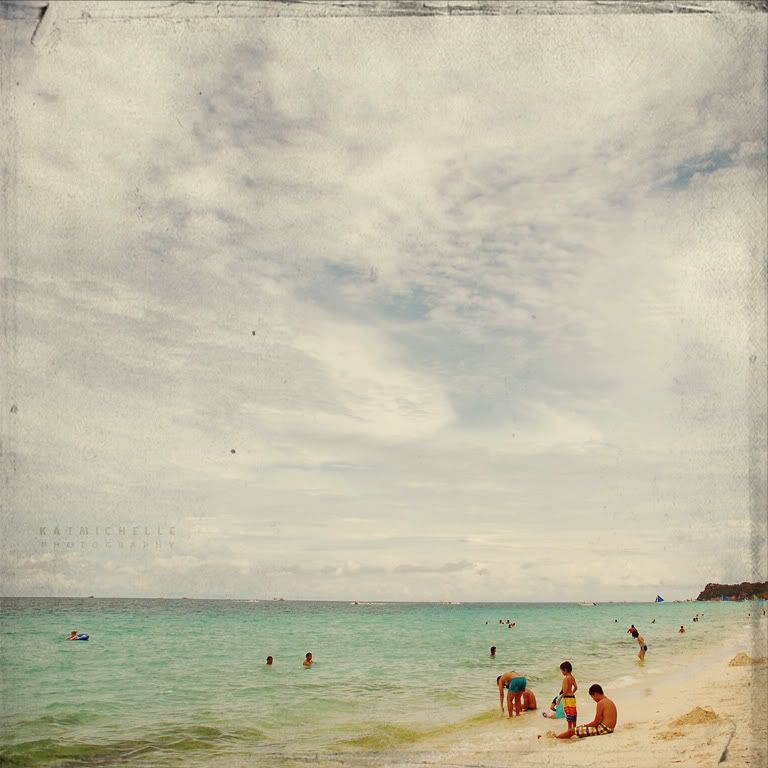
Is she cognizant of that effect in her photograph? Probably not, and perhaps all for the better. She simply recounted of it: “For me, the best place to shoot is the beach. This photo shows my love for travel, my love for the beach, and my love for shooting landscapes. It shows my fascination with cloud formations.”
And yet, there is some recognition in her part of a style, a photographic tick: “You’ll also notice my attempt in making this photo look vintage. I don’t know what about me adores old-looking photos. Now that I think about it, it’s funny that some photos I’ve taken were with modern equipment—but I make them look old, as if they were taken by cameras from the past.”
And sure, it looks pretty. But also something else entirely. That something else is what counts, and what makes Ms. Banay an artist.
Next: Ray Dy as the Maker of Small Beautiful Things
Labels: art and culture, dumaguete, negros, photography
[0] This is Where You Bite the Sandwich
Friday, March 30, 2012
9:27 PM |
The Staycation Option
For the past few months, ever since I started work on my graduate thesis, I've developed this (highly expensive) habit of just leaving the too-comfortable confines of my apartment -- and checking into the AC-comforts of a hotel room. With a good bed. And good wifi. With the TV remote untouched, hotel rooms are great havens for people who need to finish things in relative comfort, without the distractions of home.
I've been frequenting this one new hotel right in the middle of downtown, which is rather cheap and comfortable -- save for the horrendous plastic flowers as decor, and the linoleum tiling in the bathroom that ultimately turns the entire showering adventure into something quite icky. (Bring slippers!) The hotel will, of course, remain unnamed.
But here is this new find. GoHotel just opened a branch in Dumaguete, and offered me a much welcome complimentary accommodations this weekend as it goes through its dry-run/soft opening. The rates, while not fixed (
they have this Internet promo thing as a system), are quite remarkable considering the compact and inspired execution of the rooms, which, while tiny, are more than good enough for a traveling nomad, or a person bent on a staycation. Like I am. (I like what they say in their website: "We want you to sleep like royalty, but we won't ask you to fork over a king's ransom. Thanks to the year-round low rates, every Juan, Dick and Larry can afford hotel-quality sleeping experience.")
I love staycations. Staycations give me the thrill and the illusion of "travel" without me having to leave the city I am bound in because of work and other responsibilities. Staycations are cheap. They are relaxing. They give one a sense of the different that never fails to jog the imagination.
So here we are, on a Friday night, behind Robinson's Place in Dumaguete, checking into this bright spot...


This is the entrance to the hotel...

These are the wonderful members of the staff, Angelo and Reicha....

This is the corridor of the first floor. (The second floor is still being finished as I type.)

This is my room...

This is me inspecting the new (temporary) digs...

This is the bed, and now home of my gadgets...

This is the mandatory bathroom shot...

And this is me easing into the night, about to start writing/editing my novel, trying to find the courage to turn off the television...
So wish me luck, and may you have a great weekend ahead.
Labels: dumaguete, holidays, hotels, life, travel
[2] This is Where You Bite the Sandwich
4:36 PM |
Finishing Things
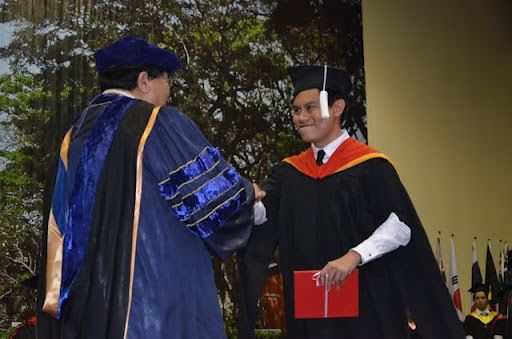
Truth be told, it took me forever -- about eleven years -- to obtain my MA degree. Somewhere along the way, I lost direction. First, my Graduate School teachers moved to other universities, some to other countries. Then work, and more work, happened. Then love happened. Life happened. So many excuses. And then after a while, finishing my degree didn't seem to matter anymore. But something (in fact, many things) happened to me in between 2008 and 2009 that put things in perspective, and made me realize what I considered truly important in this life. I've written considerably about my Christ Year and its aftermath, which culminated on that lovely quiet spot on top of a hill in Sagada.
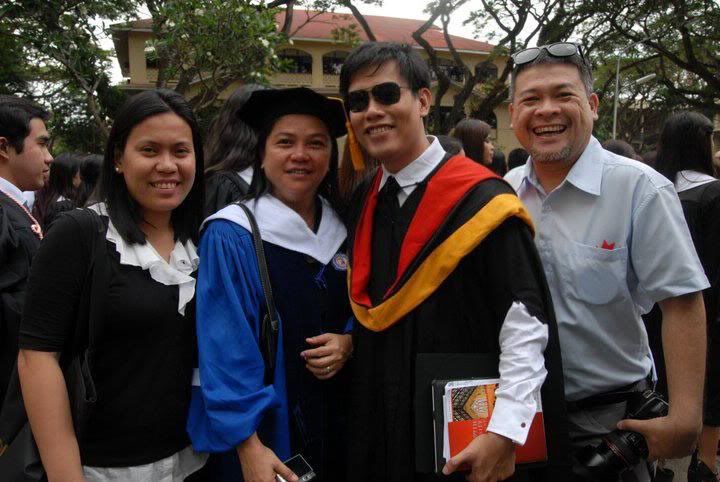
That Sagada experience has finally translated to this: a diploma. And a degree.
Of course, these things are never done, or finished, without other people to lean on to for support and encouragement. The writing of a master’s thesis is almost always fraught with drama and self-doubt, and these are the ones who made the unbearable bearable.
In my moments of utter chaos, there was one kind of stillness that I counted on time and again—God in His infinite graciousness and kindness. Sometimes I call Him the Universe, which is one and the same thing. He guided me through the hard times, and answered my prayers with such generosity, teaching me always to trust in His plans.
In my acknowledgment, I thanked a thousand people for getting me through the tough work. But I would like to specifically thank in this blog the following people for their help and guidance (as well as the much-needed tough love) in finishing this thesis: Dr. Ceres Pioquinto, Dr. Ben S. Malayang III, Dr. Margaret Helen Udarbe-Alvarez, Dr. Betty Cernol-McCann, Dr. Betsy Joy Bustamante-Tan, Dr. Laurie Raymundo, Dr. Elizabeth Susan Vista-Suarez, Dr. Gladys Rio-Malayang, Prof. Leonor Briones, and Prof. Gina Fontejon-Bonior. Quite a formidable bunch to compose my own pressure cooker. But these were the people who persevered with me for close to a decade, giving me just the right amount of encouragement to get me going, especially through the tough times when I was ready to give up. My panel has been most helpful in giving shape—and giving encouraging insights—to this thesis: my adviser Dr. César Ruìz Aquino (from whom I’ve learned much about the magic of creative writing), Prof. Philip Van Peel, Dr. Evelyn Mascuñana, Dr. Maria Teresita Sy-Sinda, and Dr. Andrea Gomez-Soluta in whose literary research class actually was planted the seeds of this thesis. I would like to thank my other professors in Graduate School—Prof. Timothy Montes (who got me started on creative writing), Prof. Eva Rose Repollo-Washburn, and Prof. Antonino de Veyra—for the guidance.
In particular, I would like to thank the great poet and critic J. Neil C. Garcia, whose many ideas on Philippine-specific queer theorizing fill this thesis.
I would like to thank Ron Jacob Calumpang for egging me on constantly, and for being the constant presence that anchored my often wandering mind.And finally, I would like to thank [Dev] who absolutely has no idea how much he has influenced the completion of this thesis. Thank you.
Labels: life, school
[1] This is Where You Bite the Sandwich
1:38 AM |
The Photographer of Moments
Part 1 of the Dumaguete Design Upstarts SeriesWhat inspires, or propels, someone to pursue art? Every artist has his reason, and there is no one answer to this question of beginnings. What we can know for sure—even if only in the language of the ephemeral—is the gravity that great art bears on us upon encounter. Sometimes great talent is something we come by through sheer accident, and sometimes we are drawn to it by the power of word-of-mouth. Regardless of how one comes about it, the sheer impact of its recognition is powerful. One is simply reduced into a state of awe. It is almost always a religious experience, as if having come in touch with it, you get an inkling of the spiritual.
It felt exactly that way when I first beheld one of my favorite paintings, Edward Hopper’s 1942 painting
Nighthawks—a somber existential drama in bright lights and color depicting four denizens in a city trapped in nighttime, in a bar, seen through a windowpane. Something about this painting has always intrigued me, deepening all the more over the years. When I finally came to see it for real in the gracious halls of Chicago’s Art Institute, I stood before it like a muted acolyte. I stared at it for what seemed like forever, unable to believe that I was finally seeing this great masterpiece, that it was before me. The experience of it moved me, and I must confess to tearing up just a bit, a wistfulness that was quite unexpected. Great art moves you like that.
One time, I was in a gig in Café Antonio when they used to do musical revues once every few weeks. (I don’t know why they don’t do that anymore.) I’m not sure exactly now what show that was. Perhaps it was the Apo Hiking Society tribute show, but I remember most this after-show jamming where this one singer—whose name escapes me, regrettably—started singing “Quando, Quando, Quando.” The guy did it with such unbelievable grace, his voice touched by something of a svelte naughtiness—I think everyone of us in that room stopped whatever it was we were doing, and just paid the greatest tribute of all: we listened, and we tried to capture the nuance of every single note. And when his song ended, we looked around, and we smiled. And somehow we knew we were touched by the divine in that masterful rendition of an old song.
Of course, these things come by rarely. The world, alas, is mostly awash in mediocrity. The shallow is currency in a world that is besotted by the common. The sublime always gets the shaft in favor of the silly. It is a world ruled by plastic beauty, the Kardashians, Taylor Swift, and
Twilight. Which is why, when we see great talent—especially in the small corners of Dumaguete City—we pounce on it like the treasure that it is.
This is an attempt to chronicle, somehow, a glimpse of what the future holds for the artist in Dumaguete, in particular the young people in this city who are into design. Because much has been said, and written, about our visual artists, our budding filmmakers, our writers—but what about those who dabble in photography, in fashion and jewelry design, in graphic design, in architecture, in interior design, in video art, in furniture design, in mixed media? Design is a tricky business of aesthetics, defined once by Valerie Pettis as “the search for a magical balance between business and art; art and craft; intuition and reason; concept and detail; playfulness and formality; client and designer; designer and printer; and printer and public.”
This brief survey of great young designers and artists in Dumaguete is not meant to compose an exhaustive list. God knows I must have missed one of two (or more) deserving of space in this essay. But these are the people who—over the past few years—have struck me as having captured something of an acute understanding of design. And they are young, of course—in body, and in ideas: composing a bright future for a city that will soon be in reckoning of their talents.
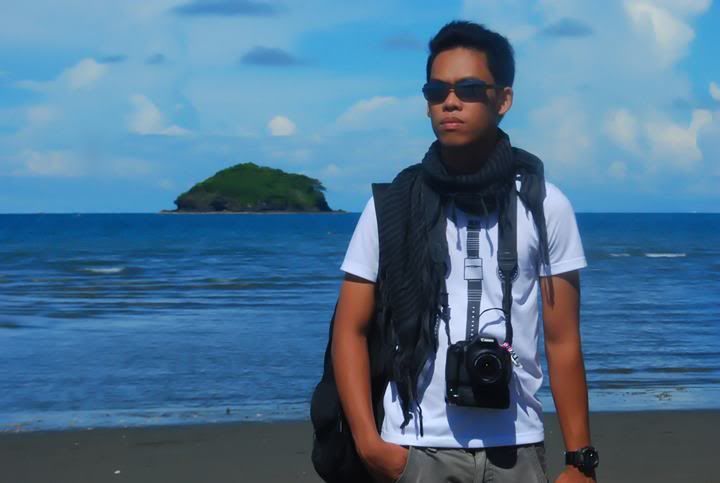
One begins with Hersley-Ven Casero, of course. Only a few weeks ago, he sold—through auction, which was a first in Dumaguete—a painting in benefit of the victims of Sendong and the Guihulngan earthquake. He is hardly an up-and-comer, having come into his own the past few years with his photography, and now his paintings. He got his start in design work in 2004 when he held his first digital camera, issued to him by Foundation University, where he now works. That encounter with the camera brought a bewildering enthusiasm in him: “I always brought it with me, and I took pictures of
everything,” he admitted.
Later on, Hersley realized that his interests lied primarily in portraits, especially in capturing how his subjects interacted with their environment. That bent is something he has come to nurture more and more. “It is photojournalism and documentary photography that I want to venture more into,” he said. “For me, this kind of photography is like catching the moment beyond the normal, and with spontaneity and decisiveness.”
And then he met photographer Luis Sinco of the Los Angeles
Times. The encounter proved productive, and this spurred him on with his interests. “There would be no Hersley-Ven Casero if there was no Luis Sinco,” he said. “He taught me a lot of things about photography—from the knowledge of the basics, up to the most complicated techniques. But he also taught me not just about recording images. He also taught how to interpret them, and how to deliver the message or the story behind a particular photo.”
Besides Mr. Sinco, he also cites Henri Cartier-Bresson as a major influence: “I admire his works because of the ‘joy of geometry’ that you see in his photographs.” He also cites Eugene Smith, an inspiration of a more practical sort: “Even when [Smith] had difficulties in his career, he still pursued and continued doing it.
But what is the underlying philosophy behind Hersley’s work? Looking at his photographs, and hearing him talking about them, it comes to me that it is not so much a philosophy than a form of intent. “It gives me satisfaction to share a slice of reality with every person seeing my photographs,” he says. “I put my heart in every picture I take, and for me that is one way of creating work that is edgier than expected.”
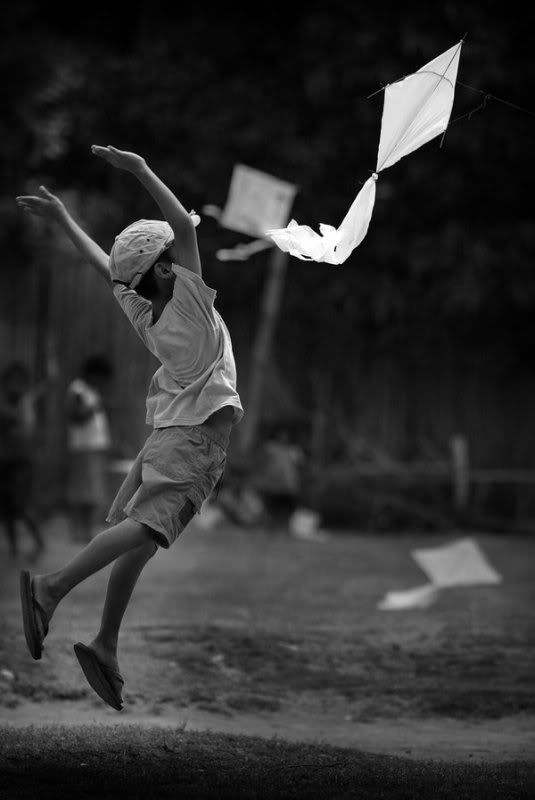
In that, Hersley makes a claim that his pictures speak really about his love for life. “I see life in a different way,” he said, “as a beautiful gift that one should treasure because it is worth keeping. I consider myself as the keeper and preserver of those precious moments that is part of life.” He cites his photo titled “Lift Up Yourself” as an example of this philosophy. It is a black and white photo of a kid at play with his kite. There is a sense of joy to the picture, and a sense of dramatic involvement demanded of the viewer. And the picture very much seems to capture an elusive moment of happiness in a child’s life. “Many of my friends thought this was a manufactured photo, a posed shot,” Hersley said. “In fact, this is a very good example of my philosophy of just catching a moment.”
(Next: Photographer Kat Banay as the Capturer of Natural Light….)Labels: art and culture, design, dumaguete, photography
[0] This is Where You Bite the Sandwich
Saturday, March 17, 2012
6:14 PM |
New Cinematic Voices From Dumaguete
First off, I must extend my congratulations to the winners and participating filmmakers of the
Third 61 Student Short Film Festival in Silliman University! It was an unexpectedly tremendous, jam-packed success—and now there plans afoot to make it bigger, perhaps even to expand the pool of talents beyond the College of Mass Communication.
Three years ago, when I was invited to be the Dumaguete representative for that year’s edition of the Film Congress of the Cinemalaya Independent Film Festival, I was asked during my panel at the Cultural Center of the Philippines whether there was a sizable filmmaking community here. And yet, despite my presentation declaring the city to be a cocoon for such filmmakers as National Artist for Film Eddie Romero, Seymour Barros Sanchez, Jonah Lim, Carmen del Prado, Ramon del Prado, and myself, there was not much you could consider to constitute a “community”—meaning there was no active active filmmaking scene, even of the independent variety, that churned out a regional cinema.
Later that year, in my film class for what was then the School of Commmunication, I challenged a group of students to make their own short films, and those who rose to the challenge—among them Anthony Gerard Odtohan (with
Papa Mike and the Rainbow Village), Eliora Bernedo (with
The Bird, The Bees, and All the In-Betweens), Karen Grace Yasi (with
The Anniversary), and Marc Cabreros (with
The Web Cam)—produced short films of a beginner’s variety: rough, but ultimately showing a promise of bigger and better things. That edition of what is now known as the 61 Short Film Festival showed us that things can happen, if we let them happen, of course with the attendant “pushing” that comes with any project. It showed us that Dumaguete was perfectly capable of creating its own regional cinema. Bacolod, across the island in Negros Occidental, was already leading the way. Dumaguete
Soon, we saw the trickling of filmmaking turning into a kind of flood. In 2011, SPI Global—a call center company in Dumaguete—ran a short film contest that yielded a filmmaker in Mark Duran. Also that year, North City Elementary School and the Negros Oriental State University also ran short film competitions that may have produced films short on either technological or story-telling considerations, but signaled more than just cinematic possibilities: they showed that Dumaguetenos—given the chance—were perfectly capable of becoming filmmakers. They have stories to tell, and they knew how to tell it in the specialized language of film. Soon, we got Stephen Abanto’s
Suga, an animated horror film; Razceljan Salvarita’s
I Am Patience, a nature film that is a meditation of Zen-like stillness; and Hersley-Ven Casero’s
Paper, a kind of animation that utilized more than a thousand still pictures to create the story of a piece of paper as it journeys around the Foundation University campus.
Suga and
Paper became the city’s representatives to the 2012 CinemaRehiyon Festival in Bacolod City. The year before that, the city was represented by Carmen del Prado’s documentary
Dumaguete—An Artists’ Haven.
This year’s festival crop is an amazing group that includes Jose Adrian Miraflor’s
Voldemort Must Die, which won Best Film and Best Director for Miraflor. The film also won the Audience Choice Award, Best Supporting Actor for Von Colina, Best Supporting Actress for Abbie Sagucio—and then Best Editing, Best Sound, and Best Costume Design, all for Miraflor. Mahogany Rae Bacon’s
Marry Me won the Jury Prize for Best Film, and also won Best Actress for Megan Alexandra Cariaso, Best Cinematography for Aris Ramiro, Cezar Galang, and Jerick Hernani, and Best Make-up for Nicole Villanueva. David Delantar won Best Actor for Crizza Almagro’s
Submarino.
Best Screenplay went to Mariella Sagarbarria Bustamante and Shadid Sidri for
Temperomine, which also won Best Production Design. Best Musical Score went to Jem Robert Talaroc for Kaiza Abaincia’s
Mikaela. Best Poster Design went to Eunji Ha's
The Haunted House.
Congratulations to the other student filmmakers Precious Grace Heradura (
Party), Beverly Linao (
Document1), and Grace Yang (
Crossed Destiny) for a job more than well done. And thanks to our Jury composed of Ma. Cecilia Genove, Dessa Quesada-Palm, Annabelle Lee-Adriano, Greg Morales, Ian Manuel Mercado, Carmen del Prado, Hersley-Ven Casero, and Hope Tinambacan.
Let’s hope for even bigger things, cinematically-speaking, in the nearest future.
Labels: art and culture, cultural affairs committee, dumaguete, film, silliman
[0] This is Where You Bite the Sandwich
GO TO OLDER POSTS
GO TO NEWER POSTS


