Celebration: An Anthology to Commemorate the 50th Anniversary of the Silliman University National Writers Workshop Sands and Coral, 2011-2013
Silliman University, 2013
Today, with good friend and partner Ramuel Benedicto Reambonanza, I went on a sack race in Freedom Park, counted 635 kernels of rice, raced to the public market 3km away to find Manang Lolit's stall in the middle of the market maze, ate five big cubes of ice in less than 90 seconds, raced to Valencia town after haggling with a jeepney, planted a tree in the mayor's brother's yard where he also collected non-biodegradable garbage, took a quiz about composting, dug into a huge pot full of earthworms, solved a clue using cellphone codes, then begged a habal-habal for a P24 ride to Hayahay [which is worth P100 on ordinary days], ate pizza for lunch, made wind chimes out of Tanduay bottles, solved a puzzle about garbage, raced to Mercury Drug and ran more than 10km to the city dumpsite while picking up garbage on the way [while Ram rode a potpot], threw said garbage to the city dumpsite, raced back to the city on the same backbreaking route, haggled for P30-worth of children's clothes at the ukay, ran 3km to Looc to give ukay to a poor kid, solved a Rubiks cube, ran to the Boulevard, and finally obtained 20 ecological petitions from total strangers.
"What will you do in bed? Stare at each other? That is supposed to make her happy?" ~ Patrick Seagrove
I am beginning to believe that those who like to throw around, with such careless abandon, the much-abused phrase "I don't believe in labels" are actually lazy idiots who think they can get by in the world in spineless namelessness. For example: "I'm not gay. I'm not straight. I just believe in love. Why label love?" Fuck that. You're already naming that chemical reaction inside you as "love." That's labeling. You cannot get away from naming. It is a basic function of intelligence that has a link to the spiritual. "In the beginning was the Word" -- even the Bible says that. If you think hard about it, such abandon of refusing to name oneself actually most often produces unexpected hurt and pain, especially for the party that has been [or will ultimately be] fooled/hoodwinked. It's the philosophical equivalent of fence-sitting, the coward's cop out. Be gay. Be straight. Whatever. Just deal with it. Don't live in the world that is full of shadows and call it paradise.
Over lunch in Jutsz Cafe, where I have my favorite dish of garlic fish fillet with salad, I begin filling out the calculations for my red mixed income form from the Bureau of Internal Revenue, which came with the regular income tax return. Michael, our English Department secretary who knows his accounting stuff, had earlier done the complicated mathematics for me—all those numbers swimming in my eyes signifying nothing.
Already that morning, I had dutifully made my annual pilgrimage to City Hall to get my CTC, my cedula.
In my head, the route for the rest of the afternoon is well-laid. I’d stop over at the BIR main office near the Capitol to have my documents checked. Then I’d scoot over to the nearest bank and pay whatever penalties I am supposed to pay. I’ve done this ritual every April for so many years. The only hassle I have ever encountered was once forgetting the filing deadline in 2007, and I had to frantically do the required legwork precious minutes before the banks closed. Afterwards, I think, I’d go home, pick up my laptop, go straight to class, lecture on Contemporary Philippine Literature, go to the gym, go home and shower, go to Maoai Benitez’s birthday party, and then watch Broken Hearts Club with The Hive. Perfect.
The BIR office is friendly enough. Entering its premises, I find a gigantic poster of the BIR head commissioner in a pose gesturing welcome. I think it funny how our high officials find it always necessary to put their visages on such things.
Inside the BIR, I joke around with fellow Silliman University employees who are, like me, doing their filing at the 11th hour. The nice BIR office lady tells me everything in my documents seems in order, but tells me only to change my entries in my red form from pencil marks to ink. I say thank you, and I proceed to redo the form in ink.
“Where can I pay my mixed income tax?” I ask later.
She smiles and says, “Well, there’s Landbank, and there’s DBP.”
I think: DBP is just a little too far, near the Boulevard. Landbank, on the other hand, is only a stone’s throw away from the Capitol Area. So I go down from the BIR building to the highway—and there I realize that there is no tricycle headed in the direction of Landbank. The DPWH has closed the strip to do repairs on the road, and public transportation has been routed somewhere else. “Great,” I think of the public works being demonstrated right in front of me. “This is my tax pesos at work.”
I decide to walk the length between the Capitol Area and Landbank. It’s not too far, I think. Under the 1:30 sun, I walk and brown in the sweltering summer heat.
I arrive in Landbank. I ask the guard on duty, “Where do I file my income tax?”
He nods towards the teller, “Go straight over there.”
I go to the teller. “Is this where I file my income tax?”
She says, “Go to the BIR representative over there. He will first approve your documents.” She points at his direction with her lips formed into a snout.
The BIR representative stationed in Landbank turns out to be an overeager asshole who gives me an unnecessary hard time.
I give him my forms, the same forms the people in the BIR main office have already gone over.
“You need to change this red form to the blue form,” he says, in a tone of such bright overeagerness it borders on the infuriating know-it-all.
“But I’ve always used this red form for my mixed income.”
“No,” he insists, “you have to.”
I look over the new form. “But the calculations are not the same anymore then, and my accountant has already filled in the calculations. Do you expect me to recalculate all this?”
“It’s the same,” he insists.
“But I have always used this form.”
“If you insist on using the red form, you will be liable for a tax audit.”
A tax audit? On a fixed income?
I sit down and study the difference between the two forms.
I text Michael at the department and my friend Jacqueline at the Silliman Business and Finance. These people will know what to do, I think. They breathe these things. But they tell me to just follow the BIR rep’s suggestion.
I study the forms some more. “But the boxes for the amounts are no longer the same,” I tell the overeager BIR rep.
This goes on for more than ten minutes.
“But they are the same,” he says.
“They’re not.”
“They are.”
“They’re not.” I become exasperated. I sit down, and try to fill out the new blue form anyway. They are not the same.
I think: I can get out of the bank, and have Michael recalculate this. Or, or...
Or go to another bank.
I immediately stand up and get out of Landbank, planning on a quick transfer to DBP.
Thirty minutes have elapsed.
There are no tricycles headed that way. So I walk again, under the heat of the sun, from Landbank to the Boulevard Area. I tan with each ticking second.
I arrive at the DBP. It is past 2 pm. The guard stops me. I tell him I am there to file my taxes. He asks, “How many sets of payments?”
I blink. “What do you mean?”
He takes my forms and starts counting. “One...,” he intones, “two... three... You have to fill out these three individual payment forms.”
An older guard suddenly comes out of the bank’s doors. “Are you sure?” he asks the first guard. He, too, counts my forms. “He only needs one payment form to fill,” he says.
“Oh,” the first guard says. “Okay then.”
I take the new form.
“Here’s your number,” the first guard says. “They will call you with this number.”
My number is 82.
“Do you have a cellphone?” he asks.
“Yes,” I say. “Why?”
“Leave it here with me. You can’t bring it inside,” he says, and then gives me another number. It is a claim tag. It is numbered 8.
“Okay,” I say, giving him my cellphone. “Where do I go after this?”
“Fill out the payment form first, and then go to that BIR representative stationed over there,” he says.
Yes, another BIR representative.
“Okay,” I say.
I sit down at the nearest couch and fill out the new form. It is mercifully short.
Then I go to the BIR representative seated at her table. She looks over my forms, including the OLD red one I had refused to change, and then she tells me, “Everything is in order. Please wait for your number to be called.”
In my head, I am screaming: What? What? What? What exactly was the problem with that other BIR representative in Landbank? How can two BIR representatives disagree on procedure?
I sit down and wait for my return. It turns out to be a long, long, long wait. But the electronic call number above the tellers’ heads does not seem to be working, and the numbers they are calling out do not seem to make sense with my own number. I am 82. They are calling out digits immediately after 10. Surely I am not supposed to be here in the bank forever! I go back to the guard outside.
“Are you sure this is the right number?” I ask.
He looks down at his work station—and on top of it was a merry pile of other numbers. He picks out a smaller one. Now I am No. 38.
Such system! I laugh inside. I am slowly being torn to pieces by the madness of it all.
I go back to the air-conditioned interiors of the DBP, wanting only to laugh at the absurdity, at the randomness of everything. I feel like I am in a Kafka story.
The minutes drag. I fall asleep where I sit.
I must have been inside that bank for more or less two hours.
And then finally, a voice rings out. “Number 35, 36, 37, 38, 39, 40...” and so on and so forth.
I rush towards where the voice is, and the kind-looking teller takes my form. “Please wait to be called again, sir,” she says.
I wait for thirty more minutes.
And then finally, my name, ringing out from another teller’s mouth.
I pay my taxes.
Soon I drag my feet out of the bank. I claim my cellphone from the guard’s desk. I begin to send out cranky messages to the rest of the world. I look at my watch. It is past 3:30. I am late for my class. And I no longer have any plans for going, or partying later in the night. I am exhausted.
While I pause to take a breather right outside the bank, a motorcycle screeches to a stop outside the entrance. An old woman alights from the passenger’s side, and goes straight to the doors.
She knocks.
The bank guard peeks out. “Ma’am, sorry. The bank closes at 3 pm.”
“But,” she begins with a voice laced with worry, “I have to pay this. This is my BIR income tax form. If I don’t pay this today, I will have to pay the penalty.”
“Ma’am, sorry,” the guard insists. “The bank closes at 3 pm.”
I quickly walk away from the scene, hoping for a quick tricycle ride home.
5:00 PM |
Why Love is Like Raccoons in Burning Chimneys
"The thing to remember about love affairs," says Simone, "is that they are all like having raccoons in your chimney.... We have raccoons sometimes in our chimney.... And once we tried to smoke them out. We lit a fire, knowing they were there, but we hoped the smoke would cause them to scurry out the top and never come back. Instead, they caught on fire and came crashing down into our living room, all charred and in flames and running madly around until they dropped dead." Simone swallows some wine. "Love affairs are like that," she says. "They are all like that."
"We are built to suffer terribly when love fails -- first to protest the departure and try to win the beloved back, and later, to give up utterly, dust ourselves off and redirect our energy to fall in love again."
“Sitting quietly, doing nothing, spring comes, and the grass grows by itself.” —ZEN PROVERB
I don’t know who it was who first told me that one sure way to calm yourself in the frenetic whirlwind of days is to stop and just look at a flower.
Imagine this. You command yourself to stare at the bloom, to feel all your undivided attention focus on the intricacies of its petals and the sure tuck of its sepals. See how it folds at some edges, and then how it flares just so at the others. See the creeping diffusion of hues. You soon feel its colors begin to pulsate, you feel the wonderful symmetry of its biology...
Almost always, perhaps because you will it so, the world begins to shrink away. And then there is only you and the flower, a quiet invisible cocoon shedding you from the cacophony of everything else. You. And a flower. And the bliss of a full flowing concentration.
Sometimes all we really want, in the best of days, is quiet.
In Muriel Barbery’s intelligent and deeply affecting novel The Elegance of the Hedgehog, which is about a trio of geniuses “in hiding” in some rich Parisian apartment building, we find that the precocious child genius Paloma Josse is always in search of a hiding place, away from the bourgeois “barbarians” who are her family and neighbors. She wants to get away from everyday disturbances to nurture quiet, which breeds what she calls “profound thoughts” about the “movements of the world.” She rarely gets it, but in the end she finds it in the loge of Mme. Renée Michel, their squat concierge, who fiercely hides a formidable intelligence by embodying for everybody else in the building the stereotype of an unthinking blue-collar worker. But perhaps Adlai Stevenson said it best, when he once declared: “In quiet places, reason abounds.”
This is true.
Not everybody can appreciate that kind of quiet, of course. They often mistake it for boredom. Perhaps this is because we have grown so used to increasing decibels as an everyday thing in all our lives. It has almost become the new make-up of the world.
My music mentor, the radiant Elizabeth Susan Vista-Suarez, once told me that she believed most of the world has gone increasingly deaf over the years. She has found that what were once perfectly acceptable (and hearable) levels of sound—especially during concerts at the Claire Isabel McGill Luce Auditorium—have fallen on increasingly unhearing ears.
“It’s not even about the acoustics anymore,” she said. “People are just becoming hard of hearing these days.” She knows why. The world has become a playground of noise.
And I know this for sure in my life. You see, it has become a bit harder for me to hear sound in “normal” levels—the music that I play in my apartment, for example, nears maximum volume, but I play the denial game by convincing myself that my stereo’s volume dial is calibrated for soft sound, even at maximum.
It is the same for the sound coming from my television. And it is perfectly reflective of how I have become inured to noise that I cannot fall asleep without the television turned on. I nod off to its disembodied sounds. That and the flickering blue that it emits into the walls of my darkened bedroom becomes my kind of lullaby. I sleep to the sound of CNN anchors, to the silly chatter of MTV veejays, to the chatter of unseen adventurers of Discovery Channel.
It is as if we have come to truly believe that all the universe is made of this fabric of sonance—honking cars horns and screaming children and blaring televisions and puffing politicians and screeching car wheels navigating the asphalt jungles of our lives.
And so, when suddenly we find ourselves in the green solitude of mountains or at some secluded beach, we take to the quiet that pervades like it was an alien thing, which we can amuse ourselves with. It is something decidedly different for us that it borders what we make for novelty. “Quiet,” for a lack of a better description, has become quaint.
Over the Holy Week, as Dumaguete dissolved into the doldrums and I surfed the Internet to distract myself from watching too much television, I found people begin to make noise online with the same whine: “I’m bored.”
Over and over—in Facebook status updates, in Twitter shoutouts, in Tumblr posts—it was essentially the same thing and the same concern: “It’s too quiet. I’m bored.” There were Boracay wishes and invitations to escape the sweltering heat to the cooler enclaves of the mall or Baguio or Valencia town—such fuss because there was none of that comforting din people were used to. Outside, there were no tricycles trolling the streets. There was no rush of people. There was only quiet.
And then, once again, that whine: “I’m bored. It’s too quiet.”
Even I, child of noise, had to react to this tiresome litany. And so I wrote in my Facebook and my Twitter pages: “That’s not boredom, people. That’s a chance for rare quiet in this noisy world, and a chance to listen to what the depths of your heart can tell you.” It was a corny note, but I felt it was calculated enough to make some of the whining stop.
And for the most part, it did. At least for a few hours, anyway. That note miraculously snowballed into a chance of reflection among some of my friends. One eventually wrote back: “That made me rethink what I am exactly doing now. Thanks for the perspective shift.”
Later on, I too began to believe in my own mantra. I turned off my television, closed the laptop to break away from the “chatter” of the unceasing online world. I settled for a book, and in low volume, I played “Thy hand, Belinda; darkness shades me” from Purcell’s opera Dido and Aeneas. This, according to the fictional Mme. Michel, the heroine of Barbery’s world, is “the most beautiful music for the human voice on earth...”
Barbery continues in Mme. Michel’s voice: “It is beyond beautiful, it is sublime, because of the incredibly dense succession of sounds, as if each were linked to the next by an invisible force and, while each one remains distinct, they all melt into one another, at the edge of the human voice, verging on an animal cry. But there is beauty in these sounds that no animal cry can ever attain, a beauty born of the subversion of phonetic articulation and the transgression of the careful verbal language that ordinarily creates distinct sounds. Broken steps, melting sounds. Art is life, playing to other rhythms.”
Melting sounds. Life in rhythm. Things you can hear only when all else is quiet and you are in tune with how the universe hums without the distraction of the noises we make.
1:18 AM |
The 60th Palanca Awards Now Accepting Entries
The Carlos Palanca Memorial Awards for Literature (more popularly known as the Palanca Awards) continues to live up to its reputation as the country’s most prestigious and longest-running literary contest as it officially opens its 60th year.
This year, the Carlos Palanca Foundation looks forward to more brilliant works to add to its trove of 1,954 winning literary gems it has gathered since it first handed out an award in 1951.
The regular categories under which participants can submit their entries are: English Division [Short Story, Short Story for Children, Essay, Poetry, One-act Play, and Full-length Play]; Filipino Division [Maikling Kuwento, Maikling Kuwentong Pambata, Sanaysay, Tula, Dulang May Isang Yugto, Dulang Ganap ang Haba, and Dulang Pampelikula]; Regional Languages Division [Short Story-Cebuano, Short Story-Hiligaynon, and Short Story-Iluko]. Each contestant may submit only one entry per category.
Much anticipated as well are entries to the competition’s relatively new categories: Poetry Written for Children in the English Division and Tulang Isinulat Para sa mga Bata in the Filipino division. The categories were launched last year to encourage the development of a body of poetry for young children ages 6-12.
Meanwhile, in the Kabataan Division, Palanca Awards’ special division for young writers below 18 years old, the Kabataan Essay theme in the English category is "What is it in the environment that I can protect?", and in the Filipino category, “Ano sa kalikasan ang aking kayang pangalagaan?”.
The literary contest is open to all Filipino (or former Filipino) citizens, except current officers and employees of its organizing body, the Carlos Palanca Foundation, Inc. Contest rules and official entry forms are available at Palanca Awards’ official website, www.palancaawards.com.ph.
Entries with complete requirements may be submitted to the Foundation’s office at the 6th Floor, One World Square Bldg., 10 Upper McKinley Road, McKinley Hill Town Center, Fort Bonifacio, Taguig City or may also be entered online through the Palanca Awards website or sent through email at cpawards@palancaawards.com.ph.
Deadline of submission of entries for this year’s awards is midnight of 30 April 2010. Winners will be announced on September 1, 2010.
For further information, you may call telephone number 856-0808.
One of my bestest friends, the ever lovely and extremely talented writer Rica Bolipata-Santos, now blogs. I've been telling her to blog like since forever, because her brand of confessional nonfictional seems suited for it. And finally she has!
A strange, queasy feeling suddenly descended on me yesterday when I was going about my way in the city paying the horrendously astronomical bills needed to make my life livable and functional—electricity, water, the cable television, the Internet, the credit card, and all that jazz. Growing up is all about these little receipts.
It felt like a mild form of horrible.
My friend, the eternally nonplussed Ren, merrily texted me back when I complained to him about the amount and the perplexities of adult responsibilities: “It’s masakit, right? Then again, life is boring without bills!” Give it to Renair Dy, Mr. Optimist in the Rainbow of His Days, to find gold in a room full of horse shit. (Whether he will enter that room at all, given his O.C.-ness, is another story.)
Ah, the problems and challenges of middle class living in the Philippines. Being bourgeois is affordable comfort for most of us lucky enough to thrive in this part of the social divide—but there’s also an unstable quality to this; how we desperately invest in sweat (or back pains, from stress), for example, just to get it. I once gloriously pronounced to my literature class, while dissecting Emmanuel Lacaba’s proletariat-in-the-ideological-journey-of-his-life poem “Open Letter to Filipino Artist,” that we were all comfortably burgis, conditioned to the core, that no other kind of life would seem feasible or right for us. “Can you do an Emman Lacaba and go to the mountains for a social belief?” No one raised his or her hand.
Of course, it’s infinitely better than out-and-out poverty, but it’s getting harder these days—so it seems—to stay comfortably middle class, and be sane at the same time. And the burdens on this class! Any economist worth his salt will tell you that one simple way of measuring the fiscal health of a nation is to measure the size of its middle class. Is it growing? Is it even existent?
Which makes me think: is there a Filipino middle-class ba? I once read somewhere that the problem with the Philippines, at least in terms of its struggle with economic potential, is that its middle-class largely lives abroad, leaving behind only the very elite and the very poor scrambling and in constant war for power, like cockroaches in a dung heap.
Ay naku, if that theory holds water, will there be any solution at all to our problems?
I thought of this while lining up in the bank (in what was positively the slowest line in the history of world), while waiting for my turn in NORECO, while shivering from the blast of air-conditioning in Globelines, while….
I paid my bills, and reflected on the world. It was one of those lovely summer mornings in Dumaguete, those rare days when the sun shines with a mild generosity—a bright day that does not bear down on you with a relentlessness of heat. I was attuned, you could say, to the stirrings of the world outside. It was easy enough to believe that all was well with the world. Through the open doors or the open windows of whatever cramped space I was in, I could look into the bright summer blue, and thought how great a day this could be.
On days such as this, if there wasn’t the fact of bills-paying to focus on, one could easily forget all his troubles, and it would become easy enough to disbelieve that there was a cancer growing out there in the world. But—people were dying, you knew, people were bombing each other in no-longer-so-obscure places in the world in the name of God and freedom. There were earthquakes and other natural disasters everywhere. And now, in the Philippines, there were people going about in sorties, in battle-ready composure, campaigning for their political survival, disrupting our existence with stupid jingles, with clichéd TV and radio ads trumpeting a showbiz-influenced kind of sensibility, with practiced smiles, and with even more practiced (and ingratiating) command of the local language. Such scrambling! I thought, Such hideous and naked ambitions for power!
It gives you pause sometimes, how people could will themselves to become the worst versions of themselves—corrupt and corrupting—just to secure a position in office in this, our glorious Republic of Shit. Politics must be so lucrative to the bottom line. This month and next month, I bet our very air will be polluted with the promises of politicians promising you the moon just for our vote. And everybody’s jumping into the circus, of course, quarreling with each other in Facebook, over dinner tables, and everywhere else over the intricacies of their political bets’ qualifications for office. I refuse to be ensnared so far into the debate, although I know the debate is necessary. It’s just that—I feel we’ve been through this circus so many times before, and yet nothing much has changed. What makes me angrier is that these people get into office with our supposed consent, and then get rich courtesy of our taxes. And yet, and yet…
Oh, what a circus. There’s a word for all of these: kakistocracy. This is government by the least qualified or most unprincipled citizens. Add that to your vocabulary, and draw the Filipino.
I remember filing my income tax return the other year. I remember how the taxable amount glared at me like a wart on paper. And I remember thinking to myself: I pay the government this much every year? It was highway robbery. I wanted a street named after me! I remember I was so riled up that I needed some cooling down after that. And so Mark took me out to squander the day away. We were doing our bit of leisurely strolling, something we used to do often before but didn’t do for the longest time... (I remember that I was busy salvaging stories and preparing for summer term that time, and he had been busy graduating from college and shooting TV shows. It was remarkable how so much clutter disguised as responsibilities made up our lives, we forget sometimes to actually live.)
In Lee Super Plaza, we did our regular route of browsing the second-hand books and magazines at the mezzanine, eating siomai (and sometimes the tacos) at the Food Court, then going on to the kitsch on display at the third floor knick-knacks department: all those figurines and picture frames and candles and lamps and fake flowers of astonishing bad taste, I wondered who would actually buy these things. We became more excited when we got to the kitchenware section, and the furniture section, and we wondered out loud: Why was that so? Had we become too domesticated together? Have we become the perfect picture of burgis bliss?
At the toy section, we suddenly reverted to being children. Suddenly, there were all these Spongebob stuffed toys, and toy cars, and funny dolls, and teddy bears, and mechanical snakes to occupy our fancy! Then I saw some board games with familiar names, the kind I used to play with as a kid, games that use to bring families and friends together in an increasingly rare social interaction: Pictionary, Trivial Pursuit, Scrabble, Bingo, Monopoly, Snake and Ladders, Clue… It struck me suddenly: I didn’t know anybody—kids or adults—who play board games these days.
That and taxes and bills, I decided, have made the world become all so much sadder. But that’s just how it is.
This made me think, because I have friends who are exactly like this:
Everyone knows a baffling couple like the one that takes shape in Greenberg, Noah Baumbach's defiantly unsettling new film. One half of the couple is a genuinely lovely person. The other seems to have no redeeming qualities whatsoever. You come home from being at a dinner party with them stumped as to why the lovely person hasn't noticed that their spouse or partner is a total stinker. You ponder, maybe for the first time, the term co-dependency. Mostly you wonder how this pair ended up together.
I realize that my favorite characters in film or literature are my favorites, not because they're grandly heroic, but because they're ordinary, flawed people striving for beautiful balance. Like this lost girl singing of rivers in the moon...
... or this one singing of feeling the sun in a whole new world...
Their search for that dreamed-of only happiness in a world that's cruel or apathetic is for me the finest brand of heroism.
You guess, when you woke up this morning to the sound of Bruce Springsteen singing "The Secret Garden," that something must be done about this. The truth is, you really can't control what you feel. When you feel sad, you feel sad. When you're happy, you're happy. Your head can tell you to feel the opposite, but you suddenly find you are not an automaton. You are hostaged to the chemical rushes your body makes. Emotions are the only truly stubborn thing there is. And they're flighty, too. They change with each slight nudge of the seasons. Nothing can be done about that as well.
But you can change the specific circumstances -- deleting the Internet accounts with which you can see him mug for the world to see, for example -- by which you feel things.
Because you can't go on like this forever. Today must be the start of your emancipation. You must remember most that he does not love you, not the way you deserve to be loved, anyway. All that you are and all that you can give, they're wasted on stone. It's not right.
Someday, the universe will conspire to make you complete. But you must first learn to let go.
The thing they don't tell you about graduation is this: the bliss of an afternoon clad in a toga is quick and shallow. The commencement speech is boring, and you feel that the summer sun, which is blistering hot, is laughing at you. It still doesn't quite register that a great chapter in your life is over -- college, you will soon realize, was a time when you had all the chance to explore, and do, all that you can be without adult recriminations -- and then you realize it rang away so quickly and unexpectedly, just like the sound of a misfired shot gun.
Four years are quick. The future is long.
And then this bullet of a realization suddenly gets to you: it's all over. You finally say to yourself, in a sudden acknowledgment of what's to come: "Okay... what now?" You're sweaty in your toga, and all you get is silence. Your mother smiles at you. She expects you to get a job fast.
"I have a friend who owns a college," your mother says. "I want you to stay in our hometown. Be with me."
You feel yourself wilt inside.
The very next day, you realize you can't really ask for an allowance anymore.
A sandwich, especially when done right, is a veritable architecture of food perfection, defined by simplicity of structure—two slices of bread hugging yummy goodness—but distinguished by possibilities of invention. This inventiveness comes with whatever suits anybody’s sandwich fancy—put in salami, put in roast beef, put in a delectably fried beef patty with a melted slice of cheese. Put into the mix your coleslaw, your slices of the choicest tomato, your onion rings, and voila, that’s heaven in all of a piece.
I love sandwiches.
Which is why I’m taken in quite well, in measures of muted admiration, by this establishment in the second floor of UTH Building along Avenida Santa Catalina, a stretch that is increasingly distinguished by the number of restaurants and cafés popping up in what one might as well be call Dumaguete’s new Food Street. There’s Café Antonio at the northern end and Café Noriter farther down south, sprinkled in between by assorted chicken grill houses and high-end gourmet joints like Boston Café. In the middle of it all, like a secret haven, there’s Mels.
It is not easy to spot Mels, if one judges location by quick landmark recognition and accessibility straight from the streets. Its signage outside calls attention to a side entrance, but a quick flight up the stairs leads you to a small square of a café. I’m a little ambivalent about the place’s décor since my preferences usually run towards the artsy and the dramatic, which for me usually provides any restaurant a kind of quirk or soul that certainly lends charm to the menu; Mels approximates for me a spare dorm room made busy with little pieces of stickers, and blackboards, and shelves of books and magazines stuck to the wall. I don’t know what design philosophy has gone into the making of this one, and I could wish for something more that whets both the eyes and the appetite.
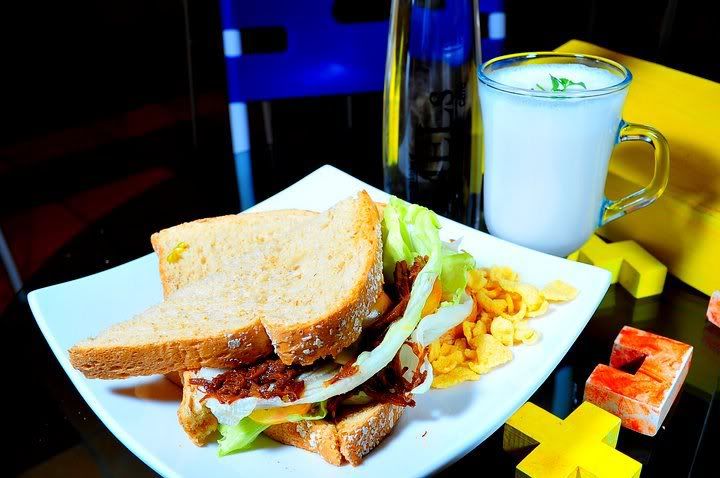
But that doesn’t matter. I take in, first of all, the bestselling piece of the menu—something called a Cheezy Burger, which is not a burger but an oversized sandwich. The patty melts in my mouth with just the right kind of texture and softness. Bundled with lettuce in between slices of wheat bread, it has just the right kind of sizzle and bite. The cracklings on the side—not potato chips or French fries as is common in other establishments—is something of an afterthought. But I drink it all in with a glass of Frizz, a carbonated fruit drink (this one’s in strawberry flavor).
“You must try the Roast Beef Sandwich,” somebody tells me.
It was decadently delicious. The roast beef, downy and coming in flakes, is a sweetish blend that belies the whole sandwich-ness of the thing. It is a full meal. I pronounce it the perfect sandwich.
I take that down with what is now my favorite drink in the café: the Butter Beer—something inspired by the fictional drink in Harry Potter’s world—but this one is a non-alcoholic concoction that still gets you drunk with semi-creaming goodness. What I had was a milk-based vanilla inspiration (one can also have the drink in cinnamon or strawberry or banana or mocha) with sprig of mint on top of the froth. It was so relaxing, it’s better than mocha. One sip instantly reminds me of Baguio rainy nights—a perfect nightcap especially on a hot summer day.
The place is called Mels because—as is commonly done by many Filipino establishments—it is the perfect shortcut for the names of all the proprietors. Here, Mels stand for Melvin (whose specialty is soup and drinks), Melody (who concocts the desserts), Melanie (who makes the cakes and cookies), and Melissa (who also does dessert), all of them Uymatiaos with a dream of food.
“How did you come up with the menu?” I asked Melvin.
“It was a matter of us coming together with our specialties,” he said, “and convincing the other that this has got to be part of the whole experience.”
The idea behind the café, which opened in January 2010, began with Melvin who graduated from Silliman University in 2003, with a degree in Information Technology—a far cry from the kitchen from which he invents culinary pleasures. He had done his share of plodding through the corporate warpath in Procter and Gambe, and then in Hewlett Packard, which afforded him to travel extensively—in the United Kingdom, in Egypt, in India, and in China, taking from each place a sense of culinary invention. By 2009, he was back in Dumaguete to begin work for the family company. But he had always felt that Dumaguete was missing something new.
“Can you define that something?” I asked him.
“Innovation,” he said. “Because what do we always have around us in Dumaguete? What’s the usual? Chicken.” He said that even when they were young, they—he and his sisters—knew they’ve always wanted to have something different. But it was always the same—McNelys, Jo’s, City Burger, Jollibee…
In a sense, for Melvin, Mels is the antithesis to all that. “There’s no other place in the city that is offering this kind of food—salads, especially—especially for those who are adventurous, and for those who are on a budget,” Melvin said.
They began constructing a menu they thought would be a little something different. “There’s soup. We have mushroom soup here,” Melvin said. “And our salads comes in seasonal themes—there’s Summer Fruity Salad, there’s Spring Mandarin Chicken Salad, there’s Winter Crab Salad, there’s Autumn Apple Salad. But you must also try our desserts… There’s the WBC, otherwise known as a Warm Brownie Cup, a brownie topped with vanilla ice cream, heated. There’s our mango ice box cake. And there’s what we call muraputo—an angel cake topped with fruits.” That’s what I had, and it was like tasting a sweet but firm brazo de mercedes, without the mercedes.
But they pull out all the stops with their sandwiches. Aside from the ones that I’ve had—the Cheezy Burger and the Roast Beef Sandwich—there’s the Garden Delight Burger, with its inventive use of coleslaw; there’s the California Sandwich, which is all vegan—no meat, just lettuce, tomato, cucumber, crab kani, and mango; there’s the Pork Barbecue Sandwich. Then, of course, there’s the tuna and the classic ham and egg—but with a Mels twist.
One of the things that is quite special about the place is Melvin’s own invention of a parlor game—something he calls Dodecamino, which is composed of wooden blocks inspired by Tetris pieces, the objective of which is to form a rectangle from a pre-selected set of pieces. This sounds easy, but takes a lot of time to decipher. On the wall, tacked to a board, there’s a bondpaper that contains the design of a robot figure. “Use all pieces to make that design, and you get one free meal,” Melvin said.
If you do, make sure you get the roast beef and the butter beer.
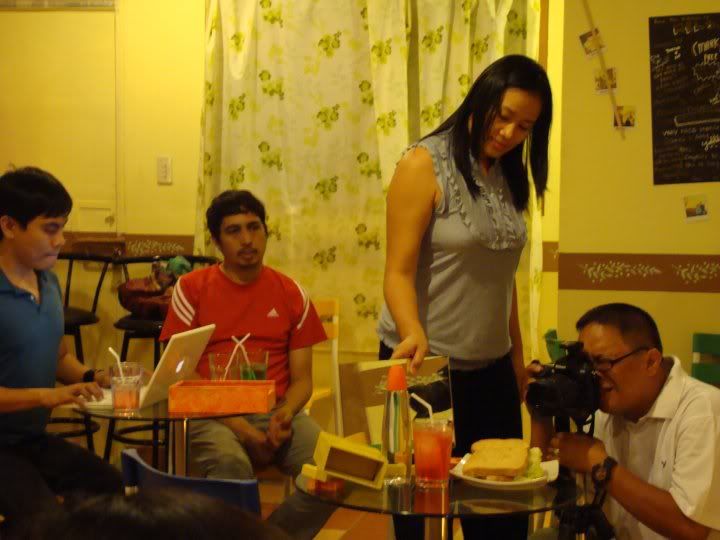
[The Team: Photos by Greg Morales. Food styling by Arlene Delloso-Uypitching. Arrangement by Moses Joshua Atega.]
I used to love drinking milk, until sometime ago I developed what medical science calls lactose intolerance. I asked my nephew, Charles Louis Moncal, a medical student, if there was anything I could do to tame it, the way you can do an allergy -- like drinking more milk? until my body just learns to accept the fact that, dammit, this guy loves milk? "You can't, Tito," Caloy says. "You lack the enzyme na to properly digest lactose."
Well, how did I lose it? Did it fall out of my pocket when I was in line at the bank? Did somebody steal it? Did that stupid enzyme crawl out of me when I was asleep in college?
"So how come I can still eat ice cream and have cream in my coffee?" I asked.
"Must be a mild form of lactose intolerance."
"Are you sure I can't just tame it? Drink more milk and let my body get used to the idea?"
"You will only get thinner that way."
"Huh? How come?"
"Because of the constant discharge," he smiled.
Thinner. Hmmmm....
On second thought, a diet based on constipation is never a good idea.
I was watching Star Movies a few nights ago, and it was showing an old favorite—Peter Weir’s majestic Dead Poets Society from 1989. This was a film I saw as an impressionable high school student, and I remember that it moved me. It was to become a defining film for my life, something to store in my personal cinematic treasury box—which would include Cameron Crowe’s Singles and Jerry Maguire, Isao Takahata’s Grave of the Fireflies, Ben Stiller’s Reality Bites, Audrey Well’s Under the Tuscan Sun, and Yasujiro Ozu’s Floating Weeds—all of them films from which I would constantly derive a sense of drive despite setbacks and ounces of inspiration to give my own life make a little more sense.
The film—which was Oscar-nominated for Best Picture—is a sweet but tragic melodrama that tells of a bunch of boys in an American prep school and the budding of their dreams and adult reckoning in inspiration of their literature teacher John Keating (played by a non-manic Robin Williams). The professor’s unconventionality flies against the school’s stultifying rigidity of tradition and its (almost mandatory) uninspired classroom atmosphere of droning. He urges his class, for example, to one day tear away—with the full force of disgust—the introductory essay on poetry from their textbook because it approximated an appreciation of verse in a turgid mathematical method.
But in the end, even after a tragedy, he is able to inspire his students to find their own voice in the sea of conformity, to become the captains of their fate, and to live each day with unique zeal and seize the marrow of every living moment. Carpe diem! Oh, Captain, my Captain!
Above all, he taught them to stand up and fight for their dreams despite everything, including unreasonable parental disapproval. I cite this specifically because how many of us have killed our vast potentials and our talents simply because our parents, with all their good intentions, have unknowingly killed our dreams in the service of what they think is practical? (And so it is best to quote Aldous Huxley now: “Hell isn’t merely paved with good intentions; it’s walled and roofed with them. Yes, and furnished too.”) I know of one Fine Arts student in Silliman University, for example, whose astounding works in a recent group exhibition easily showed an uncanny talent for the visual arts. But he is planning to stop his painting study because his parents are pressuring him to graduate “on time.”
That fight for the dream that dramatically ended Dead Poets Society moved me, because it is the perfect antidote to what Ally Sheedy’s character in John Hughes’ high school drama The Breakfast Club feared the most: “When you grow up, your heart dies.” Or learns to die, in the gradual accommodation in all our lives of everything that runs counter to our dreams.
I had no idea that years later, I would be following in the footsteps of John Keating—much to my surprise. He had always defined for me what makes a good teacher, and when I try to analyze my own methods as an educator, it does not surprise me that what I do is a combination of that film’s protagonist’s efforts—I make my students in Intensive Composition stand on their chairs to prove a point about looking at old things in new ways, for example, a rip-off of one classroom scene in the film—and the efforts of all the best teachers that I’ve had, including Bennie Vic Concepcion in grade school, and Luz Erum and Alice Mamhot in high school, and Timothy Montes, Ceres Pioquinto, Gina Fontejon-Bonior, Peter Sy, Vicente Maxino, Reynaldo Rivera, and Earl Jude Cleope in college. They’ve helped shaped me, I realize that. The best teachers are shapers of our lives.
That realization about teaching sometimes scares me. Because teachers are also frail human beings much in need of inspiration as well, something that is always in short supply given the paltry salaries, the low professional regard, the endless duties of marking grades (always a thankless task), and the accepted role of being parent, guidance counselor, social worker, policeman, and psychic all rolled into one. Then there are the department politics that distract and dishearten. The vexations are eternal. We are undeniably the face of the arching stress that is at the heart of a student’s college existence—much to our consternation, of course, but what can we do about that? When we demand excellence, we are labeled “terror teachers.” When we slack off a little bit to counter that impression, we are taken to task for not providing enough of an atmosphere of competitive excellence. There can be a balance, of course, but there’s no formula to it. I have written before of one fellow teacher who received death threats from students—a case that has remained unresolved. It’s enough to make anyone teaching a schizophrenic. Thus, teachers are almost always wounded souls. We are easily bruised. And sometimes there are days when I think that being a teacher is all about dealing with utter precariousness, like walking a tightrope without a safety net—and there are many days wherein the very act of fulfilling the obligations of that profession requires inspiration that must at the very least be divinely inspired, because anything else less than that would not be enough.
Sometimes, the solution for some is to create an invisible barricade between two worlds—that of teachers’ and that of students’—that only interface during classroom rituals. There is impregnable distance between the worlds. Distance is all good when the thing to be is to become like Zeus, the god of thunder and lightning, high up in Olympus, deciding what fate must befall mortals. This whole archetype is typical of our imagination of teachers, who remain as remote figures in a student’s life and who do not seem to have a life outside of the scribbles on the blackboard. When I was a student in Japan, I observed close hand how this Zeus-like archetype defines teachers: the deference Japanese students make towards their sensei almost borders on servile, and in the classroom, there is an invisible but palpable layout of the classroom where the sensei always occupy a throne front-center, surrounded by acolytes who shrink in the shadows on the sides.
I have never taken to that arrangement well, at least not lately. Because I have quickly realized as well that a source of inspiration for teachers can be his students. When I began teaching many years ago, I thought that the distance I was talking about was standard and de rigeur for the classroom setting. But I have since found out that reaching out to students beyond curricular considerations and situations not only humanizes you to them, but you also learn many things about what makes them tick—which are things you can use to teach better. In the past three years, starting with a group of campus writers I called the LitCritters (a loose group of students I’ve gathered to talk about and do creative writing), I have become friends with many of my students—and while the professional demarcations remain, the blurring of the boundaries has afforded me an adventure into a different brand of mentorship. I am able to reach to them, finally, because they have found out—sometimes to their surprise—that I could be reached. I am no Zeus in Olympus, after all.
And they inspire me. They teach me things I would never probably learn if I only kept the company of fellow teachers. Marvin Flores, for example, has taught me that there can be no excuses in one’s pursuit of excellence—not poverty, not bureaucratic nightmare, not anything. Anna Katrina Espino has taught me that talent is always a diamond in the rough—and the only way for it to shine is to strive, sometimes slowly, until you just surprise everybody with your unexpected brilliance. Irish Reambonanza has taught me a grounded sense of loyalty. Likko Tiongson has taught me the value of singularly pursuing dreams until you wear your dreams down for it to be yours. Mariekhan Edding has taught me how to remain strong despite the conspiracies of small things. Jai Dollente has taught me the comforts of staying true to good friends. Robert Jed Malayang has taught me to consider that not all exceeding brilliance can be officially celebrated—and to promptly never mind that fact. They all keep me young, at least in spirit and sensibility. Which is important, because once any teacher has calcified and hardened to old ways, I don’t think he will be capable of inspiration or fresh insight.
The past three years, come graduation time, have become increasingly hard for me. I’ve grown very close to a number of students I could very well call my good friends. After this year, there will only be a few left. Those who already have—RJ, Marvin and the rest of The Physics Boys, Miko Tingne, Yves Villareal, Rodrigo Bolivar, Michelle Eve de Guzman, Lyde Villanueva, Celeste June Rivera, Marianne Catherine Tapales, Fredjordan Carnice, Micah Dagaerag, Matilde Hescock, Zara Dy, Dok Timbancaya, Bryan King, Justine Yu, Alvin Clyde Gregorio, Lycar Flores, Ray Donn Lim, Aiken Quipot, Ernest Hope Tinambacan, Mayah and Yassi Dulnuan, Magenta Villegas, and so many others—or will soon be passing through the portals of Silliman to exit towards their own post-collegiate lives will become part of an irretrievable past no amount of reunions can ever make happen again. And it’s sad. But also happy, the fact that I have somehow become part of some young people’s lives.
Sometimes you wish they could remain in Dumaguete, and Silliman, forever—but of course life and graduation demand that there must be Moving On. That’s why we call this ritual every March as a Commencement Ceremony, because they are all about beginnings, although it starts with a resounding end to one chapter of our lives.
So to those student/friends who are graduating this year—Ramuel Reambonanza, Anthony Gerard Odtohan, Eliora Eunice Bernedo, Karen Grace Yasi, Emarrah Sarreal, Marc Cabreros, Ian Lizares, Bogy Lim, and all the rest—you know I mean this with the deepest love and affection: maayo unta’g mangahagbong mong tanan. Wahahaha! (Wink.)
Thanks for the friendship and the company. And the inspiration.
6:40 PM |
An Excerpt From 'There are Other Things Beside Brightness and Light'
[a story]
I once cared about a dog named Tibby. It was a white Pomeranian—one of those frivolous types of dogs that are easy to love because the busy brilliance of their thick hair reduces even adults to squealing children. Tibby—if I try to recall correctly—was a gentle soul, and he had eyes that seemed to see through me. I was a young boy, and he was my world—a yapping mass of cuteness that required devotion. I fed him, I bathed him. Tibby slept at the foot of my bed. Once, in a boring drunken episode, my father shot it with his gun, because the dog barked too loudly and made him spill his beer on his shirt that barely contained a swollen belly.
“Why did you kill the dog?” I mustered enough courage to ask my father after mother buried the animal in the backyard, near the garbage cans, which was shaded by a hollowed out acacia tree in the dark subdivision we lived in.
My father snorted. “Because I can,” he guffawed, his breath smelling of beer stink. Hell, I quickly knew, smelled like this.
I remember that was the first time I ever felt pain. Perhaps also the last. I was nine. It throbbed like an ancient truth, coming to the fore from the gut, ending as a strange tingling between my legs that surprised me, just for a moment. There was pain, and there was father looking at me like I was a mouse. All I could see in the feverish anger that swelled my thoughts was Tibby’s shattered head upon my father’s body, blood dripping down its jaws and into the soiled beer-stained sleeveless shirt my father wore that night—five years, eight months, and thirteen days before he died.
I had a hard-on. I remembered that most of all. At nine, I had a fucking hard-on.
Later on, in my quiet days, my imagination tries to springs on me the sound of a dog yelping, in that frightened drawn-out cadence that signaled a knowledge of pain. But I have learned to drown that out with the noise of nothingness—a gathering blob of pure vacuum that settles in my head and sits in it like a strange dark dream.
And all I would ever learn to see would be the dark side to everything.
Unlike history, fiction can proceed with confidence.
For example: a few years ago we were living on a Thames barge, and on the boat next door lived an elegant young male model. He saw that I was rather down in the dumps, a middle-aged woman shabbily dressed and tired, and he took me on a day-out to the sea, to Brighton. We went on all the rides and played all the slot machines. We walked for a while on the beach, then caught an open-top bus along the front. What happiness!
A few days later he went back to Brighton, by himself, and walked into the sea until it had closed over his head and he drowned. But when I made him a character in one of my books, I couldn’t bear to let him kill himself. That would have meant that he had failed in life, whereas, really, his kindness made him the very symbol of success in my eyes.
~ Penelope Fitzgerald, “Why I Write” (excerpt), from The Afterlife


 10:24 PM |
A Race
10:24 PM |
A Race