Celebration: An Anthology to Commemorate the 50th Anniversary of the Silliman University National Writers Workshop Sands and Coral, 2011-2013
Silliman University, 2013
7:46 PM |
Amihan Explores Femininity and Power in New Art Exhibit at Silliman
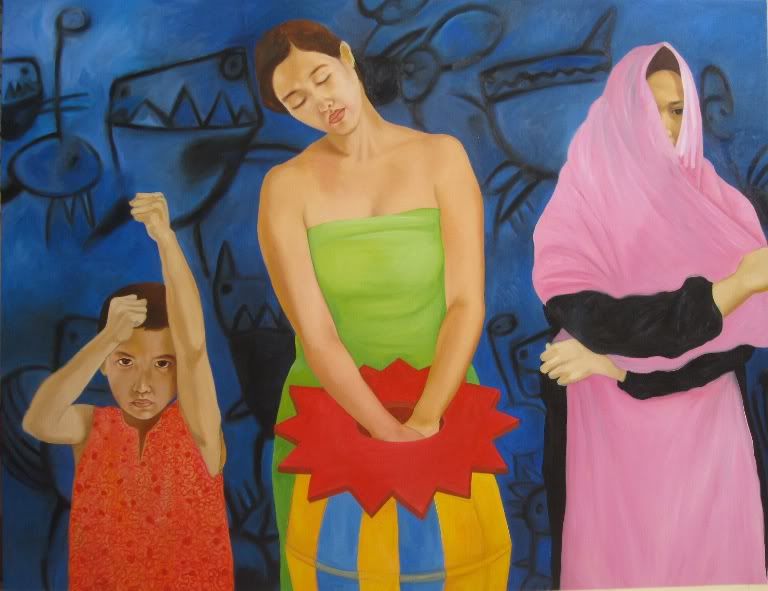
The exhibit title evokes power and femininity; it paraphrases a chess term about how a pawn journeys across the length of a board to become a queen. Amihan, the eldest daughter of the Jumalon family of painters, shows us glimpses of her own journey in becoming an artist and a mother in the above-titled art show. It opens at the Luce Auditorium Foyer Gallery at Silliman University in Dumaguete on 24 July 2010 at 5:30 P.M.
The exhibit is part of the 48th cultural season of the Silliman University Cultural Affairs Committee.
“Being a mother and an artist is like walking a tightrope. If I fall, something breaks. You can’t run, you don’t have the time. So you tread slowly and allow these roles to serve as your balance beam,” says the artist. “Queen Building is a visual, surreal chronicle about undertaking and maintaining these roles.”
The works in this coming exhibit all feature female figures, which have been Amihan’s primary subjects all throughout her career as a visual artist. Some are grim personas born out of the artist’s struggles to fuse being a mother and an artist in the years she has been largely absent from the art scene. Some are painted almost like mythological figures; dream symbols that evoke a particular aspect of women’s experiences. And some are virtually self-portraits, the artist recreating and discovering facets of herself.
Thus, on ‘Iron Maiden’ (acrylic on canvas), we see the artist’s implacable likeness personifying a medieval torture device while another figure crawls out of its dark, womb-like recess. The monochromatic painting manages to evoke both aggression and femininity, qualities that can be found in the artist’s earlier paintings.
In ‘Lovers’ (acrylic on canvas), we see the artist recreating herself once again, this time as two copies of herself, setting them up in mischievous poses while a huge mastodon skull dominates the background.
We see another figure with her likeness in ‘Magician’ (acrylic on canvas), which provides a colorful counterpoint, not only to the more muted approach of the other works, but to the mother-and-child genre paintings. This large-scale work features a portrait of the artist with her hands inside a barrel, her young son, and another hooded female figure. Naïve stick figures of monsters (which her son doodled) dance in the background.
The personal becomes the universal. “Queen building” is a reflection of the multitude of roles and personas worn by women. It is in these explorations of self as archetypal female subjects that Amihan’s work shines.
The exhibit runs until August 14, and is open to the public. For more information, please call (034) 422-6002 loc. 520 or 09173235953. (Bendix Fernandez for the Silliman University Cultural Affairs Committee)
Looking back, sitting there outside Dencio’s in Harbor Square, a stone’s throw away from the Cultural Center of the Philippines, it felt good to be just a mere spectator for once. Because last year, in the Cinemalaya, I was part of its Film Congress as a representative of the filmmaking scene in Dumaguete—and it was the usual part work, part pleasure things. But this year, it was all pure pleasure, pure moviegoing relaxation.
I was, to cite an example, relaxing, taking the night in, and drinking San Mig Lite outside Dencio's with the screenwriter Armando Lao.
Earlier that weekend, I had planed in from Dumaguete just for the Cinemalaya and to process my U.S. visa for my fellowship in the International Writers Program in Iowa. It was the start of a good weekend, and the film festival—the most acclaimed of its kind this part of the Philippines—had just began. People I know from film were suddenly everywhere. I’ve always loved this kind of Manila trips that I take; they are always occasions for instant reunions. People you only see in Facebook are suddenly there in front of you, in the flesh. And the hugs and the handshakes are constant, they fly everywhere.
That Saturday, I had gone to the launch of three books being put out by newbie publisher Gilbert Sape of Grey Matter Publishing—two of them by good friends of mine, people I “hang” out with in the blogging world. There’s Dear Migs: Letters to the Manila Gay Guy by “Migs” and edited by Philippine Daily Inquirer theater critic Gibbs Cadiz, and then there’s The Wet Book: Stories From the Bathhouse by Joel Macaventa, alias McVie, and edited by the film producer and writer Raymond Lee. The launch was in Quezon City—and the place, which was the studio of the photographer Ian Felix Alquiros, was packed. I met old friends and new—the writers J. Neil Garcia, Moki Villegas, and Ronald Baytan, the visual artist Daniel Palma Tayoma, the director Jade Castro of Endo fame, the TV broadcasters RG Cruz and Ryan Edward Chua, among many others. Hugs, handshakes. I saw Carlo Vergara, the genius behind ZsaZsa Zaturnnah—and we both exclaimed with such delight: “Finally!” Another round of hugs.
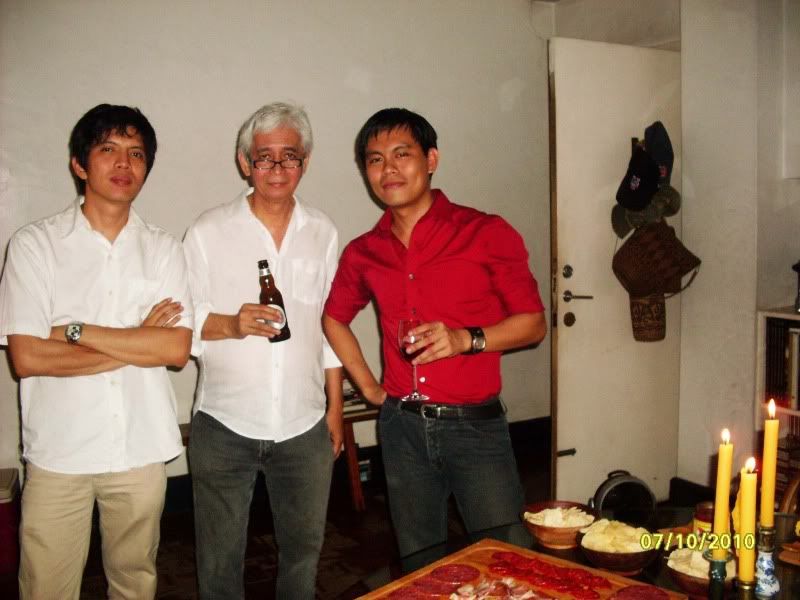
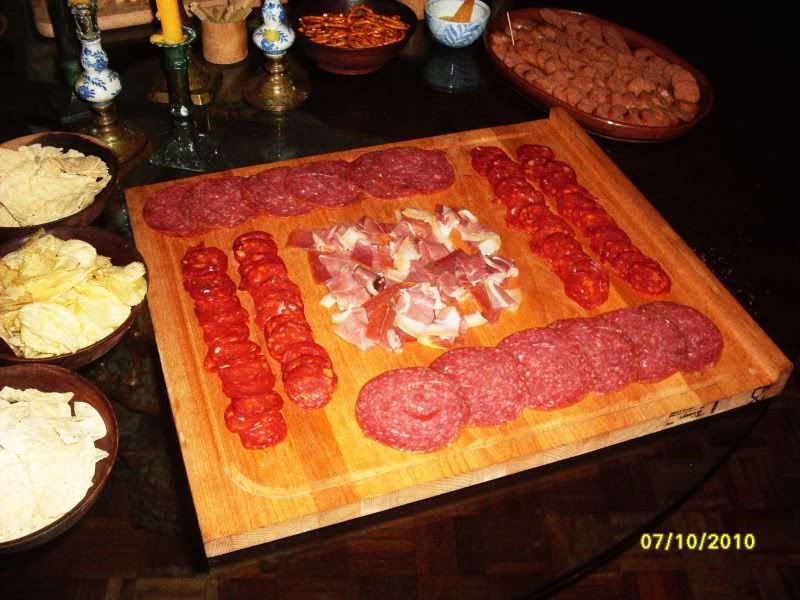
Then it was back to Manila, to the lovely Syquia Building near Malate, where I dined on varieties of cheese and wine and cold cuts in the beautiful apartment of the director Butch Perez.
Butch had a great view of the Manila Bay, and he entertained us—the writers Ginny Mata, Kit Kwe, Marc Escalona Gaba, and Kris Lacaba—to the disco beat of David Byrne and Fatboy Slim’s Imelda musical Here Lies Love. We talked about Iowa winters and Negrense Chinese matriarchs with recipes and the lives and loves of people we know. The usual stuff.
On Sunday, there was the late night beer with Bing Lao. “You are a god,” I had told Bing earlier—a compliment he must get a lot. This is the screenplay writer, after all, of all those acclaimed movies, from Jeffrey Jeturian’s Pila Balde and Sana Pag-ibig Na and Kubrador to Brillante Mendoza’s Serbis and Kinatay, those controversial Cannes Film Festival winners that has brought to the world a concept of film writing that is gaining traction the way the Danish had with its Dogme 95. In Bing’s case, it is the Found Story concept that is central to the style of such emerging filmmakers as Francis X. Pasion, Jay Altarejos, Jeturian, and Mendoza, among others.
He had been going around the CCP complex among the throng that constituted the devotees of the Cinemalaya Film Festival, filming Mark Xander Fabillar (who has a supporting turn in Pink Halo-Halo) and Jay Altarejos as they went about their way welcoming people to the gala premiere of Jay’s latest film. It was going to be a kind of pseudo-documentary, and I was in the middle of the shoot. Later, after the premiere, the beer came, and the talk and banter.
People came and went. Joel Torre passed by. Raymond Lee stopped by, and I told him, “When are you going to finish Patayin sa Shokot si Remington? I can’t wait to see it na.” He laughed and did a short curtsy. That was it. The director Raya Martin also passed by, sporting a new look of cropped hair. “When did you come back?” I asked him, “I thought you were holed up somewhere in Paris or wherever.” We hugged, and he said, “I’m just here, just lying low.” I laughed.
The female lead of Halo-Halo, the wonderful Angeli Bayani, soon joined us—and it was the start of the marathon to a long, beautiful night where everybody pitched in to share “talk” and industry tidbits, all told in gestures and enunciations of grand drama. You know, theater and film people.
I called her the new Meryl Streep. She blushed. She was transcendent in Pink Halo-Halo, a film of such beautiful simplicity that I turned to Jay, who was sitting beside me in the Tanghalang Nicanor Abelardo, and said, “I hate you. Pinaiyak mo ako.” And I thought of that, and was bemused by how far Jay had come—from the titillations of Ang Lalake sa Parola and Ang Lihim ni Antonio to the grit of Ang Laro sa Buhay ni Juan to the heart of Pink Halo-Halo. Because sometimes it’s hard when you find yourself put in a box by other people—and not allowed to be anything more. “Hindi ka na bold gay films!” the magnificent Ed de los Santos Cabagnot had told him earlier, and broke into boisterous laughter.
We all laughed, too.
And that was it that weekend. Those nights. With Manila friends.
And then, two days later, I escaped Typhoon Basyang by minutes, and planed all the way back to my Negros town, where everything is quieter. Quiet, yes—but it has also become a reservoir of so much missing other people not here.
I have a love-hate relationship with performance art. When it’s good, it blows our minds and makes us reach deep within ourselves, asking questions about this and that. It transcends its inherent strangeness—and all performance art is strange—and makes the familiar both unfamiliar and intimate at the same time.
But when it’s bad, you feel like a monkey’s uncle.
Once in Hayahay I had to sit through a turgid piece by some performance artist from Manila, whose work consisted of reading aloud to the microphone entries from the Webster’s Dictionary. It’s not that I didn’t get it: it was just a bad piece, a complete waste of time—and like the worst of junk art, it didn’t give us anything new. “If I wanted to get the definition of the word ‘ghastly,’ I’d be home and find my own dictionary,” I told my companion. “I didn’t have to come here all the way through the rain, with an order of beer.”
But all performance art always courts the tricky borders of ghastliness and transcendence. Some do it though with the command of the true artist. I know the writer Vim Nadera does his performances with much wit and aplomb. In Dumaguete, there is Tara Ilic whose feminist moanings are designed to make the hair at the back of your neck stand.
There have been a lot of performance artists whose place in the world of art is now part of history: Yves Klein, Japan’s Gutai Group, Joseph Beuys, Allan Kaprow, and the controversial Carolee Schneemann. They all have put their distinct signatures to the art form—which is an inevitability—but all subscribe to the general definition, here provided by Wikipedia, of the art “in which the actions of an individual, or a group at a particular place and in a particular time constitute the work, and can happen anywhere, at any time, or for any length of time, involving any situation that involves four basic elements: time, space, the performer’s body, and a relationship between performer and audience.”
Let me give a popular example. In 1975, the great performance artist Chris Burden unveiled one of his most well-known works, in Doomed, in which he lay motionless in a gallery at the Museum of Contemporary Art in Chicago. He was under a slanted sheet of glass with a clock running nearby.
The hours passed. People were beginning to be worried—Mr. Burden had not had any food or water or any break to relieve himself. What the museum administrators did not quiet know was that Mr. Burden hatched the idea for the piece that he would remain, “doomed,” in that position until someone or something would interfere in some way.
The film critic Roger Ebert writes of that event, where he quotes museum curator Alene Valkanas:
’The piece ended at 5:20,' she said. Forty-five hours. 'We felt a moral obligation not to interfere with Burden’s intentions, but we felt we couldn’t stand by and allow him to do serious physical harm to himself. There was a possibility he was in such a deep trance that he didn’t have control over his will. We decided to place a pitcher of water next to his head and see if he would drink from it. The moment we put the water down, Chris got up, walked into the next room, returned with a hammer and a sealed envelope, and smashed the clock, stopping it.’
The envelope contained Burden’s explanation of the piece. It consisted, he had written, of three elements: the clock, the glass, and himself. The piece would continue, he said, until the museum staff acted on one of the three elements. By providing the pitcher of water, they had done so.
‘I was prepared to lie in this position indefinitely,’ he wrote. ‘The responsibility for ending the piece rested with the museum staff but they were always unaware of this crucial aspect’...
‘My God,’ Valkanas said. ‘All we had to do was end it ourselves, and we thought the rules of the piece required us to do nothing.’
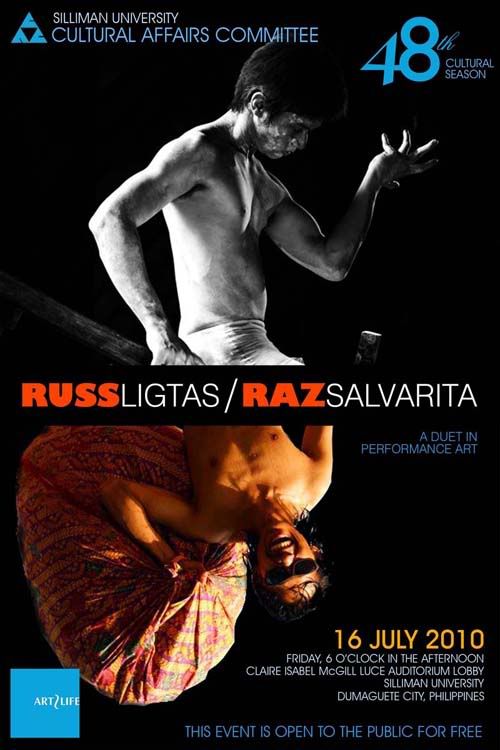
It blows the mind. But while performance art has become a mainstay in the world of art in general, in terms of popular acceptance and visibility, it still has to take its roots in the culture of Dumaguete. In that sense, the city is “ripe” for a good introduction into the best of local performance art, with Russ Raniel Ligtas of Cebu City and Razceljan Salvarita of Bacolod City and Dumaguete.
Mr. Ligtas is a visual and performance artist who regularly performs with Cebu’s only performance art group XO?. His performances involve dance, costuming, and pop culture elements. He writes poetry and other creative text and is a member of the Cebuano writer’s group Bathalad Inc.
Mr. Salvarita, on the other hand, is a member of a family of artists based in Bacolod, but is now based in Dumaguete City and Bali, Indonesia. He graduated with a bachelor’s degree in Mass Communication at Silliman University, where he also later pursued a master’s degree in Environmental Policy. Razcel, perhaps Dumaguete’s fast-rising young visual artist is also a writer, a photographer, a performance artist, an environmental activist. He is best remembered as the person whose body was painted white and then who walked around Dumaguete semi-naked to call attention to his “Save the Balinsasayao Twin Lakes” campaign. He has also founded the collective art group Artantrum.
On 16 July 2010, each one will present a suite of three performances, alternating with each other. The combined work, titled Russ/Raz: A Duet in Performance Art, is sponsored by the Silliman University Cultural Affairs Committee, and will be performed at the Claire Isabel McGill Luce Auditorium Lobby at 6:00 PM.
It is open to the public, and they are prepared to blow our minds with this duet of strangeness involving body and time and space and us, the spectators.
1:00 PM |
Acclaimed Rondalla Groups Invade Silliman
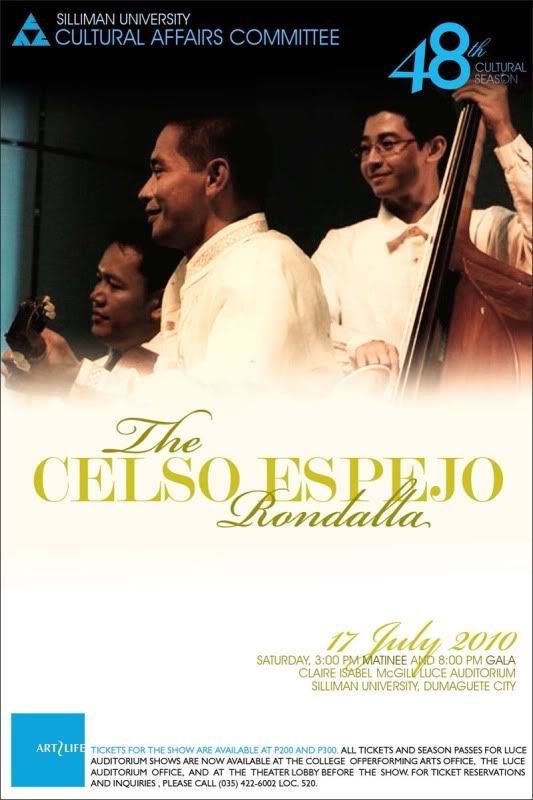
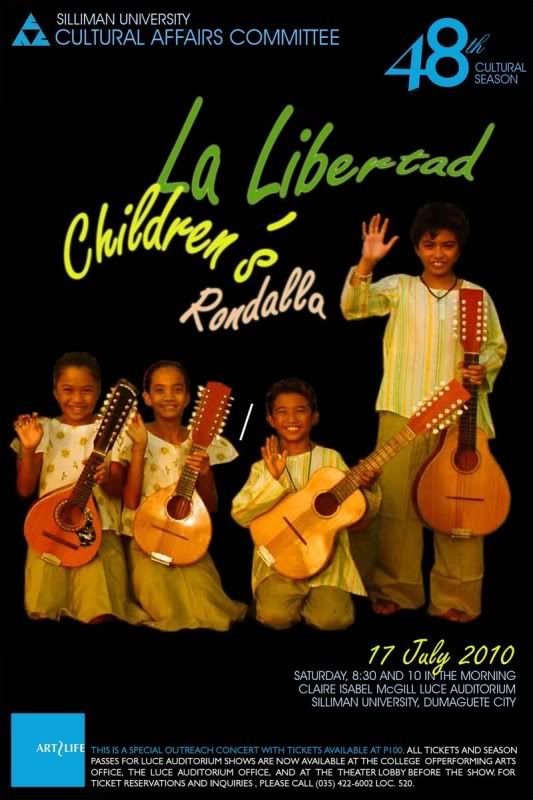
Two rondalla groups will perform in a rare full day of rondalla performances at Silliman University’s Claire Isabel McGill Luce Auditorium. The acclaimed Celso Espejo Rondalla and the La Libertad Children’s Rondalla are slated to do back-to-back performances on 17 July 2010, Saturday.
The Celso Espejo Rondalla, who will give a matinee performance at 3 PM and a gala performance at 8 PM, is composed of two generations of outstanding rondalla players: the senior members are professionals in their chosen fields while the younger ones are college students. The members were winners in the National Music Competitions for the Young Artists (NAMCYA), either as a solo instrumentalist or members of rondalla ensembles.
The group, named after Maestro Celso Espejo, the group’s conductor and one of the pillars of the Philippine Rondalla, was one of the performers in Cuerdas nin Cagabsan: The 1st International Rondalla Festival in Naga and Legazpi Cities, where they made an outstanding performance of light classics and contemporary Filipino compositions for rondalla. It was also one of the crowd favorites in Cuerdas Sa Panaghiusa: The 2nd International Rondalla Festival in Dumaguete.
The La Libertad Children’s Rondalla, on the other hand, will perform twice in the morning, at 8:30 and 10 A.M. This show is part of the Silliman University Cultural Affairs Committee’s outreach program, with this show designed specifically for children.
A fast-rising cultural act from the municipality of La Libertad, the group started when the town became a recipient of a set of rondalla instruments donated by the Provincial Government of Negros Oriental through Board Member Mariant E. Villegas. Then La Libertad Mayor Jocelyn Sy-Limkaichong, now the First District Representative of Negros Oriental, initiated the rondalla training program when she invited Mr. Ian Encarnacion, a voice major in Silliman University and a member of Kwerdas de Negros, to initiate a musical group in the town of La Libertad. The move sprang from Rep. Limkaichong’s vision to preserve local culture and revive an interest in Filipiniana.
Most of the members of the group are elementary school children, from grade four to five of Pio Banogon Elementary School.
Tickets for the Celso Espejo Rondalla Concert are available at P200 for the matinee and P300 for the gala show. Tickets for the La Libertad Children’s Rondalla are available at P100. For inquiries, please call (035) 422-6002 LOC. 520 or 09173235953.
This song, a cover of a U2 classic and interpreted to new rawness by Mary J. Blige, gets to your guts and rips out every strand of beautiful anger. And it's strange, because this is my anthem now. And you, of all people, gave this to me.
I'm not exactly sure what happened. But I can't stop listening to this song. It began that Saturday night when, at the end of their concert for "Harana" at the Claire Isabel McGill Luce Auditorium, the ensemble from the Philippine Opera Company decided to do an encore. They chose "Gaano Ko Ikaw Kamahal," a popular Filipino folk song composed by the National Artist for Music Ernani Joson Cuenco with lyrics by Levi Celerio, another National Artist. They belted out the song as they roamed the auditorium house, shaking everybody's hands. The audience, at full capacity for the Luce, were already in awe from the concert itself: the result was electric. It brought tears to my eyes.
Since then, I can't stop listening to this song. The clip above is from Legaci, an acapella group from the U.S. Here's one more, arranged by international conductor Redentor Romero and played by the Moscow Symphony Orchestra...
I don't know why this song just speaks to me at this moment. Maybe because of its overwhelming drama? It is a song after all where the lover declares his undying love for the beloved. He assures the beloved that he/she is the only one in his life and assures him/her that his love will not fade, "tulad din ng umagang may pag-asang sumisikat." Ouch. So anyway...
7:00 PM |
High School Blues, Sixteen Years Too Late
There's something I need to get off my chest. I don't know why this bothers me so. This is usually something I totally ignore -- but my mind keeps returning to this, like the way we do with scabs we love to pick, again and again. I have a high school classmate. A girl. Pretty, let's just say. She was normal in high school, I guess. I don't really remember her much. And I'm actually closer to her younger sister. This one hasn't been to any of the reunions, so I have completely forgotten her. Last May, she added me in Facebook. I remembered her name, it sounded familiar. "Hey, it's that girl," I said. I clicked "Confirm."
Let's call her Suzy J.
The next day, Suzy J. writes me a dramatic letter. How she has never forgiven me for something. You see, in Silliman High, we have this tradition in the Junior Sillimanian, the high school paper, where specific members of the roster of graduating honor students would write an assigned essay. One is the Class Will and Testament, where the Graduating Seniors bequeath responsibilities -- even talent! and specific things like books and what-not! -- to the members of the Junior Class. Another one is the Class Prophecy, where an appointed "prophet" predicts the future of the Seniors. Here we marry off each other, give each other fantastic jobs, and exile each other to even more fantastic foreign lands. All in good fun of course.
Come to think of it, I think I wrote both. Anyway...
Suzy J. wrote me in Facebook [unedited]:
Ian, you forgot to put my name as one of your classmates who have a golden voice in the Last Will and Testament in Highschool... Marrianne Joy Ga was defeated by me in the Singing Contest. I always won singing contest inspite of me being Philosopo .. i am not that ugly... I also have a golden voice... Anyway, I understand although I was deeply hurt by it.. You must have been busy studying you forgot to know your classmates more... I understand that you need to study because you need to... I just want to express how I felt about the Last Will and Testament you gave years back.. What a relief I finally said that to you.. God bless you... But I am thankful you never failed to know I've got brains more than I have the body and I love you for that.. It is just that I reaally do have a lovely voice.. hehhehhhe. LOL...
My immediate reaction went this way: Sheeesh, girl. High school was fifteen years ago. Grow up! I never replied. Still, I categorized her in one of my many Facebook friend tags, and in her particular case: "High School Buddies" + "No Chat Zone."
The other week, at the apex of preparations for the opening of the 48th Cultural Season of Silliman University, where I am a member of the Cultural Affairs Committee [in charge of publicity and general programming], I sent invitations of our upcoming events for the year to specific people. Facebook helps a lot. And tags in Facebook help in selecting special targets; and because this was a Silliman event, I naturally included in the invitation everybody categorized as a "High School Buddy."
She soon replied with something terse: "Stop sending me invitations. I'm in Ateneo now."
In that haughty tone that just riles you up. It says, I'm in Arneo now, I cahn't be bothered.
I replied: "Hormonal much. No wonder I don't remember you from high school."
Five days before I left Tokyo for Hokkaido, I was on a train, the Chuo Line bound for Musashi-sakai from Shinjuku. It was a regular day—nothing much was of interest, and I stared blankly into the mass of people surrounding me, thinking only of the bed that waited for me in my dorm room.
Suddenly, two elderly Japanese women erupted into a furious catfight, despite the heavy passenger crowd inside the train. It happened in front of me. They went about it in a strange stranglehold—no shouting or screaming, just two women locked in a furious quiet, battling each other. I felt embarrassed for them. And nobody, not one among us, attempted to separate them.
When the train doors opened at the next station, the wintry air suddenly blasted in, and they both got off in their quiet huff, still clutching each other’s clothes, gripping tight each other’s hair.
Then the train chugged on, everybody occupied in their own private shells, all in our own journeys to some future where there would soon be an abundance of so much coldness.
My first sight of snow was from above, up in the air—it was little patches of white sectioned in parts in the vast brown earth below in Hokkaido, as my plane from Tokyo started its maneuvering for eventual landing. Farther on, the white patches spread—and I remember suddenly exclaiming: “It looks like a giant vanilla cake!” They all laughed.
But it’s true. Snow is the icing of wintry earth, although a more apt simile is of a spread of vanilla ice cream over a loaf of rye bread.
Hokkaido looked as wild as the guidebooks contended it would be: vast pristine forests, frozen lakes, and rolling fields clamor for space, all dwarfing the occasional farm house now buried under several centimeters of snow. The patches of snow at first gave way to the greenish brown of wintry land. But one knows the snow eventually wins: going farther inside Japan’s northernmost island region so near Siberia, away from the sea, there would only be stark whiteness.
From the plane, I expected a nasty freeze to attack every pore of my tropical body. Nothing did. Kitami City, on entry, was sunny, and the snow was crisp and dry, perfect for a snowball fight. After an airport lunch of Japanese curry rice, the trendiest dish in town, we finally went outside to the perfect cold. I stopped to touch for the first time the ubiquitous white, and found that it was what I always thought it would feel like: beautiful but perfectly ordinary ice scrapings from the Big Freezer in the sky. But the beauty of the thing was the shimmering light reflected from everywhere, creating that illusion of snow with a creamy consistency when actually everything is just ice flakes packed tightly together.
Soon my feet were cold, although I longed to strip off my four or five layers of clothing. Still, at -6°C, it was “too warm” for winter—but I liked it that way. I became slightly disappointed, however: where were the shivers? the blue lips? the frozen eyes? the tongue stuck on frosty metallic surfaces? I was an impatient tropical boy. After four o’clock, however, when the sun began to set, a hard and fast coldness started to creep into our consciousness, just enough to make everyone shiver and whisper in such pious observation of weather: “Samui desu ne?”
During that trip to the northern lands, I was to get in touch with the best of Japanese culture—make some glazed china, go skiing in a mountain resort, make a snowman, learn ikebana, go to the onsen or hot spring, make rice cakes, wear a kimono, ride a snow mobile, go to a shrine during the New Year, and do para-sailing. I was staying with the Koras, a Japanese family. Both my vacation okasan (mother) and otosan (father) were veterinarians, and when I could I was supposed to help out in their downstairs clinic. We lived upstairs. They were an extremely kind and generous kazoku. I conversed with them nightly in broken Nihongo. Totemo muzukashii desu ne… But I was not supposed to speak English at all. After every spare Japanese dinner, in typical Nihonjin politeness, I’d say: “Oishikatta desu neu. Onnaka ga ippai desu”—although I was still famished. After TV, which I did not understand, I’d excuse myself to my room, but not before sneaking some dried shrimps from a bowl just lying on the kitchen counter.
I knew I would have a nice fuyu yasumi. I had hoped. The kazoku were Buddhists by practice, and they tried their best to entertain a Filipino boy. But it was also a lonely time: every night in Hokkaido when I went to bed, I told myself beyond the keen understanding that my spirit longed for home: I needed this. I couldn’t always be home. I will have a future in stranger lands lonelier than Japan. Melodrama might have defined my nights there, but my reality eventually demanded sense, or at least an understanding of the deeper things that lie just beyond the province of tears.
It was snowing that last morning of 1997—softly at first, then in a mute frenetic dance that blurred to an icy grayness the surface of the car window. I sat spellbound in my passenger seat, mesmerized by this vision in white. I was, I think, murmuring: “Hajimete, hajimete...” First time. This was much to the amusement of my ojisan. The old man was chuckling, “So desu ka…” as he drove our death-trap of a car around the turns and bends of gravel, asphalt, ice, and snow.
I found myself drawing figures and kanji characters on the frozen window, while Naoki and Nozumi, aged 13 and 9, were fighting over some otamatoshi in the backseat with me. The car radio was blurting out a strange singsong that I could only identify as some furui ongaku. Somehow, it all seemed alien in this Hokkaido landscape—this place could not be Japan! I thought this should be the wilds of some European steppe.
The snowfall fascinated me because, unlike rain, it is soft and stealthy. It does not announce itself like the dropping pellets of rain; it just sneaks over everything, like a thief of time. For example, the view from the car window, when a moment ago was blue and green was soon transformed into a whiteness you could feel. The whiteness stretched on and on, soon blurring the distinction between land and sky.
And on and on, ojisan drove. The drive seemed to take forever. And there was only silence and snow.
When we arrived at the onsen, I thought quickly that it was most interesting. The winding mountain path led us to this perfect hot spring getway—a common bath of a beguiling rusticity. Soon I quickly find out that everybody went naked together, but I didn’t care, and it was not embarrassing. You won’t have time to mind your own fragile nudity once you step into the boiling water. I remember I loved that hot bath with its fiery 40°C heat. My skin felt tight and supple. I felt reborn.
Ojisan turned to me, and naked and in Japanese, he said, “I know a woman from your country. She is married to a farmer I know. I’ll take you to see her before you leave for Tokyo.”
In Engaru, a town an hour away from the bright city lights of Kitami, I met her. She was a hapless Waray named Divina who was married to mono-syllabic Japanese cow-farmer. I thought quickly that she was probably your typical mail-order bride—a country girl, ignorant, but hard-working, full of hopeful ambition. She had been living in Engaru for nine years, and she told me that she was happy.
“My husband is good,” she declared to me, after offering me a plate of pancit, which I swiftly gobbled up. But she also told me horror stories of other Filipinas in the area who kept running away from abusive husbands, who are married to Yakusza mobsters, who work as Japayukis to what she quaintly referred to as bodabil. It was the first time I saw such a thing. I’ve heard about these things most definitely—about OCWs, about penpal girls, about exotic dancer, but they didn’t seem exactly real to me. Until then.
Soon, she had both of us clad in stained overalls and in protective gloves. “I want to show you where I work,” she said. And we stepped out into the snow again and into a dingy place that smelled quite bad. Divina showed me where she worked morning, noon, and night: in a cow barn that smelled of dung, littered with hay and refuse and treated corn. It was an automated cow farm—there were sucking machines milking the cows instead of old-fashioned human hands. But for an hour, I saw her go about her work, I listened to her broken Tagalog and her familiar Cebuano. She told me she just finished the construction of her family house in Samar, and now she was about to send money to purchase the “Frigidaire” and the washing machine her sister was demanding. I looked at her house and saw something very typical for a Japanese small town: a miserable , tiny structure barely consisting of three rooms, warmed only by an old stove placed in the middle of a cluttered living room. This and her dirty barns, and her cow shit, and her eternal snow. I asked her, “Did you expect this life here in Japan?” She smiled and said, “No.” But she had come. She worked hard. She was resilient.
Later that week, we—my kazoku and I—went to a temple for the New Year, in a tradition the Japanese called Hatsumode, and there I offered my prayers and my wishes to the gods.
Back in Tokyo, the metropolis was suddenly deluged by thick and unexpected January snow. So thick and so fast that in less than an hour, it covered everything. It was supposed to be the heaviest snowfall in the metropolis in four years. Everywhere, there was a blanket of whiteness that dazzled. But nightfall, it was almost a disaster, but a merry one. Snowmen and igloos were popping out by the scores, all made by eager student hands in my Tokyo university. Elsewhere else, trouble and chaos reigned. Tokyo is a huge maze of a city and imagination alone cannot surpass its monstrous size or complexity. To get from one side to the next would take hours of endless train rides. Trains crisscross the metropolis like blood veins: they are the sole means of transportation by millions of Tokyoites. In Shinkjuku station alone, about 4 million people change trains every day. Trains in Tokyo have never been an image of comfort. In a regular rush hour, they’re hell on earth, with everybody practically canned inside like sardines.
Now imagine thick snow blocking the railways during rush hour in the evening. Electricity is soon cut off. The trains stop between stations, in the middle of nowhere. The door won’t open. The people inside cannot get out. The people in the stations cannot get in, nor get a ride. Working men and women, high school and elementary school students—everybody cannot go home or even go eat. Everyone is trapped. That is, until 6 or 7 the next morning. It was really funny listening to the “adventures” of people in call-in radio stations the following morning. The first world and its problems…
Much later, I suddenly felt I could do anything. That I could be anybody I wanted to be. Maybe this was my gift to myself in choosing to come here: to have that newfound sense of self long buried by the static of Dumaguete life. Perhaps I found myself by leaving home.
3:05 PM |
This Weekend in Culture in Dumaguete : The Philippine Opera Company in 'Harana'
The Silliman University Cultural Affairs Committee presents the Philippine Opera Company in Harana. June 25 and 26 at 8 PM. Claire Isabel McGill Luce Auditorium, Dumaguete City.
Somewhere around the bend was the end of the road. He knew. Soon it would be morning and already he could see a cast of faint light breaking through the night sky, through the clouds. There will soon be light on that horizon, he thought. But Tañon Strait itself was still dark. The far-off islands -- Cebu, Siquijor, Bohol -- were still in shadows. Only the whole Escaño stretch seemed alive with people on the last gasp of rhum-flavored stupor. They slurred, they sang and danced to dying music.
He walked on, and behind him the haphazard late night music, blaring for what seemed like endlessness, faded away as distance grew.
Long ago, I was wounded. I lived to revenge myself against my father, not for what he was— for what I was: from the beginning of time, in childhood, I thought that pain meant I was not loved. It meant I loved.
11:23 PM |
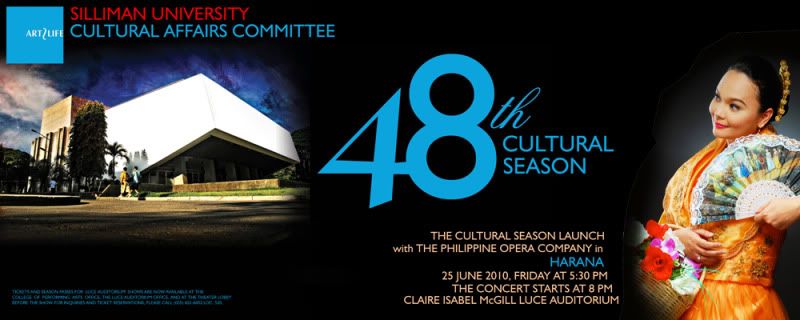
Silliman University Cultural Affairs Committee Launches Its 48th Cultural Season with Philippine Opera Company's 'Harana'
The Silliman University Cultural Affairs Committee presents the Philippine Opera Company in Harana, which will be performed in the Claire Isabel McGill Luce Auditorium on June 25 as part of the launch of the cultural season, and on June 26 for regular patronage.
The June 25 launch, which will start at 5:30 PM at the auditorium foyer, will also feature a screening of Carmen Singson del Prado's documentary Dumaguete: An Artists' Haven. The performance by the Philippine Opera Company will start at 8 PM.
The POC show features the country’s highly celebrated singers Ana Feleo, Karla Patricia Gutierrez, Ma. Florence Aguilar-Barquez, Arlynne Lupas-Tecson, Jennifer Villegas, Sherwin Sozon, Glenn Gaerlan and Nazer Salcedo. This comes after Harana’s first Visayan tour last May as part of the National Heritage Festival celebration.
When POC launched the show in 2008, it reaped good notices from audiences and critics. Julie Yap-Daza in Manila Bulletin, wrote: “How long have we waited for such an endearing piece of artful, delightful entertainment.”
Harana refers to the traditional form of courtship where a man woos a woman’s affection by singing underneath her window. In the 1920s, the harana or kundiman became a mainstream musical style, with many popular performers including Diomedes Maturan and Ruben Tagalog performing it. A celebration of this musical tradition comes in a time when the country is rapidly losing an appreciation of Filipino music to foreign influences. Many people are no longer interested in listening to Filipino classics, composed by gifted Filipino geniuses.
Philippine Opera Company’s cultural repertoire showcases the evolution of Philippine music through song, movement and drama. The show consists of six suites—the Igorot, Maria Clara, Rural, Folk, Muslim, and the Contemporary—each theatrically presented with authenticity and visual excitement. The creation of each suite is a product of thorough research, with the commitment to preserve indigenous music, dance and folklore. POC’s skill is evident as it restructures and enhances this research to evolve into a show of great appeal to theater. Contemporary audiences will find the performance an absolute feast to the senses.
Repertoire for the tour includes timeless classics such as “Bituing Marikit,” “Dahil Sa Isang Bulaklak,” “Iyo Kailan Pa Man,” “Kalesa,” “Ang Maya,” “Ano Kaya Ang Kapalaran,” “Dumbele,” “Ay Salidumay,” “Waray-Waray,” “Sa Kabukiran,” “Manang Biday,” “Atin Cu Pung Singsing,” “Pobreng Alindahaw,” “Saan Ka Man Naroroon,” “Gaano Ko Ikaw Kamahal,” “Usahay” and “Hindi Kita Malimot.”
Future shows from the CAC include Silly People’s Improv Theater Live in Dumaguete, the Ryan Cayabyab Singers in Concert, the Philippine Madrigal Singers in Concert, Douglas Nierras’ Powerdance in Aerial Suite, Coke Bolipata and the Pundaquit Virtuosi in Concert, the Celso Espejo Rondalla in Concert, the La Libertad Children’s Rondalla in Concert, Children’s Letters to God, and Silliman Performs with the Kayahag Dance Troupe in a Lucy Jumawan Dance Tribute. Other events include the Active Vista Film Festival and Armando Lao’s Found Story Screenwriting Workshop.
For inquiries, call 422-6002 loc. 520 or 0917-323-5953.
"It is finitude that makes beauty possible. I guess the beloved is beautiful precisely because he cannot be possessed, or because he can easily be lost." ~ J. Neil C. Garcia
All I know is that, in the end, the world is beautiful. Even the pain that this familiar hollowness brings. In the brief and quiet moment when I reflect on what has happened, I tell myself that I may have become the virtuoso of such terrible forms of beauty. Now I see through my window an evening sheathed in the music of crickets and the occasional noise of distant tricycles, while nearby the wafting odors of a dinner being prepared next door beckon like a temptation. Nothing else stirs, and my senses shift. So I tell myself to breathe deep, and I take in the music, the sounds of quieting traffic, the tantalizing memories of a thousand heartfelt meals -- and the sudden unbearable knowledge that I have said goodbye. It feels absolute, the finality of things.
I hope you will remember that I had caressed your face tonight. I hope you will remember that I had touched your lips lightly with mine, all rushing desire kept still by the knowledge that restraint is so much more lovely. I hope you will remember that I had softly kissed each of your eye as I went about the task to commit to memory the geography of you.
“You are so beautiful,” I told you softly, just enough so that you could hear me without disturbing the quiet that enveloped us.
And then between that and the last goodbye at the gate which would you lead you to a path that will separate, with the decisiveness of the stars, you and me, I will remember nothing else. Nothing except that sadness in your eyes and the lilt in your mouth and the loving way the darkness of the encroaching evening embraced you.
Words are such traitors. You must notice that when I’m in front of you, they carelessly abandon me, and I can speak only in spaces and strange sounds that pass for "hello" or "nice meeting you."
7:11 PM |
According to Myth, Our World is Just a Rat's Excreta
I have always loved this creation story from Bohol, culled from Fr. Francisco Demetrio's "Creation Myths Among The Early Filipinos" in theAsian Folklore Studies:
In the beginning there was only darkness. Then the heavens covered the earth so that the two together looked like an immense tabo or coconut-shell bowl. Within the bowl a rat was born. It graduaIIy grew in size until it transformed itself into the giant Angngalo, the Bisayan Atlas who carried the heavens on his shoulders. One day, he eased himself, and from his feces and urine were born the islands, lakes and rivers, of the Archipelago. God who saw him thus occupied gave him a kick which sent him to China by way of Mariveles.
I don't know why knowing that we all live in divine excreta fascinates me.
I've been told so many times in my life by people who are supposed to love me that I am a disappointment because I would not compromise, just because I insist on following my dreams, just because I would not be a nurse or one of those God-forsaken career moves where I become a zombie for a quick buck. The thing is, there are two things I know: (1) I cannot be hurried for your sake, because everything has its place in the universe, and (2) I'm just a little too young to follow your recipe for unhappiness which you mistakenly call responsibility. Your words hurt me, and I'm scared for you -- because when my dreams come true, I don't want you to fade into that part of my world where all things that don't matter stay held by the darkness where they can't touch me.
All best-of lists are dangerous. They are invitations for condemnation.
But we love them because they fulfill our hankering for order in the glut of things. We love them because they provide a measure, even if a crude one, for our taste. And we love them because they are a concentrated form of validation (“Of course that should be in this list!”) and drama (“How dare he include this and not that? Who does he think he is?”).
Such an endeavor is a trap of sorts—and yet how joyfully we jump into a chance to do so. When I was a kid, I compiled notebooks of movies I have seen, giving them the appropriate number of stars out of five to measure whether they were “great” or "not great"—greatness simply being the capacity of a film to move a 12-year-old. (Steven Spielberg's E.T. was only four stars.) Many years later, the notebooks may have gone, but the innate human tendency to measure something quite relative remains. But in many ways, it is tempered by a very adult realization: first, that one has not sadly seen everything, and second, that what is trash for one cineaste is the glimmer of genius for another. Take for example the esteemed film critic Roger Ebert and his putdown of Ridley Scott’s Blade Runner and David Lynch’s Blue Velvet. When he calls the last one an atrocity, we shake our heads and tell ourselves, “The guy does not get it.”
Of course, there will always be someone who will soon decry that something else very important is missing. But like all good people tasked to write essays like this, we all know the drill. Lists such as this are more often a reflection of a very personal taste. They are also an avenue for critics to champion something, highlighting an obscure title that usually is not given the chance to move out of the shadows of the firmly canonical. (Lino Brocka! Ishmael Bernal! Eddie Romero! Gerardo de Leon! Manuel Conde! Lamberto Javellana!) At best, they are something that can spark an impassioned debate among film buffs.
I have not seen all Filipino films, but I have seen my fair share of what are considered the best of what local cinema can offer. (Sad to say, a great percentage of our cinematic heritage—those prints that came before the 1960s—has been lost to posterity simply because we didn’t know we should care for them.) In coming up with this list, I arrived at a haphazard criteria—that I will only select something that I have actually watched, and that something must have been able to engage me in a deeper way than most films I have seen. And because there is a sheer number of brilliant Filipino films, I am pegging my number at lucky 13—simply because ten is boring and usual, and fifteen may just be a little too much.
But first I got some help. Because I remember Cinemalaya’s Ed Cabagnot once telling me that he considers Romero’s Ganito Kami Noon Paano Kayo Ngayon as probably one of the best Filipino films ever made—simply because it tasked itself to answer the question: who or what is a Filipino? I wondered what other critics had to say about what is the best, and so I cornered a few of the country’s top film critics and asked them for their two cents’ worth. If they could add at least two titles to a list such as this, what would those two titles be? I told them it didn’t have to be a conventional choice—“You can select a Star Cinema movie, for all I care,” I said—but it had to be something springing from the personal.
Mike Cruz of the popular film blog Lessons From the School of Inattention, goes straight to his choices: “Lav Diaz’s Batang West Side and Raya Martin’s Independencia. But if there’s one which I think is ripe for rediscovery, it would be Joey Gosiengfiao’s Bedspacers.”
The Philippine Daily Inquirer’s Rito Asilo agonized over it: “This is a hard decision. But while there are countless brilliant indies out there, there’s a general feel of relentless grimness and collective myopia. I call them hara-kiri movies, in which all hope is lost. But I choose Magnifico. Despite its tragic finale, Maryo J. de los Reyes’ stirring 2003 drama nonetheless leaves strands of hope for the viewers. In a grim world overwhelmed by cynicism and rancor, the movie reminds us that kindness begets kindness. There’s still hope for all of us, after all.”
UNO’s Luis Katigbak said that a few titles came to mind: “There’s Luis Quirino’s short film Pasakalye, a darkly humorous little road trip of a film, which pulls off the neat trick of having you laugh with mild contempt at a pair of characters who you then find yourself rooting for—and even being touched by—at the end. There’s Quark Henares’ Keka, which I love for the sheer irreverent fun it offers: dance number, death scenes and all. There’s Aureaus Solito’s Pisay, widely considered to not be his best film (that’s probably Maximo), but which I love for reasons nostalgic and sentimental and literary, being, respectively, a Pisay graduate, a sap, and a writer who admires the challenges of the structure of the movie (four years, four-plus story-threads, characters weaving in and out). None of these films is particularly Important. They may not even be particularly good, when all is said and done. But hey, you wanted unusual and personal. I also have a soft spot for Mike de Leon’s Itim, though I suspect that may be more due to the charms of a young Charo Santos than de Leon’s atmospheric, eerie mastery.”
Businessworld’s Noel Vera raves on two films: “Mario O’Hara’s Kastilyong Buhangin stars Nora Aunor and Lito Lapid as a vehicle for both. I can only describe it as a cross between George Cukor’s A Star is Born and Ringo Lam’s Prison on Fire. The finale is an action sequence worth watching. Then there’s Bakit Bughaw ang Langit. Briefly put, it’s Mario O’Hara encroaching on Lino Brocka territory, on neorealist melodrama. I think his take on it is quieter, more intense. I might add that along with Celso Ad. Castillo and Gerardo de Leon, O’Hara is the finest action director we have (Brocka, Bernal, even De Leon have nothing on him). You see a bit of that action filmmaking in Kastilyong Buhangin.”
Which proves my point: the untidy richness of lists lies in the fact that, collating opinions from the film-struck, no one really agrees with another. And that is something to cherish.
In the end, I had to come up with my list—knowing full well my own criteria, and knowing that I wanted to touch on things not usually considered for lists like this, and that included a survey of all genres, as well as a consideration of short films, documentaries, animated films, independent films you don’t often see in the cineplex, and even the unabashedly commercial. And so here we go with my own take, whether I “get it or not.”
13. Trip
Directed by Juan Pula [Jon Red] for Mowelfund, 1993
A boy goes to the city for the first time on board a jeepney, and gets a lesson about the nation that he more than bargains for. That is the basic plot of this short film, but that is not the point. The point is the jeepney as a metaphor for Filipino society. Of course, such things have been done to death—but in this film by Jon Red, signing in as Juan Pula for the project, it becomes an inventive and freshly satirical take on all our collective idiosyncrasies and what-not. This short film came during a brief wave of fantastic filmmaking by the likes of Avic Ilagan (Ang Babae Kapag Nag-iisa sa Manila) and Fruto Corre (Laho), a generation of independent filmmakers who really should direct again.
12. Kimmy Dora
Directed by Joyce Bernal for Spring Films, 2009
I wanted to put in a comedy. Seriously. But Dolphy’s cinematic triumphs—even if iconic in recollection—seem to be totally of a different world now, and scouring the filmmography of Tito, Vic, and Joey leaves us with nothing more than a memory of tired slapstick. Of course, there are a few gems in Joey de Leon’s mix bag of Barbie and Starzan—but I didn’t want to go there. I’ve considered vehicles for Ai-Ai de las Alas and other comedy stars—but could not find anything that not only tickled my funny bone but also my intellect. Soxy Topacio’s brilliant Ded na si Lolo (2009) came close, but it seemed a little too unpolished, although it may well be the best comic rendition of a Filipino family yet. Bernal’s Kimmy Dora—a tale of twins, one scheming and one simple, whose lives suddenly becomes a drama of mistaken identities—seems the best bet. Eugene Domingo’s characterization of the twins is spot-on. And the film is wickedly funny, and incredibly witty—and above all, we’ve already memorized the lines. Talk about an instant classic.
11. Himala
Directed by Ishmael Bernal for Regal Films, 1982
Personally, I prefer the city stories of Bernal in Manila By Night, Relasyon, Broken Marriage, and Working Girls. He had this uncanny ability to capture the lightning truthfulness of contemporary living in the proverbial bottle—but one has to consider the visual poetry and the cinematic bravado that come into play in Himala, his story of a young girl in the province (played with such acclaim by Nora Aunor) suddenly possessed by unearthly visions—and becomes the necessary target for religious devotees, the dispossessed, the opportunists, and the vicious. In other words, the very picture of Filipino society in the grips of a circus.
Art by Warren Espejo and movie posters from Video 48. Special thanks to Gibbs Cadiz, Rolando Tolentino, Luis Katigbak, Rito Asilo, Mike Cruz, and Noel Vera for the help.
I can't wait to see this sunset very soon. I've been hoping for this. God knows how much I need this chance to get away from it all. And write that book.
Years ago, in college, I was told by some people I was not and could never be a writer. [The exact circumstances were this: a bunch of campus writers were decamping for another university, and the general sentiment was this: "What happens now? Sino na lang ang matitirang writer sa Sillman University?" When somebody came up with my name, the idea was poo-pooh'd. "Ian? A writer?" And they all laughed.] Of course it pissed me off. So off I went to write a short story. Which won me my first Palanca. So you see, you gotta love haters. Because they push you to do even better than you thought you could. Story of my life.
I write this now, knowing there are those who think that my getting into Iowa is a fluke. Something to poo-pooh. I don't mind. It's just the nature of the game. Plus you can always slap them with your next book.


 7:46 PM |
Amihan Explores Femininity and Power in New Art Exhibit at Silliman
7:46 PM |
Amihan Explores Femininity and Power in New Art Exhibit at Silliman