Celebration: An Anthology to Commemorate the 50th Anniversary of the Silliman University National Writers Workshop Sands and Coral, 2011-2013
Silliman University, 2013
1:18 AM |
The 60th Palanca Awards Now Accepting Entries
The Carlos Palanca Memorial Awards for Literature (more popularly known as the Palanca Awards) continues to live up to its reputation as the country’s most prestigious and longest-running literary contest as it officially opens its 60th year.
This year, the Carlos Palanca Foundation looks forward to more brilliant works to add to its trove of 1,954 winning literary gems it has gathered since it first handed out an award in 1951.
The regular categories under which participants can submit their entries are: English Division [Short Story, Short Story for Children, Essay, Poetry, One-act Play, and Full-length Play]; Filipino Division [Maikling Kuwento, Maikling Kuwentong Pambata, Sanaysay, Tula, Dulang May Isang Yugto, Dulang Ganap ang Haba, and Dulang Pampelikula]; Regional Languages Division [Short Story-Cebuano, Short Story-Hiligaynon, and Short Story-Iluko]. Each contestant may submit only one entry per category.
Much anticipated as well are entries to the competition’s relatively new categories: Poetry Written for Children in the English Division and Tulang Isinulat Para sa mga Bata in the Filipino division. The categories were launched last year to encourage the development of a body of poetry for young children ages 6-12.
Meanwhile, in the Kabataan Division, Palanca Awards’ special division for young writers below 18 years old, the Kabataan Essay theme in the English category is "What is it in the environment that I can protect?", and in the Filipino category, “Ano sa kalikasan ang aking kayang pangalagaan?”.
The literary contest is open to all Filipino (or former Filipino) citizens, except current officers and employees of its organizing body, the Carlos Palanca Foundation, Inc. Contest rules and official entry forms are available at Palanca Awards’ official website, www.palancaawards.com.ph.
Entries with complete requirements may be submitted to the Foundation’s office at the 6th Floor, One World Square Bldg., 10 Upper McKinley Road, McKinley Hill Town Center, Fort Bonifacio, Taguig City or may also be entered online through the Palanca Awards website or sent through email at cpawards@palancaawards.com.ph.
Deadline of submission of entries for this year’s awards is midnight of 30 April 2010. Winners will be announced on September 1, 2010.
For further information, you may call telephone number 856-0808.
One of my bestest friends, the ever lovely and extremely talented writer Rica Bolipata-Santos, now blogs. I've been telling her to blog like since forever, because her brand of confessional nonfictional seems suited for it. And finally she has!
A strange, queasy feeling suddenly descended on me yesterday when I was going about my way in the city paying the horrendously astronomical bills needed to make my life livable and functional—electricity, water, the cable television, the Internet, the credit card, and all that jazz. Growing up is all about these little receipts.
It felt like a mild form of horrible.
My friend, the eternally nonplussed Ren, merrily texted me back when I complained to him about the amount and the perplexities of adult responsibilities: “It’s masakit, right? Then again, life is boring without bills!” Give it to Renair Dy, Mr. Optimist in the Rainbow of His Days, to find gold in a room full of horse shit. (Whether he will enter that room at all, given his O.C.-ness, is another story.)
Ah, the problems and challenges of middle class living in the Philippines. Being bourgeois is affordable comfort for most of us lucky enough to thrive in this part of the social divide—but there’s also an unstable quality to this; how we desperately invest in sweat (or back pains, from stress), for example, just to get it. I once gloriously pronounced to my literature class, while dissecting Emmanuel Lacaba’s proletariat-in-the-ideological-journey-of-his-life poem “Open Letter to Filipino Artist,” that we were all comfortably burgis, conditioned to the core, that no other kind of life would seem feasible or right for us. “Can you do an Emman Lacaba and go to the mountains for a social belief?” No one raised his or her hand.
Of course, it’s infinitely better than out-and-out poverty, but it’s getting harder these days—so it seems—to stay comfortably middle class, and be sane at the same time. And the burdens on this class! Any economist worth his salt will tell you that one simple way of measuring the fiscal health of a nation is to measure the size of its middle class. Is it growing? Is it even existent?
Which makes me think: is there a Filipino middle-class ba? I once read somewhere that the problem with the Philippines, at least in terms of its struggle with economic potential, is that its middle-class largely lives abroad, leaving behind only the very elite and the very poor scrambling and in constant war for power, like cockroaches in a dung heap.
Ay naku, if that theory holds water, will there be any solution at all to our problems?
I thought of this while lining up in the bank (in what was positively the slowest line in the history of world), while waiting for my turn in NORECO, while shivering from the blast of air-conditioning in Globelines, while….
I paid my bills, and reflected on the world. It was one of those lovely summer mornings in Dumaguete, those rare days when the sun shines with a mild generosity—a bright day that does not bear down on you with a relentlessness of heat. I was attuned, you could say, to the stirrings of the world outside. It was easy enough to believe that all was well with the world. Through the open doors or the open windows of whatever cramped space I was in, I could look into the bright summer blue, and thought how great a day this could be.
On days such as this, if there wasn’t the fact of bills-paying to focus on, one could easily forget all his troubles, and it would become easy enough to disbelieve that there was a cancer growing out there in the world. But—people were dying, you knew, people were bombing each other in no-longer-so-obscure places in the world in the name of God and freedom. There were earthquakes and other natural disasters everywhere. And now, in the Philippines, there were people going about in sorties, in battle-ready composure, campaigning for their political survival, disrupting our existence with stupid jingles, with clichéd TV and radio ads trumpeting a showbiz-influenced kind of sensibility, with practiced smiles, and with even more practiced (and ingratiating) command of the local language. Such scrambling! I thought, Such hideous and naked ambitions for power!
It gives you pause sometimes, how people could will themselves to become the worst versions of themselves—corrupt and corrupting—just to secure a position in office in this, our glorious Republic of Shit. Politics must be so lucrative to the bottom line. This month and next month, I bet our very air will be polluted with the promises of politicians promising you the moon just for our vote. And everybody’s jumping into the circus, of course, quarreling with each other in Facebook, over dinner tables, and everywhere else over the intricacies of their political bets’ qualifications for office. I refuse to be ensnared so far into the debate, although I know the debate is necessary. It’s just that—I feel we’ve been through this circus so many times before, and yet nothing much has changed. What makes me angrier is that these people get into office with our supposed consent, and then get rich courtesy of our taxes. And yet, and yet…
Oh, what a circus. There’s a word for all of these: kakistocracy. This is government by the least qualified or most unprincipled citizens. Add that to your vocabulary, and draw the Filipino.
I remember filing my income tax return the other year. I remember how the taxable amount glared at me like a wart on paper. And I remember thinking to myself: I pay the government this much every year? It was highway robbery. I wanted a street named after me! I remember I was so riled up that I needed some cooling down after that. And so Mark took me out to squander the day away. We were doing our bit of leisurely strolling, something we used to do often before but didn’t do for the longest time... (I remember that I was busy salvaging stories and preparing for summer term that time, and he had been busy graduating from college and shooting TV shows. It was remarkable how so much clutter disguised as responsibilities made up our lives, we forget sometimes to actually live.)
In Lee Super Plaza, we did our regular route of browsing the second-hand books and magazines at the mezzanine, eating siomai (and sometimes the tacos) at the Food Court, then going on to the kitsch on display at the third floor knick-knacks department: all those figurines and picture frames and candles and lamps and fake flowers of astonishing bad taste, I wondered who would actually buy these things. We became more excited when we got to the kitchenware section, and the furniture section, and we wondered out loud: Why was that so? Had we become too domesticated together? Have we become the perfect picture of burgis bliss?
At the toy section, we suddenly reverted to being children. Suddenly, there were all these Spongebob stuffed toys, and toy cars, and funny dolls, and teddy bears, and mechanical snakes to occupy our fancy! Then I saw some board games with familiar names, the kind I used to play with as a kid, games that use to bring families and friends together in an increasingly rare social interaction: Pictionary, Trivial Pursuit, Scrabble, Bingo, Monopoly, Snake and Ladders, Clue… It struck me suddenly: I didn’t know anybody—kids or adults—who play board games these days.
That and taxes and bills, I decided, have made the world become all so much sadder. But that’s just how it is.
This made me think, because I have friends who are exactly like this:
Everyone knows a baffling couple like the one that takes shape in Greenberg, Noah Baumbach's defiantly unsettling new film. One half of the couple is a genuinely lovely person. The other seems to have no redeeming qualities whatsoever. You come home from being at a dinner party with them stumped as to why the lovely person hasn't noticed that their spouse or partner is a total stinker. You ponder, maybe for the first time, the term co-dependency. Mostly you wonder how this pair ended up together.
I realize that my favorite characters in film or literature are my favorites, not because they're grandly heroic, but because they're ordinary, flawed people striving for beautiful balance. Like this lost girl singing of rivers in the moon...
... or this one singing of feeling the sun in a whole new world...
Their search for that dreamed-of only happiness in a world that's cruel or apathetic is for me the finest brand of heroism.
You guess, when you woke up this morning to the sound of Bruce Springsteen singing "The Secret Garden," that something must be done about this. The truth is, you really can't control what you feel. When you feel sad, you feel sad. When you're happy, you're happy. Your head can tell you to feel the opposite, but you suddenly find you are not an automaton. You are hostaged to the chemical rushes your body makes. Emotions are the only truly stubborn thing there is. And they're flighty, too. They change with each slight nudge of the seasons. Nothing can be done about that as well.
But you can change the specific circumstances -- deleting the Internet accounts with which you can see him mug for the world to see, for example -- by which you feel things.
Because you can't go on like this forever. Today must be the start of your emancipation. You must remember most that he does not love you, not the way you deserve to be loved, anyway. All that you are and all that you can give, they're wasted on stone. It's not right.
Someday, the universe will conspire to make you complete. But you must first learn to let go.
The thing they don't tell you about graduation is this: the bliss of an afternoon clad in a toga is quick and shallow. The commencement speech is boring, and you feel that the summer sun, which is blistering hot, is laughing at you. It still doesn't quite register that a great chapter in your life is over -- college, you will soon realize, was a time when you had all the chance to explore, and do, all that you can be without adult recriminations -- and then you realize it rang away so quickly and unexpectedly, just like the sound of a misfired shot gun.
Four years are quick. The future is long.
And then this bullet of a realization suddenly gets to you: it's all over. You finally say to yourself, in a sudden acknowledgment of what's to come: "Okay... what now?" You're sweaty in your toga, and all you get is silence. Your mother smiles at you. She expects you to get a job fast.
"I have a friend who owns a college," your mother says. "I want you to stay in our hometown. Be with me."
You feel yourself wilt inside.
The very next day, you realize you can't really ask for an allowance anymore.
A sandwich, especially when done right, is a veritable architecture of food perfection, defined by simplicity of structure—two slices of bread hugging yummy goodness—but distinguished by possibilities of invention. This inventiveness comes with whatever suits anybody’s sandwich fancy—put in salami, put in roast beef, put in a delectably fried beef patty with a melted slice of cheese. Put into the mix your coleslaw, your slices of the choicest tomato, your onion rings, and voila, that’s heaven in all of a piece.
I love sandwiches.
Which is why I’m taken in quite well, in measures of muted admiration, by this establishment in the second floor of UTH Building along Avenida Santa Catalina, a stretch that is increasingly distinguished by the number of restaurants and cafés popping up in what one might as well be call Dumaguete’s new Food Street. There’s Café Antonio at the northern end and Café Noriter farther down south, sprinkled in between by assorted chicken grill houses and high-end gourmet joints like Boston Café. In the middle of it all, like a secret haven, there’s Mels.
It is not easy to spot Mels, if one judges location by quick landmark recognition and accessibility straight from the streets. Its signage outside calls attention to a side entrance, but a quick flight up the stairs leads you to a small square of a café. I’m a little ambivalent about the place’s décor since my preferences usually run towards the artsy and the dramatic, which for me usually provides any restaurant a kind of quirk or soul that certainly lends charm to the menu; Mels approximates for me a spare dorm room made busy with little pieces of stickers, and blackboards, and shelves of books and magazines stuck to the wall. I don’t know what design philosophy has gone into the making of this one, and I could wish for something more that whets both the eyes and the appetite.
But that doesn’t matter. I take in, first of all, the bestselling piece of the menu—something called a Cheezy Burger, which is not a burger but an oversized sandwich. The patty melts in my mouth with just the right kind of texture and softness. Bundled with lettuce in between slices of wheat bread, it has just the right kind of sizzle and bite. The cracklings on the side—not potato chips or French fries as is common in other establishments—is something of an afterthought. But I drink it all in with a glass of Frizz, a carbonated fruit drink (this one’s in strawberry flavor).
“You must try the Roast Beef Sandwich,” somebody tells me.
It was decadently delicious. The roast beef, downy and coming in flakes, is a sweetish blend that belies the whole sandwich-ness of the thing. It is a full meal. I pronounce it the perfect sandwich.
I take that down with what is now my favorite drink in the café: the Butter Beer—something inspired by the fictional drink in Harry Potter’s world—but this one is a non-alcoholic concoction that still gets you drunk with semi-creaming goodness. What I had was a milk-based vanilla inspiration (one can also have the drink in cinnamon or strawberry or banana or mocha) with sprig of mint on top of the froth. It was so relaxing, it’s better than mocha. One sip instantly reminds me of Baguio rainy nights—a perfect nightcap especially on a hot summer day.
The place is called Mels because—as is commonly done by many Filipino establishments—it is the perfect shortcut for the names of all the proprietors. Here, Mels stand for Melvin (whose specialty is soup and drinks), Melody (who concocts the desserts), Melanie (who makes the cakes and cookies), and Melissa (who also does dessert), all of them Uymatiaos with a dream of food.
“How did you come up with the menu?” I asked Melvin.
“It was a matter of us coming together with our specialties,” he said, “and convincing the other that this has got to be part of the whole experience.”
The idea behind the café, which opened in January 2010, began with Melvin who graduated from Silliman University in 2003, with a degree in Information Technology—a far cry from the kitchen from which he invents culinary pleasures. He had done his share of plodding through the corporate warpath in Procter and Gambe, and then in Hewlett Packard, which afforded him to travel extensively—in the United Kingdom, in Egypt, in India, and in China, taking from each place a sense of culinary invention. By 2009, he was back in Dumaguete to begin work for the family company. But he had always felt that Dumaguete was missing something new.
“Can you define that something?” I asked him.
“Innovation,” he said. “Because what do we always have around us in Dumaguete? What’s the usual? Chicken.” He said that even when they were young, they—he and his sisters—knew they’ve always wanted to have something different. But it was always the same—McNelys, Jo’s, City Burger, Jollibee…
In a sense, for Melvin, Mels is the antithesis to all that. “There’s no other place in the city that is offering this kind of food—salads, especially—especially for those who are adventurous, and for those who are on a budget,” Melvin said.
They began constructing a menu they thought would be a little something different. “There’s soup. We have mushroom soup here,” Melvin said. “And our salads comes in seasonal themes—there’s Summer Fruity Salad, there’s Spring Mandarin Chicken Salad, there’s Winter Crab Salad, there’s Autumn Apple Salad. But you must also try our desserts… There’s the WBC, otherwise known as a Warm Brownie Cup, a brownie topped with vanilla ice cream, heated. There’s our mango ice box cake. And there’s what we call muraputo—an angel cake topped with fruits.” That’s what I had, and it was like tasting a sweet but firm brazo de mercedes, without the mercedes.
But they pull out all the stops with their sandwiches. Aside from the ones that I’ve had—the Cheezy Burger and the Roast Beef Sandwich—there’s the Garden Delight Burger, with its inventive use of coleslaw; there’s the California Sandwich, which is all vegan—no meat, just lettuce, tomato, cucumber, crab kani, and mango; there’s the Pork Barbecue Sandwich. Then, of course, there’s the tuna and the classic ham and egg—but with a Mels twist.
One of the things that is quite special about the place is Melvin’s own invention of a parlor game—something he calls Dodecamino, which is composed of wooden blocks inspired by Tetris pieces, the objective of which is to form a rectangle from a pre-selected set of pieces. This sounds easy, but takes a lot of time to decipher. On the wall, tacked to a board, there’s a bondpaper that contains the design of a robot figure. “Use all pieces to make that design, and you get one free meal,” Melvin said.
If you do, make sure you get the roast beef and the butter beer.
[The Team: Photos by Greg Morales. Food styling by Arlene Delloso-Uypitching. Arrangement by Moses Joshua Atega.]
I used to love drinking milk, until sometime ago I developed what medical science calls lactose intolerance. I asked my nephew, Charles Louis Moncal, a medical student, if there was anything I could do to tame it, the way you can do an allergy -- like drinking more milk? until my body just learns to accept the fact that, dammit, this guy loves milk? "You can't, Tito," Caloy says. "You lack the enzyme na to properly digest lactose."
Well, how did I lose it? Did it fall out of my pocket when I was in line at the bank? Did somebody steal it? Did that stupid enzyme crawl out of me when I was asleep in college?
"So how come I can still eat ice cream and have cream in my coffee?" I asked.
"Must be a mild form of lactose intolerance."
"Are you sure I can't just tame it? Drink more milk and let my body get used to the idea?"
"You will only get thinner that way."
"Huh? How come?"
"Because of the constant discharge," he smiled.
Thinner. Hmmmm....
On second thought, a diet based on constipation is never a good idea.
I was watching Star Movies a few nights ago, and it was showing an old favorite—Peter Weir’s majestic Dead Poets Society from 1989. This was a film I saw as an impressionable high school student, and I remember that it moved me. It was to become a defining film for my life, something to store in my personal cinematic treasury box—which would include Cameron Crowe’s Singles and Jerry Maguire, Isao Takahata’s Grave of the Fireflies, Ben Stiller’s Reality Bites, Audrey Well’s Under the Tuscan Sun, and Yasujiro Ozu’s Floating Weeds—all of them films from which I would constantly derive a sense of drive despite setbacks and ounces of inspiration to give my own life make a little more sense.
The film—which was Oscar-nominated for Best Picture—is a sweet but tragic melodrama that tells of a bunch of boys in an American prep school and the budding of their dreams and adult reckoning in inspiration of their literature teacher John Keating (played by a non-manic Robin Williams). The professor’s unconventionality flies against the school’s stultifying rigidity of tradition and its (almost mandatory) uninspired classroom atmosphere of droning. He urges his class, for example, to one day tear away—with the full force of disgust—the introductory essay on poetry from their textbook because it approximated an appreciation of verse in a turgid mathematical method.
But in the end, even after a tragedy, he is able to inspire his students to find their own voice in the sea of conformity, to become the captains of their fate, and to live each day with unique zeal and seize the marrow of every living moment. Carpe diem! Oh, Captain, my Captain!
Above all, he taught them to stand up and fight for their dreams despite everything, including unreasonable parental disapproval. I cite this specifically because how many of us have killed our vast potentials and our talents simply because our parents, with all their good intentions, have unknowingly killed our dreams in the service of what they think is practical? (And so it is best to quote Aldous Huxley now: “Hell isn’t merely paved with good intentions; it’s walled and roofed with them. Yes, and furnished too.”) I know of one Fine Arts student in Silliman University, for example, whose astounding works in a recent group exhibition easily showed an uncanny talent for the visual arts. But he is planning to stop his painting study because his parents are pressuring him to graduate “on time.”
That fight for the dream that dramatically ended Dead Poets Society moved me, because it is the perfect antidote to what Ally Sheedy’s character in John Hughes’ high school drama The Breakfast Club feared the most: “When you grow up, your heart dies.” Or learns to die, in the gradual accommodation in all our lives of everything that runs counter to our dreams.
I had no idea that years later, I would be following in the footsteps of John Keating—much to my surprise. He had always defined for me what makes a good teacher, and when I try to analyze my own methods as an educator, it does not surprise me that what I do is a combination of that film’s protagonist’s efforts—I make my students in Intensive Composition stand on their chairs to prove a point about looking at old things in new ways, for example, a rip-off of one classroom scene in the film—and the efforts of all the best teachers that I’ve had, including Bennie Vic Concepcion in grade school, and Luz Erum and Alice Mamhot in high school, and Timothy Montes, Ceres Pioquinto, Gina Fontejon-Bonior, Peter Sy, Vicente Maxino, Reynaldo Rivera, and Earl Jude Cleope in college. They’ve helped shaped me, I realize that. The best teachers are shapers of our lives.
That realization about teaching sometimes scares me. Because teachers are also frail human beings much in need of inspiration as well, something that is always in short supply given the paltry salaries, the low professional regard, the endless duties of marking grades (always a thankless task), and the accepted role of being parent, guidance counselor, social worker, policeman, and psychic all rolled into one. Then there are the department politics that distract and dishearten. The vexations are eternal. We are undeniably the face of the arching stress that is at the heart of a student’s college existence—much to our consternation, of course, but what can we do about that? When we demand excellence, we are labeled “terror teachers.” When we slack off a little bit to counter that impression, we are taken to task for not providing enough of an atmosphere of competitive excellence. There can be a balance, of course, but there’s no formula to it. I have written before of one fellow teacher who received death threats from students—a case that has remained unresolved. It’s enough to make anyone teaching a schizophrenic. Thus, teachers are almost always wounded souls. We are easily bruised. And sometimes there are days when I think that being a teacher is all about dealing with utter precariousness, like walking a tightrope without a safety net—and there are many days wherein the very act of fulfilling the obligations of that profession requires inspiration that must at the very least be divinely inspired, because anything else less than that would not be enough.
Sometimes, the solution for some is to create an invisible barricade between two worlds—that of teachers’ and that of students’—that only interface during classroom rituals. There is impregnable distance between the worlds. Distance is all good when the thing to be is to become like Zeus, the god of thunder and lightning, high up in Olympus, deciding what fate must befall mortals. This whole archetype is typical of our imagination of teachers, who remain as remote figures in a student’s life and who do not seem to have a life outside of the scribbles on the blackboard. When I was a student in Japan, I observed close hand how this Zeus-like archetype defines teachers: the deference Japanese students make towards their sensei almost borders on servile, and in the classroom, there is an invisible but palpable layout of the classroom where the sensei always occupy a throne front-center, surrounded by acolytes who shrink in the shadows on the sides.
I have never taken to that arrangement well, at least not lately. Because I have quickly realized as well that a source of inspiration for teachers can be his students. When I began teaching many years ago, I thought that the distance I was talking about was standard and de rigeur for the classroom setting. But I have since found out that reaching out to students beyond curricular considerations and situations not only humanizes you to them, but you also learn many things about what makes them tick—which are things you can use to teach better. In the past three years, starting with a group of campus writers I called the LitCritters (a loose group of students I’ve gathered to talk about and do creative writing), I have become friends with many of my students—and while the professional demarcations remain, the blurring of the boundaries has afforded me an adventure into a different brand of mentorship. I am able to reach to them, finally, because they have found out—sometimes to their surprise—that I could be reached. I am no Zeus in Olympus, after all.
And they inspire me. They teach me things I would never probably learn if I only kept the company of fellow teachers. Marvin Flores, for example, has taught me that there can be no excuses in one’s pursuit of excellence—not poverty, not bureaucratic nightmare, not anything. Anna Katrina Espino has taught me that talent is always a diamond in the rough—and the only way for it to shine is to strive, sometimes slowly, until you just surprise everybody with your unexpected brilliance. Irish Reambonanza has taught me a grounded sense of loyalty. Likko Tiongson has taught me the value of singularly pursuing dreams until you wear your dreams down for it to be yours. Mariekhan Edding has taught me how to remain strong despite the conspiracies of small things. Jai Dollente has taught me the comforts of staying true to good friends. Robert Jed Malayang has taught me to consider that not all exceeding brilliance can be officially celebrated—and to promptly never mind that fact. They all keep me young, at least in spirit and sensibility. Which is important, because once any teacher has calcified and hardened to old ways, I don’t think he will be capable of inspiration or fresh insight.
The past three years, come graduation time, have become increasingly hard for me. I’ve grown very close to a number of students I could very well call my good friends. After this year, there will only be a few left. Those who already have—RJ, Marvin and the rest of The Physics Boys, Miko Tingne, Yves Villareal, Rodrigo Bolivar, Michelle Eve de Guzman, Lyde Villanueva, Celeste June Rivera, Marianne Catherine Tapales, Fredjordan Carnice, Micah Dagaerag, Matilde Hescock, Zara Dy, Dok Timbancaya, Bryan King, Justine Yu, Alvin Clyde Gregorio, Lycar Flores, Ray Donn Lim, Aiken Quipot, Ernest Hope Tinambacan, Mayah and Yassi Dulnuan, Magenta Villegas, and so many others—or will soon be passing through the portals of Silliman to exit towards their own post-collegiate lives will become part of an irretrievable past no amount of reunions can ever make happen again. And it’s sad. But also happy, the fact that I have somehow become part of some young people’s lives.
Sometimes you wish they could remain in Dumaguete, and Silliman, forever—but of course life and graduation demand that there must be Moving On. That’s why we call this ritual every March as a Commencement Ceremony, because they are all about beginnings, although it starts with a resounding end to one chapter of our lives.
So to those student/friends who are graduating this year—Ramuel Reambonanza, Anthony Gerard Odtohan, Eliora Eunice Bernedo, Karen Grace Yasi, Emarrah Sarreal, Marc Cabreros, Ian Lizares, Bogy Lim, and all the rest—you know I mean this with the deepest love and affection: maayo unta’g mangahagbong mong tanan. Wahahaha! (Wink.)
Thanks for the friendship and the company. And the inspiration.
6:40 PM |
An Excerpt From 'There are Other Things Beside Brightness and Light'
[a story]
I once cared about a dog named Tibby. It was a white Pomeranian—one of those frivolous types of dogs that are easy to love because the busy brilliance of their thick hair reduces even adults to squealing children. Tibby—if I try to recall correctly—was a gentle soul, and he had eyes that seemed to see through me. I was a young boy, and he was my world—a yapping mass of cuteness that required devotion. I fed him, I bathed him. Tibby slept at the foot of my bed. Once, in a boring drunken episode, my father shot it with his gun, because the dog barked too loudly and made him spill his beer on his shirt that barely contained a swollen belly.
“Why did you kill the dog?” I mustered enough courage to ask my father after mother buried the animal in the backyard, near the garbage cans, which was shaded by a hollowed out acacia tree in the dark subdivision we lived in.
My father snorted. “Because I can,” he guffawed, his breath smelling of beer stink. Hell, I quickly knew, smelled like this.
I remember that was the first time I ever felt pain. Perhaps also the last. I was nine. It throbbed like an ancient truth, coming to the fore from the gut, ending as a strange tingling between my legs that surprised me, just for a moment. There was pain, and there was father looking at me like I was a mouse. All I could see in the feverish anger that swelled my thoughts was Tibby’s shattered head upon my father’s body, blood dripping down its jaws and into the soiled beer-stained sleeveless shirt my father wore that night—five years, eight months, and thirteen days before he died.
I had a hard-on. I remembered that most of all. At nine, I had a fucking hard-on.
Later on, in my quiet days, my imagination tries to springs on me the sound of a dog yelping, in that frightened drawn-out cadence that signaled a knowledge of pain. But I have learned to drown that out with the noise of nothingness—a gathering blob of pure vacuum that settles in my head and sits in it like a strange dark dream.
And all I would ever learn to see would be the dark side to everything.
Unlike history, fiction can proceed with confidence.
For example: a few years ago we were living on a Thames barge, and on the boat next door lived an elegant young male model. He saw that I was rather down in the dumps, a middle-aged woman shabbily dressed and tired, and he took me on a day-out to the sea, to Brighton. We went on all the rides and played all the slot machines. We walked for a while on the beach, then caught an open-top bus along the front. What happiness!
A few days later he went back to Brighton, by himself, and walked into the sea until it had closed over his head and he drowned. But when I made him a character in one of my books, I couldn’t bear to let him kill himself. That would have meant that he had failed in life, whereas, really, his kindness made him the very symbol of success in my eyes.
~ Penelope Fitzgerald, “Why I Write” (excerpt), from The Afterlife
“The way to criticize a movie is to make another movie.” —Jean-Luc Godard
To make a film is the province of mad people. And the director in the midst of it all—the circus ringmaster, if you will—is the king of mad men. You will have to be when you consider an art form that demands a magician’s patience for dealing with the intricate battles of a collaborative project and the careful attention to billions of details—What motivation must an actor take for a scene to work? Is that actor even cast right? Is this piece of prop provided by the production designer true to the milieu demanded by the story? What angle or what lens or what lighting design should the cameraman settle for to distill the emotion of a particular set-up? Does the scriptwriter need to change this line? Should the editor take the dailies now and begin cutting? What kind of musical theme is appropriate for the entire picture? Where’s craft for the crew’s food? Where is the producer with the promise of new investment?
Real filmmaking is not glamorous. We only think that it is, given the attention we give to it in blogs and TV shows and newspaper lifestyle column inches. Most of us don’t know this—and that is the eternal appeal of moviemaking: the illusion of glamour in front and behind the camera. But when you are bitten by the moviemaking bug, you stay bitten and obsessed by it all. It is like a drug. In the 1973 film Day for Night by François Truffaut, we are introduced to a film crew in their daily struggles to put to celluloid a film called “Meet Pamela,” and in the process we get a glimpse of the drama of filmmaking—the temperamental actors and their eccentricities as well as the rest of the crew. Slowly, we begin to see that for most of them, the final product—the finished film itself—is often the concern they are least invested in. They’re there on the set not for the sake of the film but for the sake of being in the set. They love the temporary bubble of camaraderie that a collaborative project like this brings.
I was reminded of that when I watched my Film Appreciation class in Silliman University—composed of Mass Communication majors Anthony Gerard Odtohan, Eliora Eunice Bernedo, Albert Babaylan, Shan Marie Sojor, Karen Grace Yasi, Marc Cabreros, Hamfredo Golosino, Judy Gay Jandayan, Jenifer Ediesca, and Bobae Lee—struggle with the challenge I gave them last semester. We were learning all throughout the semester the basics of film aesthetics, which included a passing mastery of acting, directing, screenwriting, editing, cinematography, production design, sound, and music. They knew the film elements, but I reminded them quickly that all these would be just stock knowledge they would soon easily forget—unless they put it to use by making films themselves. The great French director Jean-Luc Godard, who gave us such classics as Breathless, once famously said that the best critical take on the movies should not rest merely on the pages of magazines or newspapers filled with movie reviews—it was the very act of filmmaking itself.
And so I told them to make their own short films.
It was the first time for all of them. And the odds were even more challenging beyond their amateur status as filmmakers. With barely any working budget, how do they cram pre-production, production, and post-production in the span of three weeks, before they are supposed to show their finished products on a date I set for them for a mini-film festival of sorts? I had already recruited a motley crew of judges—people from the community who had working knowledge on various aspects of film production—who would render their take on their efforts for that final screening.
And yet—busy and frazzled they might have been in the process—I think they all came out of that experiment richer for the experience. I asked them a series of questions…
What was the experience of filmmaking like? Did you learn anything new about cinema from the experience?
Eliora Eunice Bernedo (who made the polished The Birds, the Bees, and All the In-Betweens, a comic look at four teenagers who confront their own brush with sexuality as they munch popcorn and drink soda to an afternoon viewing of Sin City): Filmmaking was like war—probably because I was treading on virgin territory. I somehow had to bleed my mind out just to finish what I started, and couldn’t possibly foresee all of the things that could go wrong.
Albert Babaylan (who made Coffee, an existential story about a guitarist bored with his day, and the surprise can bring for somebody trapped with writer's block): Making the short film opened my mind to certain things I pre-conceived about filmmaking. I learned that film isn’t just about putting things in front of a camera, but that it’s a medium for hard storytelling. It was hard for me, personally, because I had very little help from anyone. All I had was my camera, my other actor, and my girlfriend during the shooting. And it was just me and a friend who recorded the musical score.
Hamfredo Golosino (who made the surprisingly effective Kugi, the story of a hardworking student assistant): When I was young, I wanted to make my own movie without thinking of the things to consider in their making. But now, here it was: I was making my own film with much effort.
Shan Marie Sojor (who made the artsy story of love lost and love found in The Gallery): Filmmaking was a very good experience for me—the bonds of friendship we made, the fun, everything. I was even interested in making another film. Yes, I learned that cinema is not just filming someone act. It is more that that.
Judy Gay Jandayan (who made a romantic story out of a computer gamer and his long-suffering girlfriend in DOTA): Filmmaking is really exhausting. And it is even more exhausting if you’re the writer, director, producer and cameraman all rolled into one. Watching the movie is very different from actually making it.
Hamfredo: I realized that making film isn’t that easy. It needs ample time to produce. I did not have enough funds as well, considering that I was just a self-supporting student. I had questions, too: What kind of movie should I produce? Who would be my actors? Where I should take my film? Where could I look for the equipment? Do I have enough money? For a first-timer like me, those queries were inescapable. But during the taping, we all had this adrenaline rush to shoot because my actors also had other priorities, and I couldn’t compel them to stay longer. And balancing work and study was not a simple thing to do for me. I felt like being chased by a train wanting to bump me. So I needed to run as fast as I could. But I’m simply a human being and not a machine.
Bobae Lee: Making a film is like ruling a kingdom. You can do whatever you want, but you also have all the responsibilities of doing so. Especially, in our case we are both the director and scriptwriter. Every single decision I make has a huge impact on the result of the movie. I learned how to use the shots that I learned in class and saw in movies to deliver to the audience what I had in mind in certain scenes. I also learned the importance of weather, light, time, and PR in filmmaking.
Jenifer Ediesca (who made the ghostly love story 7 Days about a couple and the poetry that binds them): Such opportunity doesn’t always happen. I didn’t have enough sleep in the two weeks I made the film. Even in my sleep, I was haunted by the film, but the bright side was taking the challenge, and doing my best—and getting the self-fulfillment that followed after.
Eliora: I can say for sure that filmmaking, especially no budget filmmaking, is riddled with obstacles. Also, the need to sleep is only one of many.
Marc Cabreros (who made the bright, episodic, and comic The Web Cam, a take on four college students and what they do online): I was always behind the camera in most of my film projects, but this was the first time I was REQUIRED to make an actual film. I learned that I was hard in making things right, and making five or more people fit into a small screen. That was hard!
Karen Grace Yasi (who made the quirky The Anniversary, a tale about a guy who encounters all sorts of problem while he goes about his day trying to make a perfect anniversary date for his girlfriend): “Great” would be an understatement for the experience. It was my first time to ever make a film, and everything was just so new to me. I’ve always been a laid-back, procrastinating kind of person and this filmmaking experience totally changed my routine. I’ve learned that filmmaking is definitely not as easy as I first thought it would be. It took a great amount of talent to come up with something—a story that could captivate an audience. And even more so: talent to bring this story to life.
Anthony Gerard Odtohan (who made a very good documentary about an American running a local orphanage in Papa Mike and the Rainbow Village): It was a challenging project in all areas, especially considering that I opted to go for a documentary. Technically, I’m a rookie although I’ve had minimal experience using video editing software. Psychologically, I was overwhelmed with the whole idea of going on a solo project for a 15-20 minute film. Emotionally, I would picture out scenes and scenarios in my head for multiple times during the day. I guess I was being so hard on myself and taking things so seriously. Physically, I had to log in close to 50 hours (or even more) for the production since I was practically grasping in the dark for creativity as well as sleeping awfully late. Spiritually, I was in constant prayer and even felt moments of despair for my inability. Overall, I realized that documentary filmmakers have no control over what happens on film. You simple have to be there and make sure that the camera is rolling, otherwise you will lose a picture-perfect moment. Also, you have to go through literally hours of footage to pick out what best aids the narrative. When editing, it’s utterly important to remain focused on the centrality of the dramatic structure so that you won’t get lost in the middle of all the clutter (I used Syd Field’s three-act structure as a skeleton). Of course, I am by no means an expert now though I gained a deeper appreciation for the immense difficulty of coming up with a documentary.
Albert: But making the film was fun in the overall. I would never consider what I did as “work.” It was art, and I was like an artist shaping an image into my captured shots.
Judy Gay: If you are part of the audience, you can just critique the film all you want but when you’re the one doing it, you can only hope, pray, and try so hard just so you can come up with at least a viewable and decent output.
What did you learn about yourself from the entire endeavor?
Judy Gay: I learned that you cannot be a filmmaker in just one day or in just a blink of an eye...
Jenifer: I won’t choose to be a director!
Judy Gay: ... You really need to have the proper education, the passion, and the utmost patience to produce a movie of your own.
Marc: I was actually patient... and nice.
Jenifer:I learned patience. Nothing happens over time. And this is the time where you have to have a lot of charisma, and tough guts, especially if you’re in the grips of desperation.
Albert: I learned that I love the art of filmmaking, and I look forward to learning more of the craft. It’s a very rewarding art, I’ve always been a fan of anything with a good story—may it be literature, films, music… but it’s a very different thing when you yourself are at the helm of the story.
Hamfredo: I learned that attitude is very important for someone who leads the production. This means patience—towards my actors’ attitude, and most of all, towards myself as director. I also learned to be organized and systematic.
Bobae: I knew that I love music but I also learned I’m very sensitive when it comes to sound. Ever since we were entitled to make our own film, every time I listen to a song I thought: Can I use this song in my movie? If I can, which part and with what kind of shot shall I use? Every time I watch a movie, my antenna for sound effects goes through the roof. Also, I learned that life is a movie without a script. Instead of a script, we all have our special scriptwriter, which is called choice.
Marc: I never thought I could be so polite in times of pressure! I mean, I have always been sarcastic and arrogant to my friends, but this made me so unreasonably calm. I guess I’m a good person after all!
Eliora: I learned that it is good to be wrong every once in awhile and not be afraid to admit it. I couldn’t just lie to myself. Also, more importantly, if I learned that if didn't surround myself with the proper support system (crew) the obstacles could go from challenging to a living hell very quickly. By that I mean – delegation is key. I had to surround myself with eager, imaginative, supportive people that I could depend on so obstacles would seem more like something we could handle together and less like the reason of secretly fantasizing about hitching a ride to space with the hope that my film would never find me.
Anthony: I never realized that I could come up with a documentary on my own as well as being able to edit the film by myself. The project pushed the limits of my creative threshold.
Karen: I have learned—and I will keep this lesson for as long as I live—that the amount of pressure, anxiety, and paranoia one feels when she is in the process of filmmaking is directly proportional to the amount of relief and satisfaction she feels when the movie is shown. A very important lesson on delayed gratification.
Albert: When you are the one telling the story, and having someone grasp at least a bit of what you put out, is an amazing feeling. In my film, the goal was to leave people confused and freaked out a bit, and I remember a few people asking me about my film and telling me they were confused. The feeling of actually getting through your desired effect was great.
Shan: I learned that I can do films, and that I can do more beyond painting. Filmmaking is another form of art that I’m beginning to love.
Anthony:I realized too that prayer and faith in God is crucial in holding me together throughout the entire process.
Do you think that what Jean-Luc Godard said about filmmaking is true? Why?
Albert: Godard is indeed right. To fully understand the complex processes involved in making a 1-minute shot of a film is the only way you can fully and credibly criticize that 1-minute shot. One must understand how filmmaking works and how a film is made before he can criticize any film. This is because filmmaking is an art form that involves so many different techniques, perspectives, processes, etc.
Judy Gay: Godard is right in some ways, but in some manner overly ambitious and challenging. You cannot just make the film you really want if you lack the materials needed to produce such a film. You also have to consider the money you will invest and the actors you will cast.
Marc: It’s hard to make films, most especially if you don’t pay your crew or cast. I feel like I do not have the right to tell them what to do. I also had to make the script and direct the whole thing. It’s also hard to make it all come together, for what I wrote and what I imagined came out differently in filming! I had to learn that the hard way, with time pressure, busy schedule, and all the peer pressure! Sheesh! Next time I make a movie, I will make sure I won’t do it alone!
Hamfred: He is absolutely wrong! Can’t we criticize a film without making one? Doesn’t he know that learning can’t only be acquired through experience, but also through observation?
Bobae: Well, for me, I think what he said is true. First, you cannot imagine enough how hard it is to make a film. When I heard I needed to make a film at the end of the semester, I was so shocked, astonished, surprised, as was everybody in my class. But it was one of the great challenges in my life. Second, you get to know deeper about the filmmaking process.
Shan: Experience is the best teacher. We can’t criticize something if we don’t know the whole process.
Bobae: Yeah, to criticize something, you need to know why it had to be criticized. For example, you may not like particular shots of a movie. But it doesn’t mean you can just criticize it because you didn’t like it. Maybe the director used that shot to emphasize the situation, or to get certain reactions from the audience. Now, I cannot really criticize easily, like before. I didn’t know this much about film.
Karen: I believe that the beauty of a film is not only seen when we watch it, but when we realize how the people behind the film were able to gather all creativity and come up with something worth watching. It’s really easy to criticize a film when you just look at it in the audience’s perspective, but when you’re exposed to all the challenges the process of filmmaking comes with, you’ll eventually learn to appreciate a good movie when you see one.
Jenifer: Me, I vow to never ever again criticize a movie, no matter how banga it is. It is an all-out effort for all concerned. If one fails, the movie fails as well.
Eliora: I would critique films before without even thinking. I’d fail to see the whole experience (from its technicalities, good acting, etc). I can certainly say now that ignorance is not bliss—it’s a waste. Because doing almost everything caused me to see things in a clearer and different light. When my turn came, the criticism was like an avalanche, each of my amateurish mistakes rolling off my friends’ tongues was clobbering me at the back of the head. I was blown wide open. It was hard to be able to separate myself from the work and it hurt. But it felt so satisfying as well when it was praised.
Anthony: Still, I don’t think it’s necessarily true that you have to make your own film as the only license to be a good critic. I’m sure that there are some critics out there who have that gift. However, I’m not one of them. I think that if one involves himself in the actual process of filmmaking, from start to finish, there will be deeper insights gained. There will be a sharpening of the critical eye to see the intentionality of the director and the cinematic methods used (type of shots, lights, sound, etc) which overall can affect the value (or non-value) of a film.
These are the other two events I've helped midwifed -- with the help of Mariekhan Edding and Bogy Lim, who really sweated big for these -- for Kisaw 2010, the National Arts Month celebration of Dumaguete City. One is a showcase of local poetry (balak) and folk music (balitaw), with a little kumparsa thrown in for good measure.
And the other is a weeklong showcase of Filipino plays produced by my Philippine literature classes in Silliman University.
I'd like to thank everybody who helped in the effort. You are all wonderful people.
By the time I've upload this piece here, Kisaw 2010—Dumaguete’s fledgling attempt at a celebration of the National Arts Month, which is now on its second year—would be in the last stretch, with a culminating burst of activity at Quezon Park during a special Tayada sa Plaza presentation that would also provide a showcase of all that has been done in the name of art and culture in the past month.
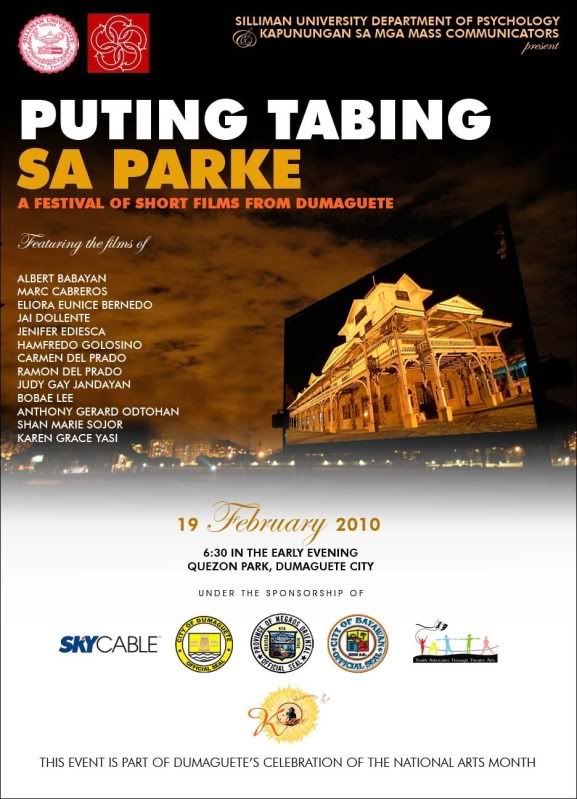
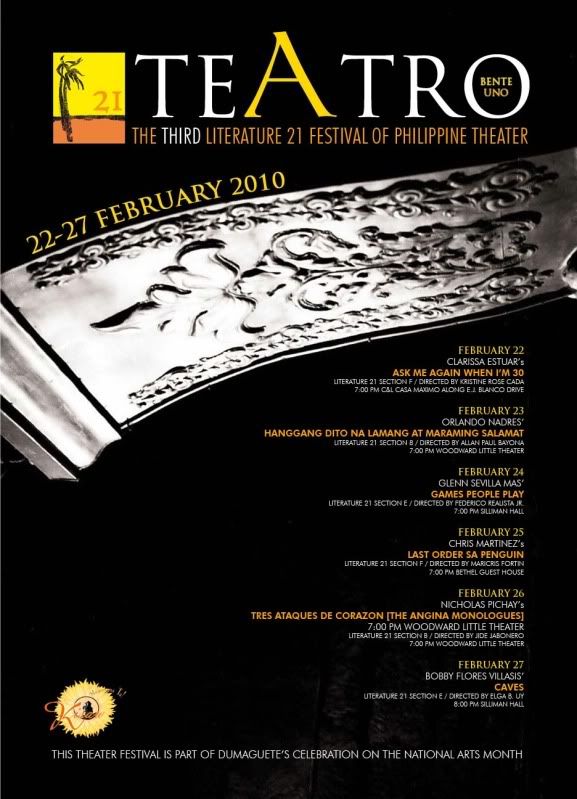
February was festive, indeed, like a palette of colors—if we have to be metaphorically obvious about it. Schools around town—including Holy Cross High School, St. Louis School Don Bosco, Dumaguete Science High School, and ABC Learning Center—took their best talents to the city’s main stage in a circular of performances known as Tayada sa Plaza. There was a parade of local filmmaking talents in a special screening of short films in Puting Tabing sa Parke, of masters in song in Huni sa Kampanaryo, of Filipino theater in Teatro Bente Uno, and of works by some of our best local visual artists in Kulay at Hugis sa Robinson’s. There was a celebration of Cebuano and Tagalog verse and naughtiness in lyrical prose in Balak, Balitaw, ug Uban Pa sa Boulevard. There were stand-alone shows and events of epic cultural moments that awed audiences—including Ballet Philippines in Masterworks, Razceljan Salvarita in his installation exhibit Damgo Quatros Kantos Artboxes Project, Joey Ayala in Raw the Concert, Youth Advocates Through Theater Arts (YATTA) in Leon Kilat and Other Short Plays, and a colorful retelling in drama and dance of the great Visayan epic Hinilawod. My dynamic hometown of Bayawan, through the Character First! Bayawanihan Technical Working Group, got into the act this year by playing host to some inventive cultural fare that bodes well the ascendance of a true art movement from that city in the south.
That we are doing this for a second year in a row is testament worthy of both shock and hope. Hope, because—while the organizers are coursing through the events with barely a budget and a marketing plan—the whole celebration seems to be stirring local imagination, and its battlecry of “Magmuga Ta!” has become increasingly infections, so much so that this year, there is finally a ground-swelling of institutional support from the Dumaguete City Hall and the Negros Orienrtal Provincial Capitol. While all are still quite in an inchoate stage of coordination and support, there is much to hope for—and a lot of promise to finally see bear into beautiful fruition.
But also this: shock—because why did it take any of us so long to institutionalize something like this? Art and culture is the conscience of any nation, a wise man once said. It is the truest measure of how we fare as a people and as a civilization—certainly not politics or religion, which are tainted with the presence of alligators and snakes and blind men and magician fools. But it did take Dumaguete 18 years—18 years!—to get its cultural act together. It was way back in 1991, after all, when the late President Corazon Aquino declared February as National Arts Month through Proclamation No. 683, “to promote arts and culture in our country, and nurturing the Filipino creativity and imagination.”
This isn’t always an easy to do in Dumaguete, contrary to what most of us might believe. The art and culture scene in the city is “vibrant” here, yes, but this is akin to a miracle of a flower blooming in the desert, given circumstance and context. Years hanging around the cultural beat has given some of us amusing insights about how things really go and yet remained unreported.
Local artists, for example, constantly bicker in hazy quarrels that sometimes exhibits become virtual chess moves in an invisible war where everybody is polite but carry bloodied paintbrushes. It is telling, for example, that no official association of creatives has ever gone beyond the two-year mark without dissolving into nothingness. The reason? An endless clash of ideas and creative direction and personalities who see the petty, not the general picture. (Tell that to the Baguio artists.)
Institutional support and recognition, too, most often come in trickles (with the exception of Silliman University and its unique cultural development program), and official pageants in culture are almost always dipped in the vomitus of politics.
Then there is local patronage to the art scene. It is not on the wane, and there are certainly serious audiences and collectors in our midst—but on the whole, it is a largely absent thing.
And the local high society that is usually taken in our culture as the expected benefactors and pursuers of a local art renaissance—the way the Zobel de Ayalas and their ilk are, for example—is simply content in withering away in nostalgia and dwindling relevance. Most of us are ready to champion Dumaguete as being on the forefront of culture in our region—and I’ve been one of these for the longest time. But it’s not. And what’s worse, nobody really seems to care even.
Still, in 2009, a group of Dumaguete artists, media practitioners, and young people passionate about arts and culture—led by the indefatigable Dessa Quesada-Palm of YATTA and Glynda Descuatan of SkyCable—met and resolved to give the Proclamation its rightful recognition by celebrating it and bringing the arts into public spaces where people from all walks of life are given a glimpse into the creative wealth that our local artists and our cultural heritage can offer. We dubbed the entire celebration as Kisaw—Magmuga Ta!, and we thought of the whole celebration as an embodiment of “the generous spirit of artists who see their arts as a powerful medium and process of reflecting, shaping, and inspiring our lives as a people.”
Last year’s edition was a success, despite an organization on the run and a budget that defied even categorization as something remotely shoe-string. That success begat our efforts this year, and our theme, “Handu-Lantaw—Pagdugtong sa Handumanan sa Pagpanglantaw sa Unahan (Bridging the Past into the Future),” can also be read as a hope for a continuity, while at the same time attempts to create a conversation between works created from our past and how they continue to be of relevance to our realities today.
I’ve asked Dessa once why we do what we do—given that we really don’t get anything from all this, except the headache of organization and logistics, but also the flush of success and the knowledge of a job done well, as well as the pleasure of giving an ounce of culture and a push for talent in an age that seems stingy on all these. She said, “Because we think we’re Superman! Because we will die if we don’t!” She laughed, and then turned serious: “And we will die soon anyway, so we might as well use the time that we have to create something essential for our sense of humanity.”
Such strong words, but what she said reached within me and has given me good foundation for why I do the things I do in the name of Dumaguete art and culture, even when sometimes I just want to give up because “nobody cares anyway.” But in the end everything in my life as a creative—whether as a writer, theater director, and graphic artist—will have to lead me to a full-measured desire to have art and culture as an inborn advocacy. If I won’t fight for it, who can fight for me? All artists must, if they know what’s good for them—and I have no respect for those who don’t. A community that has developed strong roots and traditions in art and culture benefits greatly from that exposure, even including the economic.
And the artist can only gain from this in the long run.
Manny Villar gives me the rashes, just so you know. Manny Villar is the political equivalent of suicide. Manny Villar is dirtier than a trapo, he's a pasador. That Google ad above of which I can do nothing about? I take that as a form of blog terrorism.
When I no longer have your heart I will not request your body your presence or even your polite conversation. I will go away to a far country separated from you by the sea -- on which I cannot walk -- and refrain even from sending letters describing my pain.
I sometimes wonder how I've come to be the way I am now -- somebody who insists on a life of writing [not something "practical" like ... nursing], and on a life on his own terms -- despite the odds. And there are so many odds. Most people think I have it easy. They don't know anything. I have always been a vulnerable sort given my slight tendency for manic depression, de rigeur for an introspective existence, but if a weaker person had my life, he would have called it quits a long time ago. I have somehow managed the miracle of staying sane, although just barely. Another miracle is the fact that I have managed to hide all these under a demeanor of easy-going-calmness. But I'm a theater person. Drama and make-believe are sometimes the only other way to live.
I have never had what you would call a good support system, for one thing. Sure, there are friends out there who tell you they are there for you -- and they are, in their own way, God bless them -- but I was listening to Sandra Bullock a few days ago when she was receiving an award from the Golden Globes, and she had this to say to her husband in the audience: "I'm not surprised when my work got better when you came into my life. Because I never knew someone who's got my back." And when I heard that, I was surprised to feel that I knew exactly what she meant.
Because all my life, I have always felt alone -- which is why, every time I would have projects to do, I'd rather do it on my own. Other people always seem to have a capacity to disappoint. "If you want something done well, do it yourself." This was my mantra. [That is, up until last year, when I decided to experiment with the notion -- and ended up getting burned. But never again.]
My family, for example, God bless them, is a master of bringing on you plates of guilt gilded with the most nuanced passive aggression. They mean well, and they do give their ounces of support -- but in all honesty, I have never felt anything remotely reassuring from them. It's all just pressure and guilt and the occasional toys [a laptop, for example] to remind you of possible rewards. But never the reassurance that even if you fail, they will still have your back. They prod you with the vehemence of the over-eager, and yet they also have the infinite capacity of cutting through you. Yesterday, for example, I get a call from my brother who congratulates me for bagging the SNAAF. "But why did you get that?" he says, "You're not deserving naman." He wants to mean it as a joke, and I laugh because I'm meant to. But the comment reaches into my very core, and makes me question all over again what I have done in my life.
My whole life has been composed of little quaking moments like this.
Still I love him, and I try to convince myself of this universal story: that all families are dysfunctional. Those who survive them with color and panache become artists.
But I remember graduating valedictorian in elementary school. When it was announced, instead of utter joy I felt a kind of guilt -- because the first thing that came to my 12-year-old head was this: "God, I hope this makes my family happy."
Because I'm never sure if anything does.
So forgive me if you all have been insisting about so many things in my life that you feel should happen. I know what good finishing this and that can do for my life. But I'm still alone in this struggle to please all of you, which I feel a fathomless incapacity for fulfilling.
Sometimes I just want to rebel by doing exactly nothing.


 1:18 AM |
The 60th Palanca Awards Now Accepting Entries
1:18 AM |
The 60th Palanca Awards Now Accepting Entries